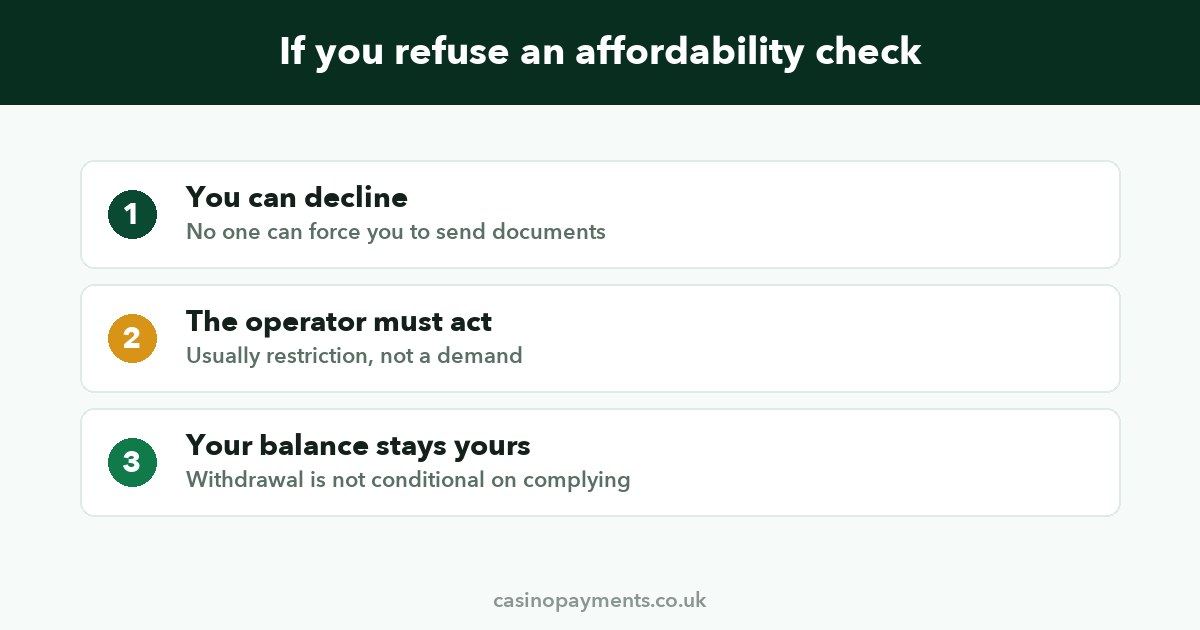
You can refuse. Nobody can compel you to upload a payslip, and declining is not an admission of anything. What refusing does do is leave the operator holding a regulatory duty it cannot discharge, and its usual answer is to stop you depositing rather than to keep arguing. The part worth being clear about is what happens to money already in your account, because that is where players get talked into accepting something they should not.
Can You Actually Refuse?
Yes. There is no offence, no penalty and no register you go on. An operator asks; you may decline. What you cannot do is decline and expect the account to carry on exactly as before, because the operator has obligations it must satisfy to keep serving you.
It is worth separating two things that get conflated. The light-touch check asks nothing of you at all, running against public insolvency records in the background. If you are being asked to send documents, that is something else: an enhanced assessment, the operator’s own risk policy, or ordinary verification work.

What Operators Typically Do
The common sequence, in order of likelihood:
- Deposits are blocked first. The cheapest response for an operator is to stop new money arriving while leaving everything else alone.
- Limits are imposed. A cap may be applied rather than a block, which some players never notice.
- The account is restricted. Play stops, but the account and its balance remain intact.
- The account is closed. Less common as a first move, and closure carries its own duties about returning your funds.
What should not happen is your balance being treated as forfeit. If a message implies that, read the next section carefully.
Your Balance Is Still Yours
Money in your account belongs to you. Declining to send a document does not change that, and an operator cannot keep customer funds as a consequence of a refusal. The Commission has been explicit that deposit balances must be withdrawable without unreasonable restriction, and a withdrawal condition invented after the fact is exactly the sort of thing that gets operators into trouble.
There is one genuine complication. Anti-money-laundering rules are separate from affordability rules, and an operator may lawfully need to verify your identity or the source of funds before releasing money. That is why a blanket refusal to engage can stall a payout even when the affordability request itself was unreasonable. Identity verification and affordability are different requests, and it is worth asking in writing which one you are actually facing. Our guides on what documents casinos ask for and accounts that will not verify cover that ground.
Restriction, Suspension and Closure
| What happened | What it means | Your balance |
|---|---|---|
| Deposits blocked | You can still play existing funds and withdraw | Accessible |
| Account restricted | Play suspended pending resolution | Should be withdrawable |
| Account closed | Relationship ended by the operator | Must be returned to you |
If an account is closed with money in it, that has its own well-trodden process, covered in our guide on a casino closing your account with money in it.
When a Request Is Not Proportionate
Not every document request is reasonable, and you are allowed to say so without refusing outright. Reasonable practice is to ask for what is needed and no more. A request for twelve months of full bank statements to explain a hundred pounds of deposits is worth pushing back on, and pushing back is different from refusing.
Useful middle grounds: send a redacted statement covering the relevant transactions only; ask what specific question the operator is trying to answer; ask which regulatory duty the request arises from. A well-run operator will answer all three. One that will not is telling you something.
How to Escalate
- Put the complaint in writing through the operator’s formal process, not live chat, and keep a dated copy.
- Be specific. “You are withholding GBP 420 that I deposited and did not lose” beats a general objection.
- Wait for eight weeks or a deadlock letter, whichever comes first.
- Go to the operator’s ADR provider, which is free to you and genuinely independent at the adjudication stage.
- Do not reach for a chargeback as a shortcut. It closes off the routes above and creates problems of its own.
Our guide on complaining about a UK casino walks the whole path, and when a casino can refuse to pay out covers the grounds that genuinely hold.
Avoiding the Situation Altogether
The reliable way not to meet an affordability request is to stay below the deposit levels that prompt one. A deposit limit is the practical tool: instant to lower, binding on the operator, and entirely within your control. Verifying your account fully when you open it also removes the most common reason a payout stalls, since identity checks done early are checks not done under pressure later.
Verdict
Refusing is your right and carries no penalty beyond the operator’s own response, which is usually to stop your deposits rather than to fight you. The line that matters is your balance: declining to send documents and forfeiting your money are separate events, whatever a support message implies. Ask in writing which duty the request arises from, send what is genuinely needed and no more, and if funds are withheld anyway, use the complaint and ADR route rather than a chargeback.
If the request landed because deposits had crept up further than you intended, that is worth its own attention. BeGambleAware and the National Gambling Helpline on 0808 8020 133 are free and confidential, and our responsible gambling page sets out the tools that work at the payment level.
Refusing an Affordability Check FAQs
Can I refuse an affordability check?
Yes. There is no penalty and no offence, and refusing is not treated as evidence of anything. The operator will usually respond by restricting your account rather than pressing further.
Will my account be closed if I refuse?
Sometimes, though blocking deposits or applying limits is the commoner first response. Closure carries its own obligations, including returning the money in your account.
Can a casino keep my balance if I refuse?
No. Money in your account belongs to you, and a refusal to send documents is not grounds for keeping it. Deposit balances must be withdrawable without unreasonable restriction.
Why is my withdrawal still blocked then?
Because identity and source-of-funds checks are separate from affordability checks and can lawfully hold a payout. Ask in writing which one applies, since the answer changes what you need to provide.
What if the request seems excessive?
Push back rather than refuse outright. Ask what specific question the operator is answering and which duty it arises from, and offer a redacted statement covering only the relevant transactions.
How long should I wait before complaining?
Raise it in writing straight away. The formal clock runs for eight weeks, or until you receive a deadlock letter, after which you can take it to the operator’s ADR provider free of charge.
Does refusing affect my other casino accounts?
No. There is no shared register of refusals, and each operator assesses its own customers separately.
Can I just use a different casino instead?
You can, but the same thresholds apply everywhere, so the request will recur once your deposits reach a similar level. Setting a deposit limit is the more durable answer.
Sources & verification: checked 25 July 2026 against the Gambling Commission’s published position on light-touch financial vulnerability checks and its requirements on customer funds and account closure, under which deposit balances must be withdrawable without unreasonable restriction. Anti-money-laundering identity and source-of-funds duties are separate from affordability requirements and can lawfully delay a payout. See gamblingcommission.gov.uk. 18+ · begambleaware.org