Everyone knows the paysafecard model: buy a voucher in a shop, type the PIN at a cashier. Paysafecash, from the same company, inverts it. You start at the cashier, generate a barcode for the exact amount you want to deposit, walk it to a participating shop, and hand over cash. No voucher bought in advance, no PIN to guard, no leftover balance — and no bank account or card anywhere in the process.
The casinos that accept Paysafecash are listed below, though the shop network behind it matters more than the brand on the button.
Casinos with Paysafecash Payments
| Paysafecash at a Glance | |
|---|---|
| The mechanism | Casino issues a barcode; you pay cash at a shop counter |
| Bought in advance? | No — the opposite of a voucher |
| Bank or card needed | Neither |
| Withdrawals | Not supported — deposit-only |
| UK casino coverage | Thin; paysafecard is the voucher method cashiers list |
Checked 24 July 2026 against Paysafe’s own product documentation.
| Question | Answer |
|---|---|
| Is Paysafecash the same as paysafecard? | No — same owner, opposite mechanism. The casino issues a barcode; you pay cash against it |
| Do I buy anything in advance? | No. There’s no voucher and no 16-digit PIN to purchase |
| Bank account or card needed? | Neither — that’s the entire point of the product |
| Withdrawals? | No — deposit-only, so plan a payout method separately |
| UK casino coverage? | Thin. paysafecard remains the voucher method UK cashiers actually list |
Checked 24 July 2026 · 18+ · UKGC-licensed operators only · begambleaware.org
Paysafecash: Quick Facts
| Category | Cash payment method — barcode generated at checkout, paid at a counter |
|---|---|
| Owner | Paysafe Group, which also owns paysafecard, Skrill and Neteller |
| Launched | 2018 |
| Direction | Deposit-only; no withdrawals, ever |
| Prerequisites | None — no bank account, card or pre-bought voucher |
| Where you pay | Participating retail partners; coverage varies sharply by country |
| Timing | Not instant — you must physically visit a shop to complete |
| UK casino presence | Limited; paysafecard dominates the UK voucher slot |
| Fees | Set by operator and partner; check before generating the barcode |

The Reversal: Paysafecash vs paysafecard
These two products from the same company are routinely conflated, including by casinos listing them. They are near-opposites in flow, and the differences have real consequences.
| paysafecard | Paysafecash | |
|---|---|---|
| Where you start | The shop | The cashier |
| What you buy | A voucher with a 16-digit PIN | Nothing — you generate a barcode |
| Amount | Fixed denominations | The exact amount you chose |
| Leftover balance | Possible, and easily stranded | None by design |
| Deposit timing | Instant once you have the PIN | After you reach a shop and pay |
| Scam exposure | PIN can be socially engineered out of you | Barcode is tied to one specific payment |
| UK availability | Broad — ~60 UKGC casinos | Thin |
Two of those rows deserve emphasis. Exact amounts eliminate stranded balances — the £3.47 left on a voucher that never gets used is a genuine, if small, recurring annoyance of the paysafecard model. And the fraud profile is meaningfully better: the entire voucher-scam industry works by persuading a victim to read out a PIN that carries transferable value, whereas a Paysafecash barcode is bound to one pending payment on one account. Full comparison on our paysafecard page.
Against the Other Cash Routes
Cash-to-casino in Britain is a small field, and Paysafecash sits awkwardly inside it.
| Paysafecash | paysafecard | CashtoCode | Prepaid card | |
|---|---|---|---|---|
| UK casino coverage | Thin | Broad | Thin | Moderate |
| Buy in advance? | No | Yes | No — barcode model | Yes, then load |
| Exact amounts | Yes | No — denominations | Yes | Yes |
| Withdrawals | No | No | No | Sometimes |
| Instant? | No — shop trip required | Yes, with PIN in hand | No — shop trip | Yes |
The honest summary: paysafecard wins UK cash gambling on coverage alone, and it isn’t close. Paysafecash and CashtoCode are the better-designed mechanisms competing for a slot British cashiers had already filled. If a hard spending ceiling rather than literal cash is what you actually want, a prepaid card does that job while also being able to receive some payouts.
How a Paysafecash Deposit Works
Step by step
- Choose Paysafecash at a cashier that offers it and enter the amount you want to deposit.
- The system generates a barcode — on screen, by email, or in the Paysafecash app — representing that exact pending payment.
- Take it to a participating retail partner and hand over the cash. The clerk scans; the payment settles against your pending transaction.
- Your casino balance credits once the payment confirms. No PIN is ever typed into the cashier, because there isn’t one.
What this changes in practice
The trip to the shop is the defining feature, in both directions. It rules out spontaneous deposits entirely: you cannot fund an account at 11pm from the sofa, which is a genuine inconvenience and, from a safer-gambling standpoint, an unusually effective piece of built-in friction. It also means the barcode has a validity window — generate it, don’t get to a shop, and it lapses harmlessly with nothing bought and nothing lost.
Before you generate a barcode — the four checks
- Confirm the cashier actually lists it. UK coverage is thin, and finding out at the counter is the wrong moment.
- Check the total, including any operator or partner fee. These are shown on the cashier screen and are easier to review before you set off than to query mid-transaction.
- Locate a participating shop first. Coverage varies far more than paysafecard’s, so establish where you are going before the barcode’s validity window starts running.
- Decide how winnings will reach you. This is the one people skip, and it is the one that bites — see below.
The payout problem
Paysafecash is deposit-only and always will be — there is no mechanism for a casino to hand you banknotes. Winnings must leave by another route, which under closed-loop rules typically means bank transfer to an account in your name. Sort that out before you deposit, not after you win, because a player who chose Paysafecash specifically to avoid using a bank account will find the payout stage asking for exactly that.
Security, Limits & the Verification Layer
Paysafecash’s security model is inherently strong for the thing cash-adjacent products usually get wrong. Because a barcode is bound to a single pending payment on a single account, it carries no transferable value in a stranger’s hands — which structurally defeats the voucher-scam pattern where a victim is talked into reading out a PIN. That is a meaningful improvement over the model it complements, and it is the reason the company can market it for invoices and loan repayments.
Anti-money-laundering rules still apply, and cash always attracts the tightest of them. Expect identity verification for anything beyond small amounts, expect limits set by both the operator and the local partner, and expect the casino’s own KYC to arrive at the first meaningful withdrawal regardless of how the deposit was funded. Nobody should approach cash deposits expecting anonymity from a licensed operator: paying in cash keeps a transaction off your bank statement, not out of the casino’s records.
Two practical cautions. Fees can be charged by the operator or the retail partner rather than by Paysafe, so check the total before you set out. And the usual rule holds: only ever generate a barcode inside a cashier you initiated yourself — a barcode arriving by message from someone else is the beginning of a fraud, not a favour.
A Sibling Product, Built for a Different Cash Problem
- 2000 — paysafecard launches in Vienna, establishing the prepaid-voucher model this product later inverts.
- 2013 — Paysafe Group acquires paysafecard, beginning the consolidation that eventually houses Skrill and Neteller under one roof.
- 2018 — Paysafecash launches, aimed at cash-preferring customers paying invoices, instalments and top-ups online.
- 2019–2020 — Retail partner networks expand across Europe and beyond; e-commerce and utilities are the target verticals.
- 2021 — Gambling operators in cash-heavy markets add it; UK adoption stays limited, with paysafecard already occupying the slot.
- 2022–2024 — Positioning settles on financial inclusion — serving the underbanked rather than chasing gambling volume.
- 2026 — A well-designed method with modest UK casino presence, and a strong story everywhere cash still dominates.
The instructive point is commercial rather than technical. Paysafecash is arguably the better-engineered product — exact amounts, no stranded value, a far worse target for scammers — and it still did not displace its own sibling in Britain, because cashier integrations follow player familiarity and paysafecard had an eighteen-year head start. In payments, being second and better is a genuinely difficult place to stand.
Where Paysafecash Actually Works
Paysafecash’s footprint tracks cash culture rather than gambling markets. It is strongest where a large share of the population prefers or needs to pay in physical money — parts of central and eastern Europe, the German-speaking markets, Latin America — and correspondingly weaker in countries that went card-first and then phone-first, Britain very much included.
That geography explains the UK position better than any commercial analysis. British consumers reach for cards by default, contactless payments are near-universal, and cash usage has fallen for a decade. A product whose core promise is “you can pay online without a bank account or card” addresses a smaller share of the population here than almost anywhere else in Europe.
For UK players the practical reading is simple. You may encounter Paysafecash at a licensed casino here, and if you do it works exactly as described. But it is not a method to hunt for, and its absence from a cashier is not a shortcoming — the UK voucher slot is occupied by paysafecard, which does a related job with far broader acceptance. As always, meeting an unfamiliar method at an unlicensed site is a fact about the site rather than a discovery about the method.
Paying Cash for Things Other Than Gambling
Paysafecash’s natural home is financial inclusion, and that is genuinely where most of its volume sits: people without bank accounts or cards paying utility bills, insurance premiums, loan instalments and e-commerce orders in cash. In several European markets that population is substantial, and giving it a route into online commerce is a real service rather than a marketing line.
There is an irony worth noting for readers of this site. The same property that makes Paysafecash valuable for the underbanked — a physical trip to a counter with real notes — is exactly what makes it an unusually well-behaved gambling deposit method. It cannot be used impulsively, it cannot exceed the cash in your pocket, and it leaves no card on file for a repeat. Products designed for financial inclusion keep turning out to have safer-gambling properties nobody set out to build, and this is a clear case.
Paysafecash & Safer Gambling
On the harm-reduction ledger, Paysafecash is one of the better-behaved methods on this site. You can only deposit cash you physically have; there is no card on file and no stored balance; and the requirement to walk to a shop inserts a delay that no other mainstream method matches. Impulse deposits are effectively impossible, which is precisely the friction that helps most.
The counterweight is the familiar one for cash routes: bank gambling blocks cannot see it. A player who has armed a block at Monzo, Starling, Revolut or Chase is protected against card and bank deposits, and cash-funded methods walk straight past that protection. If a bank block is load-bearing in your setup, treat cash deposit routes as outside it — and pair with tools that follow the person: GAMSTOP closes every UKGC operator at once regardless of how money arrives, and cashier deposit limits bound each individual site. Our responsible gambling hub has the full stack, and the National Gambling Helpline is free and confidential on 0808 8020 133, any hour. 18+.
What Cash Depositors Say About Paysafecash
UK player commentary on Paysafecash is sparse, and mostly consists of people meeting it somewhere unexpected and asking what it is — usually followed by someone correctly explaining that it is not paysafecard and does not involve buying a voucher. The European threads, where the product has real usage, are more informative and consistently practical rather than enthusiastic: it works, the shop trip is the whole experience, and the exact-amount feature is appreciated by people who dislike stranded voucher balances.
Two recurring notes carry over usefully. First, the barcode-expiry surprise — players who generate one, get distracted, and find it lapsed; harmless, but worth knowing it happens. Second, and more consequential, the payout realisation: players who chose a cash method specifically to keep gambling off their bank statement, then discovered that winnings need a bank account to reach them. That is not a Paysafecash flaw; it is closed-loop rules and AML working as designed everywhere. But it lands hardest on exactly the person this method attracts, which is why the how-it-works section says to plan the exit before the entrance.
Cash-Friendly Routes That Work Better in the UK
If a cashier does not offer Paysafecash — and most UK ones do not — the substitutes are well established:
- paysafecard — the same company, the voucher model, and roughly sixty UKGC casinos. The obvious first choice for cash-funded play in Britain.
- Neosurf — the other established cash voucher, with decent coverage at wallet-friendly operators.
- CashtoCode — the closest mechanical cousin, also barcode-based and also thin on UK coverage.
- Prepaid cards — if the real goal is a hard ceiling rather than physical cash, these enforce one and can sometimes receive payouts too.
And the point worth repeating from the section above: whichever cash route you choose, decide how winnings will get to you before you deposit. Every one of these is deposit-only, so the exit is always a separate arrangement.
Who This Method Is Genuinely For
Cash deposit methods attract a specific and often misunderstood set of users, and it is worth being clear about which of them Paysafecash actually serves well.
It serves the deliberately-budgeted player well. If your approach is to decide a figure, withdraw it in notes, and play only that, this method enforces the decision at the level of physics. There is no card on file, no stored balance and no way to exceed what is in your pocket. Very few payment methods make overspending genuinely impossible rather than merely inadvisable.
It serves the statement-conscious player partially. Cash leaves no gambling entry on a bank statement, which matters to people managing a joint account, an upcoming mortgage application or simple privacy. The caveat is significant and often discovered late: withdrawals arrive by bank transfer, so the moment you win meaningfully, the statement records it. Privacy on the way in, not on the way out.
It serves the unbanked player best of all, which is the market it was designed for — though this is a smaller group in Britain than in the markets where the product originated.
It serves the block-avoiding player badly, and this is the important one. If cash appeals partly because your bank’s gambling block has become inconvenient, the method is not solving your problem — it is routing around a protection you set up deliberately, and doing so successfully. That is worth naming honestly rather than acting on, and the safer-gambling section above has the tools that actually help.
Our Verdict on Paysafecash for UK Players
Paysafecash is the better-designed half of a sibling pair that Britain has already decided about. You pay the exact figure, leave no orphaned change behind, hand over no PIN that anyone could talk out of you, and accept a walk to the shop that rules out depositing on impulse — on the merits it improves on the voucher model in every respect except the one that decides these things, which is how many cashiers list it.
For UK players that makes it a method to use if you happen to meet it, not one to seek out. If you want cash-funded play at a British casino, paysafecard has the coverage; if you want a spending ceiling, a prepaid card enforces one and may pay you back. Where Paysafecash genuinely shines is outside gambling altogether — giving people without cards a way to pay bills online — and that is a better product story than any casino page can tell. Just remember the exit: it can take your money in, and it can never hand any back.
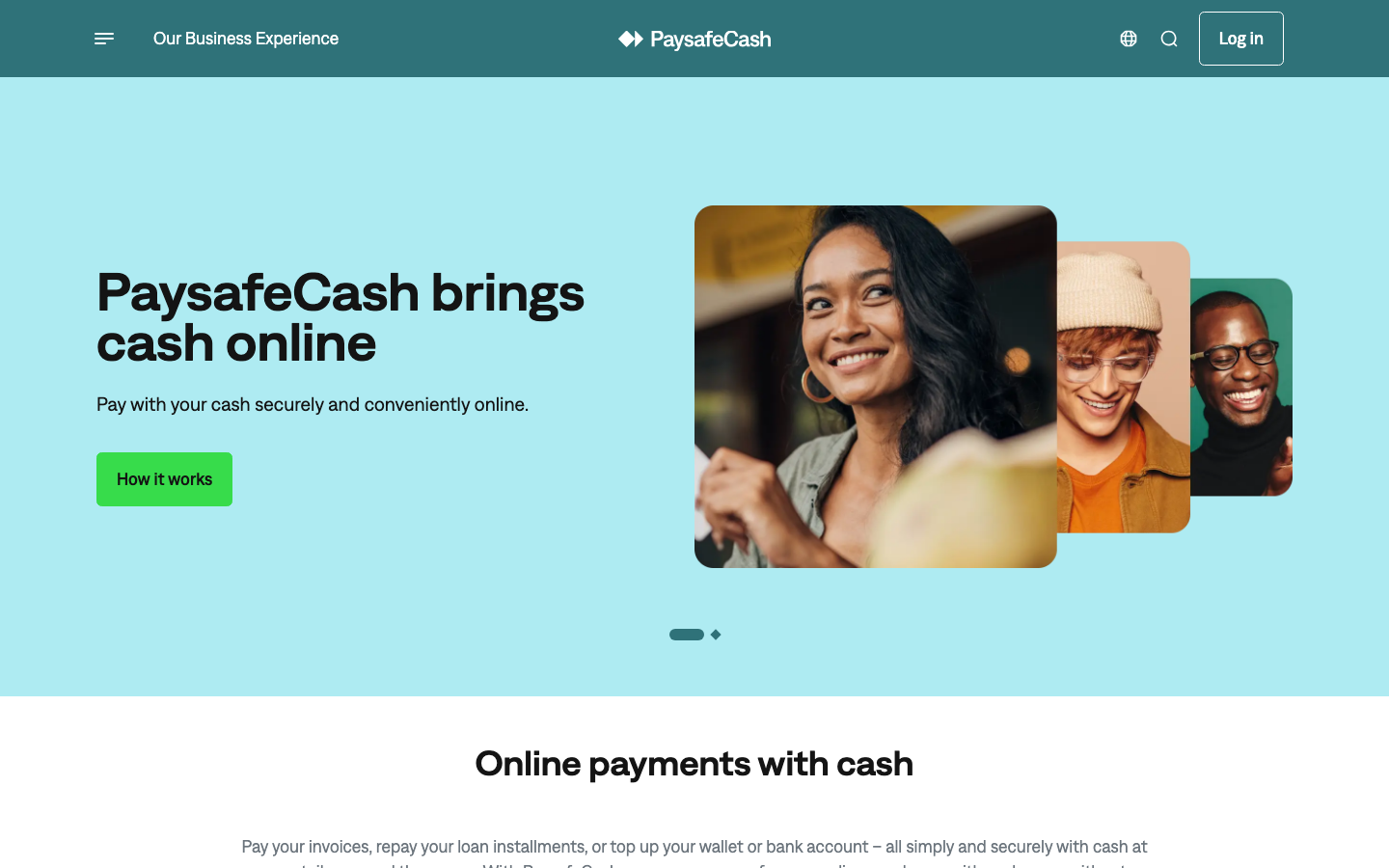
Paysafecash’s own site, checked directly this month, states the proposition in one line: “PaysafeCash brings cash online — pay with your cash securely and conveniently online.” The use cases it lists are revealing about where the product actually lives: paying invoices, repaying loan instalments, and topping up a wallet or bank account — everyday financial admin for people who hold cash rather than cards. Gambling is one application among many, and not the one the company leads with.
Paysafecash Casino FAQs
Is Paysafecash the same as paysafecard?
No — same owner, reversed mechanism. With paysafecard you buy a voucher in a shop and type its PIN at the cashier. With Paysafecash the cashier generates a barcode for an exact amount and you pay cash against it at a shop.
Do I need a bank account or card for Paysafecash?
No, and that is the product’s purpose. The deposit needs only physical cash and a participating shop. Withdrawals are a different matter — those will need a bank account.
Can I withdraw winnings to Paysafecash?
No. It is deposit-only, permanently — there is no mechanism for a casino to hand back banknotes. Arrange your payout route, usually a bank transfer in your own name, before you deposit.
Which UK casinos accept Paysafecash?
Few. UK cashiers overwhelmingly fill their voucher slot with paysafecard, which around sixty UKGC casinos accept. Check the banking page before assuming availability.
Is Paysafecash safer than a voucher PIN?
For scams specifically, yes. A barcode is tied to one pending payment on one account, so it carries no value to a stranger — unlike a 16-digit voucher PIN, which is the currency of an entire scam industry.
Are there fees?
Possibly, set by the operator or the retail partner rather than by Paysafe. Check the total before generating a barcode and heading out.
What happens if I don’t pay the barcode?
It simply expires within its validity window. Nothing is bought, nothing is charged and no money is at risk — you have only lost the trip.
Does a bank gambling block stop Paysafecash?
No. Bank blocks see card and bank payments; cash handed over at a shop counter is invisible to them. If a bank block is central to your setup, treat cash routes as outside it and add GAMSTOP.
Do I still need to verify my identity?
Yes. Anti-money-laundering rules apply to cash particularly closely, and the casino’s own KYC will arrive at your first meaningful withdrawal regardless of how you deposited.
Can someone else pay my Paysafecash barcode?
They physically could, but you should never share one — and you should never pay a barcode someone sends you. Legitimate barcodes are generated by you, inside a cashier you opened yourself; an inbound one is the opening move of a fraud.
What happens if the shop refuses the barcode?
Usually the retailer is not a participating partner, or the barcode has expired. Neither costs you anything — nothing is charged until a successful scan. Check the partner list before travelling and regenerate if the window has lapsed.
Is Paysafecash good for budgeting a bankroll?
Unusually good, yes. You can only deposit the cash in your hand, there is no card on file and no stored balance, and the trip to a shop makes impulsive deposits effectively impossible. The trade-off is that bank gambling blocks cannot see cash at all.
Paysafecash or CashtoCode?
Mechanically very similar barcode-and-cash products, both thin on UK casino coverage. Whichever your cashier offers is the one to use; if neither appears, paysafecard is the practical UK answer.
Sources & Verification
Checked 24 July 2026 against: Paysafecash’s own site (captured by screenshot the same day, including its stated use cases and payment flow); Paysafe Group’s published product documentation for Paysafecash and paysafecard; live UKGC operator cashier listings for voucher-method availability on the date above; and the Gambling Commission’s guidance on blocking gambling payments for the safer-gambling framing.