
Prepaid cards are the shape-shifters of the casino cashier: they look like debit cards to the payment terminal, behave like vouchers on the way in, and split down the middle on whether winnings can ever come back. Load one with cash or app transfer and the card’s balance is your hard ceiling — budgeting discipline the banking industry accidentally built. This guide maps which prepaid products work, which can receive payouts, and where the traps sit.
Casinos that accept prepaid cards vary more than you would expect, and those differences decide whether you can be paid out at all.
Casinos with Prepaid Card Payments
| Prepaid Cards at a Glance | |
|---|---|
| Best for | A hard, load-based budgeting ceiling with no credit line behind it |
| UKGC coverage | Broad — accepted wherever standard Visa/Mastercard rails are |
| Deposit speed | Instant |
| Withdrawals | Rarely supported — usually routes back to the underlying card |
| UK trade body | UK Finance publishes usage and fraud data for the category |
Checked 5 July 2026. The acceptance question has an unusually happy answer — and an asterisk that decides everything else on this page.
| Question | The short answer |
|---|---|
| Do UK casinos accept prepaid cards? | Almost all of them — a prepaid Visa or Mastercard runs on debit rails, so any cashier that takes cards takes most prepaid products |
| So why no casino league table? | Because acceptance depends on the card product, not the casino — the variables worth ranking are the cards themselves |
| Can winnings come back to the card? | Only on products that accept push payments — many can't; the rest of the time it's a bank-transfer exit |
| Best products for casino use | App-based prepaid cards with receive-capability and named accounts; anonymous gift-style cards are the worst fit |
| The one rule | Check your specific card's receive-ability and your casino's payout policy before depositing |
Practically every UKGC casino on this site — from bet365 to the smallest network skin — will accept a mainstream prepaid Visa or Mastercard for deposits, because the cashier can't always tell it from a debit card. That's why this page ranks card behaviours rather than casinos: your experience is decided at the card-issuer layer, and the sections below map it product-type by product-type.
Checked 5 July 2026 · 18+ · UKGC-licensed operators only · begambleaware.org
Prepaid Cards at Casinos: Quick Facts
| Category | Prepaid Visa/Mastercard products — loaded value on card rails |
|---|---|
| Casino acceptance | Near-universal for deposits — cashiers process them as cards |
| Withdrawals back to card | Product-dependent: push-payment-capable cards yes, closed-loop and gift cards no |
| Spending ceiling | The load is the limit — no overdraft, no credit, ever |
| Anonymity | Cash-loaded products offer partial privacy; named app cards none |
| KYC friction | Anonymous cards can trigger source-of-funds questions at payout time |
| Fees | At the issuer, not the casino: load fees, monthly fees, FX — varies wildly by product |
| Credit-ban status | Fully legal — prepaid is your own money; the 2020 ban touches only borrowed funds |
| Our score | 6.5/10 as a category — the right product scores higher |
The Card Types, Ranked for Casino Use
“Prepaid card” covers four product families whose casino behaviour differs completely. Ranked best to worst fit:
| Product type | Examples of the breed | Deposits | Payouts to card | Casino verdict |
|---|---|---|---|---|
| App-based named prepaid | Fintech prepaid cards with full accounts | Yes | Usually — push-capable | The best fit: ceiling + a working exit |
| Reloadable retail prepaid | Named cards loaded at shops or online | Yes | Sometimes — check the issuer | Good, verify receive-ability first |
| Gambling-adjacent prepaid | Wallet-linked cards (Skrill, MiFinity et al.) | Yes | Via the wallet, yes | Fine — but that’s really wallet play |
| Anonymous gift-style cards | Non-reloadable gift Visa/MC | Usually | Never | Worst fit: no exit, KYC friction at payout |
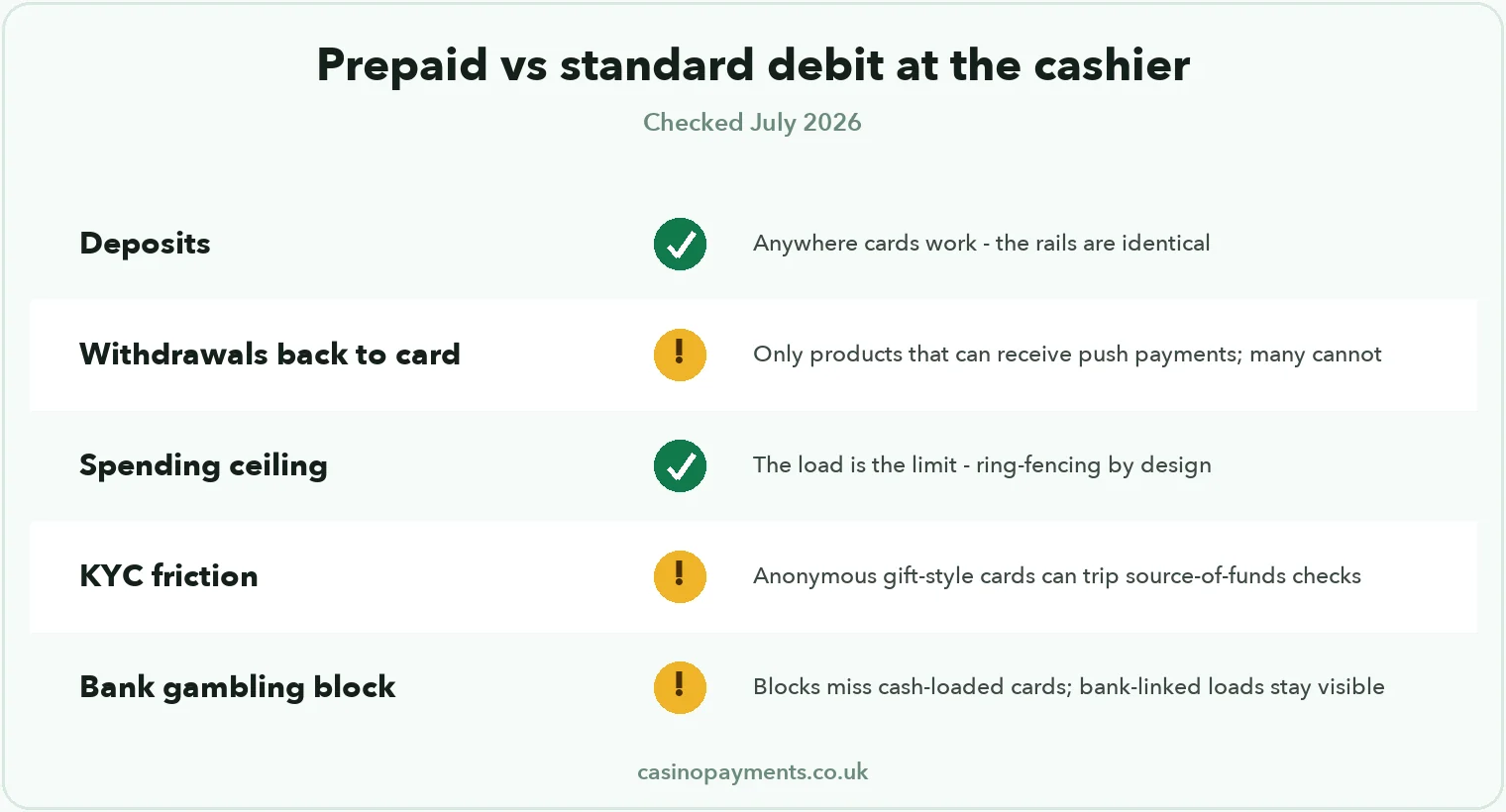
The pattern behind the ranking: the more account there is behind the card, the better it behaves at payout time. Full-account products receive push payments and sail through source-of-funds checks; anonymous plastic does neither, and a casino that can’t return funds to your deposit card will route you into verification-heavy bank exits instead.
Prepaid Cards vs Debit, Vouchers & Wallets
Prepaid’s pitch is the budget ceiling. Here’s what that costs against the neighbours.
| Prepaid card | Debit card | paysafecard | E-wallets | |
|---|---|---|---|---|
| Casino acceptance | Near-universal | Universal | Very broad | Broad |
| Hard spending ceiling | Yes — the load | No — the account | Yes — the code | Only if you discipline it |
| Withdrawals | Product-dependent | Yes, universal | No | Yes |
| Bank-statement privacy | Partial (cash loads) | None | Total | Partial |
| Fee exposure | Issuer-dependent, can sting | Free | Edge fees | Schedule-dependent |
Full guides: debit cards, paysafecard, Skrill. The honest positioning: prepaid sits exactly between debit and vouchers — debit’s acceptance with a voucher’s ceiling — and whether that midpoint beats either endpoint depends entirely on whether your chosen product can receive payouts. With receive-ability: arguably the best budgeting method on card rails. Without it: a paysafecard that costs monthly fees.
Prepaid cards vs Every Other Payment Method
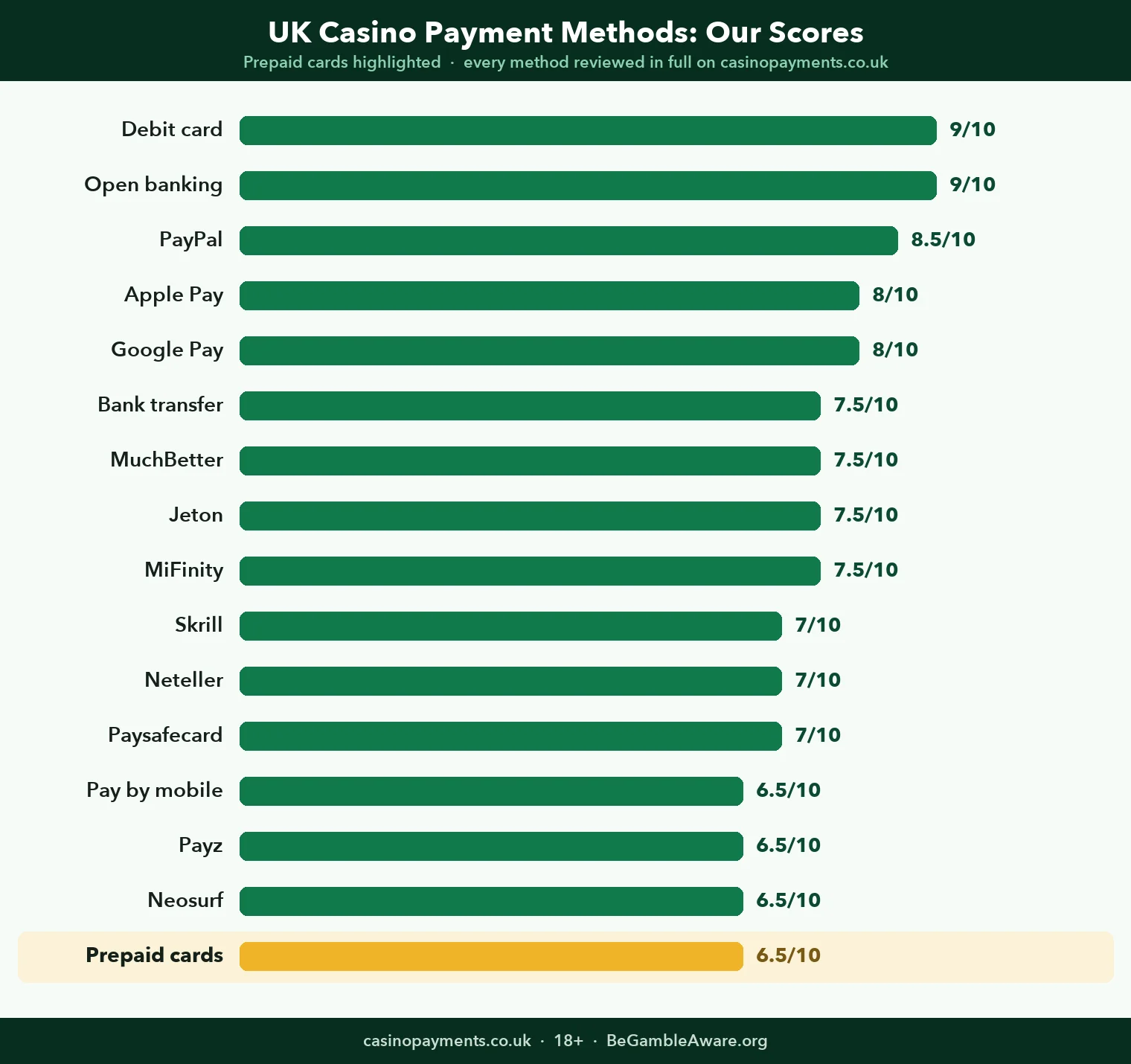
Prepaid borrows debit’s rails and the voucher’s discipline, so it collides with everything. The full-field grid shows where the hybrid wins — and where a purer tool does the job better.
| Against | Prepaid cards wins on… | It wins on… |
|---|---|---|
| Debit card | A ceiling your current account can’t impose | No loading step and payout returns everywhere |
| Open banking | A ring-fenced budget your bank can’t blur | Payout pace straight into FSCS territory, where it out-does prepaid |
| PayPal | Spending walls a wallet won’t build | The widest wallet acceptance on the high street, ground prepaid gives up |
| Apple Pay | Discipline Face ID can’t provide | Face ID deposits in a couple of seconds, still ahead of prepaid there |
| Google Pay | A ceiling that survives convenience | Tap-speed deposits across every Android, an area prepaid concedes |
| Bank transfer | Small-stakes control against big-money rails | Heavyweight limits no wallet will match, which prepaid can’t claim |
| MuchBetter | Card-rail reach beyond wallet listings | The category’s lightest fees and freshest security, — not prepaid’s game |
| Jeton | Acceptance wherever cards work, full stop | High-street listings and cash-code entry, something prepaid doesn’t offer |
| MiFinity | No dependence on cashier wallet lists | Home-turf regulation with a cheap schedule, outpacing prepaid on this front |
| Skrill | A hard limit the wallet only promises | Sheer coverage, deep into the casino long tail, — prepaid’s blind spot |
| Neteller | Plastic without the fee legacy | The Net+ Mastercard and veteran reach, a lead over prepaid |
| Paysafecard | A payout route on push-capable products | Zero product research; every code behaves identically |
| Pay by mobile | Load sizes a phone bill can’t hold | Needing nothing but a phone number, — beyond prepaid here |
| Payz | Budget control without tier chasing | The ecoVoucher door and tier rewards, where it out-does prepaid |
| Neosurf | Card-rail acceptance and a way back | No account, no fee schedule, just a receipt |
The hybrid’s report card: it out-disciplines the pure cards and out-reaches the pure vouchers, while the specialists beat it at their own single games. Choose a named, push-capable product and the grid tilts noticeably in prepaid’s favour.
How Prepaid Card Casino Payments Work
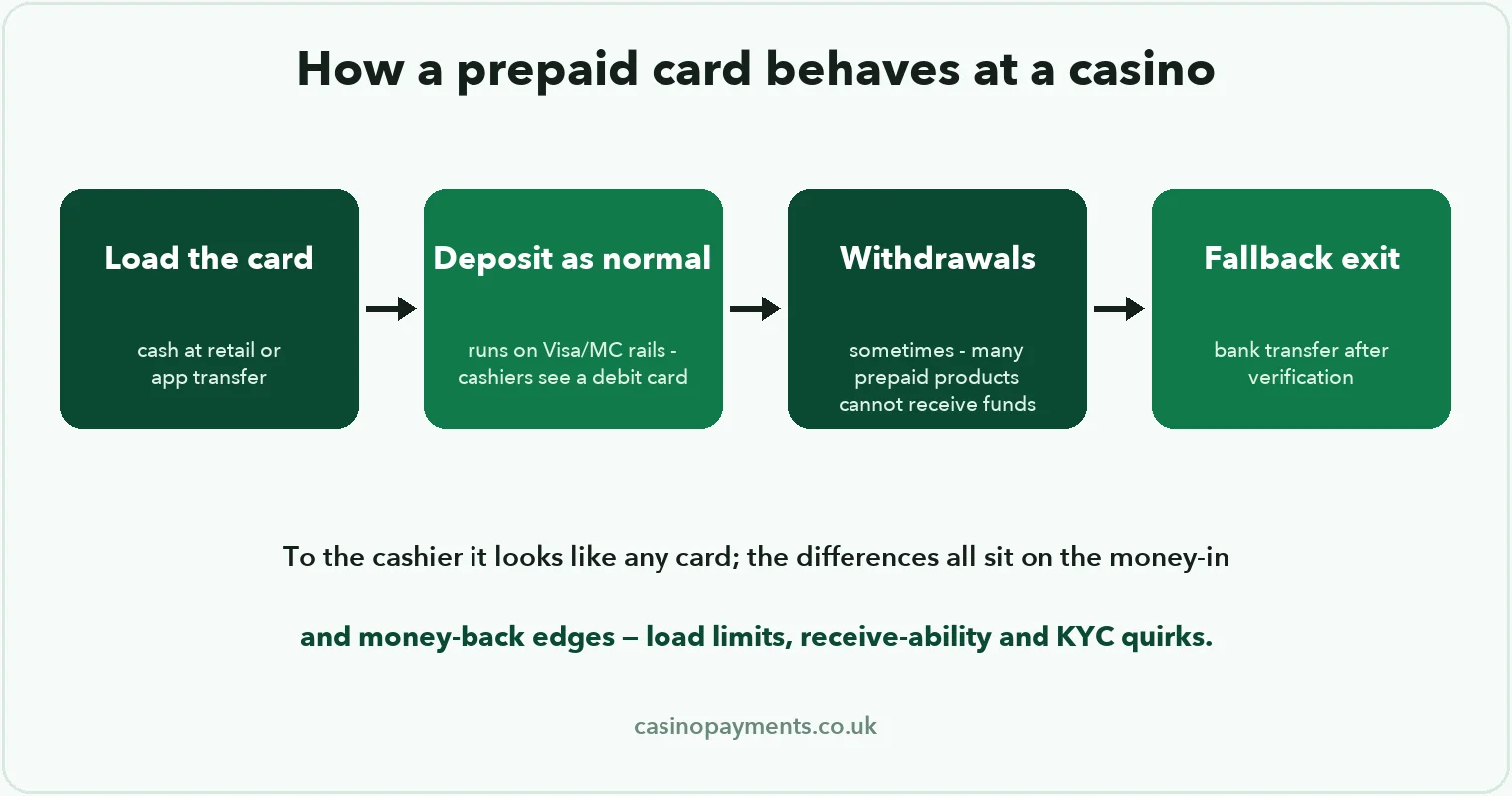
The deposit loop
- Load the card — cash at a retail load point, bank transfer, or app top-up, depending on product.
- In the cashier, choose card deposit and enter the prepaid card’s details exactly as you would a debit card’s; set your amount at the first-deposit limit prompt.
- The payment authorises on Visa or Mastercard rails — most cashiers neither know nor care that the card is prepaid.
- 3-D Secure approval happens in the card’s app for named products, or is skipped entirely on some anonymous plastic — one of several reasons casinos treat those warily.
The payout fork
- If your product accepts push payments (Visa Direct / Mastercard Send), the casino can return winnings straight to the card — the clean loop.
- If it can’t, the casino offers a bank-transfer exit instead, with the standard verification steps — the workable loop.
- If you deposited with an anonymous gift card, expect the full source-of-funds conversation before anything moves — the loop to avoid.
Security, KYC & the Anonymous-Card Problem
Prepaid’s security profile is genuinely strong on the deposit side: a loaded card exposes only its load — a compromise can never reach a bank account that isn’t connected — and cash-loaded products keep gambling off bank statements entirely. Named app-based products add current-generation controls: freeze buttons, per-merchant blocks, instant notifications, and increasingly the same gambling-block toggles the banking apps offer.
The friction concentrates at the identity layer. UKGC casinos must verify who’s playing and where money comes from, and anonymous plastic is structurally bad at answering: a payout triggered from gift-card deposits routinely means document requests, load-receipt questions and slow manual review — not hostility, just the anti-money-laundering rules meeting a method designed to carry no name. The practical rules that dissolve the whole problem: use named prepaid products for casino play, keep load receipts if you load with cash, and match the card name to the casino account name, always. Do that and prepaid clears KYC as smoothly as debit; ignore it and payout day becomes paperwork day.
From Payroll Plastic to Fintech Ceiling
Prepaid cards reached the casino cashier by a route that had nothing to do with gambling.
- 1990s — Prepaid emerges in the US for payroll and benefits — card rails for people without bank accounts.
- 2000s — Gift cards mainstream the format; reloadable consumer prepaid follows into UK retail.
- 2010–2015 — The gambling-adjacent era: wallet-linked prepaid cards let Skrill and Neteller balances spend anywhere, and casino use surges.
- 2016–2019 — UK fintech reinvents the category: app-first prepaid with full accounts, instant notifications and controls that legacy banks would take years to copy.
- 2020 — The credit card ban clarifies prepaid’s status: loaded money is your money, so prepaid stays legal while credit exits — and the budget-ceiling framing enters safer-gambling conversation.
- 2021–2024 — Anonymous-card KYC tightens across the sector as AML rules bite; named products become the practical standard for gambling use.
- 2026 — A mature niche: universally accepted for deposits, split forever on receive-ability, and quietly beloved by budget-first players.
Prepaid Cards & Gambling Around the World
Prepaid’s global gambling role tracks banking exclusion: strongest where bank accounts are scarce or distrusted — much of Latin America, parts of Asia and Africa — where prepaid rails carry mainstream commerce and licensed gambling alike. The US runs its own peculiar version, with gambling-specific prepaid products serving regulated state markets. In the UK, prepaid occupies the opposite niche: nearly everyone has a bank account, so prepaid’s casino users choose it deliberately — for the ceiling, the statement privacy, or the separation of gambling money from household money. One cross-border note matters: prepaid cards denominated in other currencies meet FX margins at UK cashiers, and some overseas-issued prepaid products are blocked by UK casinos’ fraud rules entirely — UK-issued cards for UK play is the friction-free rule. As everywhere on this site: the card working at an offshore casino is not a licence check; the UKGC register is.
Prepaid Cards Beyond the Casino Cashier
The prepaid category’s main life is elsewhere: payroll cards, government disbursements, corporate expenses, travel money, teen-banking products and the gift-card economy dwarf its gambling use. That breadth is why the products keep improving — competition happens on features built for mainstream money management, and casino users inherit them free: real-time notifications that double as session awareness, per-category blocks that include gambling toggles, and app-visible balances that make the ceiling concrete rather than abstract. The category’s trajectory is fintech absorption: the line between “prepaid card” and “app bank account” thins every year, and the best casino-fit products are precisely the ones furthest along that path — named, push-capable, control-rich. The gift-card end of the category, meanwhile, drifts further from casino usability as AML rules tighten. Choose from the fintech end and the category at its best is genuinely excellent.
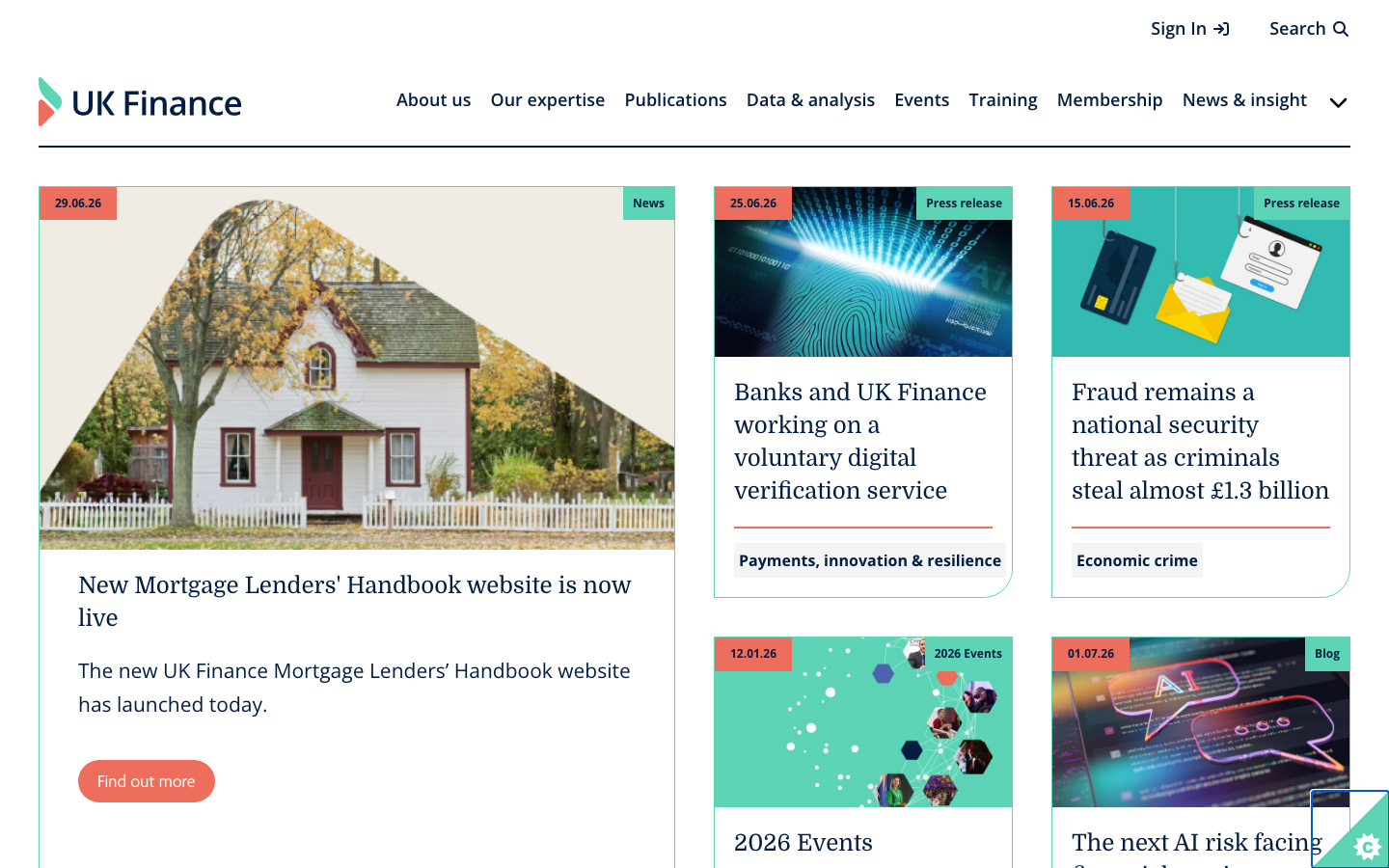
UK Finance’s own homepage, checked directly this month, is currently leading with a stark figure from its economic-crime coverage: criminals stole almost £1.3 billion through UK payment fraud in the period covered by its latest release — a reminder that the trade body publishing the prepaid-card usage data this page cites is the same one tracking fraud losses across every UK payment rail, prepaid included.
Prepaid Cards & Safer Gambling: The Ceiling and the Hole
Prepaid’s safer-gambling case is real: the load is a hard ceiling with no credit anywhere behind it, making a deliberately-loaded prepaid card one of the few payment methods that physically enforces a budget. Used that way — load Friday’s allowance, play to zero, stop — it’s the budgeting tool this site most often recommends to players who want structure without full self-exclusion.
The hole in the ceiling: cash-loaded prepaid is invisible to bank gambling blocks, exactly like vouchers. A block on your bank card does nothing about a prepaid card loaded at a shop till — so if bank blocks are load-bearing in your setup, either use only bank-linked loads (which blocks can see) or keep prepaid out of the toolkit. And reloading mid-session defeats the entire point: a ceiling you can raise at will is a suggestion, not a limit — the product’s discipline is only as good as the loading habit behind it. Operator-side protections apply in full regardless: deposit-limit prompts, the 2026 limits regime, and GAMSTOP across every UKGC site. Our responsible gambling hub has the full toolkit; the National Gambling Helpline is 0808 8020 133, free and always open. 18+.
What Players Say About Prepaid Card Casino Play
The community record sorts neatly by product type, which is the page’s thesis wearing forum clothes. App-based prepaid users barely generate threads: deposits work, payouts land where the product supports them, and the notification-per-spin experience gets praised as accidental session tracking. The retail-reloadable crowd posts the practical questions — which issuers support casino merchant codes, which load points charge what — and the answers change often enough that current-month threads beat any static guide.
The horror-story genre belongs almost entirely to gift cards: deposits accepted, winnings frozen pending source-of-funds evidence the anonymous card can’t provide, weeks of document ping-pong. Regulars answer these threads with the same advice this page leads with — named products, kept receipts, matching names — usually alongside the sharper question of why an anonymous card was the choice in the first place. And a steady minority thread runs through it all: players who use the load-and-stop pattern as deliberate self-limitation and credit it with keeping their play inside budget — the category’s best argument, made by the people it works for.
If Prepaid Isn’t the Fit: The Adjacent Options
Prepaid sits at a crossroads, and each neighbour does one of its jobs better:
- For the hard ceiling with total anonymity — paysafecard or Neosurf: pure cash codes, no product research required, accepting the no-withdrawals trade openly.
- For the ceiling with a proper two-way wallet behind it — Jeton (JetonCash entry) or MiFinity (eVoucher entry): voucher-style loading, wallet-grade exits.
- For frictionless everything and no ceiling — the debit card you already hold, still the UK default for good reasons.
- For bank-level money with bank-level speed — open banking, whose account-to-account transfers make even push payments look quaint.
The decision rule in one line: if you can name why you want prepaid specifically — the ceiling, the separation, the statement privacy — pick a named push-capable product and it will serve you well; if you can’t, one of the four alternatives above is your actual answer.
Three Prepaid Myths Worth Retiring
“Prepaid cards are anonymous, so casinos can’t identify me.” Half wrong and the wrong half is expensive: the card can be anonymous, but the casino account never is — UKGC verification identifies every player regardless of payment method. All an anonymous card achieves is making the money-side checks harder for you at payout time. If statement privacy is the goal, a cash-loaded named product delivers it without the KYC tax.
“The credit card ban covers prepaid cards too.” It doesn’t and can’t: the ban targets borrowed money, and a prepaid balance is money you already handed over. Prepaid products sailed through April 2020 untouched — and gained relevance from it, as the only card-family route left with a built-in ceiling.
“Any prepaid card that deposits can receive a payout.” The costliest assumption in the category. Receiving requires push-payment capability the issuer must have built; vast swathes of the prepaid market — gift cards absolutely, many retail reloadables too — never did. The deposit working proves nothing about the return leg, which is why this page’s single rule is to check receive-ability before the first deposit, not after the first win.
Choosing Your Product in Ten Minutes
Everything this page argues, compressed into the checklist you’d actually run:
- Named account? If the product doesn’t know who you are, stop — payout-time KYC will be the tax on that anonymity. Named products only for casino use.
- Can it receive push payments? The issuer’s documentation or support chat answers in a minute. Yes → you have the full loop. No → accept the bank-transfer exit consciously or keep shopping.
- What’s the fee schedule? Load fees, monthly fees, FX. The best app-based products charge nothing for the pattern casino play involves; anything charging monthly rent needs a reason.
- Which load routes exist? Cash-at-retail preserves statement privacy but escapes bank blocks; bank-linked loads reverse both. Pick the trade that matches your setup — deliberately.
- Does the app have controls? Freeze, notifications, per-category blocks including gambling. The good products carry all three; they’re free discipline.
Five questions, ten minutes, and the category’s entire trap-list — the payout wall, the KYC ambush, the fee leak — is designed out before the first load. That’s the whole trick of prepaid: the product choice is the method.
Our Verdict on Prepaid Cards at UK Casinos
Overall: 6.5/10 as a category — 8/10 for the right product
| Sub-score | Rating | In one line |
|---|---|---|
| Deposit experience | 8.5 | Card-rail acceptance almost everywhere, instantly |
| Withdrawal support | 5 | The great divide — push-capable products fine, the rest bank-exit only |
| Fees | 6 | Casino-free but issuer-dependent; the wrong product leaks monthly |
| Budgeting power | 9 | The hardest spending ceiling on card rails — if the loading habit holds |
| KYC smoothness | 5.5 | Named products glide; anonymous plastic pays for its privacy at payout time |
Choose prepaid if you want an enforced budget with mainstream acceptance and you’re willing to pick a named, push-capable product deliberately. Look elsewhere if you want zero product-research overhead — debit for convenience, paysafecard for the ceiling-plus-privacy trade taken cleanly. The category’s verdict is really a sorting rule: prepaid done deliberately is excellent, prepaid done casually is the worst of both worlds, and the difference is fifteen minutes of product research this page has hopefully just done for you.
Prepaid Card Casino FAQs
Do UK casinos accept prepaid cards?
Nearly all of them — mainstream prepaid Visa and Mastercard products run on debit rails, so any cashier that takes cards processes them. The variation that matters is on the card side: load routes, receive-ability and fees differ by product, not by casino.
Can I withdraw casino winnings to a prepaid card?
Only if the product accepts push payments (Visa Direct / Mastercard Send) — many prepaid cards, and all gift-style ones, cannot receive funds at all. Where the card can’t receive, casinos pay by bank transfer instead. Check your issuer’s documentation before depositing.
Are prepaid cards covered by the credit card gambling ban?
No — the 2020 ban covers borrowed money, and a prepaid balance is your own money loaded in advance. Prepaid remains fully legal at UKGC casinos, and its hard spending ceiling is the reason safer-gambling guides often mention it favourably.
Are anonymous prepaid gift cards good for casino deposits?
They’re the worst fit in the category: deposits usually work, but the cards can never receive payouts, and their anonymity triggers source-of-funds checks when you cash out. A named, app-based prepaid product avoids every one of those problems.
Do prepaid card deposits qualify for casino bonuses?
Generally yes — cashiers process them as card deposits, and card deposits qualify almost everywhere. A minority of operators exclude prepaid products explicitly in their significant terms, so the standard ten-second check applies.
What fees do prepaid cards charge?
Nothing at the casino — the costs sit with the issuer: purchase or load fees, monthly account fees on some products, FX margins on non-sterling cards. Schedules vary more widely than any other method category, which is why product choice is most of the game.
Will a bank gambling block stop prepaid deposits?
Only partially: bank-linked loads stay visible to your bank’s controls, but cash-loaded value is invisible to them — the same gap vouchers have. If bank blocks matter in your setup, use bank-linked loads only, or skip prepaid entirely.
Prepaid card or paysafecard — which is better?
Same ceiling logic, different trade: paysafecard is simpler (no product research, total statement privacy) but strictly one-way; a push-capable prepaid card keeps the ceiling and adds card-rail acceptance plus a working payout route. Deliberate players take the card; simplicity takes the voucher.
Why did my prepaid deposit trigger extra verification?
Usually the card’s fault, not yours: anonymous or mismatched-name products make the operator’s source-of-funds obligations hard to satisfy, so documents get requested. Named card, matching casino account name and kept load receipts prevent nearly all of it.
Can I load a prepaid card with a credit card and gamble?
Most prepaid issuers block credit-funded loads for gambling-bound spending, and doing it deliberately routes borrowed money into deposits — exactly what the 2020 ban exists to stop. Load with your own money; the ceiling only means something when it’s real.
Which prepaid card is best for UK casinos?
We deliberately rank behaviours rather than brands, because products change terms often: the winning profile is a named, app-based card that accepts push payments, charges no monthly fee, and offers gambling-block controls. Run our ten-minute checklist against any candidate and the answer falls out.
Can I use a foreign-issued prepaid card at UK casinos?
Often not — UK operators’ fraud rules block many overseas-issued cards, and non-sterling denominations add FX margins where they do work. UK-issued, GBP-denominated products are the friction-free rule.
Do prepaid cards affect my credit score?
No — there’s no borrowing, no credit check and no reporting, which is partly why they suit players separating gambling entirely from their financial footprint. The flip side: they build no history either; they’re spending tools, not credit products.
Why do casinos sometimes decline prepaid deposits that worked before?
Usually issuer-side: load balances running below the deposit amount, velocity limits on gambling merchant codes, or the product’s risk rules tightening. Check the card app’s transaction log first — the casino cashier rarely knows more than “declined”.
Can I set a gambling block on a prepaid card?
The better app-based products offer per-category merchant controls including gambling toggles, mirroring what the big banking apps provide. It’s worth weighting in product choice: a ceiling plus a self-set block is the strongest combination the card category offers.
Changelog: 9 July 2026 — added an at-a-glance box, UK Finance's current fraud-loss figures, and an official homepage screenshot.
Sources & Verification
Primary sources checked 5 July 2026: Visa and Mastercard’s published prepaid product and push-payment (Visa Direct / Mastercard Send) documentation; issuer terms sampled across UK app-based and retail-reloadable prepaid products; the Gambling Commission’s credit card ban provisions confirming prepaid’s status and its gambling-block guidance; UK Finance materials on prepaid card usage (re-verified 9 July 2026), and the FCA’s payment-services consumer guidance for the e-money safeguarding context.

Will's test drawer holds more prepaid plastic than any sensible person's should, and the receive-ability fork this page maps — which cards can take a payout, which never will — is the single question he's answered most often since this site launched. More about Will →