Volt is the open-banking provider British players are most likely to have used without ever seeing the name. Founded in London, authorised by the FCA for payment initiation, and built to connect account-to-account rails across continents rather than one country, it powers pay-by-bank deposits at UK casinos through the same generic button its rivals hide behind. Here is what it actually does, and where it sits against Trustly.
Casinos that accept Volt rarely say so by name, which is exactly why a list is worth having.
Casinos with Volt Payments
| Volt at a Glance | |
|---|---|
| UK status | FCA-authorised for payment initiation services |
| Where you meet it | Inside “Pay by Bank” / instant bank transfer cashier options |
| Deposits | Instant, authorised in your own banking app |
| Withdrawals | Faster Payments — minutes after operator approval |
| Coverage | Real but thinner than Trustly’s |
Verified 24 July 2026. Volt’s FCA authorisation is the fact that separates it from some rivals — see the comparison below.
| Question | Answer |
|---|---|
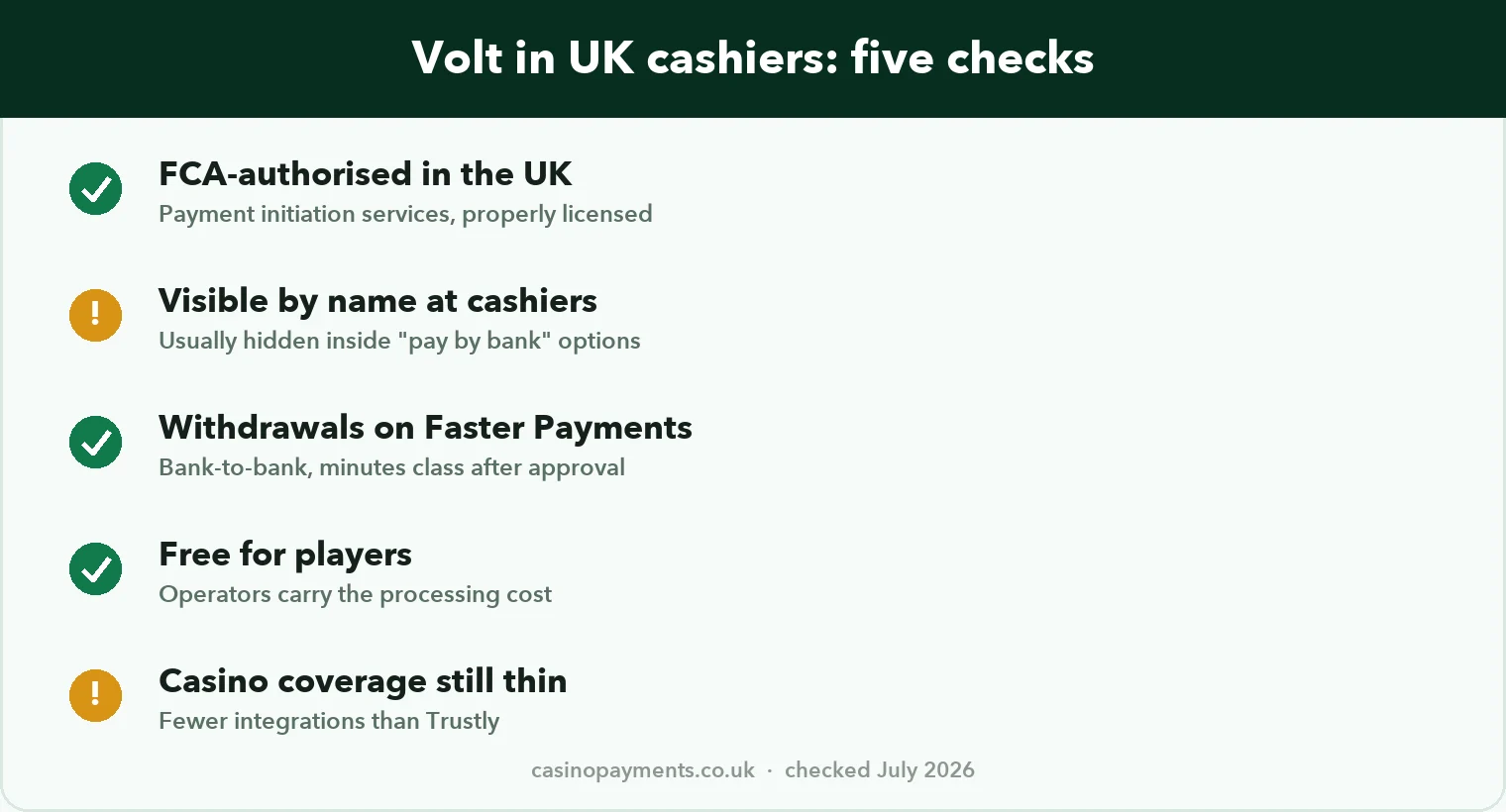
| Can UK players use Volt? | Yes — it’s FCA-authorised for payment initiation and live in UK cashiers |
| Will I see the name? | Rarely — it sits behind “Pay by Bank” buttons like its rivals |
| Withdrawals? | Yes — bank-to-bank on Faster Payments, minutes after approval |
| How common is it? | Thinner coverage than Trustly; a genuine third option rather than a headline one |
| Cost to players? | Nothing — the operator pays |
Verified 24 July 2026 · 18+ · UKGC-licensed operators only · begambleaware.org
Volt: Quick Facts
| What it is | Account-to-account payments provider — bank pays merchant, no card involved |
|---|---|
| Founded | 2019, London |
| UK regulatory status | FCA-authorised for payment initiation services |
| Cashier appearance | Usually generic: “Pay by Bank”, “Instant Bank Transfer” |
| Deposit speed | Instant on approval in your banking app |
| Withdrawal speed | Faster Payments — minutes to hours after the casino releases |
| Player fees | None |
| Data shared with casino | None beyond confirmation — no card number, no credentials |
| Distinctive angle | Cross-border A2A network rather than one national scheme |
The Third Rail: Why Volt Matters
UK open banking at casinos is not one product but a market of providers competing to sit behind the same button. Trustly is the incumbent with the deepest gambling coverage. Volt is the most credible British-built challenger, and it differs in ambition rather than mechanics.
The mechanics are common to all of them: you pick pay-by-bank, choose your bank, approve the exact amount inside your own banking app with biometrics, and the money moves account-to-account. No card number is typed, nothing storable reaches the casino, and the whole thing is authorised under the UK’s regulated open-banking framework.
The ambition is where Volt separates. Rather than perfecting one country’s bank connections, it has built toward stitching together the instant-payment schemes that different regions developed independently — UK Faster Payments, European SEPA Instant, Brazil’s PIX, Australia’s NPP. For a UK casino player that global architecture is mostly invisible, but it explains why operators with international footprints integrate Volt: one contract covering markets that would otherwise need several.
The honest caveat: at British cashiers specifically, Volt’s coverage remains thinner than Trustly’s. It is a genuine third option, not a co-leader — and since the button rarely names its provider, most players will never know which one carried their deposit.
Volt vs Trustly vs Brite: The FCA Line
These three get listed together constantly, which obscures a decisive difference: only two of them are authorised to operate in the UK.
| Volt | Trustly | Brite | |
|---|---|---|---|
| FCA authorisation | Yes | Yes | No — UK market not live |
| Home base | London | Stockholm | Stockholm |
| UK casino coverage | Growing, moderate | The broadest | None |
| Founded | 2019 | 2008 | 2019 |
| Strategic angle | Cross-region A2A network | Depth in gambling and US expansion | European instant payments |
Worth noting how easily this distinction disappears in practice. Providers are named in cashier small print rather than on buttons, comparison tables list them together because they genuinely are the same category of product, and a company can maintain a London office with British staff while holding no UK permission at all. None of that is deception — it is simply what a wholesale market looks like from the retail side, where the customer never signs a contract with the provider and so never has cause to check its paperwork. The remedy is the FCA register: public, free, and decisive in under a minute for any payment brand you encounter.
Full guides: Trustly and Brite — the latter being a genuinely useful page precisely because so many lists name it as a UK casino method when it is not one. For players the practical takeaway is reassuring: whichever of the two authorised rails your cashier uses, the experience and the protections are effectively identical.
How a Volt Payment Runs
Depositing
- Choose the pay-by-bank or instant bank transfer option in the cashier.
- Select your bank — the majors and the app banks all appear.
- Your banking app opens; approve the exact amount with fingerprint or face.
- The balance credits instantly. The casino receives a confirmation, never your credentials or card details.
Withdrawing
- Request the payout to the same bank account, under the closed-loop rule.
- The operator’s approval queue is the real wait — the rail is not the bottleneck.
- Once released, funds move on Faster Payments; arrival in minutes is routine.
Under the hood
Volt operates as a regulated payment initiation service provider: it never holds your money, it instructs your bank to make a payment you have personally authorised. That distinction matters for risk — there is no stored balance, no float, no wallet to be frozen. The money goes from your account to the operator’s, and the provider’s role ends when the instruction completes. For withdrawals the flow reverses over the same bank rails, which is why pay-by-bank payouts are consistently among the fastest routes home this site measures.
Regulation & Safety
The security argument for bank-rail deposits is structural rather than promotional. Nothing storable is exposed: no card number to be skimmed, no wallet password to phish, no credentials shared with anyone — authentication happens inside your own banking app under your bank’s own controls, including its fraud monitoring and strong customer authentication. Volt is FCA-authorised for exactly this activity, operating within the UK’s open-banking framework, and because it initiates payments rather than holding funds there is no stored-value balance to worry about and no FSCS question distinct from your own bank account’s.
The boundaries are the ones this site draws on every method. Instant, app-authorised deposits are frictionless in both senses — the three taps that make a planned deposit pleasant make an unplanned one equally easy, which is where bank-level gambling blocks and cashier deposit limits earn their place. And no provider’s authorisation underwrites the operator: a perfectly executed Volt deposit to an unlicensed site is simply an efficient way to fund a place with no rules. Verify the licence, not the rail.
A London Startup Building Global Rails
- 2019 — Volt is founded in London, at the point when UK open banking moves from mandate to working infrastructure.
- 2020 — European expansion begins; the model targets account-to-account payments as a card alternative rather than a niche.
- 2021 — Funding rounds back the cross-border thesis: connecting national instant-payment schemes into one network.
- 2022 — Brazilian and Australian connectivity extend the reach beyond Europe, matching PIX and NPP to the same interface.
- 2023 — Gambling and high-volume e-commerce become significant verticals, where instant settlement and low chargeback exposure matter most.
- 2024–2025 — UK casino integrations grow as pay-by-bank normalises across cashiers post-card-ban.
- 2026 — Established as one of the small group of FCA-authorised rails behind Britain’s pay-by-bank buttons.
The instructive contrast with its Swedish contemporaries is regulatory rather than technical: Volt built British authorisation into its foundations because it started here, while EEA-passported rivals discovered post-Brexit that European licences no longer reach the UK market.
Volt Around the World
Volt’s defining characteristic is that it treats account-to-account payments as a global category rather than a European one. Britain has Faster Payments, the eurozone has SEPA Instant, Brazil has PIX, Australia has the New Payments Platform — all doing conceptually the same job under different rules, built by different institutions, at different times. Volt’s proposition is one integration reaching all of them.
For gambling operators that has obvious appeal: a business licensed in several markets can offer bank payments everywhere through a single relationship. For a UK player it changes nothing about the experience — you tap pay by bank, approve in your banking app, and Faster Payments does the work exactly as it would through any other provider.
The standing caution transfers unchanged. A rail’s international reach says nothing about an operator’s licensing: an offshore site offering slick pay-by-bank deposits is still an offshore site, outside GAMSTOP, outside ADR routes, outside funds-protection rules. Infrastructure quality and regulatory protection are separate questions, and only the second one protects you.
Volt’s Wider Role in Open Banking Payments
Gambling is one vertical among several for Volt, which sits within a broader shift: the slow migration of payments away from cards toward direct bank rails. The commercial logic is unsentimental — account-to-account payments typically cost merchants less than card interchange and carry no chargeback exposure — and it is why pay-by-bank buttons have spread across retail, travel and subscriptions as well as cashiers.
The consumer-facing consequence is worth noting for anyone reading this site: the generation now paying for everyday purchases by approving them in a banking app will find casino cashiers that still want a sixteen-digit card number increasingly quaint. Volt, Trustly and their peers are not competing for gambling deposits specifically; they are competing to become the default way money moves online, and gambling is simply an early adopter because the economics bite hardest there.
Volt & Safer Gambling
Bank-rail deposits carry a genuine transparency advantage: every transaction lands on your bank statement in plain sight, correctly coded as gambling, catchable by bank-app blocks and visible to anyone doing honest budgeting. There is no stored wallet balance sitting beyond your bank’s reach — a structural benefit over wallet methods for anyone relying on blocking tools.
The trade-off is speed. Three taps from impulse to funded account is the category’s cost, which is why the framework around the rail matters more than the rail. Set cashier deposit limits before you play; arm your bank’s gambling block if control is part of your picture (it catches these payments reliably, since they are honestly coded); and register with GAMSTOP for person-level exclusion no payment choice can route around. The full stack is in our responsible gambling hub, and the National Gambling Helpline answers free and in confidence on 0808 8020 133, day or night. 18+.
What Players Notice When a Casino Runs Volt
Volt-specific player commentary barely exists, and that is the most accurate thing this section can report. British players discuss “pay by bank” as a category and almost never learn which provider carried the transaction — the name typically surfaces only in a settlement reference or a cashier’s small print.
What the category threads say applies to Volt directly. Payout speed draws consistent praise: bank-rail withdrawals regularly get described as the fastest players have had, with same-hour arrivals routine at operators that approve quickly. Deposit-side, the recurring note is how much better approving in a banking app feels than typing card details — more secure and less effortful at once. The grumbles are mundane: an occasional bank-app redirect timing out mid-flow, resolved by retrying, and confusion when a withdrawal screen lists a bank account the player forgot linking.
Absent entirely is any pattern of Volt-specific failures, disputes or fee surprises. For infrastructure whose job is to be invisible, an empty complaints file is the outcome to want.
When to Choose the Bank Rail
Pay-by-bank — whichever provider is behind it — is the right default more often than most players assume. Choose it when:
- Payout speed is the priority — Faster Payments home generally beats card rails, and pairs best with an operator that approves quickly.
- You would rather share nothing — no card number means nothing stored, leaked or re-billed.
- You bank app-first — Monzo, Starling, Revolut and Chase users get the smoothest approval flows.
One further consideration specific to bank rails, worth weighing before you commit to them as a default. Card deposits carry chargeback rights — a formal route to dispute a transaction through your card issuer. Bank-rail payments do not: an authorised push payment is final, and the recourse that exists runs through the operator and the gambling regulator rather than your bank. At a UKGC-licensed casino that is a perfectly reasonable trade, because the licence supplies the dispute route a chargeback would otherwise provide. At anything less than a licensed operator, it is the difference between a bad evening and an unrecoverable one, which is why this site treats the licence check as the step that matters most.
Reach elsewhere when the fit is wrong: vouchers for strictly cash-budgeted play the bank never sees, PayPal for a deliberate buffer between casino and current account, pay by mobile for small capped stakes. And if instant bank deposits feel too easy for your habits, that is a real finding — slower methods are legitimate tools, and the safer-gambling section above has the rest.
How to Tell Which Rail Carried Your Deposit
Since UK cashiers rarely name their provider, players occasionally want to know which rail actually moved their money — usually when reconciling a statement or chasing a payment that has not appeared. There are three reliable places to look.
- Your bank statement. The payee reference on an open-banking deposit frequently names the payment provider rather than the casino, since the provider initiated the instruction. A reference you do not recognise beside a gambling transaction is usually the rail, not a mystery.
- The confirmation email. Cashier receipts often carry a transaction reference with a provider prefix, even when the button on the site said nothing at all.
- The casino’s banking or terms page. Operators frequently name their payment partners in the small print even when the cashier interface does not.
The practical value of knowing is admittedly limited: whichever authorised rail carried it, your recourse runs through the operator rather than the provider, because rails execute instructions and do not adjudicate disputes. But there is one situation where it matters — if a deposit left your account and never arrived, the reference tells you what to quote to the cashier’s support desk, and a specific reference gets a materially faster answer than “I paid by bank”.
It is also, in a small way, the point of this page. Payment infrastructure that never announces itself is easy to use and hard to reason about. Knowing that Trustly and Volt are the two authorised names behind the button — and that a third name frequently listed alongside them is not authorised here at all — is worth more than any preference between them.
Our Verdict on Volt for UK Players
Volt is a recommendation you can act on without changing anything: if your cashier offers pay by bank, you may already be using it. It brings genuine FCA authorisation, a British base, a global account-to-account network that most rivals cannot match, and a UK implementation identical in experience to the market leader — instant detail-free deposits, Faster Payments withdrawals, nothing to pay.
Its limitations are honest ones: thinner casino coverage than Trustly, and no consumer brand presence to speak of, so you cannot choose it deliberately at most cashiers. Neither matters much, because the two authorised rails are interchangeable from the player’s side. The genuinely useful thing this page can tell you is the comparison it enables — Volt and Trustly are FCA-authorised and live in the UK; Brite, listed alongside them constantly, is not. That distinction is worth more than any preference between the two that are.
Volt’s own site, checked directly this month, positions the company well beyond a single-market open-banking provider: it describes building real-time account-to-account payments infrastructure across regions, connecting the domestic instant-payment schemes that have grown up separately in Europe, the UK, Brazil and Australia. That global-network framing is the strategic difference from rivals built primarily around one continent’s banking — and it is why a UK casino integrating Volt is buying access to more than British bank connections.

Volt Casino FAQs
Which UK casinos accept Volt?
Any cashier offering pay-by-bank or instant bank transfer may run on Volt — the provider sits behind the button rather than on it. Coverage is real but thinner than Trustly’s.
Is Volt authorised in the UK?
Yes — Volt is FCA-authorised for payment initiation services, which is precisely what a pay-by-bank deposit is. That authorisation is what distinguishes it from some rivals listed alongside it.
Why can’t I find a Volt button?
UK cashiers almost always use generic labelling. Choosing the pay-by-bank option gets you this experience whichever authorised provider carries it.
How fast are Volt withdrawals?
Once the casino approves, funds move on Faster Payments — minutes to a few hours. The operator’s approval queue is the real variable, not the rail.
Does Volt cost anything?
Nothing for players. Operators pay the processing costs, which are typically lower than card interchange — part of why pay-by-bank spread so quickly.
Do I need a Volt account?
No. There is nothing to sign up for. Volt initiates a payment from your bank with your authorisation; your banking app does the rest.
Is Volt safer than paying by card?
Structurally, yes on data: no card number or credentials reach the casino, and authentication happens in your own banking app. Operator licensing remains the thing to verify, whatever the rail.
Volt or Trustly — does it matter which my casino uses?
Not in practice. Both are FCA-authorised, both deposit instantly and pay out on Faster Payments, and the player experience is effectively identical.
Will my bank’s gambling block stop Volt deposits?
Yes — pay-by-bank gambling deposits are honestly merchant-coded, so app-bank blocks catch them. For anyone using blocks deliberately, that coverage is a feature.
How do I find out whether Volt carried my deposit?
Check your bank statement’s payee reference, the cashier’s confirmation email, or the operator’s banking page — the provider is often named in one of the three even when the button was unbranded. It rarely changes your options, but a specific reference gets a faster answer from support.
Is Volt a British company?
Yes — founded in London in 2019 and FCA-authorised, which is unusual in a field where the best-known providers are Swedish. It has since built connectivity into instant-payment schemes well beyond Europe.
Does Volt hold my money at any point?
No. It is a payment initiation provider, meaning it instructs your bank to make a payment you have authorised. There is no stored balance, no float and no wallet that could be frozen — the money goes directly from your account to the operator’s.
What if the casino takes my Volt deposit but won’t pay out?
That is an operator dispute, not a payment one — rails execute transfers, they don’t adjudicate winnings. At a UKGC casino, use its complaints route then the ADR body.
Sources & Verification
Checked 24 July 2026 against: Volt’s own site (captured by screenshot the same day) and its published account-to-account product documentation; Volt’s payment-initiation authorisation on the FCA Financial Services Register; the FCA’s open banking and open finance framework; Open Banking Limited’s regulated-provider directory; and the Gambling Commission’s payment-blocking guidance.