
Pay by mobile is the UK cashier’s oddball: deposits charged to your phone bill through Boku or Fonix, no card, no bank details, no wallet account — just a text-style confirmation. It’s capped around £30 a day, it can never pay you a penny back, and at some networks it even carries a fee. Yet for small, strictly limited top-ups it remains genuinely useful, and this guide plays it completely straight.
Casinos that accept pay by mobile are common enough; the cap, not the coverage, is the limiting factor.
Casinos with Pay by Mobile Payments
| Pay by Mobile at a Glance | |
|---|---|
| Best for | Small, tightly-capped deposits with no bank details shared |
| UKGC coverage | Boku and Fonix are the two main UK providers |
| Deposit cap | ~£30/day, by design |
| Withdrawals | Not supported — deposit-only |
| Fees | None at the cashier; billed via phone contract |
Carrier billing lives at the bingo-and-slots end of the market — the networks built for a fiver here and a tenner there, not the high-roller lobbies. In Touch Games practically runs on it, Jumpman’s 150-odd sites offer it (mind the fee), and the bingo networks keep it alive for players who’d rather never type a card number. Ten worth knowing, checked 5 July 2026.
| Casino | Why it stands out for phone-bill deposits | Min deposit |
|---|---|---|
 mFortunemfortune.co.uk mFortunemfortune.co.uk | The spiritual home of pay-by-phone: In Touch built its own games and its own billing flow around exactly this method, fee-free. | £3 |
 Cashmocashmo.co.uk Cashmocashmo.co.uk | mFortune's sister keeps the same fee-free phone billing with a £3 floor — among the smallest deposits anywhere in UK gambling. | £3 |
 Amazon Slotsamazonslots.com Amazon Slotsamazonslots.com | A flagship of Jumpman's enormous network — phone billing works across all its sisters, though the £2.50 fee makes cards better value here. | £10 |
 Mecca Bingomeccabingo.com Mecca Bingomeccabingo.com | Rank runs proper fee-free phone billing with a £5 minimum — a natural fit for bingo-sized stakes. | £5 |
 Kitty Bingokittybingo.com Kitty Bingokittybingo.com | Daub's bingo stack has carried carrier billing for years; small rooms, small deposits, no card required. | £5 |
 MrQmrq.com MrQmrq.com | Phone-bill deposits sit beside wager-free rewards, so the method's natural small-stakes rhythm isn't spoiled by playthrough maths. | £10 |
 Betfredbetfred.com Betfredbetfred.com | One of the few big bookmaker brands still offering phone billing on the casino side, with its round-the-clock payout desk for the exit leg. | £10 |
 Virgin Gamesvirgingames.com Virgin Gamesvirgingames.com | Bally's keeps carrier billing available across its family — handy for capped top-ups between card deposits. | £10 |
 Jackpotjoyjackpotjoy.com Jackpotjoyjackpotjoy.com | Same Bally's rails with a bingo-first audience that suits the method's ceiling perfectly. | £10 |
 Lucky Pants Bingoluckypantsbingo.com Lucky Pants Bingoluckypantsbingo.com | Daub's louder sibling — the £30-a-day cap barely registers when rooms cost pennies. | £5 |
Checked 5 July 2026 · 18+ · UKGC-licensed operators only · begambleaware.org

Pay by Mobile at UK Casinos: Quick Facts
| Category | Carrier billing — deposits charged to your phone account |
|---|---|
| Main providers | Boku (San Francisco, 2009) and Fonix (London, LSE-listed) |
| UK gambling status | Accepted at mobile-first and bingo-led UKGC casinos |
| Deposits | Yes — instant, confirmed by text or tap |
| Withdrawals | Never — carrier billing has no inbound rail; a second method is mandatory |
| Typical cap | Around £30 per day, set by carriers and operators |
| Fees | Usually none — but Jumpman-network sites charge £2.50 per deposit |
| Minimum deposit | As low as £3 (In Touch brands); £5–£10 elsewhere |
| Works on | Contract and pay-as-you-go, all four UK networks — mobile only |
| Bank gambling block | Does not apply — the charge lands on your phone bill, not your bank |
| Our score | 6.5/10 — sub-scores in the verdict |
The £30 Cap & the Rules That Shape Everything
Every quirk of this method flows from one design decision: the money rides your phone contract, an account that was never built for gambling. Regulators and carriers responded with the tightest ruleset in the cashier.
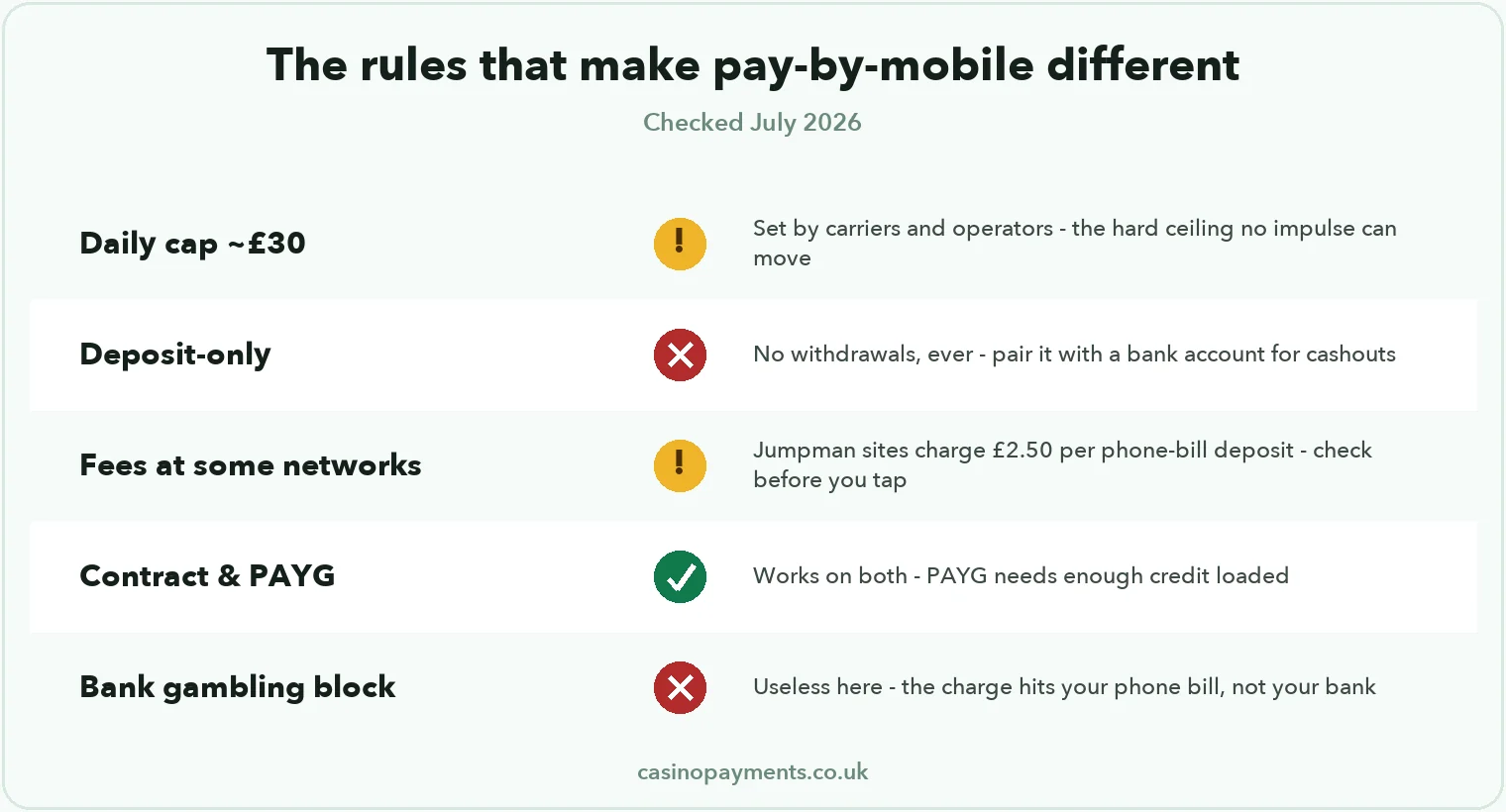
Read the cap the right way round: £30 a day isn’t a limitation of the method, it is the method. Nothing else in UK gambling has a hard ceiling that neither you nor the casino can raise in a weak moment. For some players that’s exactly the appeal; for anyone wanting flexibility, it’s the sign to use a debit card instead.
Phone Bill vs Debit Card vs Paysafecard vs Apple Pay
Pay by mobile competes with the other “no bank details at the casino” options more than with mainstream methods — and each draws the privacy-versus-flexibility line differently.
| Pay by mobile | Debit card | Paysafecard | Apple Pay | |
|---|---|---|---|---|
| Details shared with casino | Phone number only | Card (tokenised) | A voucher PIN | None reusable |
| Withdrawals | Never | Yes | No (account needed) | Rare |
| Hard spending cap | ~£30/day | None built in | Voucher value | None built in |
| Possible fees | £2.50 at some networks | None | None at deposit | None |
| Bank block coverage | No | Yes | No | Yes |
| Best for | Capped small stakes | Everything | Cash budgeting | Speed |
Full guides to debit cards, paysafecard and Apple Pay cover each rival properly.
Pay by mobile vs Every Other Payment Method
Phone-bill deposits are the field’s great outlier — capped, deposit-only, gloriously simple — which makes the full-field comparison lopsided in both directions, and all the more useful for it.

| Against | Pay by mobile wins on… | It wins on… |
|---|---|---|
| Debit card | No card details existing in the loop | Universal acceptance with zero bonus exclusions, — not phone billing’s game |
| Open banking | No banking app involvement whatsoever | Payout pace straight into FSCS territory, something phone billing doesn’t offer |
| PayPal | Nothing to register or remember | The widest wallet acceptance on the high street, outpacing phone billing on this front |
| Apple Pay | Working on any handset ever made | Face ID deposits in a couple of seconds, — phone billing’s blind spot |
| Google Pay | Carrier billing needs no NFC | Tap-speed deposits across every Android, a lead over phone billing |
| Bank transfer | Two taps against form-filling | Heavyweight limits no wallet will match, where phone billing can’t follow |
| MuchBetter | No wallet to fund beforehand | The category’s lightest fees and freshest security, — beyond phone billing here |
| Jeton | Zero setup against account onboarding | High-street listings and cash-code entry, where it out-does phone billing |
| MiFinity | Simplicity no e-money product matches | Home-turf regulation with a cheap schedule, ground phone billing gives up |
| Skrill | A built-in brake the wallet lacks | Sheer coverage, deep into the casino long tail, still ahead of phone billing there |
| Neteller | Deposits without a fee sheet | The Net+ Mastercard and veteran reach, an area phone billing concedes |
| Paysafecard | No shop visit — the phone is the voucher | A ceiling set in banknotes at the till, which phone billing can’t claim |
| Payz | One SMS versus a tier ladder | The ecoVoucher door and tier rewards, something phone billing doesn’t offer |
| Neosurf | Topping up from bed, not the till | Shop-bought codes with hard budget edges, outpacing phone billing on this front |
| Prepaid cards | No plastic, no loading station | A load-is-the-limit ceiling on card rails, — phone billing’s blind spot |
Almost everything beats pay by mobile on flexibility; nothing beats it on simplicity or on the discipline of a hard cap. It is a small-stakes specialist — keep it for exactly that, with a bank-transfer exit standing by for the wins worth withdrawing.
How Pay by Mobile Casino Deposits Work
Depositing, step by step
- Choose Pay by Mobile (sometimes branded Boku or Fonix) in the cashier and enter an amount inside the daily cap.
- Type your mobile number — the only detail the casino ever gets.
- Boku or Fonix pings a confirmation text or an on-screen tap-to-approve; reply or tap to authorise.
- The balance credits instantly. On contract, the charge appears on next month’s bill; on pay-as-you-go it comes straight off your credit.
Why withdrawals are impossible — and what to do about it
Carrier billing was engineered for ringtones and app purchases: a one-direction pipe from phone account to merchant. There is no mechanism — none, at any casino, ever — for money to travel back onto a phone bill. So every phone-bill player needs an exit plan from day one:
- Register your bank details (or a debit card) with the casino as your withdrawal method.
- Complete ID verification before you win, not after — payout to a method that never deposited always triggers extra checks.
- Expect the payout via bank transfer at most mobile-first brands, on their standard timeline.

Under the hood
Boku and Fonix are payment intermediaries wedged between casinos and the four UK mobile networks. When you approve a deposit, they instruct your carrier to add the charge to your account and simultaneously guarantee the casino its money — settlement between carrier, intermediary and operator happens later, invisibly. It’s the same direct-carrier-billing machinery that sells app-store credit, wrapped in the extra age and identity checks gambling demands. The elegance is real: no financial credentials exist in the transaction at all. So is the limitation: phone accounts can be charged, never credited.
Pay by Mobile Casino Fees, Limits and the Daily Cap
This is the one mainstream method where “is it free?” genuinely depends where you’re standing.
| Item | Reality |
|---|---|
| Deposit fee | Free at In Touch, Rank, Daub and most bingo networks — but £2.50 per transaction across Jumpman’s sites |
| Deposit speed | Instant once you confirm the text or tap |
| Daily ceiling | ~£30, enforced jointly by carriers and operators; some sites set it lower |
| Minimums | £3 at mFortune and Cashmo — the lowest in the UK market; £5–£10 elsewhere |
| When you actually pay | Contract users: next bill. PAYG users: immediately from credit |
| Withdrawal cost/speed | Not applicable — payouts travel by bank transfer on the casino’s normal timeline |
That Jumpman fee deserves emphasis because it’s easy to miss at the point of deposit: £2.50 on a £10 top-up is an instant 25% loss before a single spin. On those sites a debit card does the same job free. Where billing is fee-free — the In Touch and bingo heartland — the method costs nothing beyond its constraints. The delayed-payment quirk cuts both ways too: contract users effectively defer settlement until bill day, which feels painless precisely because it is — keep an eye on the running total mid-month.
A worked example makes the arithmetic concrete. Deposit £10 three times on a Tuesday and the method is done until Wednesday — no override exists, whatever support says, because the ceiling lives with the carrier. Now run the same day on a Jumpman site: three £10 deposits cost £7.50 in fees, leaving £22.50 of playable money from £30 charged — a worse rake than any slot’s house edge before a reel has turned. The same three deposits at mFortune cost nothing extra. Same method, same cap, radically different value: in carrier billing, the platform you pick matters more than anything else on this page.
Set against the rest of this site’s methods, the value calculation is refreshingly binary. Where billing is free, pay by mobile costs exactly what cards cost — nothing — and buys you total card privacy plus the hard cap. Where it’s fee-charging, no privacy benefit on earth justifies handing back a quarter of a small deposit. There is no middle case: check the fee line once per site, and the decision makes itself.
And if you’re weighing it against a voucher: paysafecard offers the same card-free privacy with a chosen ceiling instead of a fixed one, at the cost of a walk to the shop — the two methods bracket the budgeting niche between them.
Platforms & Networks With Phone Billing
Carrier billing tracks the small-stakes platforms almost perfectly — the big card-first casino groups mostly skip it.
| Platform | Example casinos | Phone billing status |
|---|---|---|
| In Touch Games | mFortune, Cashmo, Dr Slot | The heartland — fee-free, £3 minimums, built in-house |
| Jumpman Gaming | Amazon Slots, Aztec Wins + 150 sisters | Network-wide but with the £2.50 per-deposit fee |
| Rank Interactive | Mecca Bingo, Grosvenor | Yes, fee-free |
| Daub Alderney | Kitty Bingo, Lucky Pants Bingo | Yes — long-standing bingo staple |
| Bally’s UK | Virgin Games, Jackpotjoy | Yes across the family |
| Skill On Net | PlayOJO, Lord Ping | Yes |
| MrQ / Betfred (proprietary) | MrQ, Betfred | Yes on both |
| The card-first majors | bet365, Flutter, Entain brands | Largely absent — their audiences deposit bigger than the cap allows |
The pattern says everything about who this method is for: platforms whose average deposit sits under the £30 ceiling embrace it; platforms built around £50-plus sessions don’t bother. Match yourself to the right column and the method never disappoints.
Why Pay by Mobile Exposes No Bank Details
From a data-security angle, pay by mobile is close to unbeatable: the casino learns your phone number and nothing else. No card to breach, no wallet login to phish, no bank credentials in play — the attack surface is a text message confirmation. Boku and Fonix are established, regulated payment institutions (Fonix is London-listed; Boku processes for the app stores), and UK carriers add their own fraud screening on top.
Financial protection is where the picture inverts. Money spent by carrier billing enjoys none of banking’s safety nets — no chargeback scheme, no FSCS anywhere in the chain, and disputes route through your mobile network’s billing process, which was designed for wrong-ringtone complaints rather than gambling issues. The industry’s own phone-payment checker (run by the premium-services regulator now folded into Ofcom’s remit) can identify charges, but recovery of disputed gambling spend is genuinely harder than on any bank-touched method. If a charge on your bill looks wrong, the escalation path runs: casino support first (they can trace the deposit), then your carrier’s billing dispute process, then the phone-paid-services complaint route under Ofcom if both stall. Keep the confirmation texts — they are your only receipts, and threads about lost disputes almost always feature deleted messages. And one household warning that recurs in every forum thread: whoever owns the phone contract pays the bill — on a family or business plan, that may not be you. Is it safe? Your data, absolutely. Your dispute rights, thinner than anywhere else in the cashier.
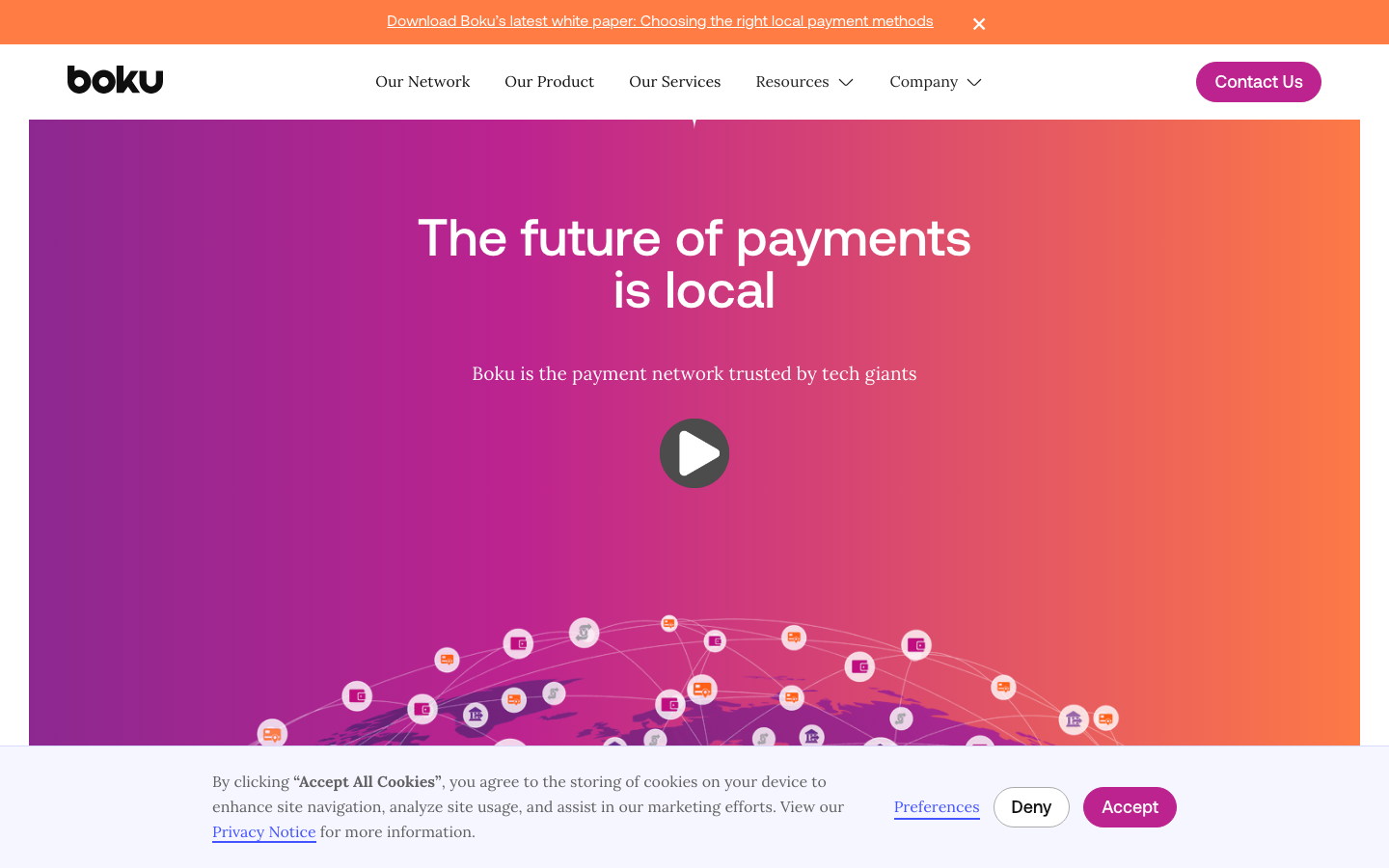
Boku’s own homepage, checked directly this month: “The future of payments is local” — positioning itself as “the payment network trusted by tech giants” for carrier billing and local payment methods worldwide, reflecting a business that has grown well beyond UK gambling carrier billing into a global local-payments network.
From Ringtones to Reels: A Short History
Pay-by-mobile gambling is the respectable descendant of the ringtone economy — and its history is really the history of UK carrier billing growing up.
- 2000s — Premium SMS builds the first phone-payment boom: ringtones, wallpapers, quiz TV — and a regulatory hangover.
- 2006 — Fonix founded in London as the UK carriers professionalise billing APIs.
- 2009 — Boku launches in San Francisco, betting phones would replace cards for micro-payments.
- 2012 — Payforit, the carriers’ joint billing standard, becomes the badge UK players first saw beside casino deposits.
- 2015–2018 — Mobile-first casinos (In Touch chief among them) make phone billing a core deposit method rather than a novelty.
- 2020–2021 — Payforit winds down as carriers move to modern direct billing through Boku and Fonix; the old logo fades from cashiers.
- 2022 — Regulation of phone-paid services consolidates under Ofcom, tightening the rails further.
- 2026 — A stable niche: the capped, card-free deposit lane of the bingo and mobile-slots world.
The through-line: every era made the pipe narrower and better policed. What survives is the most regulated version of phone payments the UK has ever had — small by design, and durable because of it.
One historical footnote explains a term you’ll still meet in old forum threads: “Payforit casinos”. Payforit was never a company but a scheme — the UK carriers’ shared checkout standard — and for most of the 2010s it was the badge on every phone-bill deposit. When the carriers retired it in favour of direct billing through Boku and Fonix, nothing changed for players except the logo, yet guides and search results still reference the dead brand years later. If you’ve been hunting “Payforit slots” and finding confusion, this page is the answer: the scheme is gone, the capability lives on, and the names to look for now are Boku, Fonix, or simply pay by mobile.
The regulatory consolidation under Ofcom matters more than it sounds, too. Phone-paid services once answered to a standalone regulator whose remit predated smartphones; folding oversight into Ofcom in 2022 brought gambling-adjacent carrier billing under the same roof as the networks themselves, closing gaps that once let dodgy subscription services flourish. Today’s phone-bill deposit is the best-policed version of the technology Britain has had — a low bar historically, a meaningful one now.
Phone-Bill Gambling Around the World
Carrier billing for gambling is a distinctly British speciality. The ingredients that make it work here — four big carriers with mature billing APIs, a regulated online market, and a bingo culture built on tiny stakes — rarely coexist elsewhere. Parts of Europe use Boku-style billing for app stores but exclude gambling by carrier policy; Ireland has flirted with it at licensed operators; and in the US, carrier billing for casino play is essentially non-existent — the state-by-state framework and carrier caution killed it before it started. The practical takeaway for UK players is the inverse of most methods: this is one cashier option you should not expect to find abroad, and any offshore site advertising “pay by phone bill” to UK numbers is operating outside both the UKGC and the carriers’ own gambling agreements — a double red flag.
Phone Billing Beyond the Casino
The two companies behind the button both outgrew gambling long ago. Boku became the app stores’ billing backbone — when someone pays for a subscription via their phone bill on a major app marketplace, there’s a decent chance Boku plumbing carried it — and its client list reads like a who’s-who of streaming and gaming giants. Fonix, the London end of the duopoly, floated on AIM in 2020 and processes everything from charity text donations (those £3 texts during telethons ride the same rails as your casino deposit) to broadcaster voting lines. There’s a neat symmetry in that: the infrastructure that counts talent-show votes and Comic Relief donations also tops up bingo balances, all of it built on the humble ability to add a line to a phone bill. Few payment methods can claim their technology has both crowned reality-TV winners and funded a Tuesday-night slot session.
Bonuses & Pay by Mobile
Phone-bill deposits qualify for welcome offers at nearly every casino that accepts them — the exclusion lists in bonus terms target Skrill and Neteller, not Boku. In fact the method’s natural home (bingo networks, In Touch, MrQ) skews toward low-wagering or wager-free promotions anyway, which suit £5 and £10 deposits far better than heavy playthrough ever could. The 2026 framework applies as everywhere: the Gambling Commission’s 10x wagering cap, no mixed-product offers, and significant terms with 18+ and BeGambleAware on every promotion. One method-specific note: minimum-deposit thresholds for bonuses (often £10 or £20) can sit awkwardly against the daily cap — a £20-deposit offer eats two-thirds of your £30 day in one claim, so read the offer against the ceiling before committing.
Safer Gambling: The Method With a Built-In Ceiling — and a Blind Spot
Pay by mobile occupies a strange, instructive corner of safer gambling. On one hand it carries the only hard, unraisable spending cap in UK gambling: roughly £30 a day, enforced by carriers, immune to winning streaks, losing streaks and 2am resolve. As a natural limit-setter for small-stakes players it genuinely works, and the £3 minimums at In Touch brands keep whole sessions inside a fiver.
On the other hand it has the cashier’s biggest blind spot: bank gambling blocks cannot see it. The charge lands on your phone account, so the Monzo/Starling/Barclays-style blocks that protect card and wallet spending are simply out of the loop — and for anyone using those blocks as their main brake, this method quietly routes around them. If that’s you, treat pay by mobile as off-limits and stick to bank-visible methods. The tools that do cover it: the casino’s own deposit limits (mandatory offer before your first deposit, standardised money-in limits since mid-2026), GAMSTOP for full self-exclusion across every licensed site, and carrier-side spending caps your network can set on request. Our responsible gambling hub walks through all of it, and the National Gambling Helpline — 0808 8020 133 — is free, confidential and open 24/7. 18+.
What Players Say About Phone-Bill Casinos
Player talk about pay by mobile is small-stakes Britain in miniature. The love is real and specific: “no card details anywhere near a casino” comes up constantly, as does the bill-day convenience of contract users and the genuine usefulness of the cap — several long-running forum threads amount to players praising a payment method for refusing them. The grumbles are equally consistent. The Jumpman £2.50 fee is the loudest: discovering a quarter of your tenner vanished before spinning generates exactly the reaction you’d expect. Second comes withdrawal confusion — new players genuinely surprised that winnings can’t return to a phone bill and that bank details are suddenly required. Third, the household-bill stories: charges appearing on a partner’s or parent’s contract, which end as arguments rather than disputes. And PAYG users occasionally hit failed deposits from insufficient credit, mistaken for casino errors. None of it contradicts the method’s purpose; all of it rewards knowing the rules before the first text.
Our Verdict on Pay by Mobile at UK Casinos
Overall: 6.5/10 — brilliant niche, firm limits
| Sub-score | Rating | In one line |
|---|---|---|
| Deposit experience | 8.5 | A phone number and a text — nothing simpler exists |
| Withdrawal support | 2 | The floor of our scale: structurally impossible, forever |
| Fees | 7 | Free where it matters most, but the Jumpman £2.50 stings hard at these stake sizes |
| Security & protection | 7 | Superb data privacy; the weakest dispute rights in the cashier |
| Casino availability | 7 | Deep in the bingo and mobile-slots world, absent from the card-first majors |
Use pay by mobile if you play small, want a cap nobody can talk you out of, and like the idea of a casino that knows only your phone number. Avoid it if you rely on a bank gambling block (it bypasses them), you’re on a Jumpman site (the fee), or you ever want a method that participates in getting paid — for that, pair it with bank transfer for the exit, or use a debit card for the whole loop.
Pay by Mobile Casino FAQs
Can I withdraw casino winnings to my phone bill?
No, and no casino ever will — carrier billing physically cannot receive money. Winnings pay out by bank transfer (or card, where one is registered) after identity verification. Set up your withdrawal route before you play.
What is the pay-by-mobile deposit limit?
Around £30 per day at most casinos, set jointly by mobile carriers and operators — some sites cap lower. It cannot be raised on request; the ceiling is the defining feature of the method.
Does pay by mobile charge fees?
Usually not — In Touch, Rank, Daub and most bingo networks bill fee-free. The big exception is the Jumpman network, where every phone-bill deposit costs £2.50. Check the cashier line before confirming.
Does it work on pay-as-you-go?
Yes. Contract users see the charge on their next bill; PAYG users pay instantly from their top-up credit, and deposits fail politely if credit is short.
Will a bank gambling block stop phone-bill deposits?
No — this is the crucial blind spot. The charge goes to your mobile account, invisible to bank-level blocks. If a bank block is part of your safety net, avoid this method and use bank-visible options instead.
Is Boku the same as pay by phone / Fonix?
Boku and Fonix are the two intermediaries powering UK phone-bill deposits; casinos brand the option variously as Boku, Fonix, Pay by Mobile or Pay by Phone Bill. The player experience is identical either way.
Why did my phone-bill deposit fail?
The usual causes: the daily cap already reached, insufficient PAYG credit, carrier-side gambling restrictions on the account, or a business/family contract that blocks premium charges. The casino sees only a decline, so your carrier is the one to ask.
Do phone-bill deposits qualify for bonuses?
Almost always — e-wallet exclusion clauses don’t touch carrier billing. Just mind the arithmetic: an offer needing a £20 deposit consumes most of the daily cap in one go.
Who pays if I deposit on someone else’s contract?
The contract holder — which is why casinos and carriers both prohibit it, and why family-plan surprises are the method’s ugliest recurring story. Only ever deposit on a contract in your own name.
Can I raise the £30 daily pay-by-mobile limit?
No. The cap is enforced at carrier level and no casino, VIP manager or support agent can lift it. If you routinely want more than the ceiling allows, the method is telling you it’s the wrong one for your stakes — debit cards and open banking have no such wall.
Why do old guides mention Payforit?
Payforit was the UK carriers’ shared checkout scheme that badged phone-bill payments until it wound down around 2020-21. Modern deposits run on direct carrier billing through Boku and Fonix; the capability is identical, the branding is gone.
Changelog: 9 July 2026 — added an at-a-glance box, Boku's current global positioning, and an official homepage screenshot.
Sources & Verification
Primary sources checked 5 July 2026: Boku’s carrier-billing documentation (re-verified 9 July 2026) and Fonix’s investor and product pages; the Gambling Commission’s deposit-limit rules and guidance on blocking gambling transactions (which documents the bank-block scope this method sits outside). Caps, fees and minimums verified against operator cashiers and platform documentation on the date above.

Will spent his disputes-desk years watching phone-bill chargebacks go nowhere, which is why this guide is blunter than most about carrier billing's thin dispute rights and its bank-block blind spot. More about Will →