
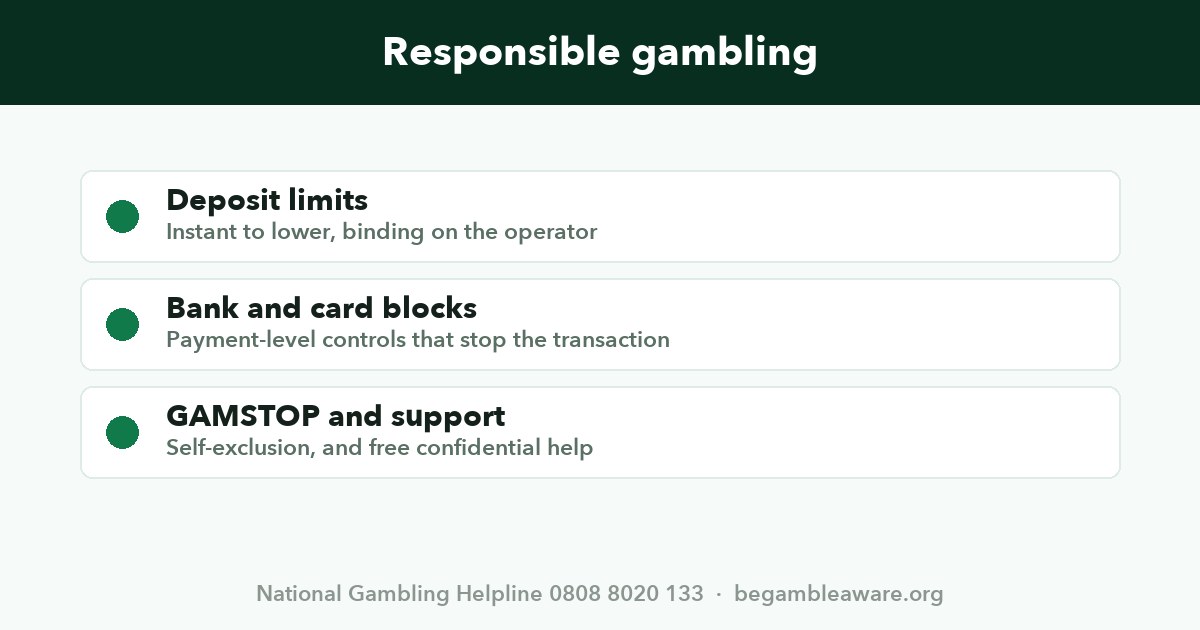
Every guide on this site is about paying money into casinos, so let’s be equally direct about the other side of the ledger: gambling can do real damage when it stops being entertainment. This page gathers the practical protections available to UK players — including several that live inside your bank account rather than the casino — and the free services that help when limits aren’t enough.
Decide the Number Before the Deposit
The single most effective habit is boring: pick an affordable monthly figure before you open the cashier, and treat it the way you treat any other entertainment budget. Winnings are a bonus, never an income; losses chased are almost always losses doubled; and gambling to escape stress, debt or boredom is the clearest warning sign there is. No slot, table or strategy changes the mathematics — the house edge is the price of the entertainment.
Protections Built Into Your Payment Method
Because this is a payments site, we’d point out something many players never discover: some of the strongest gambling controls are offered by banks, not casinos. Most major UK banks and app-based banks — including Monzo, Starling, Barclays, Lloyds, NatWest and HSBC — offer a gambling block that declines gambling transactions on your card, usually with a cooling-off period of 48 hours or more before it can be lifted. Since April 2020 it has also been illegal for GB-licensed operators to accept credit cards at all, and prepaid options such as Paysafecard let you ring-fence a fixed amount in cash before you ever go online. Used together, these put a hard ceiling on spending that no late-night impulse can move.
Tools Every Licensed Casino Must Give You
Operators licensed by the Gambling Commission are required to offer deposit limits (daily, weekly or monthly), time-outs from 24 hours up to six weeks, reality-check reminders while you play, and full self-exclusion for a minimum of six months. They all live in your account settings, they are free, and support teams are obliged to apply them when asked. Setting a deposit limit on the day you register — before any winning or losing streak exists — is the version of this that actually works.
One Request That Covers Every Site: GAMSTOP
GAMSTOP (gamstop.co.uk) is the national self-exclusion scheme. Register once, free, and every operator licensed in Great Britain must block your accounts and registrations for the period you choose — one year, five years, or until you ask for it to be lifted after the minimum term. Pairing GAMSTOP with a bank gambling block closes the two doors that matter: the account and the money.
Free, Confidential Help
The National Gambling Helpline on 0808 8020 133 is free, confidential and open 24 hours a day, run by GamCare, which also offers online chat and structured support. GambleAware (begambleaware.org) signposts every form of help available, and the NHS runs specialist gambling clinics accepting self-referrals. Nobody at any of these services will judge you, and none of them cost anything.
Worried About Someone Else?
Gambling harm rarely stays with one person. If a partner’s or friend’s gambling is affecting you, GamCare’s helpline supports affected others too, and GamAnon (gamanon.org.uk) runs groups specifically for family members. Unexplained money movements, secrecy around a phone, and borrowing that doesn’t add up are the common early signs — raising it calmly, with the helpline number to hand, does more good than an ultimatum.
18+ only. Gambling should never be treated as a way to make money. If it has stopped being fun, stop — the help above is free and it works.