Starling took the opposite route to its flashier rivals: licence first, hype later. The result is a bank whose card behaves impeccably at any UK casino cashier — ordinary Debit Mastercard, universal acceptance — and whose gambling block helped set the pattern British banking now treats as standard: armed in a tap, disarmed only after a deliberate 48-hour pause that no phone call can shorten.
For the card rules shared by every bank, start with our broader UK debit-card casino guide; this page focuses on Starling’s gambling controls and 48-hour cool-off.
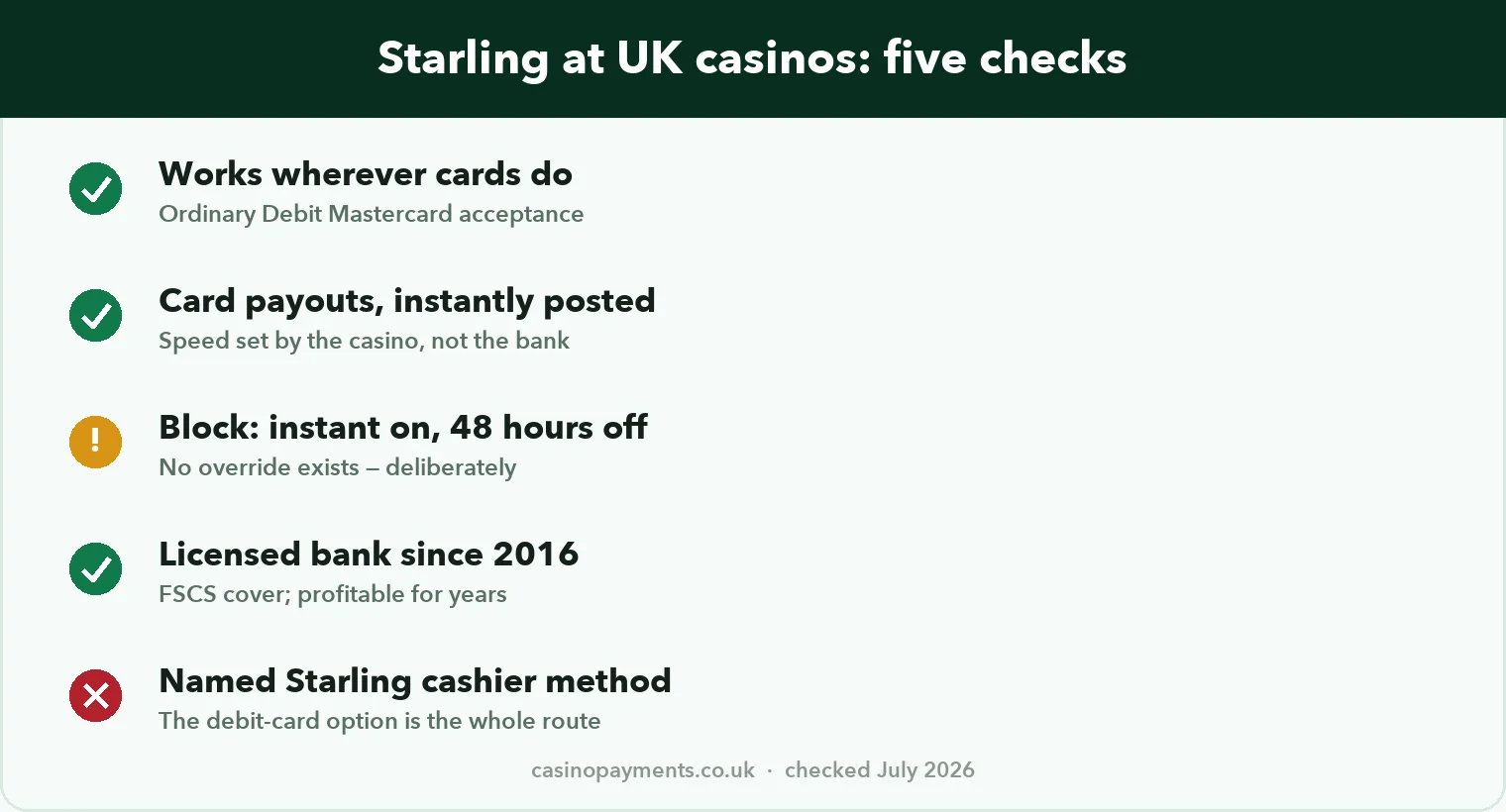
Casinos that accept Starling are simply casinos that accept Mastercard, which is very nearly all of them.
Casinos with Starling Payments
| Starling at a Glance | |
|---|---|
| At UK cashiers | Universal — deposits as an ordinary Debit Mastercard |
| Gambling block | Instant to enable; 48-hour cool-off to disable, no overrides |
| Bank credentials | UK banking licence since 2016; consistently profitable |
| Protection | FSCS on deposits, standard for an authorised bank |
| Design philosophy | The block cannot be rushed off by support, app reinstall or persuasion |
Facts checked 10 July 2026; the table gives the sixty-second version.
| Player question | Straight answer |
|---|---|
| Starling at UK casinos — possible? | Entirely — its Debit Mastercard deposits anywhere cards are taken |
| Named in cashiers? | Never; it rides the generic debit-card option |
| Winnings back to Starling? | Yes — card withdrawals post on arrival, fast where casinos push-pay |
| Gambling controls? | A toggle under card controls: on instantly, off only after 48 hours |
| Deposit safety? | Licensed UK bank since 2016; FSCS cover applies |
Facts verified 10 July 2026 · 18+ · UKGC-licensed sites only · begambleaware.org
Starling at UK Casinos: Quick Facts
| Type | Licensed UK app bank; casino use runs through its Debit Mastercard |
|---|---|
| Founded | 2014, by Anne Boden — the first of the app banks to reach a full licence |
| Licence | UK banking authorisation held since 2016 |
| FSCS | Yes — standard bank deposit protection |
| Cashier route | The debit-card option; no named Starling method exists anywhere |
| Payout return | To the same card; arrival speed set by the operator’s rails |
| Gambling control | Merchant-level block in card controls |
| Disabling it | 48-hour delay, enforced without exception since March 2020 |
| Fees for players | None on sterling card deposits; Mastercard rate abroad, no markup |
Instant On, 48 Hours Off: The Starling Design
Starling’s gambling block predates most of the industry’s, but its defining moment came in March 2020, when the bank added the 48-hour reactivation delay — and, unusually, published its reasoning. Impulse and urge, the bank argued, are short-lived states; a control that can be flicked off in the moment of temptation protects nobody. So the asymmetry became the feature: protection starts the second you toggle it, and stops only two days after you ask.
The implementation details reward attention. The block lives under card and currency controls and works on gambling merchant categories — the same MCC mechanism as every bank block, meaning honest coverage at every UKGC-licensed cashier. The delay is absolute by design: no customer-service override, no branch (there are none), no shortcut via deleting and reinstalling the app. Starling support will talk to you about the block, and about help if you need it — what they won’t do is hurry it, because the entire point is that nobody can.
One nuance for shared finances: on joint accounts the block applies at account level, so either holder arming it covers both cards — a detail that has settled more than one household negotiation, in both directions.
Starling vs Monzo vs Revolut: The Control Room View
All three deposit identically at a cashier. The distinctions are institutional.
| Starling | Monzo | Revolut | |
|---|---|---|---|
| Licence vintage | 2016 — earliest | 2017 | 2026 |
| Block off-switch | 48h, fully automated | Support chat, then 48h | 48h, fully automated |
| Published rationale | Yes — unusually open about the psychology | Partially | Minimal |
| Profitability record | The long-standing leader | Recent | Recent |
| Casino behaviour | No practical difference — all ordinary debit cards | ||
Companion pages: Monzo and Revolut. Choosing between them for casino purposes alone is choosing between identical cards; choose for the banking, and let the block philosophy break ties — Monzo if you want a human in the loop, Starling or Revolut if you prefer the machine to hold the line.
How Starling Casino Payments Work
Deposit flow
- At the cashier, choose card payment — Starling requires nothing special.
- Type the card or tap through Apple Pay / Google Pay; both routes carry the same protections and the same block coverage.
- Watch the instant notification land — Starling’s feed timestamps every deposit to the second.
- Set the deposit limit prompt honestly on first use of any site; future-you benefits.
Withdrawal flow
- Winnings return to the card under the standard closed-loop rule.
- Push-payment operators (Mastercard Send) deliver in hours; Starling posts credits immediately on receipt.
- Slower casinos mean slower arrivals — one to three working days on legacy processing, whoever you bank with.
App features that earn their keep
Spaces work as stake-separation: money parked in a Space is out of the card’s reach until deliberately moved, making a weekly gambling budget a physical action rather than a mental note. Spending insights file gambling under its own heading, giving the month a number. Neither is marketed as a gambling tool; both function as one.
Licence & Cover: The Boring Excellence
Starling’s security story is the least dramatic on this site, which is the compliment: a full UK banking licence since 2016, consistent profitability while rivals burned funding rounds, FSCS protection on eligible deposits (the £120,000 limit era began December 2025), PRA capital supervision, FCA conduct rules. There has never been an asterisk to explain.
Card-side, the toolkit matches the app-bank standard: instant freeze, per-category merchant controls (gambling among them), online-payment locks, ATM limits, real-time alerts. The habitual reminder applies with full force anyway: bank-grade protection covers money in the bank. On a casino’s ledger, your balance answers to the operator’s UKGC funds-protection tier, a promise measured in “basic/medium/high” rather than statute. The disciplined loop — deposit what the session needs, withdraw what it returns — keeps your money under FSCS for all but the minutes that matter.
From Licence-First Startup to Quiet Fixture
- 2014 — Anne Boden, ex-Allied Irish Banks COO, founds Starling on the unfashionable thesis that the licence comes first.
- 2016 — Banking licence granted — ahead of every app-bank rival.
- 2017 — Current accounts launch; the Mastercard debit card ships.
- 2018 — Gambling block arrives among its earliest card controls.
- 2020 — March: the 48-hour reactivation delay is added, with published reasoning — the moment that fixed the industry pattern.
- 2021–2023 — Profitability, business-banking scale, and a reputation as the grown-up of the cohort.
- 2024–2025 — Leadership transitions; the Which? Recommended Provider badge (November 2025) joins the homepage.
- 2026 — Steady state: fewer headlines than the rivals, fewer caveats too.
The 2020 entry is this page’s hinge: Starling didn’t invent the bank gambling block, but its published, psychology-grounded defence of the delay gave every bank permission to make protection deliberately inconvenient to remove.
Starling Outside the UK
Starling serves UK residents, so there’s no map of foreign Starling markets to draw — but the card travels well, converting at Mastercard’s wholesale rate with no Starling surcharge, which historically made it a travel-money favourite. At licensed casinos abroad it behaves as any Mastercard debit: accepted where cards are, subject to the local regulator’s rules rather than the UKGC’s. The gambling block, built on international merchant codes, remains active wherever the card goes — a Nevada cashier and a Gibraltar site trigger it as reliably as a British one. The caution that closes every jurisdiction section on this site closes this one: acceptance abroad is not protection abroad. A UK player depositing at an unlicensed offshore site with any card — Starling included — steps outside GAMSTOP, outside the ombudsman routes, outside the funds-protection rules. The card can’t protect you from the operator; only the licence does that.
Where Starling Helps Outside the Cashier
Starling’s wider significance is institutional rather than consumer-flashy: it proved an app bank could be boring in the ways that matter — licensed early, profitable soon, scandal-light throughout — and its Banking-as-a-Service arm (Engine) now sells that competence to other banks internationally. Its founder story remains one of British fintech’s best: a fifty-something banking insider out-executing a generation of hoodie-clad disruptors on the exact fundamentals they dismissed. The gambling-relevant footnote is the March 2020 delay decision discussed above, which travelled far beyond Starling: the published logic — protection should be easy to add and effortful to remove — is now embedded in how UK banking, and increasingly regulation, thinks about every impulse-adjacent product. Not bad for a settings toggle.
Starling & Safer Gambling
Starling’s block is a strong foundation stone: comprehensive at licensed cashiers, armed instantly, and shielded from your own worst moment by two days of enforced patience. Build on it rather than around it. GAMSTOP excludes the person across every UKGC operator at once; cashier deposit limits bound the damage any single site can do; the full toolkit is laid out in our responsible gambling hub. The block’s honest gaps are the category’s: cash, other accounts, and offshore merchants coding themselves dishonestly. If the monthly gambling figure in Starling’s insights has become a source of dread rather than data, that’s signal enough — the National Gambling Helpline (0808 8020 133) is free, confidential and staffed day and night. Nobody there will suggest the answer is a better bank setting; sometimes it is a conversation, and they are good at exactly that one. 18+.
What Starling Customers Report About Gambling Blocks
Starling threads are the quietest of the app-bank trio, in keeping with the brand. The payments record is clean to the point of dull: deposits succeed, card payouts post the moment casinos release them, notifications arrive before the cashier’s own confirmation screen finishes loading. The block generates the most discussion, in two familiar flavours — gratitude from players who armed it in a clear-headed moment and later collided with it in a weaker one, and frustration from players mid-48-hours discovering the delay genuinely has no exceptions. A recurring micro-genre worth noting: joint-account couples discovering the block covers both cards, usually posted by whichever partner didn’t arm it. And a pattern conspicuous by absence: the freeze-and-fee horror stories that follow some payment providers around simply don’t attach to Starling — a decade of licence-first operation buying exactly the reputation it was meant to.
Smart Pairings for Starling Users
The card needs no substitute; these choices sit well beside it:
- Open banking — deposit approval happens inside the Starling app, no card number leaves home, and Faster Payments returns often beat the card route. The natural upgrade for app-first players.
- Google Pay / Apple Pay — tokenised versions of the same card for cashiers you’d rather not hand raw details.
- Neosurf or paysafecard — the cash-voucher lane, for anyone running the block full-time who still wants a strictly-bounded flutter without touching bank rails at all.
The anti-pattern to skip: a backup account at another bank specifically to sidestep the 48-hour wait. The delay working as intended is not a problem to solve — it’s the product doing its job, and the urge to defeat it is worth more attention than the workaround.
Anatomy of a Payout to Starling, Hour by Hour
Withdrawal anxiety is mostly not knowing which stage the money is at, so here is the full journey of a £120 casino payout to a Starling card, timestamped. Hour zero: you request the withdrawal. It enters the operator’s approval queue — the only genuinely variable stage of the whole journey, ranging from minutes at automated fast-payout brands to a day or more where humans review. Nothing Starling-related has happened yet; nothing can hurry this stage except having verified your account before winning rather than after.
Approval moment: the casino releases the payment. On a push-payment integration (Mastercard Send, since Starling issues Mastercard debit), the transaction clears the network in seconds; on a legacy refund rail it enters a batch instead, and the rest of this timeline stretches into days through no fault of either end.
Minutes one to sixty: the push arrives at Starling, which posts incoming card credits immediately, around the clock — the notification frequently lands before the casino’s confirmation email does. The money is spendable the moment it appears; there is no clearing hold on push credits, because clearing happened in flight.
The honest summary of the timeline: Starling’s segment of a withdrawal takes seconds and never varies; the casino’s segment takes anywhere from minutes to days and varies enormously. Players who choose operators advertising hour-class card payouts — and clear verification on day one — experience the whole journey as a single push notification. Players who blame their bank for a three-day wait are, statistics suggest, at a refund-rail casino discovering its priorities.
Spaces, Insights & the Architecture of a Calm Bankroll
Starling’s organisational features deserve their own section because, used together, they amount to a bankroll discipline system most players assemble from willpower and regret instead. The building block is the Space: a named sub-balance whose money sits outside the card’s reach until deliberately moved back. A player who funds a “play” Space on payday — and only ever deposits at casinos after transferring from it — has converted an impulse into a procedure. The transfer step takes four seconds and changes everything about it psychologically: it is a decision made twice, once when the budget was set and once when it’s spent, and the second decision happens while looking at exactly how much of the month’s allowance remains.
Spending Insights closes the accounting loop. Gambling is a category like any other in Starling’s breakdown, which means the month has a number, the number has a trend, and the trend is on the same screen as groceries and rent — context that flatters no one and informs everyone. Bills Manager and scheduled payments keep the obligations ring-fenced before entertainment money declares itself; the card’s per-merchant and online-payment toggles add tactical locks where wanted; and all of it operates independently of — and compatibly with — the gambling block itself.
Two honest caveats complete the picture. Joint-account users share the architecture: Spaces and blocks operate at account level, which makes the system a household conversation rather than a private one — usually a feature, occasionally a negotiation. And as with every self-built structure, it holds only while its builder maintains it; the moment maintaining it becomes the struggle, the tools that don’t rely on the builder — the 48-hour block, GAMSTOP, the helpline in the section above — are the ones designed for that moment. Architecture for the calm months, deadbolts for the hard ones: Starling ships both, and knowing which is which is the whole skill.
Our Verdict on Starling for UK Casino Players
Starling is the app-bank equivalent of a well-made tool: nothing to configure, nothing to forgive. At the cashier it’s a universally accepted debit card with instant visibility; behind it stands the longest-licensed, least-dramatic bank of its generation; and its gambling block — instant on, immovably slow off — embodies the best thinking in the category with none of the theatre. If you already bank there, use it and switch the block on should control matter to you at all. Non-customers gain nothing casino-specific by switching — the three app banks tie at the cashier — but anyone choosing between them who values published reasoning over marketing will notice which bank explained its 48 hours and let the idea speak. Quietly, it said everything.
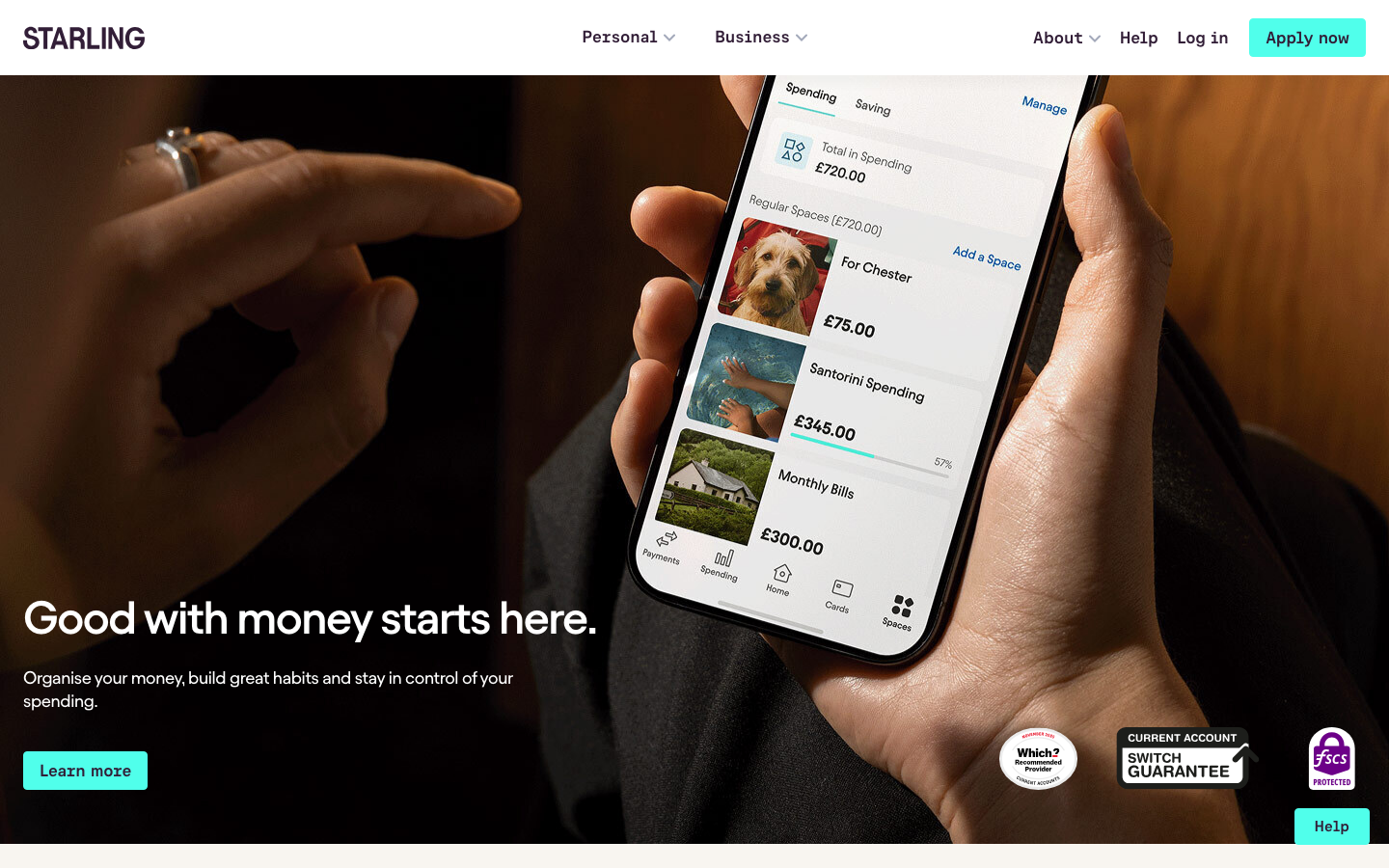
Starling’s own homepage, checked directly this month, leads with “Good with money starts here” and carries both the FSCS protection badge and a Which? Recommended Provider mark dated November 2025 — and its published help pages confirm the gambling block’s defining rule: switching it off takes effect only after a 48-hour delay that neither customer services nor reinstalling the app can bypass.
Starling Casino FAQs
Does Starling work at UK online casinos?
Yes — its Debit Mastercard is accepted at every UKGC cashier that takes card deposits. There is no Starling-specific option; use the standard debit-card route.
How does the Starling gambling block work?
A toggle in card controls declines transactions at gambling-coded merchants. It activates immediately; deactivating it takes effect only after a 48-hour delay.
Can Starling support remove the block faster?
No — the delay has no override by design. Support can discuss it and signpost help, but cannot shorten it, and reinstalling the app changes nothing.
Is money in Starling FSCS-protected?
Yes — Starling has held a full UK banking licence since 2016, so eligible deposits carry standard FSCS cover. Funds sitting on a casino’s books are covered by the operator’s UKGC protection rating instead, which is weaker — withdraw promptly.
How quickly do casino withdrawals reach Starling?
Starling posts card credits on arrival. Operators using Mastercard Send typically deliver within hours of approval; legacy processing takes 1–3 working days. The speed difference belongs to the casino.
Are there fees for using Starling at casinos?
None from Starling on sterling deposits. Abroad, conversions use Mastercard’s rate without a Starling markup — historically one of the cheapest cards to travel with.
Does the block cover Apple Pay and Google Pay deposits?
Yes — wallet payments tokenise the same card, and gambling merchant codes trigger the block identically whichever way the card is presented.
Does the gambling block affect a joint account partner?
Yes — on joint accounts the block applies account-wide, covering both cards regardless of who enabled it.
When did Starling add the 48-hour delay?
March 2020, with published reasoning about impulse psychology — a decision that helped standardise the “instant on, delayed off” pattern across UK banking.
Starling declined my casino deposit — what should I check?
The gambling block first, in card controls. If it’s on and you want it off, the 48-hour clock starts when you toggle it — and it’s worth honestly revisiting why it was on before you do.
Can I ring-fence a gambling budget in a Starling Space?
Yes — money in a Space sits outside the card’s spendable balance until you move it back, which turns each session’s funding into a deliberate transfer rather than a tap. Combined with Spending Insights’ gambling category, it’s a genuinely effective self-managed setup for players who want structure without a full block.
Does using Starling’s gambling tools affect my credit or my account standing?
Not at all — the block, Spaces and Insights are private account features. Arming or lifting the block isn’t reported anywhere, doesn’t appear on credit files, and changes nothing about how Starling treats you as a customer.
Is Starling’s block different for business accounts?
The gambling block exists across Starling’s personal and business cards with the same instant-on design. If you run both account types, check each card’s controls separately — blocking one doesn’t block the other.
Do casino payouts still arrive while Starling’s gambling block is on?
Yes — the block stops outgoing payments to gambling merchants; incoming card credits from a casino post normally. Requesting your balance out while blocked is not just possible but sensible.
Why did Starling publish its reasoning for the 48-hour delay?
Unusually for a bank, it explained the psychology openly in March 2020: urges to lift protections are short-lived states, so a delay outlasting them protects the customer’s calm-moment decision. The transparency helped make the pattern an industry standard.
Does Starling charge for receiving casino winnings?
No — incoming card credits and bank transfers are free, posted immediately whatever the hour, and there is no equivalent of the receiving fees some e-wallets apply. The payout arrives whole or the operator shorted it; the bank never takes a slice.
Sources & Verification
Checked 10 July 2026 against: Starling’s own site (homepage badges captured by screenshot the same day) and its published help pages on blocking gambling payments and the 48-hour reactivation delay; Starling Bank Ltd’s authorisation on the FCA Financial Services Register; the FSCS for deposit-protection scope; and the Gambling Commission’s guidance on gambling-payment blocks.