
 By Will Fencer, Payments Editor · Published · Last updated
Credit cards and UK online casinos parted ways on 14 April 2020, when the Gambling Commission’s ban took effect — and six years on, the search traffic still hasn’t caught up. No UKGC-licensed casino can accept a credit card, no e-wallet may launder one into a deposit, and no workaround survives scrutiny. This page explains the ban properly: what it covers, why it exists, the myths around it, and the debit-and-bank alternatives that made it, for most players, a non-event.
Casinos with Credit Card Payments
| Credit Card Gambling at a Glance | |
|---|---|
| UK status | Banned since 14 April 2020 — all UKGC-licensed operators |
| Scope | All gambling products, including credit-funded e-wallet top-ups |
| Regulator finding | UKGC's own interim evaluation found no evidence of a shift to other borrowed-money gambling |
| Still allowed | Debit cards, e-wallets, bank transfer and open banking, funded from your own money |
| Why it exists | 22% of credit-card gamblers pre-ban were classed as problem gamblers |
Checked 5 July 2026 — though this table hasn’t changed since April 2020 and shows no sign it ever will.
| Question | The legal position |
|---|---|
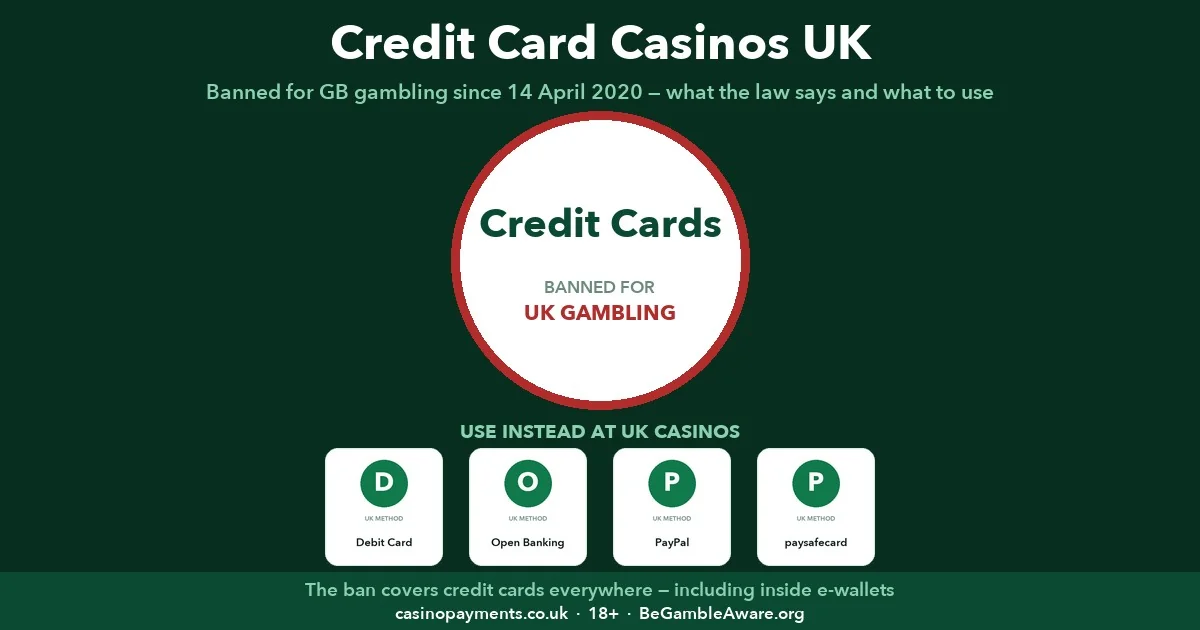
| Can I use a credit card at UK online casinos? | No. Banned by the Gambling Commission since 14 April 2020, across all remote gambling |
| Does any UK casino accept them? | No licensed one — a cashier taking UK credit cards is announcing it holds no UKGC licence |
| What about credit cards via PayPal or Skrill? | Also blocked — wallets must refuse credit-funded gambling for UK customers |
| Is this ever coming back? | No sign of it: the ban was evaluated as successful and is settled policy in 2026 |
| What do players use instead? | Debit cards and open banking — your own money, free, everywhere |
That table is the whole legal story. The rest of this page covers what people actually search for around it: why the ban happened, exactly what it covers, the workaround myths that don't survive contact with reality, what happens in the rare cases a transaction slips through — and the alternatives that make the ban painless for anyone gambling with money they actually have.
Rules verified 5 July 2026 · 18+ · UKGC-licensed operators only · begambleaware.org
The Credit Card Ban: Quick Facts
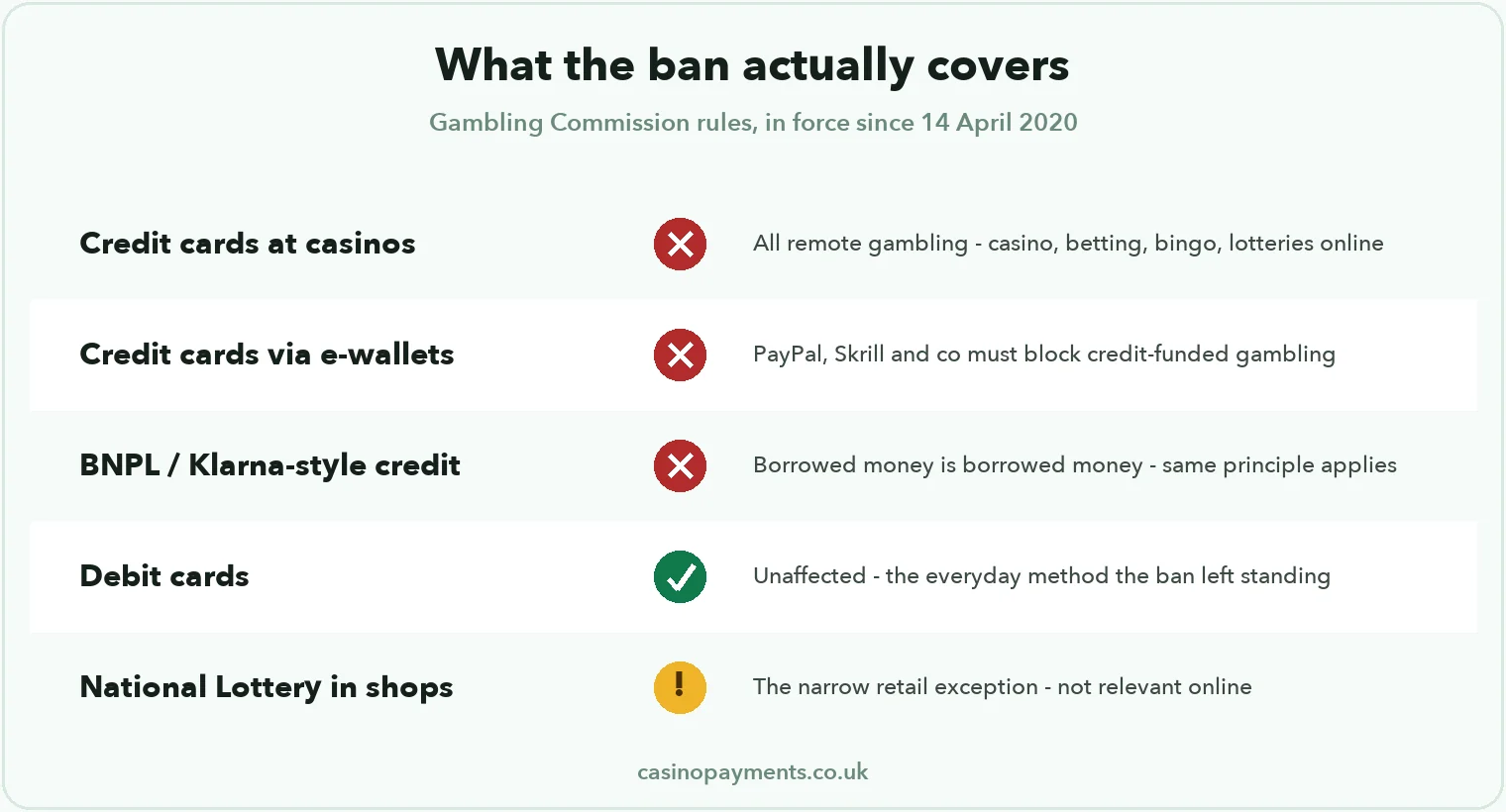
| What’s banned | All credit card gambling with UKGC remote operators — casino, betting, bingo, online lotteries |
|---|---|
| Since when | 14 April 2020, under Gambling Commission LCCP rules |
| Who it binds | Operators and payment providers — players commit no offence, transactions are simply refused |
| The wallet loophole | Closed — PayPal, Skrill and co must block credit-funded gambling for UK customers |
| BNPL / Klarna-style credit | Same principle: borrowed money can’t fund UKGC gambling — see our Klarna page |
| The retail exception | National Lottery tickets bought in shops as part of a wider purchase — irrelevant online |
| Charge cards / Amex | Treated as credit — blocked identically |
| Debit cards | Untouched — the everyday method the ban deliberately left standing |
| Review pending? | None — the 2021 evaluation called it effective; 2026 policy treats it as settled |
The Ban, Properly Explained
The rule itself is Licence Condition 6.1.2 territory: UKGC remote operators must not accept payment by credit card, directly or knowingly via any intermediary. It arrived after the Commission’s 2019 consultation put numbers on what debt charities had long argued — that a substantial share of the millions of Britons gambling on credit were harmed by it, with problem-gambling rates among credit-card gamblers several multiples of the general rate. Gambling with borrowed money at interest, the Commission concluded, is structurally different from spending your own: losses compound into debt, and the friction of seeing money leave is gone.
Three design choices explain how the ban behaves in practice. It binds operators, not players — you break no law by trying; the transaction simply fails, because gambling merchant codes are declined on UK-issued credit cards at the network level. It covers intermediaries, which is why your PayPal deposit fails if the funding source is a credit card even though PayPal itself is welcome in every cashier. And it’s UK-scoped: it protects people, through UK-licensed operators and UK-issued cards — which is why offshore sites still advertising credit deposits to Britons are exhibiting their unlicensed status, not a loophole.
Credit Cards vs the Methods You Can Use
What each banned credit-card virtue maps to in the legal toolkit:
| What credit cards offered | Legal replacement | The honest difference |
|---|---|---|
| Universal cashier acceptance | Debit cards | Identical rails, identical ubiquity — your money instead of borrowed |
| Instant, familiar deposits | Open banking | As fast, no card numbers shared, faster payouts |
| Purchase protection instincts | UKGC licence protections | Section 75 never applied to gambling anyway — the licence is the real shield |
| Spend now, settle later | Nothing — by design | The gap is the policy: gambling on next month’s money is the harm itself |
| Rewards / points on deposits | Nothing | Issuers had already gutted gambling rewards pre-ban |
The table’s lesson is that the ban removed almost nothing of practical value: everything convenient about credit cards exists in debit, and the one genuinely missing feature — gambling with money you don’t have yet — is missing on purpose.
What Actually Happens If You Try
Mechanics for the curious, because the failure modes are tidier than people expect:
- At the cashier: enter a UK credit card and the transaction declines — usually instantly, at the card-network level, via the gambling merchant category codes issuers must refuse. Some cashiers detect the card type and refuse the attempt before it reaches the network.
- Via a wallet: PayPal, Skrill and the rest check the funding source; a credit-funded gambling payment fails or the credit option is simply absent from the funding choices when the merchant is a casino.
- Via BNPL or cash advances: BNPL providers prohibit gambling merchants outright; a credit-card cash advance into a bank account technically converts borrowed money into balance, at punishing advance fees and immediate interest — the most expensive possible way to do the thing the ban exists to stop you doing.
- The rare slip-through: misclassified transactions occasionally clear. The operator, on discovering it, is obliged to act — typically refunding the deposit and voiding play. Slipped-through transactions create compliance incidents, not precedents.
The system’s completeness is the point: this is what a regulation looks like when the payments industry builds it into the rails rather than policing it after the fact.
The Real Subject: Gambling and Borrowed Money
Strip the card branding away and the ban is about one question: should gambling losses be able to become consumer debt? The pre-2020 evidence said they routinely did — balances carried at typical credit-card APRs, minimum payments stretching losses across years, and the well-documented psychology that spending unfelt money loosens every limit. Debt charities’ casework and the Commission’s own data pointed the same direction, and no serious voice has since argued the old arrangement was fine.
The same logic keeps every borrowed-money route closed: BNPL instalments, cash advances, overdraft-funded deposits (legal, but the next policy conversation), and loans taken to gamble. A useful self-check this site repeats wherever it fits: if a deposit needs borrowing to exist, the affordable answer was already no — and if gambling is creating debt anywhere in your life, that’s the signal to use the tools in the safer gambling section rather than a workaround. StepChange (stepchange.org) and National Debtline offer free debt advice with no judgment attached; gambling debt is territory they know thoroughly.
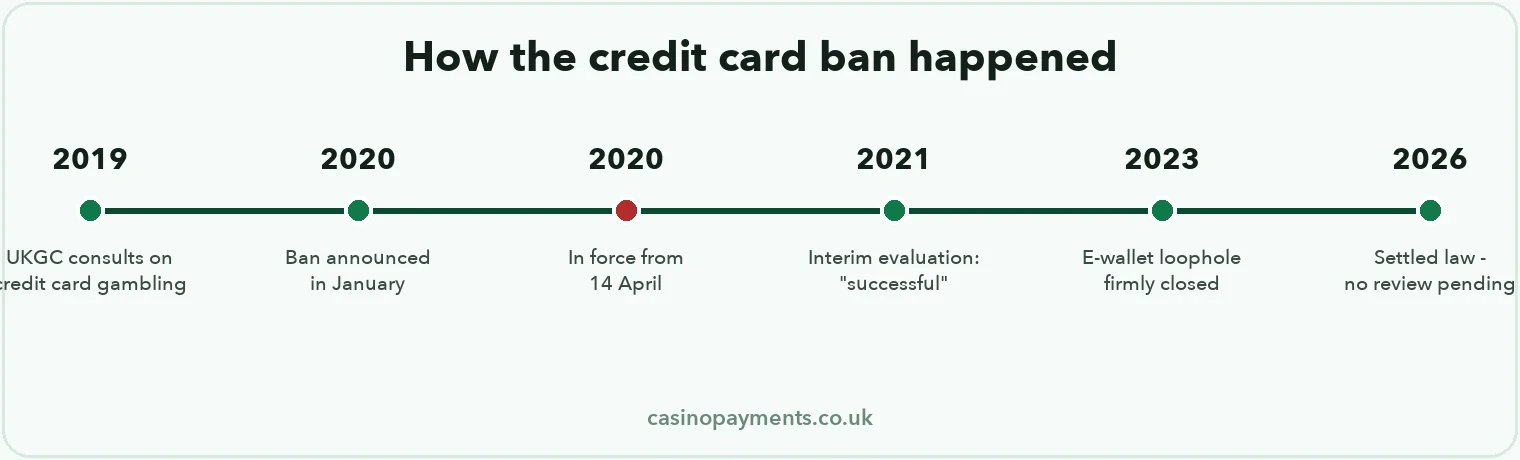
How the Ban Happened
The credit ban is recent enough to remember and old enough to have a settled history.
- 2015–2018 — Credit cards are ordinary cashier furniture; banks begin unilaterally blocking gambling on their own credit products as harm data accumulates.
- 2019 — The Commission consults, armed with research on the overlap between credit-card gambling and problem gambling.
- 2020 — January: the ban is announced with a three-month implementation runway.
- 2020 — 14 April: in force — landing mid-lockdown, as online gambling surged, which most observers now read as fortunate timing.
- 2021 — The interim evaluation: most former credit-card gamblers switched to their own money or gambled less; feared displacement to worse borrowing largely failed to materialise.
- 2023 — The wallet route is firmly shut as intermediary compliance matures; the white paper era leaves the ban untouched as settled ground.
- 2026 — Six years in: no review pending, no serious repeal lobby, and a generation of new players who’ve never seen a credit option in a cashier.
As UK gambling regulation goes, it’s the rare intervention with a clean narrative: identified harm, targeted rule, measured success, closed loopholes, done.
Credit Card Gambling Rules Around the World
Britain’s ban sits in a widening international column. Ireland banned credit-card gambling in 2024 under its new regulator; Norway and Finland’s state-monopoly systems block credit similarly; Australia extended its long-standing online-wagering credit ban in 2024, with real penalties attached; several European licensed markets restrict credit through deposit-limit and affordability regimes rather than outright bans. The United States remains the notable permissive outlier — credit-card gambling is legal in many regulated states, though issuer-level blocks make it patchy in practice. The pattern across a decade is one-directional: jurisdictions keep joining the restriction column and none has left it, which is the strongest available evidence for how the UK’s own settled policy will age. For British players the practical footnote is familiar: offshore sites advertising credit deposits to UK customers are exactly the unlicensed operators every page of this site warns about — the credit offer is the tell.
Credit Cards Beyond the Cashier
None of this page is a verdict on credit cards generally — used well, they remain arguably the best consumer-payments product Britain has: Section 75 protection on purchases over £100, interest-free periods, fraud liability sitting with the issuer, credit-history building. The ban carved out one use where the product’s core feature — spending before settling — collides with an activity where that timing does measurable damage. It’s worth noting the industry hasn’t suffered for it: issuers were restricting gambling before the Commission moved, having concluded the segment generated disproportionate arrears and complaints. The tidy summary: credit belongs where borrowed money buys something of lasting value, and the 2020 rule simply wrote into regulation what responsible lending analysis had already decided. Keep the card for the flights and the fridge; the cashier runs better on your own money anyway.
Safer Gambling: What the Ban Does and Doesn’t Do
The ban removed the single most harmful funding route, but it polices only one border of affordability — several borrowed-money paths remain technically open and personally yours to close. Overdraft-funded deposits still work at most banks; money borrowed informally or via loans is invisible to any cashier. The tools that close them: bank gambling blocks (nearly every major UK bank offers a card-level toggle, many with cooling-off periods before it can be lifted), deposit limits at every UKGC operator under the 2026 standardised regime, and GAMSTOP‘s single registration across all licensed sites.
If this page found you because credit was funding your play, take the sequence seriously — in order:
- Switch the gambling block on at your bank and card issuer today; the cooling-off period is the feature, not the bug.
- Register with GAMSTOP if exclusion is the right tool — one form, every licensed site.
- Talk to StepChange or National Debtline about the balance itself; gambling debt is territory they know thoroughly.
Beyond that sequence: the gambling side is GAMSTOP and our responsible gambling hub; the debt side is StepChange or National Debtline, free and expert; and the human side is the National Gambling Helpline on 0808 8020 133 — free, confidential, open around the clock. The ban’s deepest logic is worth internalising as personal policy: gambling money should only ever be money that could vanish without consequence. 18+.
What Players Said — Then and Now
The 2020 forum record is a period piece worth revisiting: predictions of mass VPN exodus, offshore flight and wallet workarounds dominated the announcement threads. Six years on, the record shows how little of it happened — the evaluation found most players simply moved to debit, the wallet loophole closed before it mattered, and the offshore trickle stayed a trickle populated mainly by the cautionary tales that fill this site’s warning boxes: confiscated winnings, no ombudsman, no recourse.
The revealing genre is the retrospective one. Threads from former credit-card gamblers writing years later skew strikingly positive about the ban — “best thing that happened to my gambling” appears in near-identical wording across unconnected posters describing the moment losses stopped compounding at interest. The grumbles that persist are practical and small: players abroad confused when a foreign-issued card works at a foreign-licensed site but not at home, and the occasional charge-card holder surprised that Amex counts as credit. As natural policy experiments go, few generate this clean a before-and-after in their own words.
The Alternatives, By What You Actually Wanted
Every legitimate reason someone reaches for a credit card at a cashier has a legal answer:
- You wanted universal acceptance and familiarity — Debit cards: the same networks, the same tap-and-3DS flow, in literally every UKGC cashier.
- You wanted speed with better payout behaviour — Open banking: account-to-account deposits and Faster Payments withdrawals, free, no card numbers anywhere.
- You wanted a buffer between bank and casino — PayPal or Jeton: wallet privacy and consolidation, funded by your own money.
- You wanted a spending ceiling — paysafecard or a loaded prepaid card: hard limits credit never offered.
- You wanted to gamble on money you don’t have yet — nothing replaces this, and the six years of evidence above are the reason why.
Persistent Myths About the Credit Card Ban
Six years should have killed these; search results say otherwise. The four that keep resurfacing:
“The ban was temporary / is being reviewed.” No review is pending, none is signalled, and the white-paper era — the natural moment to revisit it — left it deliberately untouched. The 2021 evaluation’s positive findings settled the question in policy terms. Pages hedging that the ban “may change” are padding, not reporting.
“Premium cards and charge cards are exempt.” Nothing about a card’s annual fee changes its funding type: charge cards, premium credit products and store cards are all credit, all blocked identically at the merchant-code level. The only card family in a UKGC cashier is debit, prepaid included.
“You can still do it through PayPal if you set it up right.” The intermediary rule closed this properly years ago: UK wallets must block credit-funded gambling, and the funding-source check happens per transaction, not per account setup. There is no configuration in which a credit card lawfully funds a UK deposit through any wallet.
“Cashback and points made gambling on credit worthwhile anyway.” A nostalgia myth: issuers had classified gambling as a cash-like transaction long before 2020 — excluded from rewards, often fee-bearing, interest from day one at cash-advance rates. The romanticised pre-ban deal never existed; the ban removed something that was already a bad product.
The common thread is wishful memory — and each myth conveniently ends where an unlicensed operator’s advert begins. The rules are duller than the myths: your own money, from a debit card or bank account, at a licensed site. Dull is what working consumer protection looks like.
What the Evaluation Actually Measured
“The ban worked” is this page’s spine, so the claim deserves its evidence unpacked. The Commission’s post-implementation evaluation tracked three questions, and it’s worth knowing what each found — and what it didn’t claim.
Did credit-card gamblers stop gambling on credit? Substantially yes: the dominant observed shift was to debit cards and own-money methods, not to exotic borrowing. The feared displacement — overdrafts, payday loans, unlicensed sites — appeared only at the margins the evaluation could detect, far below the levels opponents predicted.
Did financially vulnerable gamblers benefit? The evaluation’s most cited finding: engaged, at-risk gamblers reported the friction of the switch as a spending brake, with self-reported reductions concentrated exactly where the harm data said they should be. The mechanism — making losses spend like money rather than like numbers — behaved as the consultation theorised.
What did it cost recreational players? The honest answer the evaluation recorded: mild inconvenience, briefly. The switch to debit was near-frictionless for the majority, which is why the “punishing the many for the few” argument — the strongest pre-ban objection — faded from the record rather than being rebutted.
What the evaluation did not claim matters too: it didn’t declare problem gambling solved, didn’t measure long-horizon effects, and explicitly framed itself as interim. The scholarly caution is the credibility: a measured intervention, measuredly assessed, still standing six years later because nothing in the data has argued for unwinding it. That’s the full evidential picture behind this page’s confidence — and behind every jurisdiction that has copied the policy since.
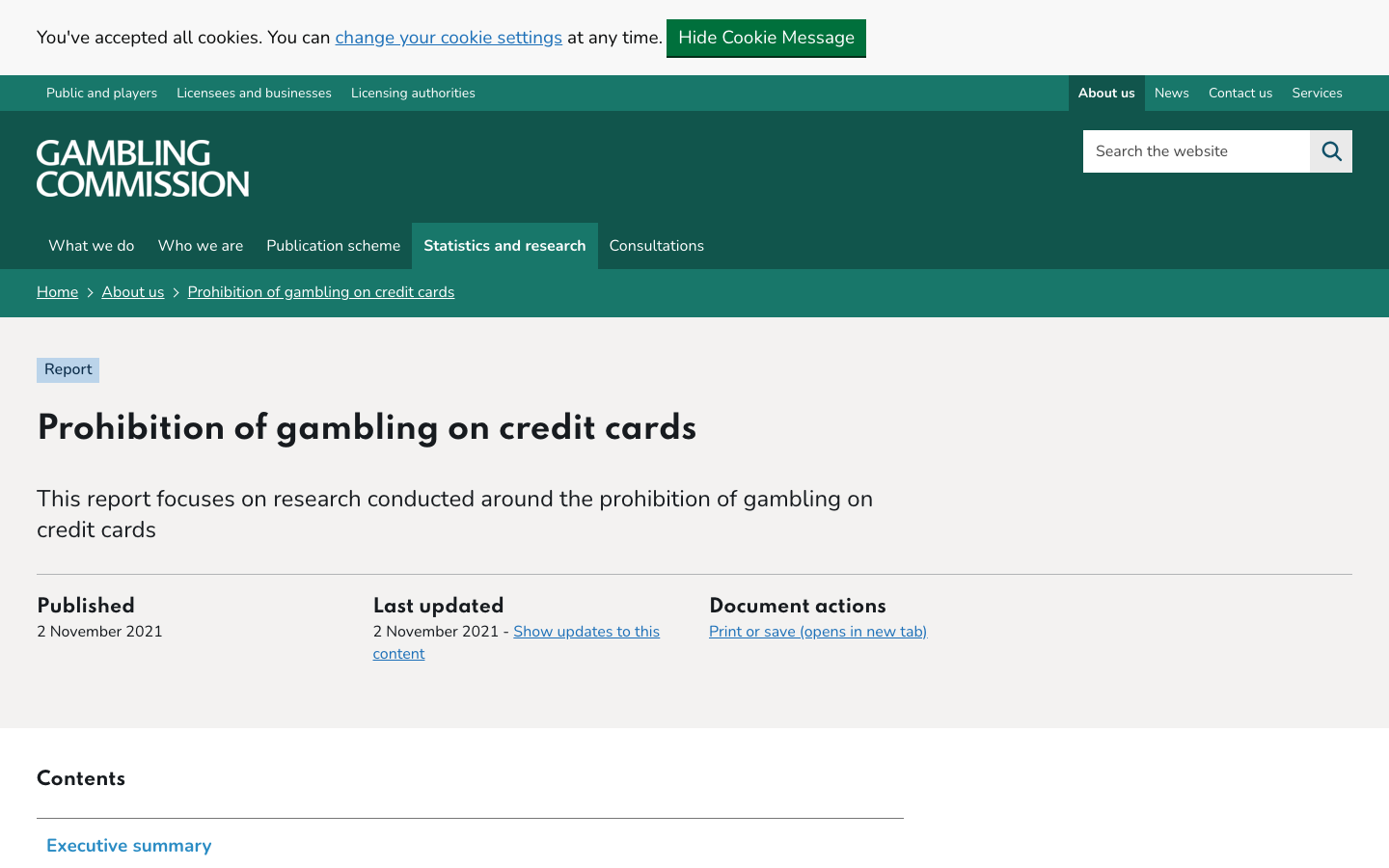
The Gambling Commission’s own interim evaluation, published 2 November 2021 and re-checked directly on gamblingcommission.gov.uk this month, reports the ban’s effect plainly: no observed spike in money transfers or ATM withdrawals from credit cards in the three months after the ban, no increase in reports of illegal money lending tied to gambling, and far more former credit-card gamblers now betting with available funds than with any other form of borrowed money.
The Verdict on Credit Cards at UK Casinos
There’s no score to give a method the law removed — but there is a verdict on the removal, and six years of evidence make it straightforward: the ban did what it set out to do. The harm it targeted was real and measured; the displacement it risked mostly didn’t happen; the loopholes it left got closed; and the alternatives waiting underneath — debit for ubiquity, open banking for speed — were always better fits for gambling’s only sustainable funding rule: your own money, in amounts that could vanish without consequence. If a cashier ever shows you a credit option with a UK address on your account, you’ve found an unlicensed operator, not an exception. And if the search that brought you here was really about credit funding play that’s stopped feeling like play — the safer gambling section above was written for exactly that search.
Credit Card Casino FAQs
Can I gamble with a credit card in the UK?
Not at licensed operators — the Gambling Commission banned credit card gambling across all remote UKGC sites on 14 April 2020, and card networks decline gambling merchant codes on UK credit cards. Only unlicensed offshore sites still offer it, with none of the UK protections.
Is it illegal for ME to try using a credit card at a casino?
No — the ban binds operators and payment providers, not players. You commit no offence; the transaction simply fails. Repeated slip-through attempts can trigger operator compliance reviews, but the legal duty sits entirely on the industry side.
Can I fund PayPal or Skrill with a credit card and then deposit?
No — the intermediary rule requires wallets to block credit-funded gambling for UK customers. The credit funding option either fails or never appears when the merchant is a gambling operator. The loophole was anticipated and closed.
Why were credit cards banned for gambling?
Commission research found problem-gambling rates among credit-card gamblers running at several times the general rate, with losses compounding into interest-bearing debt. Gambling with borrowed money proved structurally more harmful than spending your own, so the funding route was removed.
Does the ban cover Klarna and buy-now-pay-later?
In effect, yes — BNPL is credit, and providers themselves prohibit gambling merchants. No UKGC cashier offers any instalment or pay-later option. Our Klarna page covers that corner of the rules in full.
Are debit cards still allowed at UK casinos?
Completely — the ban deliberately left debit untouched, and it remains the UK’s most-used casino payment method: same networks and checkout flow as credit, spending your own balance. Our debit card guide covers it end to end.
What is the National Lottery exception?
A narrow retail carve-out: lottery tickets bought in shops as part of a wider purchase can still go on a credit card, because separating them at the till was impractical. It has no online equivalent — every remote gambling transaction is covered by the ban.
Do Amex or charge cards work at casinos?
No — charge cards are credit for the ban’s purposes and are blocked identically. The only card family in UKGC cashiers is debit (including prepaid products, which spend loaded funds rather than borrowed ones).
Will the credit card ban be reversed?
Nothing points that way: the 2021 evaluation judged it effective, the white paper era left it untouched, other countries keep adopting similar bans, and no meaningful repeal lobby exists. Treat it as permanent.
An offshore casino says UK players can deposit by credit card — should I?
No. The offer itself proves the site holds no UK licence, which means no GAMSTOP, no dispute rights, no fund protection, and winnings that can vanish without recourse. The credit option isn’t a loophole — it’s a warning label.
Can I use an overdraft to gamble instead?
Technically most banks permit it, which makes overdrafts the ban’s most-discussed remaining gap — but it’s still borrowed money at interest, carrying exactly the risk profile the ban targets. Several banks now block gambling transactions when an account is overdrawn; treat wanting the workaround as the warning.
Do prepaid cards count as credit cards?
No — a prepaid balance is your own money loaded in advance, so prepaid products remained legal through the ban and still work at UK cashiers today. Our prepaid card guide covers which products handle casino payouts properly.
What about using a credit card at a casino abroad?
Outside UKGC jurisdiction, local rules apply — a foreign-licensed casino in a permissive market may lawfully accept a credit card at its own tables. The UK ban travels with the operator’s licence, not with your passport; online from Britain, licensed sites remain credit-free.
Changelog: 9 July 2026 — added an at-a-glance box, the Gambling Commission's own evaluation findings, and a screenshot of its official report page; corrected the evaluation-report link.
Sources & Verification
Primary sources checked 5 July 2026: the Gambling Commission’s credit card licence condition and its published interim evaluation of the ban (re-verified 9 July 2026); the 2019 consultation record; UK Finance materials on gambling merchant-code handling; StepChange guidance on gambling and debt for the borrowed-money sections.
Will covered the ban as it landed in April 2020 and has re-read its evaluation evidence more times than he'd admit — this page is the write-up he wishes had existed when the announcement threads were predicting the sky would fall. More about Will →