Trustly moves money for some of the biggest names in world gambling, yet most British players who’ve used it never noticed. That’s the product working: a bank-to-bank rail that lives inside cashier buttons marked ‘Pay by Bank’, authenticating through your own banking app and returning winnings on Faster Payments. Here’s what the Swedish pioneer actually does in UK casinos, and when to pick its lane deliberately.
For a comparison of providers and the payment category as a whole, start with our open-banking casino guide; this page focuses on Trustly’s own flow, coverage and withdrawal support.
Casinos that accept Trustly usually badge it as Pay by Bank, so a list beats hunting for the logo in a cashier.
Casinos with Trustly Payments
| Trustly at a Glance | |
|---|---|
| Role in UK cashiers | The processor behind many "Pay by Bank" / instant bank transfer buttons |
| Deposits | Bank-app authenticated, instant, no card numbers involved |
| Withdrawals | Bank-to-bank via Faster Payments — often the fastest exit |
| Player cost | Free — merchants carry the fees |
| Pedigree | Founded 2008 in Sweden; invented the Pay N Play model UK rules adapt |
Verified 10 July 2026. The table settles the identity question; the page explains the machinery.
| What players wonder | How it actually stands |
|---|---|
| Can UK players deposit with Trustly? | Yes — and many already do without knowing. It powers pay-by-bank options inside UKGC cashiers |
| Will I see a Trustly logo? | Sometimes; more often the button says "Pay by Bank" or "Instant Bank Transfer" with Trustly underneath |
| Withdrawals too? | Yes — bank-to-bank payouts on Faster Payments, frequently the quickest route home |
| Is it the Nordic Pay N Play thing? | Same company; the UK version works within British registration and KYC rules |
| Cost to players? | Nothing — operators pay the processing |
Verified 10 July 2026 · 18+ · UKGC-licensed operators only · begambleaware.org
Trustly: Quick Facts
| What it is | Account-to-account payments company — banks talk to banks, cards stay home |
|---|---|
| Founded | 2008, Stockholm |
| Claim to fame | Invented Pay N Play, the deposit-is-registration model that conquered Nordic gambling |
| UK presence | Inside open-banking-era cashiers, usually under generic pay-by-bank labels |
| Named clients | DraftKings headlines a roster spanning gambling, retail and tech |
| Deposit speed | Instant once approved in your banking app |
| Withdrawal speed | Faster Payments timelines — minutes to hours after operator approval |
| Fees to players | None |
| UK regulatory frame | Authorised payment institution operating within FCA open-banking rules |

The Invisible Rail: Why You Rarely See the Name
Trustly’s British paradox is branding. In Sweden and Finland its name is the button — players choose “Trustly” the way Britons choose PayPal. In UK cashiers the same machinery typically wears the operator’s own wording: Pay by Bank, Instant Bank Transfer, sometimes just Bank. Tap it, pick your bank, approve in your banking app — and whether Trustly, or a rival rail like Brite or Volt, carried the transaction is decided by the operator’s integration, not your menu choice.
Why the anonymity? Because Britain’s open-banking standards made bank-to-bank payments a commodity interface: the operator plugs in a provider the way a site picks a hosting company, and the provider competes on conversion rates and payout speed rather than consumer fame. Trustly — with a fifteen-year head start on bank integrations across Europe and serious US scale — competes well, which is why its logo keeps surfacing in cashier small print, settlement emails and the occasional branded button at wallet-friendly operators.
For players the practical takeaway is liberating: you don’t need to hunt for Trustly specifically. Choosing any pay-by-bank option buys the same experience this page describes — and when the small print names Trustly, you now know the pedigree behind it.
Trustly vs Open Banking vs Cards: Untangling the Terms
Players meet three overlapping labels; the table separates them honestly.
| Trustly (the company) | “Open banking” (the framework) | Debit card | |
|---|---|---|---|
| What it names | One provider running bank-payment rails | The UK-regulated system such providers use | A different rail entirely |
| Cashier label | Occasionally its own name | Pay by Bank / Instant Bank Transfer | Debit card |
| Authentication | Your banking app, biometrics and all | Card details + 3DS | |
| Details shared with casino | None — no card or login ever touches the operator | Card number (tokenised at best) | |
| Typical payout arrival | Faster Payments — minutes-to-hours class | Hours where push-enabled; days on legacy rails | |
Our open banking guide covers the framework and its other providers; this page exists because “Trustly casinos” is what players search when they’ve met the name abroad, at a US book, or in the settlement email. Same destination, different signpost.
How a Trustly Payment Actually Runs
Depositing
- Choose the pay-by-bank option (or the Trustly button where branded).
- Select your bank from the list — all the majors and app banks appear.
- Your banking app opens; you approve the exact amount with fingerprint or face.
- The cashier credits instantly — the casino never saw a card number, login or balance, only a confirmation.
Withdrawing
- Request the payout to the same bank account — closed-loop rules apply as everywhere.
- Operator approval remains the real clock, as on every method this site covers.
- Once released, funds ride Faster Payments — arrival in minutes is common, and same-hour is the norm at quick-approval casinos.
Under the hood
Trustly’s engineering asset is breadth: direct integrations into thousands of banks across Europe and North America, built years before the UK’s open-banking APIs standardised the job. In Britain it operates through those regulated APIs; elsewhere it connects however each market allows. That’s what an operator buys with the integration — one contract, many countries — and it’s why the same provider name follows players from a Stockholm cashier to a New Jersey one.
Regulation & Safety: Strong Rails, Familiar Boundaries
The security case for bank-rail deposits is structural. Nothing storable leaks: no card number to skim, no wallet password to phish, no credentials shared — authentication happens inside your own banking app under your bank’s own controls. Trustly itself operates as an authorised payment institution — supervised in Sweden since the early years and working within the FCA’s open-banking framework here — and money in transit moves bank-to-bank without pooling in a wallet balance, so there’s no stored-value float to worry about, and correspondingly no FSCS question distinct from your own bank account’s.
The boundaries are the ones this site draws on every method. Instant, app-authorised deposits are frictionless in both the good and the bad sense — the same three taps that make a planned deposit pleasant make an unplanned one easy, which is where bank-app gambling blocks and cashier limits earn their place. And the provider’s excellence never underwrites the operator: a Trustly-carried deposit to an unlicensed site is just a fast way to fund a place with no rules. Verify the licence, not the rail.
From Stockholm Startup to Gambling’s Bank Rail
- 2008 — Founded in Stockholm to let online payments run directly from bank accounts — pre-dating open banking by a decade.
- 2011–2014 — Nordic e-commerce and gambling adopt the rail; bank coverage spreads across Europe.
- 2015 — Pay N Play arrives: Trustly’s deposit-as-registration model creates the no-signup casino and reshapes Nordic gambling.
- 2018 — The UK’s open-banking era begins; Trustly plugs its head start into the new standardised APIs.
- 2019 — Merger with US counterpart PayWithMyBank opens North America; regulated US gambling becomes a flagship vertical.
- 2021–2023 — DraftKings and peers headline the client roster as US online betting scales.
- 2024–2026 — Pay-by-bank goes mainstream in UK cashiers; Trustly competes as one of the rails behind the generic button — ubiquity achieved, anonymity accepted.
The instructive note: Trustly succeeded in Britain by shedding the very brand-forward model that made it famous — proof that in payments, being the plumbing pays better than being the tap.
Trustly Around the World
Three Trustlys coexist. The Nordic original remains the branded consumer favourite: Swedish and Finnish cashiers offer it by name, and at Pay N Play operators the first deposit still doubles as account creation — possible because national bank-ID schemes handle identity, a piece of infrastructure Britain lacks. The UK incarnation runs inside open-banking rules: registration and verification stay separate as the UKGC requires, and the rail does payments only — excellent ones. The American expansion is the growth story: post-merger, Trustly rides the state-by-state legalisation wave, moving deposits for major sportsbooks and casinos where cards face decline rates and wallets face fees. Everywhere, the same rule of reading applies: Trustly’s presence signals modern payments, not regulatory blessing — each market’s licence does that work. British players see the least branding and arguably the best version: no new account, no stored balance, just their own bank doing the talking.
Trustly’s Business Beyond Casino Cashiers
Gambling made Trustly famous, but the client roster tells a wider story: e-commerce checkouts, subscription billing, financial services onboarding, and marketplace payouts across two continents — anywhere card fees pinch or bank-grade authentication reassures. The Microsoft and Zalando names on its homepage do for retail what DraftKings does for gambling: signal that account-to-account payments have outgrown their niche. Strategically, Trustly represents one answer to payments’ oldest question — who owns the customer relationship? — and its answer (the merchant does; we’re infrastructure) contrasts neatly with wallet brands that fought to stay visible. For readers of this site the relevant spillover is expectation-setting: as pay-by-bank normalises across British shopping, the cashier’s bank button stops feeling exotic — and the generation that pays for trainers this way will wonder why casinos ever wanted card numbers at all.
Trustly & Safer Gambling
Bank-rail deposits have a transparency dividend: every transaction lands on your bank statement in plain sight, catchable by bank-app gambling blocks and visible to anyone doing honest budgeting. No stored wallet balance means no pre-loaded stake sitting beyond your bank’s controls — a structural advantage over wallet methods for anyone using blocking tools. The flip side is speed: three taps from urge to deposit is the category’s cost, and it’s why the framework around the rail matters more than the rail. Set cashier deposit limits before the first spin; arm your bank’s block if control is part of your picture (it catches these payments — they’re honestly coded); and register with GAMSTOP for person-level exclusion that no payment choice can route around. The full stack lives in our responsible gambling hub; the National Gambling Helpline answers on 0808 8020 133, free and confidential, whenever needed. 18+.
What Players Report About Trustly Payouts
British player commentary about Trustly comes oddly labelled — most of it lives in threads about “pay by bank” generally, with the provider name surfacing when someone reads a settlement reference. The sentiment is consistently strong on one axis: payout speed. Withdrawal-time threads regularly crown bank-rail exits the fastest they’ve had, with same-hour arrivals at quick-approval operators reported as routine rather than remarkable. Deposit-side, the recurring note is the oddly pleasant absence of typing — approval-by-fingerprint reads as more secure and less effortful than cards, and conversion complaints are rare. The grumbles: bank-app redirects that occasionally time out mid-flow (retry solves it), and confusion when a withdrawal option lists a bank account the player forgot linking. Players who know the name from Nordic or US play sometimes ask where the branded button went — the answer being this page’s whole theme. Infrastructure that mostly goes unmentioned is infrastructure working.
When to Choose the Trustly Lane — and When Not
Bank-rail deposits are the right default surprisingly often. Choose them when:
- Payout speed is the priority — Faster Payments home beats card rails at most operators; pair with a quick-approval casino and withdrawals stop being a talking point.
- You’d rather share nothing — no card number means nothing to store, leak or re-bill.
- You bank app-first — Monzo, Starling and Revolut users get the smoothest approval flows of all.
Reach elsewhere when the fit is off: vouchers for strict cash budgeting the bank never sees; PayPal if you want a deliberate buffer between casino and current account; pay by mobile for small capped stakes on the phone bill. And the honest edge case: if instant bank deposits feel too easy for your habits, that’s a real finding — slower methods are legitimate tools, and the section above this one has the rest.
Why Operators Care: The Conversion War Behind the Button
Understanding why the pay-by-bank button keeps spreading through UK cashiers requires seeing the metric operators actually optimise: deposit conversion — the share of attempted deposits that succeed. Card payments leak conversions everywhere. Typos in sixteen digits, expired plastic, 3-D Secure challenges abandoned mid-prompt, issuer declines on soft triggers — each a player who wanted to deposit and didn’t, which to an operator is the most expensive kind of customer there is. Industry chatter puts card cashier failure rates high enough that a few points of improvement pays for any integration many times over.
Bank-rail deposits attack every leak at once. Nothing is typed, so nothing is mistyped. Authentication happens in the player’s own banking app — a flow they use weekly and trust — so abandonment falls. There’s no card to expire and no issuer fraud-model guessing at intent, because the account holder just approved the exact amount biometrically. Providers like Trustly compete with each other precisely on these decimal points: bank coverage, redirect speed, retry handling, the invisible craft of not losing a depositor between tap and confirmation.
Withdrawal-side economics push the same direction — Faster Payments payouts cost operators less than card pushes and generate the “paid in minutes” reviews that fast-payout brands trade on. The takeaway for players is worth a sentence: the industry adopted this rail out of self-interest, and for once the self-interest aligns — the same properties that convert deposits (nothing shared, instant, app-authorised) are the ones this site rates highest for the person doing the depositing.
Could Pay N Play Ever Come to Britain?
The question arrives on cue whenever a British player experiences the Nordic version: if Trustly can make a deposit double as registration in Stockholm, why not here? The blocker is infrastructure, not appetite. Pay N Play leans on national bank-identity schemes — Sweden’s BankID above all — where a bank login carries government-grade proof of who you are, verified once and portable everywhere. Britain has no equivalent: open banking authenticates your account beautifully, but UKGC rules require operators to verify the person — age, identity, and increasingly affordability — through their own checks before play. Until a trusted digital-identity layer exists that regulators accept as equal to those checks, the deposit-equals-signup trick has nothing to plug into.
Could that change? The UK’s slow-burning digital-identity programmes are the watch item — a mature, gambling-recognised ID wallet would make British Pay N Play technically drawable overnight, and Trustly would be the obvious first mover given it invented the pattern. Nothing on the current policy horizon suggests soon; everything about the direction of UK verification (more checks, earlier) suggests the registration step is becoming more load-bearing, not less. Realistic forecast: Britain keeps the payments half — which this page has argued is most of the value — and the no-signup half stays a Nordic postcard for years yet.
Our Verdict on Trustly for UK Players
Trustly is the strongest kind of recommendation this site makes: a method you can endorse without asking anyone to change behaviour, because most readers are three taps from it already. The company brings fifteen years of bank-rail engineering, a client list that includes gambling’s most demanding names, and a UK implementation that trades its famous branding for something better — seamless presence inside the open-banking buttons players already trust. Deposits are instant and detail-free; withdrawals are the fastest mainstream route home; the price to players is zero. Its limits are the category’s — no stored balance to budget with, speed that cuts both ways — and the framework of limits, blocks and GAMSTOP handles those. If your cashier’s bank button has Trustly underneath, you’re well served; if it has a rival rail, you likely won’t notice the difference — and that, in payments, is what a solved problem looks like.
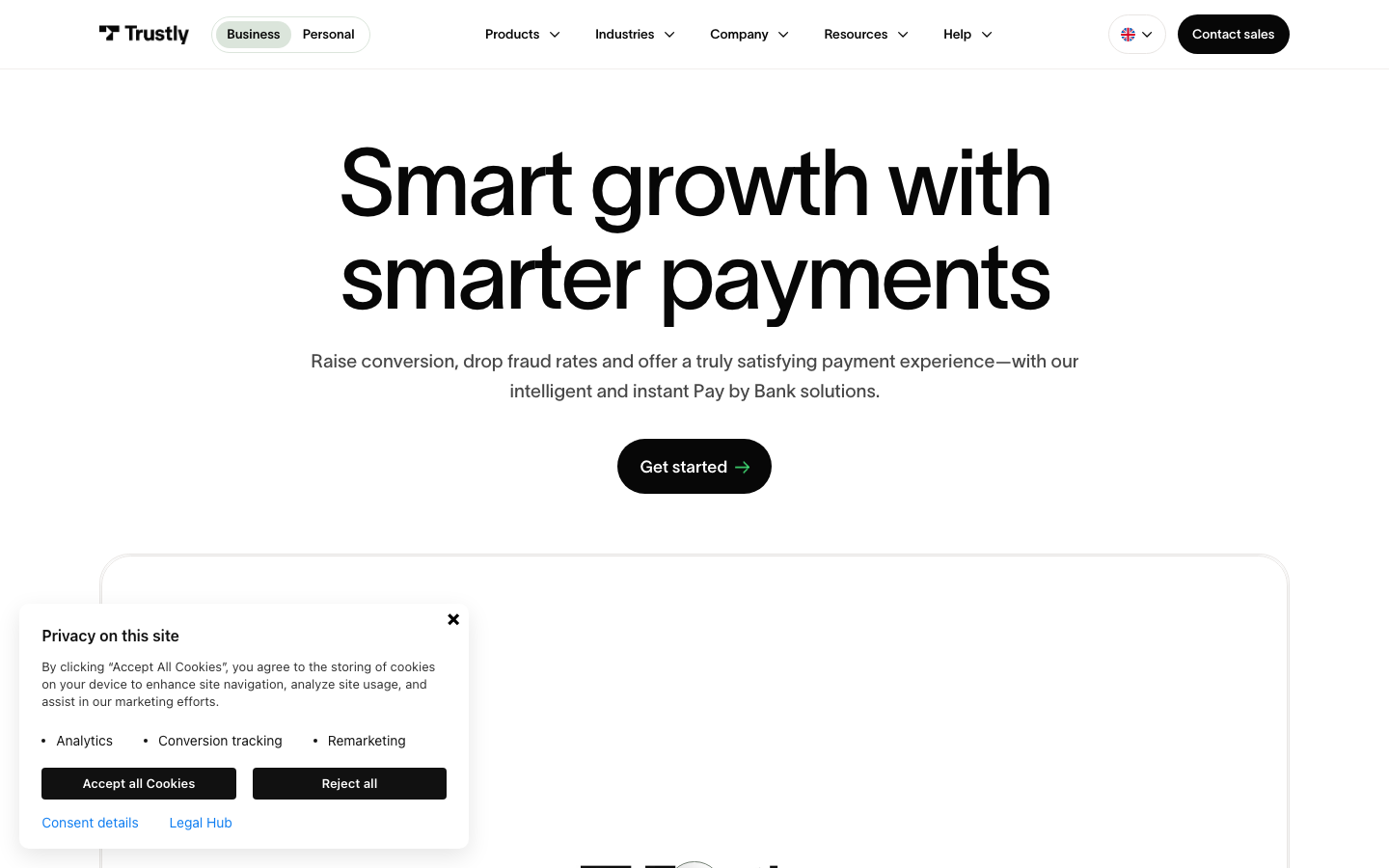
Trustly’s own site, checked directly this month, pitches “smart growth with smarter payments” through “intelligent and instant Pay by Bank solutions” — and its published client roster places DraftKings, one of America’s biggest regulated gambling brands, alongside Microsoft and Zalando. The company powering bank-transfer deposits at a US sportsbook of that scale is the same one behind the unbranded pay-by-bank buttons British players tap.
Trustly Casino FAQs
Which UK casinos accept Trustly?
Any casino offering pay-by-bank or instant bank transfer may run on Trustly — the provider sits behind the button rather than on it. Wallet-forward operators and fast-payout brands are where its rail most often appears.
Why can’t I find a Trustly button in my cashier?
UK cashiers usually label the rail generically (“Pay by Bank”), with the provider named in small print or settlement references. Choosing that option gets you the experience this page describes, whichever rail carries it.
Is Trustly safe to use?
Yes — it is an authorised payment institution, and the model is structurally safer than cards for data: authentication happens in your own banking app and the casino never receives card numbers or credentials. Operator licensing remains the thing to verify.
How fast are Trustly withdrawals?
Once the casino approves the payout, funds move bank-to-bank on Faster Payments — minutes to a few hours is typical. Operator approval time is the real variable, as with every method.
Does Trustly cost anything at casinos?
No — operators pay the processing costs. Players pay nothing on deposits or withdrawals.
Is Trustly the same as open banking?
Trustly is a company; open banking is the UK framework it (and rivals like Brite and Volt) operate through. Think airline versus airport.
What is Pay N Play, and does it work in the UK?
Trustly’s Nordic invention: the first deposit creates and verifies the casino account via national bank-ID. UK verification rules require separate registration, so Britain gets the payments half — still excellent — without the no-signup half.
Do I need a Trustly account?
No — there is nothing to sign up for. Trustly moves money between your bank and the operator; your banking app does the authentication.
Can my bank’s gambling block stop Trustly deposits?
Yes — bank-rail gambling deposits are honestly merchant-coded, so app-bank blocks catch them. For anyone using blocks deliberately, that coverage is a feature of the method.
Trustly took my deposit but the casino won’t pay out — who do I chase?
The operator — payment rails execute transfers; they don’t adjudicate winnings. At a UKGC casino, use its complaints route then the ADR body. If the site wasn’t UKGC-licensed, the rail was never your protection, and that’s the lesson for next time.
Does a pay-by-bank deposit share my bank balance or history with the casino?
No — the operator receives confirmation and the funds, nothing else. Your login happens inside your own banking app, and neither Trustly nor the casino sees credentials, balances or transaction history.
Why did my banking app redirect fail mid-deposit?
Usually a timeout between cashier and app — the attempt simply lapses, nothing is taken, and retrying completes normally. If money left your account without the casino crediting it, the transfer reconciles automatically in short order; persistent gaps are a cashier-support matter with a reference number attached.
Sources & Verification
Checked 10 July 2026 against: Trustly’s own site (UK homepage and client roster captured by screenshot the same day, DraftKings verified on it); Trustly’s published company history including the 2008 founding, Pay N Play launch and PayWithMyBank merger; the FCA’s open-banking regulatory framework under which UK bank-rail payments operate; live UKGC operator cashiers for pay-by-bank labelling practice; and the Gambling Commission’s payment-blocking guidance for the safer-gambling framing.