
Open banking is the structural riser of the UK cashier: pay-by-bank buttons powered by Trustly, Brite, Volt and TrueLayer that move money account-to-account in seconds, with your banking app’s own Face ID as the security. No card numbers, no wallet float, withdrawals in minutes at the best sites — and your money stays under FSCS protection until the instant it moves. If one method is the future, it’s this one.
Casinos that accept open banking now include most of the fast-payout names, usually behind a Pay by Bank button rather than a brand.
Casinos with Open Banking Payments
| Open Banking at a Glance | |
|---|---|
| Best for | Fast, free, card-free deposits straight from your bank app |
| UKGC coverage | Widespread and growing — the default at many fast-payout casinos |
| Deposit speed | Instant |
| Providers | Trustly, Brite, Volt — all FCA-regulated |
| Fees | None |
Pay-by-bank adoption splits the market: payout-proud casinos embraced it first because it makes their withdrawal times look heroic, while legacy cashiers lag. The ten below have proper integrations — not just a deposit button, but bank-rail withdrawals too, which is where this method earns its keep. Checked 5 July 2026; the pay-by-bank label varies (Trustly, Instant Bank Transfer, Pay by Bank), so look for any of them.
| Casino | Why it stands out for open banking specifically | Min deposit |
|---|---|---|
 Videoslotsvideoslots.com Videoslotsvideoslots.com | A long-standing Trustly house — bank deposits feed the industry's biggest lobby and withdrawals ride the same rail back out. | £10 |
 Mr Vegasmrvegas.com Mr Vegasmrvegas.com | Videoslots' sister brand shares the bank-rail plumbing with a flashier front end and the same rapid payout batching. | £10 |
 CasinoCasinocasinocasino.com CasinoCasinocasinocasino.com | L&L Europe skipped PayPal entirely and built around bank rails instead — payouts here are the platform's calling card. | £10 |
 All British Casinoallbritishcasino.com All British Casinoallbritishcasino.com | The same L&L bank-first cashier in patriotic wrapping; sterling-only, card-and-bank clean. | £10 |
 Casushicasushi.com Casushicasushi.com | Dazzletag's sushi-themed oddity runs a tidy pay-by-bank flow alongside its cards — small platform, sharp payments. | £10 |
 Fruit Kingsfruitkings.com Fruit Kingsfruitkings.com | Same Dazzletag stack, fruitier branding, identical quick bank-rail exits. | £10 |
 PlayOJOplayojo.com PlayOJOplayojo.com | Skill On Net wired open banking into the OJO brands, where no-wagering rewards mean bank withdrawals aren't held hostage by playthrough. | £10 |
 Lord Pinglordping.co.uk Lord Pinglordping.co.uk | The other Skill On Net face — same bank rails, stranger personality, 4,000 games behind the button. | £10 |
 Barzbarz.com Barzbarz.com | White Hat's speed merchant: reviewers have timed its payouts around the half-hour mark, and bank rails keep that honest. | £10 |
 bet365 Casinobet365.com bet365 Casinobet365.com | The giant added Pay By Bank alongside its cards — deposits pull from your banking app with no details typed. | £5 |
Verified 5 July 2026 · 18+ · UKGC licence holders only · begambleaware.org
Open Banking at UK Casinos: Quick Facts
| Category | Account-to-account payments over Faster Payments, initiated via open banking APIs |
|---|---|
| Key providers | Trustly, Brite, Volt, TrueLayer — all FCA-authorised payment institutions |
| UK gambling status | Accepted and spreading fast — the default at payout-focused casinos |
| Deposits | Yes — instant, approved inside your own banking app |
| Withdrawals | Yes — the method’s superpower: minutes-to-hours at proper integrations |
| Fees | None to the player |
| Typical minimum deposit | £5–£10 |
| Card details involved | None, ever — there is no card in the transaction |
| FSCS position | The strongest of any method: money moves bank-to-bank with no wallet float in between |
| Bank gambling block | Effective — banks apply gambling controls to these payments |
| Our score | 9/10 — sub-scores in the verdict |
Trustly, Brite, Volt: Who’s Behind the Button
“Pay by bank” is a category, not a brand, and four names do most of the work in UK cashiers. Knowing which one you’re looking at explains the small differences in flow and speed.
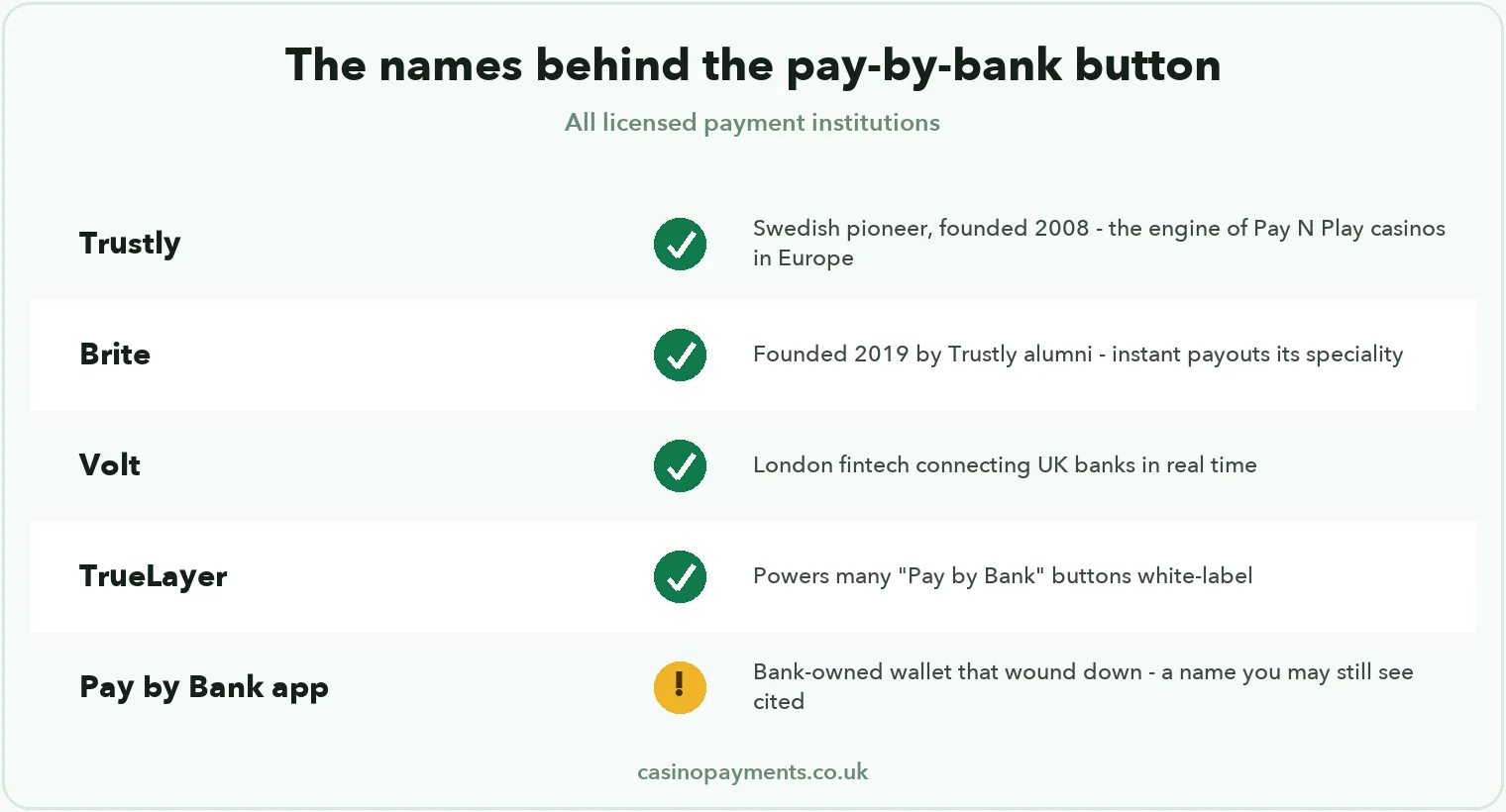
Trustly is the veteran — Swedish, founded 2008, and the company that proved the model with Pay N Play casinos in Scandinavia, where the bank payment is the registration. Brite was founded by Trustly alumni in 2019 and competes hardest on instant payouts. Volt is the London-born aggregator wiring UK banks into real-time checkout, and TrueLayer powers many unbranded “Instant Bank Transfer” buttons white-label. From your side the differences are cosmetic — every flavour ends with your own banking app asking for a fingerprint.
Open Banking vs Debit Card vs PayPal vs Bank Transfer
The one comparison that matters: open banking against the old ways of using the same bank account.
| Open banking | Debit card | PayPal | Manual bank transfer | |
|---|---|---|---|---|
| Deposit speed | Instant | Instant | Instant | Minutes + reference faff |
| Typical payout landing | Minutes–hours | 30 min–3 days | Same day to wallet | Minutes–hours via FPS |
| Details typed at casino | None | Card number once | Wallet login | Sort code & account |
| Intermediary float | None | None | Wallet balance | None |
| Bonus eligibility | Nearly always | Always | Occasional exclusions | Nearly always |
| Coverage | Growing fast | Universal | ~100 sites | Wide but clunky |
Full treatments of debit cards, PayPal and old-school bank transfer live on their own pages — the last of those is this method’s slower grandparent, and the difference deserves its own read.
Open banking vs Every Other Payment Method
Open banking shares the top of our scorecard with debit, but a headline score hides the one-on-one nuance. Row by row, here is what the bank rail beats — and the one thing each rival still does better.

| Against | Open banking wins on… | It wins on… |
|---|---|---|
| Debit card | Beating card refunds home by days | Acceptance everywhere and bonus eligibility always, ground open banking gives up |
| PayPal | No wallet balance left stranded mid-journey | Household trust and near-universal big-brand coverage, an area open banking concedes |
| Apple Pay | A payout leg Apple never built | Frictionless biometric checkout on iPhone, which open banking can’t claim |
| Google Pay | Money out as fast as money in | Checkout speed for Britain’s non-iPhone half, — not open banking’s game |
| Bank transfer | App-approval speed instead of reference numbers | No fintech layer before six-figure sums |
| MuchBetter | Bank-grade rails with no wallet to maintain | Gambling-specific security plus tiny fees, outpacing open banking on this front |
| Jeton | Winnings landing FSCS-protected, not wallet-parked | Modern fees with genuine high-street reach, — open banking’s blind spot |
| MiFinity | One less intermediary holding your money | Belfast FCA authorisation and featherweight fees, a lead over open banking |
| Skrill | Free where the veteran meters | Unmatched breadth across UK cashiers, where open banking can’t follow |
| Neteller | No dormancy clock ticking on balances | Veteran reach plus a card that spends balances, — beyond open banking here |
| Paysafecard | A full two-way loop, not deposit-only | Cash anonymity that never touches a statement, where it out-does open banking |
| Pay by mobile | No ceiling and a real payout route | Phone-number simplicity with a built-in cap, ground open banking gives up |
| Payz | Speed without a tier ladder to climb | Loyalty tiers that reward the regulars, still ahead of open banking there |
| Neosurf | Nothing to buy before playing | Over-the-counter cash entry, invisible to banks, an area open banking concedes |
| Prepaid cards | No plastic, no loading, no product research | An enforced ceiling on familiar rails, which open banking can’t claim |
What the grid shows is a method with almost no weak flank beyond the lack of a spendable balance between sessions. Pair it with a wallet if you want that buffer; run it alone if your bank account is where winnings belong anyway — ours is the second camp.
How Open Banking Casino Payments Work
Depositing, step by step
- Pick Pay by Bank / Instant Bank Transfer / Trustly in the cashier and enter an amount (first-timers get the mandatory deposit-limit prompt beforehand).
- Choose your bank from the list — every major UK bank and app-bank is connected.
- You’re bounced to your own banking app, which shows the exact payee and amount.
- Approve with Face ID or fingerprint — authentication happens inside your bank, the strongest form SCA takes.
- Faster Payments moves the money and the cashier credits in seconds.
Withdrawing — where this method runs away from the field
- Request the withdrawal; with proper integrations your account details are already known from the deposit, so there’s nothing to type.
- The casino’s review queue applies as always — the operators in our table keep it short.
- Approved funds travel back over Faster Payments: minutes at the best sites, hours typically, FSCS-protected the moment they land.

Under the hood
Open banking is the 2018 regulatory decision (PSD2 in Europe, the CMA’s order on the nine biggest banks here) that forced banks to open secure APIs to licensed third parties. A pay-by-bank deposit is a payment initiation: Trustly or its rivals, holding FCA authorisation, instruct your bank to push a Faster Payment to the casino’s account — with your in-app approval as consent. Nothing is stored that can be reused; there’s no number to steal because there’s no card, and no balance to freeze because there’s no wallet. It’s the shortest financial path between you and a casino that has ever existed, in both directions.
A detail that separates real integrations from cosmetic ones: at the best casinos, the account you deposit from is captured as your verified payout destination in the same motion — one approval covers both directions forever. Cosmetic integrations take your deposit by bank and still ask you to type sort codes at withdrawal, the tell that an operator bolted a button onto an old cashier rather than rebuilding the flow. Thirty seconds on a casino’s withdrawal page reveals which kind you’re dealing with, and it’s the single best predictor of how your first payout will feel.
Open Banking Casino Fees, Limits and Settlement Speeds
The fee column is empty and the speed column is the sales pitch.
| Item | Reality |
|---|---|
| Deposit fees | None — providers charge operators, never players |
| Withdrawal fees | None at UKGC casinos |
| Deposit speed | Seconds, end to end |
| Payout speed | Casino queue + Faster Payments — the rail itself is near-instant, 24/7, weekends included |
| Minimums | £5–£10, same as cards |
| Maximums | Generous — bank-transfer ceilings dwarf card limits, which is why high-stakes players gravitate here |
| Currency | GBP native; no FX exposure at UK casinos |
The honest qualifier on speed: “instant withdrawals” marketing still hides the operator’s own approval queue. Open banking eliminates the settlement delay — the days cards spend trundling through scheme rails — but not the human or automated review before release. That’s why our casino picks weight the queue, not just the rail: the method makes minutes possible; the operator decides whether you get them.
Two timing edge cases complete the honest picture. First, banks apply their own screening to inbound Faster Payments, and a first-ever payout from a casino occasionally rests for a short fraud check before crediting — unnerving once, routine thereafter. Second, limits: while the rail supports six-figure transfers, providers and operators set per-transaction caps, so a genuinely large withdrawal may arrive as two or three instalments minutes apart rather than one lump. Neither quirk costs you money; both cost forum threads their composure weekly.
Platforms & Networks With Pay by Bank
Adoption maps neatly onto payout culture: platforms that compete on withdrawal speed integrated early, and card-era giants are arriving one by one.
| Platform | Example casinos | Pay-by-bank status |
|---|---|---|
| Videoslots | Videoslots, Mr Vegas | Yes — Trustly veterans, both directions |
| L&L Europe | All British Casino, CasinoCasino | Yes — the bank-first platform by philosophy |
| Skill On Net | PlayOJO, Lord Ping | Yes across the network |
| Dazzletag | Casushi, Fruit Kings | Yes — small platform, modern rails |
| White Hat Gaming | Barz, 21Prive | Yes — feeds its fast-payout reputation |
| bet365 (proprietary) | bet365 | Yes — Pay By Bank live alongside cards |
| The high-street groups | Entain, Flutter, Rank brands | Rolling out steadily — check each cashier |
| Jumpman / small white-labels | 150+ bingo-slots sites | Largely absent so far — cards and phone billing still rule there |
A useful buying signal hides in this table: a casino that offers open banking withdrawals has, in effect, told you it isn’t embarrassed by its payout times. The methods a cashier chooses are a confession of its priorities.
Security & the FSCS Argument Nobody Else Makes
Every method on this site gets an FSCS paragraph; open banking wins the category outright. Money travels directly from your FSCS-protected account to the casino and directly back — there is no intermediate balance anywhere: no wallet float that’s merely “safeguarded”, no voucher sitting in a drawer, no token with a question mark. Between you and the operator, your money is either in a UK bank or inside the casino’s player-fund arrangements — never in a third state.
Transaction security is equally blunt: there are no credentials to steal. The casino never sees your login; the provider never stores reusable payment details; approval happens inside your banking app under the same biometrics that guard everything else you own. Fraud in this channel means compromising your actual bank, at which point casino deposits are the least of anyone’s problems. The caveats, fairly stated: dispute rights are thinner than cards — there’s no chargeback scheme for account-to-account payments, so errors route through your bank’s standard processes and the operator; and payments are push-payments you authorise, so the scam-protection frameworks around them assume you checked the payee. At a UKGC casino via an FCA-authorised provider, both risks are more theoretical than lived. Net verdict: the safest end-to-end architecture in the cashier.
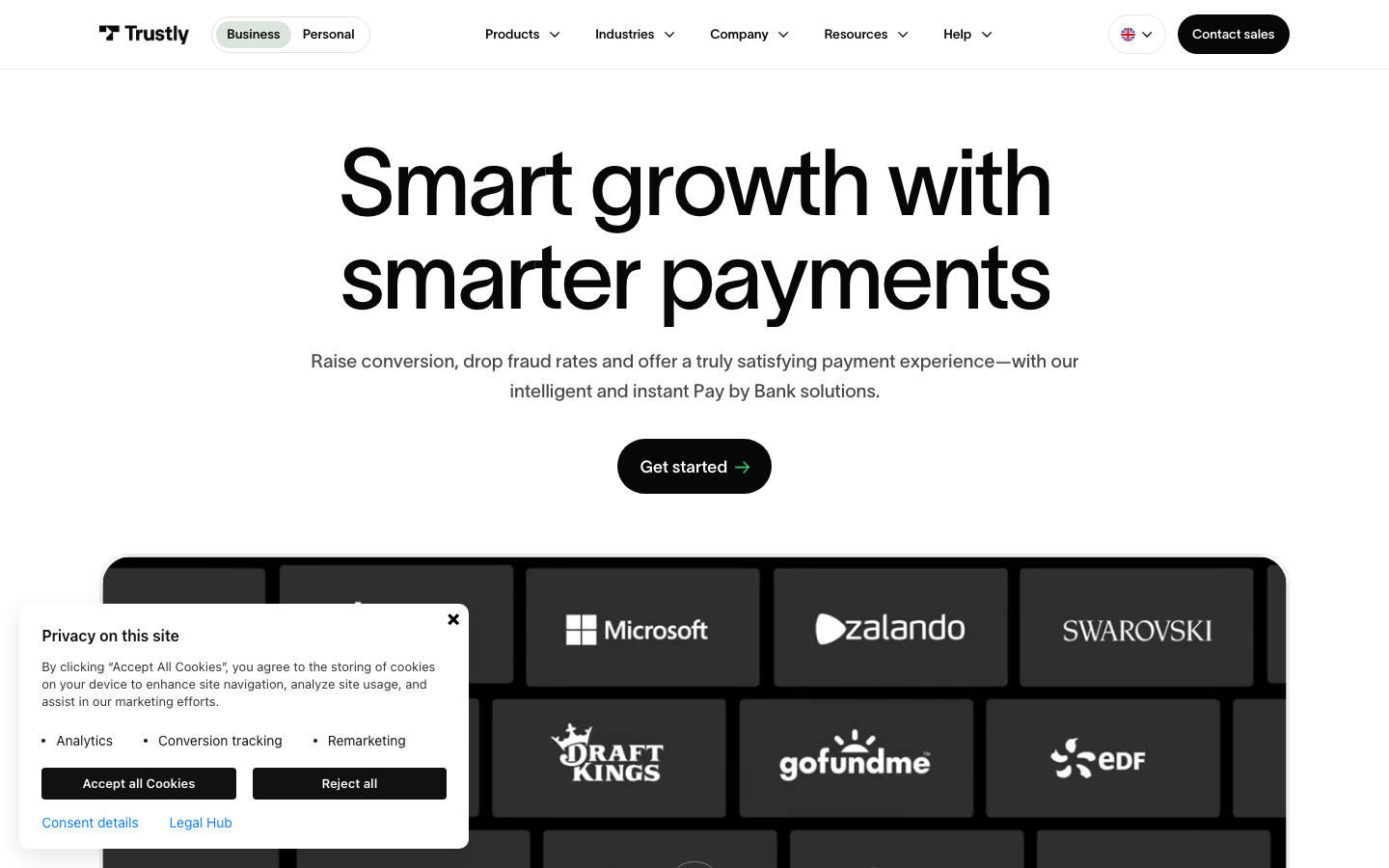
Trustly’s own homepage, checked directly this month, pitches “smart growth with smarter payments” via “intelligent and instant Pay by Bank solutions” — and its published client roster includes DraftKings among Microsoft, Zalando and GoFundMe, a genuinely useful data point: one of the biggest US sportsbook/casino brands runs its bank-to-bank payments on the same open banking rail UK players use.
From Regulation to Rail: A Short History
Open banking is that rare thing — a payment method invented by regulators that turned out to be genuinely better.
- 2008 — Two foundations laid an ocean apart: the UK switches on Faster Payments, and Trustly is founded in Stockholm to use bank rails for online payments.
- 2015 — PSD2 adopted in Europe, mandating bank APIs for licensed third parties.
- 2016 — The CMA orders the UK’s nine biggest banks to build open banking; Trustly launches Pay N Play, making the bank payment double as casino registration in Nordic markets.
- 2018 — UK open banking goes live in January — the quiet big bang.
- 2019 — Brite founded by Trustly alumni; Volt founded in London. The gambling-payments arms race begins in earnest.
- 2021–2023 — UK fast-payout casinos adopt pay-by-bank as their flagship withdrawal method.
- 2026 — The clear structural riser of the UK cashier, eating share from cards on the payout side especially.
The lesson in the dates: the technology waited a decade for the regulation, then the regulation waited five years for the casinos. What never changed is the rail underneath — the same Faster Payments network from 2008 carries almost every “instant” casino payout in Britain today.
Open Banking & Gambling Around the World
This is a story of rails, and rails are national. The UK’s combination — Faster Payments plus mandated open banking plus a regulated gambling market — is the world’s best case, which is why pay-by-bank casino payments matured here and in the Nordics first. Sweden and Finland ran ahead via Trustly’s Pay N Play model, where licensed casinos onboard players from the bank payment itself. The Eurozone increasingly follows through SEPA Instant as regulated markets adopt it. The US, tellingly, lags: real-time rails arrived late (FedNow only launched in 2023) and state-by-state gambling regulation fragments everything, so American cashiers still lean on cards and PayPal-style wallets. The travelling rule for UK players: where you see genuine pay-by-bank at a casino, you’re looking at a market with modern payment rails and real licensing — the two tend to arrive together, and their absence together is its own warning.
The regulatory tailwind is unusually strong here, which matters for anyone judging whether this method is a fad. The UK’s payments strategy explicitly favours account-to-account rails; the Gambling Commission’s affordability and deposit-limit agenda quietly benefits from payments banks can see and categorise cleanly; and every fraud statistic that damns card-not-present payments recruits another operator to bank rails. Methods usually fight regulators — this one was built by them, the safest position a payment type can occupy in a scrutinised industry. Betting on open banking’s growth at UK casinos isn’t speculation; it’s reading the direction every institution involved has committed to in writing.
Open Banking’s Reach Beyond Gambling Payments
The companies behind the casino button are busy replumbing everything else you pay for. Trustly processes for major marketplaces and subscription businesses across Europe; Volt’s aggregation layer connects real-time rails across dozens of countries for retailers far from gambling; TrueLayer powers account top-ups in trading and crypto apps whose users have never heard its name. The UK’s own trajectory makes the direction plain: open banking payments in Britain have grown from novelty to hundreds of millions of transactions a year, HMRC accepts them for tax bills — arguably the least glamorous endorsement imaginable — and “variable recurring payments” are lined up to replace direct debits next. The casino cashier, as usual, is just an early adopter with strong incentives: when withdrawal speed is a competitive weapon, the fastest rail wins the integration queue.
Bonuses & Open Banking
Pay-by-bank deposits sit comfortably inside nearly every welcome offer: bonus exclusion lists were written for the Skrill-era e-wallets, and account-to-account payments have never attracted the same suspicion. Deposit via Trustly or its siblings and the advertised offer applies, under the standard 2026 conditions — wagering capped at 10x by the Commission, mixed casino-and-sports promotions gone, significant terms with 18+ and BeGambleAware on show. One genuinely useful synergy: at no-wagering operators like PlayOJO, an open-banking deposit plus wager-free rewards produces the cleanest possible loop — money in from the bank, winnings straight back to the bank, nothing held hostage in between. If bonus terms are the small print you hate, this pairing is the closest UK gambling gets to not having any.
Open Banking & Safer Gambling
Open banking scores well on the brakes, with one subtlety worth understanding. Bank gambling blocks apply: UK banks extend their gambling controls to open-banking payments to gambling operators, so the Monzo-style toggle with its cooling-off period protects this channel alongside your cards. Because the payment happens inside your banking app, the spend is also unusually visible — every deposit sits in your transaction feed next to the groceries, with none of the psychological distance a casino wallet balance creates. Visibility is an underrated safety feature.
The subtlety: blocks and controls are implemented bank-by-bank, and coverage of account-to-account gambling payments has historically trailed card coverage at some institutions — if the block matters to you, test yours against a £5 pay-by-bank deposit rather than assuming. Layer the universal tools on top: the deposit limit every UKGC site must offer before your first deposit (standardised as money-in-only since mid-2026), GAMSTOP’s one-registration exclusion from every licensed site, and honest self-checks when deposits stop feeling like decisions. Our responsible gambling hub covers the lot; the National Gambling Helpline is free and open 24/7 on 0808 8020 133. Fast rails move money, not odds — the maths of every game is untouched. 18+.
What Players Say About Pay-by-Bank Casinos
Open banking generates the most enthusiastic payment threads in UK gambling forums, and the enthusiasm has a single subject: withdrawal screenshots. “Requested 11:04, in my bank 11:09” posts do this method’s marketing for free, and the tone is often faint disbelief from players trained on three-day card settlements. The deposit side barely gets discussed — it works, it’s quick, there’s nothing to say — which by payment-method standards is the highest compliment available.
The complaints are instructive rather than damning. Players occasionally balk at the bank-selection screen (“why does a casino want my bank?”) — a trust reflex the how-it-works section above answers: the casino never sees your login, and approval happens in your own app. Some report their bank missing from a provider’s list, usually a smaller building society. And the recurring genuine grievance is inconsistency: a casino advertising instant bank withdrawals whose review queue still takes a day, which players rightly read as the operator, not the rail, dragging its feet. The pattern across hundreds of threads: where the integration is real, this is the most-loved method in the market; where it’s marketing veneer over an old queue, players notice within one withdrawal.
The trust-arc in new users repeats so reliably it deserves recording. First-timers arrive suspicious — selecting your bank inside a casino cashier feels wrong to anyone raised on “never share your banking details” — then the redirect lands in their own banking app, the penny drops that the casino never saw anything, and scepticism converts to advocacy at almost comic speed. Payment methods rarely get second chances at first impressions; this one’s opening act is your own bank asking politely, and it disarms doubt faster than any security badge ever has.
One question recurs in those threads and deserves a straight answer: whether you can deposit from a joint account or one that isn’t your registered account. Technically the rails allow it; practically, casinos match the paying account name against the registered player, and a mismatch buys you a source-of-funds conversation rather than a bonus. The rule that keeps everything smooth is the one cards taught a generation ago — pay only from an account in your own name, and the method stays as frictionless as its reputation.
Our Verdict on Open Banking at UK Casinos
Overall: 9/10 — the future, arriving on schedule
| Sub-score | Rating | In one line |
|---|---|---|
| Deposit experience | 9 | Banking-app approval is a half-step slower than a wallet tap — and feels safer for it |
| Withdrawal support & speed | 10 | The best in the market: same rail home, minutes when operators cooperate |
| Fees | 10 | Nothing, anywhere, in either direction |
| Security & protection | 9.5 | No credentials, no float, FSCS to the doorstep — the cleanest architecture available |
| Casino availability | 7.5 | The fast-payout crowd is aboard; the high-street giants are still boarding |
Choose open banking if withdrawal speed is your priority, you want zero payment details near a casino, or you simply want the method with the strongest protection story end to end. Its only real limits: coverage gaps at older cashiers and the small-print truth that operators’ queues, not the rail, set your real payout time. Pair it with anything for deposits if you like — but once you’ve had a five-minute withdrawal, you won’t voluntarily go back to three days. Compare manual bank transfer to see how far this rail has come.
Open Banking Casino FAQs
Is open banking safe to use at online casinos?
It’s the safest architecture in the cashier: no card numbers, no wallet balance, approval inside your own banking app, and FCA-authorised providers initiating the payment. Your money is FSCS-protected in your bank right up to the moment it moves.
Does the casino see my bank login or balance?
No. The provider redirects you to your own banking app for approval; the casino receives confirmation and funds, never credentials. Payment initiation and account access are strictly separated under open banking rules.
How fast are open banking casino withdrawals?
The rail itself is near-instant — Faster Payments runs 24/7. Real timing depends on the casino’s approval queue: minutes at the best integrations, a few hours typically. The famous five-minute-withdrawal screenshots all come from this method.
What’s the difference between open banking and a normal bank transfer?
A manual transfer means typing sort codes and references yourself and waiting for matching; open banking initiates the payment through your bank’s API with the casino details prefilled. Same rail, none of the faff — our bank transfer guide covers the old way.
Is Trustly the same as Pay by Bank?
Trustly is one provider of pay-by-bank payments; Brite, Volt and TrueLayer power the same button elsewhere. Cashiers label it variously — Trustly, Instant Bank Transfer, Pay by Bank — but the flow is the same.
Are there fees for open banking casino payments?
None to players, in either direction. Providers charge operators per transaction; UKGC casinos absorb it as a cost of looking fast.
Do open banking deposits qualify for bonuses?
Almost universally — account-to-account payments never made the e-wallet exclusion lists. Standard 2026 terms apply: 10x wagering cap, no mixed offers, full significant terms displayed.
Will my bank’s gambling block stop pay-by-bank deposits?
At major UK banks, yes — gambling controls extend to open-banking payments to operators. Coverage nuances exist bank to bank, so if the block is load-bearing for you, verify with a small test deposit.
Why isn’t my bank in the list?
Providers connect virtually every major UK bank and app-bank, but a few small building societies lag. If yours is missing, a debit card from the same account does the job while coverage catches up.
Do open banking withdrawals work at weekends?
Yes — Faster Payments runs every hour of every day including bank holidays. If a weekend withdrawal stalls, the delay is the casino’s approval queue, never the rail. Operators that review 24/7 deliver genuine Saturday-night payouts.
Can I deposit from a joint or someone else’s bank account?
Pay only from an account in your own name. Casinos cross-check the payer name during KYC, and mismatches trigger source-of-funds checks that can freeze withdrawals. Joint accounts bearing your name are generally fine; anyone else’s account never is.
Changelog: 9 July 2026 — added an at-a-glance box, Trustly's own current positioning and client roster (including DraftKings), and a screenshot.
Sources & Verification
Primary sources checked 5 July 2026: provider documentation from Trustly (re-verified 9 July 2026), Brite and Volt; the UK’s open banking framework via Open Banking Limited; and the Gambling Commission’s deposit-limit rules plus its gambling-block guidance. Casino availability verified against operator cashiers on the date above.

Years of watching card settlements crawl taught Will why account-to-account rails matter; this guide measures every claim against the queue-versus-rail distinction operators hope you won't notice. More about Will →