CashtoCode is the cash-deposit method with the widest physical reach in Britain and one of the narrowest casino followings. Its eVoucher model needs no card, no bank account and nothing bought in advance: the cashier issues a barcode, you hand over notes at any of roughly 28,000 PayPoint counters, and the balance appears. The mechanism is sound. The problem is how few UK cashiers ever adopted it.
The casinos that accept CashtoCode make a short list, and it sits below alongside the cash routes that reach further.
Casinos with CashtoCode Payments
| CashtoCode at a Glance | |
|---|---|
| UK retail reach | ~28,000 PayPoint counters — among the widest of any cash method |
| The mechanism | eVoucher barcode generated at the cashier, paid with cash in-store |
| Prerequisites | None — no card, bank account or pre-bought voucher |
| Withdrawals | Not supported, ever |
| UKGC casino coverage | Thin and shrinking |
Checked 24 July 2026. The retail network is genuinely national; the casino list is not.
| Question | Answer |
|---|---|
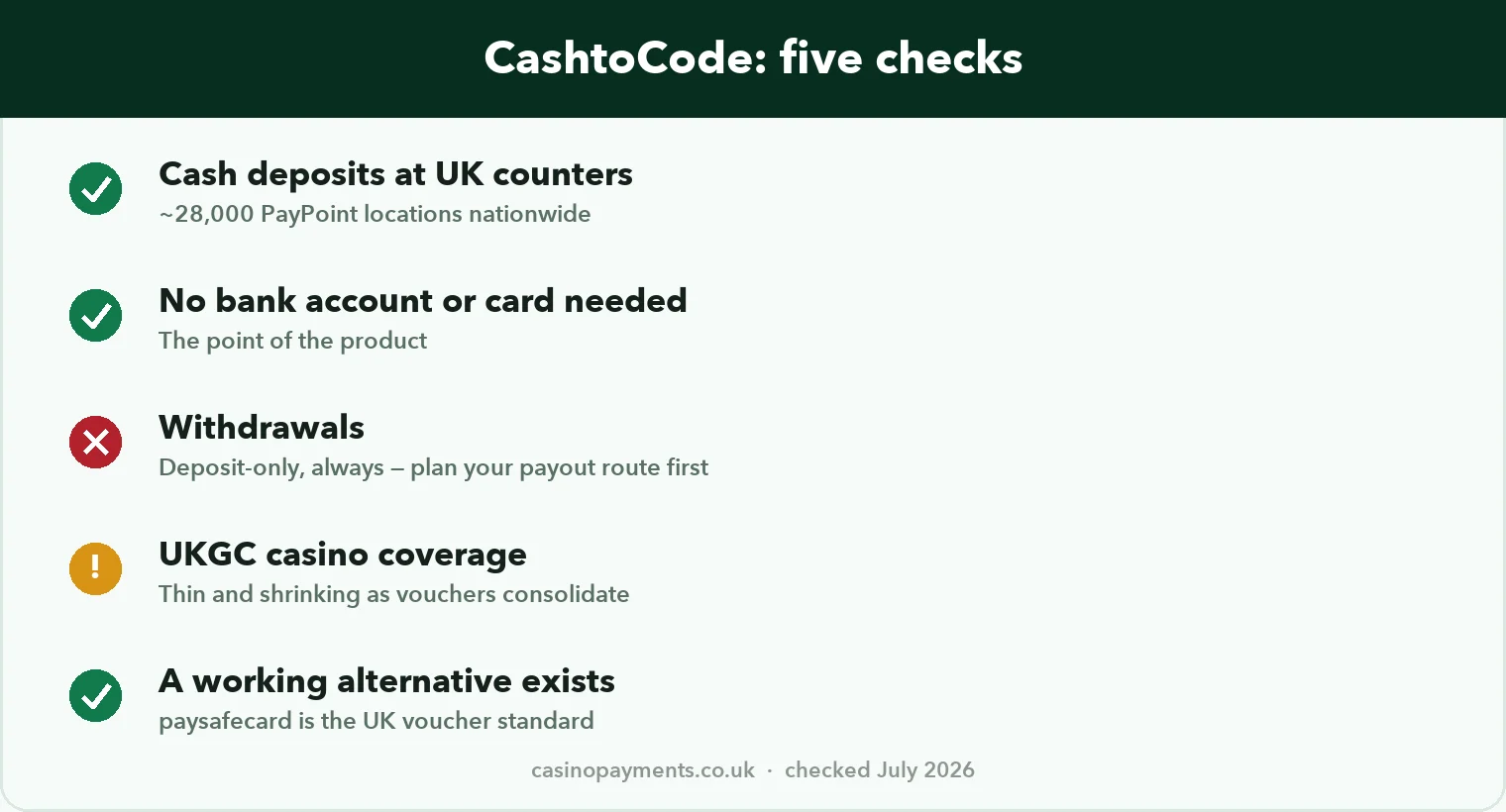
| Does CashtoCode work in the UK? | Yes — through roughly 28,000 PayPoint counters nationwide |
| Do I buy a voucher first? | No — the cashier generates a barcode, you pay cash against it |
| Bank account or card? | Neither needed for the deposit |
| Withdrawals? | Never — deposit-only, so arrange a payout route separately |
| How many UK casinos list it? | Few, and the number has been shrinking as vouchers consolidate |
Checked 24 July 2026 · 18+ · UKGC-licensed operators only · begambleaware.org
CashtoCode: Quick Facts
| Category | Cash payment (eVoucher) — barcode at the cashier, cash at the counter |
|---|---|
| UK retail network | PayPoint — roughly 28,000 locations |
| Also operates in | Germany, Austria, Switzerland and other cash-heavy markets |
| Prerequisites | None — the point of the product |
| Direction | Deposit-only; withdrawals impossible by design |
| Speed | As fast as your walk to the shop — not instant from the sofa |
| Amounts | Exact, set when the barcode is generated — no stranded balances |
| UKGC casino coverage | Thin; paysafecard occupies the UK voucher slot |
| Fees | Vary by operator and partner — check before you set out |
The PayPoint Advantage Nobody Used
The genuinely impressive thing about CashtoCode in Britain is its distribution. Rather than building a retail network, it plugged into PayPoint — the terminals sitting in corner shops, newsagents and convenience stores across the country, already familiar to millions of people for topping up energy meters and paying bills.
Roughly 28,000 locations means most British addresses have one within a short walk. Measured purely on physical accessibility, that beats every other cash-to-online method available here. If the constraint on cash gambling deposits were “how far must I travel”, CashtoCode would have won the market outright.
It didn’t, and the reason is instructive about how payment methods actually succeed. Cashier integrations follow player demand, and player demand follows familiarity. By the time CashtoCode reached Britain, paysafecard had spent two decades making itself the answer to “how do I deposit with cash” — it was already in the cashier, already in the shops, already the thing people asked for by name. A superior counter network cannot overcome an inferior position in a list of payment buttons that players never see you missing from.
So CashtoCode’s UK story is a distribution triumph paired with a demand failure, and the practical upshot for a player is blunt: the counter is near you, and the casino accepting it probably isn’t.
Against the Rest of the Voucher Field
Four cash routes, one clear UK winner, and it isn’t the one with the best network.
| CashtoCode | paysafecard | Paysafecash | Neosurf | |
|---|---|---|---|---|
| UK casino coverage | Thin | Broad (~60 sites) | Thin | Moderate |
| UK retail reach | ~28,000 PayPoint | Very broad | Limited | Moderate |
| Model | Barcode, pay after | Voucher, buy first | Barcode, pay after | Voucher, buy first |
| Exact amounts | Yes | No — denominations | Yes | No |
| Withdrawals | No | No | No | No |
The barcode products — CashtoCode and Paysafecash — are mechanically better than the voucher products: exact amounts, nothing stranded, no transferable PIN for scammers to extract. The voucher products — paysafecard and Neosurf — have the cashier acceptance. In a market where you can only use what your casino lists, acceptance beats elegance every time.
How a CashtoCode Deposit Works
The flow
- Select CashtoCode at a cashier that offers it and enter the exact amount you want to deposit.
- The system generates an eVoucher barcode — on screen or by email — representing that specific pending payment.
- Take it to any participating PayPoint retailer and pay in cash. The clerk scans; the payment settles.
- Your casino balance credits on confirmation. Nothing is typed into the cashier and no code carries value once used.
What the shop trip actually costs you
Two things, one obvious and one worth thinking about. The obvious one is convenience: deposits happen at shop opening hours and walking pace, not instantly at midnight. The less obvious one is that this is the strongest natural brake on impulsive depositing available in any cashier — a genuine cooling-off period imposed by geography rather than by a bank’s settings screen. Players who want that friction should note it as a feature; players who resent it should probably note it too.
The four checks before you set off
- Verify the cashier lists CashtoCode — coverage is thin and shrinking, so never assume from a comparison table.
- Read the total on screen, including any operator or PayPoint partner fee, before generating the barcode.
- Check your nearest participating PayPoint. Most are close, but “most” is not “all”, and the barcode has a validity window.
- Plan the payout route — almost certainly a bank transfer, which is the detail this method’s users are least likely to want and most likely to need.
Sort the exit first
CashtoCode cannot pay you back. Under closed-loop rules a casino returns funds to the depositing method wherever possible, and when that is impossible — as it always is with cash — the fallback is a bank transfer to an account in your own name. Anyone choosing this method precisely because they would rather not involve a bank account should understand that the payout stage will involve one anyway, and settle that before depositing rather than after winning.
Security, Verification & Limits
Structurally, the barcode model is the safer half of the cash category. A CashtoCode barcode is tied to one pending payment on one account, so — unlike a 16-digit voucher PIN — it has no value to anybody else and cannot be socially engineered out of you in the classic voucher scam. If someone messages you a barcode and asks you to pay it, that is a fraud in progress and the mechanism itself is the giveaway: legitimate barcodes are generated by you, in a cashier you opened yourself.
Anti-money-laundering obligations sit heavily on cash, so expect verification at thresholds, expect limits set by both the operator and the retail partner, and expect the casino’s KYC to arrive at your first meaningful withdrawal no matter how the money went in. Paying cash keeps a transaction off your bank statement; it does not make you anonymous to a licensed operator, which is required to know exactly who you are.
On fees, check before travelling. Charges here can come from the operator or the retail partner rather than from CashtoCode, and they are easier to spot on the cashier screen than to argue about at a counter with the cash already out.
A German Cash Habit, Exported
- 2016 — CashtoCode launches, targeting the German-speaking markets where cash payment remained unusually dominant.
- 2017–2018 — The eVoucher model spreads across Germany, Austria and Switzerland, where a large minority still prefer paying in notes.
- 2019 — International expansion begins; gambling operators in cash-heavy markets are early adopters.
- 2020 — The UK launch arrives via the PayPoint network — instantly national in reach, from a standing start.
- 2021–2022 — A handful of UKGC casinos add it; paysafecard’s incumbency proves decisive.
- 2023–2024 — UK casino listings thin further as operators consolidate their voucher options.
- 2026 — Strong retail presence, minimal UK gambling presence — a niche method with a national counter network.
The German origin explains the design better than anything else. In a market where a substantial share of the population pays for online purchases in cash by choice, a product like this is mainstream infrastructure rather than a fringe option. Exported to Britain — where card and phone payments long ago became default and cash usage has fallen for a decade — the same product addresses a much smaller need, however many counters it can reach.
CashtoCode Around the World
CashtoCode’s map is a map of cash preference. Germany, Austria and Switzerland remain its heartland, and its presence elsewhere tracks the same variable: how much of the population either prefers physical money or lacks convenient access to cards and bank accounts. In several of those markets it is a genuinely significant payment option, gambling included.
Britain sits at the opposite end of that spectrum, which is why the UK story is one of infrastructure without adoption. The method works here, at scale, through a network most people pass weekly — and the underlying demand it was built for is comparatively small.
The usual caution applies with a specific edge for this method. Because CashtoCode is more common at offshore operators serving cash-preferring markets than at UKGC-licensed ones, a British player who goes looking for “CashtoCode casinos” is more likely than usual to land outside the licensed perimeter. Meeting an unfamiliar payment method should prompt a licence check, and with this one it should prompt it a little faster.
CashtoCode’s Non-Gambling Uses
CashtoCode’s serious business is financial inclusion: giving people who transact in cash a route into online commerce that would otherwise be closed to them. Utility payments, e-commerce, digital services and account top-ups make up the bulk of it, and in markets with meaningful unbanked or card-averse populations that is genuinely useful infrastructure rather than a marketing claim.
The PayPoint partnership is the part worth admiring regardless of gambling. Rather than trying to build a retail estate, CashtoCode attached itself to terminals already trusted for topping up prepayment meters and paying bills — an approach that delivered national coverage on day one and cost a fraction of the alternative. It is a neat lesson in distribution strategy, and it makes the UK gambling outcome all the more instructive: you can solve the hard problem (reach) completely and still lose to an incumbent that solved the easy one (familiarity) first.
CashtoCode & Safer Gambling
As a deposit method this is among the least harmful shapes available: you can only deposit cash you physically hold, there is no card on file, no stored balance, no saved details enabling a repeat at 2am, and the walk to a shop imposes a delay nothing else in the cashier matches. If you are deliberately choosing friction, this delivers more of it than any bank setting.
The corresponding blind spot is significant and worth stating plainly: bank gambling blocks cannot see cash. Anyone relying on a block at Monzo, Starling, Revolut or Chase is protected against card and bank-rail deposits, and a cash-funded route walks straight past it. If your control setup depends on a bank block, cash deposits are outside it by construction.
Layer with tools that follow the person rather than the payment: GAMSTOP closes every UKGC operator at once however money arrives, and cashier deposit limits bound each site individually. Our responsible gambling hub collects the rest. If part of the appeal of a cash route is that it sidesteps a block you set for yourself, that is worth taking seriously — the National Gambling Helpline is free, confidential and open around the clock on 0808 8020 133. 18+.
What Players Report About CashtoCode Vouchers
British player commentary on CashtoCode is thin, and what exists splits between mild appreciation and mild frustration. The appreciation is for the PayPoint network: people are genuinely surprised how close the nearest counter is, and the exact-amount model draws praise from anyone who has ever stranded a few pounds on a voucher.
The frustration is entirely about availability. The recurring thread is a player who liked the method at one casino, then couldn’t find it at the next — which is the accurate experience of a method with a national retail footprint and a handful of cashier integrations. A second, smaller genre involves players discovering it at an offshore site and asking whether that site is trustworthy; the honest answer is usually that the payment method was the least of the concerns on that page.
The German and Austrian threads read entirely differently — routine, unremarkable, high-volume — which is the clearest evidence that nothing is wrong with the product. It is simply solving a problem Britain mostly stopped having.
What UK Players Should Reach For Instead
If your cashier doesn’t list CashtoCode — and most UK ones don’t — the practical substitutes are:
- paysafecard — the UK cash standard by a distance, accepted at roughly sixty UKGC casinos and sold everywhere PayPoint is.
- Neosurf — the other established voucher, with reasonable coverage at wallet-friendly operators.
- Paysafecash — the closest mechanical equivalent, same barcode-and-cash model, similarly thin UK coverage.
- Prepaid cards — if the real goal is a hard ceiling rather than literal cash, these enforce one and can sometimes receive payouts.
A note on why this field keeps shrinking. Cash deposit methods face a structural squeeze in Britain from both ends: consumer cash usage has fallen for a decade, and anti-money-laundering expectations around cash have tightened considerably over the same period. Operators weighing whether to integrate a second or third cash option are looking at declining demand and rising compliance overhead simultaneously, which is why voucher slots consolidate around a single incumbent rather than expanding. That trend is unlikely to reverse, so a player who values cash deposits should expect the available options to narrow further rather than broaden — and should not assume a method listed at one casino today will be there next year.
Whichever you choose, the same rule applies to all of them: they are deposit-only, so decide how winnings will reach you before you put money in.
What PayPoint Actually Is — and Why It Matters
Because CashtoCode’s entire UK proposition rests on PayPoint, it is worth understanding what that network is, particularly for readers who have used it without noticing.
PayPoint terminals sit in corner shops, newsagents, convenience stores and petrol stations across Britain — the small retail estate rather than the supermarket one. Their traditional business is bill payment and prepayment top-ups: energy meters, water bills, council rent, mobile credit. For a substantial number of households, particularly those on prepayment energy meters, the local PayPoint is a routine weekly errand rather than an obscure piece of infrastructure.
That matters for two reasons. Practically, it means CashtoCode’s counters are genuinely near most people, including in areas where bank branches have closed and free-to-use cash machines have thinned out. The network was built for exactly the demographic least served by branch banking.
Less comfortably, it means the physical infrastructure of cash gambling deposits overlaps precisely with the infrastructure of paying an energy bill in cash — a demographic correlation that gambling operators did not create but do benefit from. That is not an argument against the method, and CashtoCode’s core business is bill payment rather than gambling. But it is a reason this site treats cash deposit routes with a little more care than the convenience story alone would suggest, and why the safer-gambling section below is longer than the mechanics deserve on their own.
Our Verdict on CashtoCode for UK Players
CashtoCode is a well-built method that arrived in Britain with a genuinely excellent answer to distribution — 28,000 PayPoint counters, national from day one — and found the question already answered. The mechanism improves on the voucher model in every technical respect: exact amounts, no stranded balances, no transferable PIN for a scam to target. What it never got was the cashier acceptance that makes any of that usable.
For a UK player the recommendation follows the availability rather than the merits. Use it if your casino offers it and you want to deposit in cash — it works exactly as described and the counter is nearer than you think. Don’t go looking for it, because the search leads more often to unlicensed operators than to licensed ones. And whichever cash route you take, remember what none of them can do: hand your winnings back. Plan that exit first, and the rest of this method is straightforward.
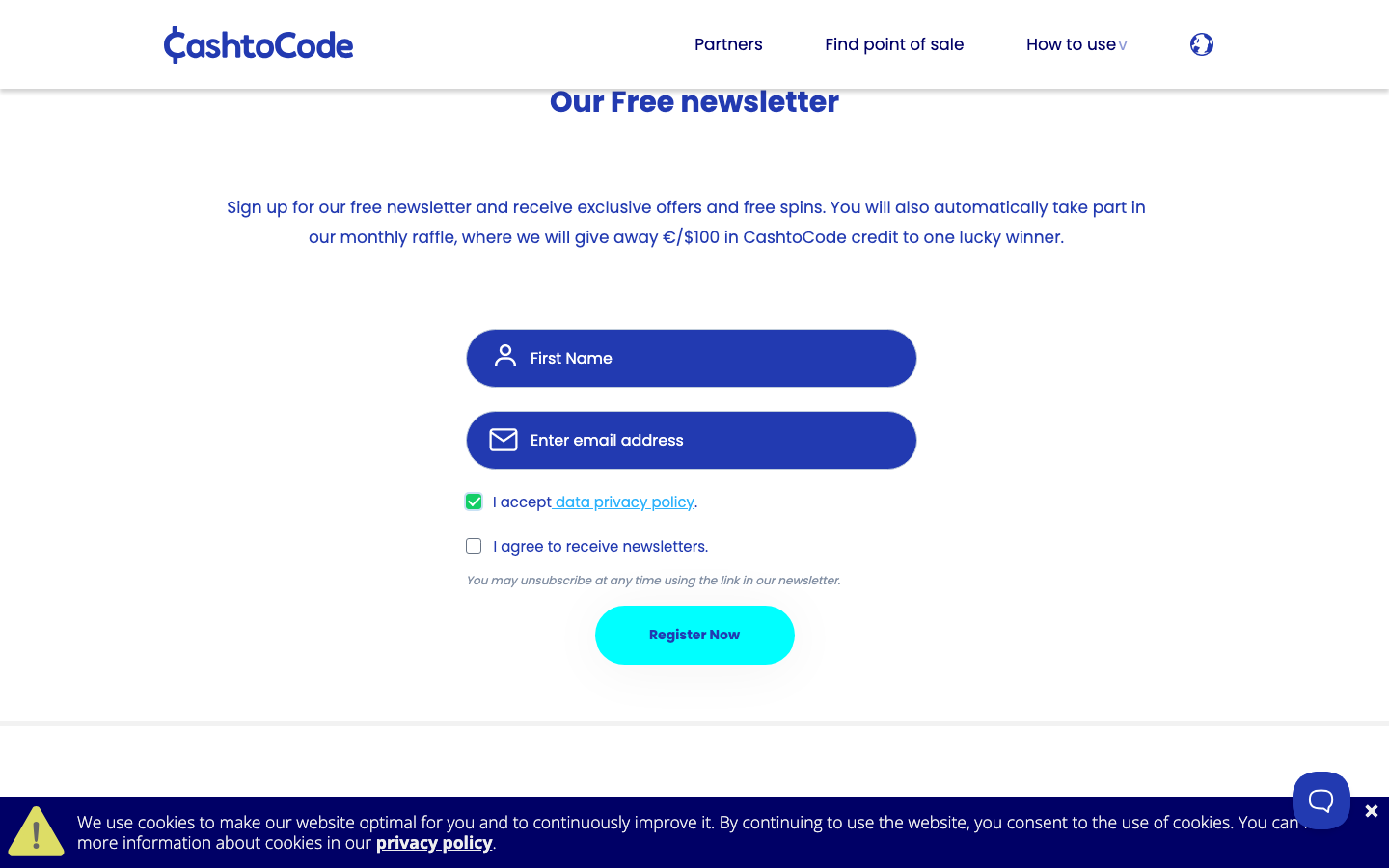
CashtoCode’s own UK site, checked directly this month, leads on anonymity and reach in equal measure — the pitch is paying online with cash, without a card or bank account, at a counter near you. That framing points at the real product: financial inclusion first, gambling incidentally. The company’s UK proposition rests on the PayPoint network, which is what makes the physical footprint credible where a proprietary retail network would not be.
CashtoCode Casino FAQs
Do UK casinos accept CashtoCode?
A few do, but coverage is thin and has been shrinking as operators consolidate their voucher options. paysafecard occupies the UK cash slot at roughly sixty UKGC casinos.
Where can I pay a CashtoCode barcode in the UK?
At participating PayPoint retailers — roughly 28,000 of them, typically corner shops, newsagents and convenience stores. Physical access is the method’s genuine strength.
Do I need a bank account or card?
Not for the deposit — that is the product’s purpose. You will need a bank account for withdrawals, since CashtoCode cannot pay winnings back.
Can I withdraw with CashtoCode?
No, never. It is deposit-only by design. Winnings leave by another route, usually a bank transfer to an account in your own name — arrange that before you deposit.
Is it the same as paysafecard?
No. paysafecard is a voucher you buy in advance and redeem with a PIN. CashtoCode generates a barcode at the cashier that you pay against afterwards, for an exact amount, with nothing left over.
Is CashtoCode safe?
The model is structurally sound: a barcode is tied to one pending payment on one account, so it has no value to anyone else — which defeats the voucher-PIN scams that plague the category. Anyone messaging you a barcode to pay is attempting fraud.
Are there fees?
Sometimes, set by the operator or the retail partner rather than by CashtoCode itself. Check the total on the cashier screen before heading to the shop.
Does it keep my gambling off my bank statement?
The deposit, yes — cash leaves no bank record. But the casino still verifies your identity, and any withdrawal will arrive by bank transfer, which does appear. It offers statement privacy on the way in, not anonymity.
Will my bank’s gambling block stop a CashtoCode deposit?
No. Bank blocks see card and bank payments; cash at a shop counter is invisible to them. If a bank block is central to your setup, add GAMSTOP, which works at the person level regardless of payment method.
What is PayPoint, exactly?
A network of payment terminals in corner shops, newsagents and convenience stores — traditionally used for energy top-ups and bill payments. Roughly 28,000 UK locations, which is why CashtoCode’s physical reach is genuinely national from day one.
Can I use CashtoCode without any ID?
Small deposits may not trigger checks at the counter, but the casino still verifies your identity — that is a licence condition, not a payment matter. Expect full KYC at your first meaningful withdrawal regardless of how you deposited.
Does a CashtoCode barcode expire?
Yes, within a validity window. If you do not reach a shop in time it simply lapses — nothing is charged and nothing is lost beyond the trip. Generate a fresh one when you are ready to pay.
Why is CashtoCode so rare at UK casinos when the network is so big?
Because cashier integrations follow player familiarity, and paysafecard had a two-decade head start as the answer to “how do I deposit cash”. Superior reach did not overcome an incumbent already sitting in the payment list.
Sources & Verification
Checked 24 July 2026 against: CashtoCode’s own UK site (captured by screenshot the same day) and its published eVoucher product documentation; PayPoint’s published UK retail-network figures; live UKGC operator cashier listings for cash-method availability on the date above; and the Gambling Commission’s payment-blocking guidance for the safer-gambling framing.