Revolut never appears as a cashier logo, yet millions of UK players deposit with it every month — because a Revolut card is just a card, welcome anywhere Visa and Mastercard are. The real story is everything wrapped around that card: a gambling block with a 48-hour lock, disposable numbers that won’t dodge it, and — since March 2026 — a full UK banking licence that finally puts FSCS protection behind the balance.
Casinos that accept Revolut are close to universal now, though the block and the new licence change the calculation.
Casinos with Revolut Payments
| Revolut at a Glance | |
|---|---|
| Works at UK casinos? | Yes — as a standard card, wherever cards are taken |
| Gambling block | Off by default; once on, lifting it takes 48 hours, app-only |
| Regulatory status | Full UK bank since 11 March 2026 (PRA + FCA) |
| Deposit protection | FSCS-covered — unusual praise on a payments site |
| Watch for | Disposable virtual cards still carry gambling merchant codes |
Checked 10 July 2026. Five questions cover the essentials before the detail starts.

| Question | The short answer |
|---|---|
| Can I deposit at UK casinos with Revolut? | Yes — the card runs on the standard networks, so every UKGC cashier that takes card deposits takes it |
| Is there a "Revolut" logo in cashiers? | Rarely — you use it as a debit card, not a named method |
| Do withdrawals come back to it? | Yes, like any debit card — often within hours where the casino runs push payments |
| The catch? | The in-app gambling block: once on, it declines every gambling transaction and takes 48 hours to lift |
| Is my money protected? | Since 11 March 2026, yes — full UK banking licence, FSCS cover on deposits |
Checked 10 July 2026 · 18+ · UKGC-licensed operators only · begambleaware.org
Revolut at UK Casinos: Quick Facts
| Category | App bank — deposits arrive at casinos as ordinary card payments |
|---|---|
| Founded | July 2015, London (Nik Storonskiy and Vlad Yatsenko) |
| Scale | 70m+ customers worldwide as of March 2026 |
| UK regulatory status | Authorised bank (PRA/FCA) since 11 March 2026, after years as an FCA e-money institution |
| Deposit protection | FSCS — the scheme’s ceiling rose to £120,000 on 1 December 2025 |
| Casino acceptance | Universal wherever card deposits exist; no dedicated cashier logo |
| Withdrawals | Back to the card like any debit product; push-payment casinos land in hours |
| Gambling block | Yes — merchant-category based, 48-hour removal delay |
| Fees for casino use | None from Revolut on GBP card payments; weekend FX margins apply cross-currency |

The Gambling Block, Properly Understood
Revolut’s gambling block is the single most consequential setting in the app for anyone reading this site. It ships switched off. Turn it on — profile icon, then Security, then Gambling block — and the app starts declining card transactions whose merchant category codes identify gambling: casinos, bookmakers, lottery terminals, the lot. Turning it off again is where Revolut shows its teeth: the setting only releases after a 48-hour cooling-off period, it can only be done in the app, and no support agent can hurry it.
Three practical truths follow. First, the block works on merchant coding, so it catches deposits at licensed UK operators reliably — they code their transactions honestly. Second, disposable virtual cards don’t dodge it: a one-time card number is still a Revolut card, still sees the same MCC, still declines. Third, the block is a card control, not a person control — money moved out of Revolut to another account is beyond its reach, which is why our safer-gambling section pairs it with tools that follow the person rather than the plastic.
The design philosophy — instant to arm, deliberately slow to disarm — is shared across the UK app banks, and it exists because the urge to lift a block usually burns out inside two days. Revolut’s implementation is solid mid-table: stricter than nothing, gentler than Monzo’s human-conversation requirement, similar in shape to Starling’s.
Revolut vs Monzo vs Starling for Casino Play
The three app banks look interchangeable from a cashier’s side — all issue cards the networks treat identically. The differences live in the controls and the corporate plumbing.
| Revolut | Monzo | Starling | |
|---|---|---|---|
| Card network | Visa or Mastercard (varies) | Mastercard | Mastercard |
| Block default | Off | Off | Off |
| Lifting the block | App only, 48h delay | Chat with support, then 48h | App only, 48h delay |
| UK bank licence | Since 11 Mar 2026 | Since 2017 | Since 2016 |
| FSCS cover | Yes, from March 2026 | Yes | Yes |
| FX / travel strength | The category leader | Fee-free spending abroad | Strong, fewer currencies |
Dedicated pages: Monzo and Starling. Honest positioning: pick by which bank you already hold. Nobody should open an account to gamble from it — but if a Revolut card is what’s in your Apple Wallet, nothing about it needs replacing at a casino.
How Revolut Casino Payments Work
Depositing
- Pick debit card in the cashier — there is no Revolut-branded option and none is needed.
- Enter the card details, or use the casino’s Apple Pay / Google Pay route with the Revolut card loaded — same rails, tokenised.
- Approve the app’s payment notification if prompted; funds land instantly.
- First deposit anywhere triggers the standard UKGC deposit-limit prompt — set one that means something.
Withdrawing
- Cash out to the same card under the closed-loop rule every UK casino follows.
- Where the operator runs Visa Direct or Mastercard Send, the credit typically arrives within hours of approval — Revolut processes push payments quickly.
- Legacy-rail casinos still take 1–3 working days; that variance belongs to the operator, not to Revolut.
Worth knowing underneath
Revolut issues cards on both major networks depending on account vintage, which occasionally explains why one player’s card behaves differently from another’s at the same cashier. Transactions carry real-time push notifications — a free session ledger most high-street banks still can’t match — and the app’s spending analytics categorise gambling spend plainly, which players tell us is either a feature or an ambush depending on the month they’ve had.
Licence, Protection & the March 2026 Change
For years the honest small print on any Revolut write-up was “e-money institution, not a bank” — safeguarded funds, no FSCS. That sentence retired on 11 March 2026, when Revolut Bank UK Ltd exited its mobilisation phase with full authorisation from the PRA and FCA. UK customer deposits migrating to the bank entity now sit behind the Financial Services Compensation Scheme — whose ceiling, helpfully, had just risen to £120,000 per person on 1 December 2025.
What doesn’t change: card security was never the weak point. Disposable virtual numbers for single transactions, instant freeze from the app, location-based security checks and per-merchant controls have been in place for years and remain the strongest consumer card toolkit in the UK market. What players should still respect: FSCS protects deposits at the bank — it does not follow money onto a casino’s books, where the UKGC’s funds-protection ratings apply instead, and it says nothing about Revolut’s crypto or investment products, which sit explicitly outside the scheme. Keep winnings in the bank layer, not the exotic layers, and the protection story is now genuinely good.
From FX Card to Licensed Bank: A Decade in Fast-Forward
- 2015 — Launched in London by Nik Storonskiy and Vlad Yatsenko as a travel-money card with interbank FX rates.
- 2018 — FCA e-money authorisation; the app sprawls into budgeting, crypto and business accounts.
- 2018 — European banking licence granted via Lithuania — a bank abroad, an e-money app at home.
- 2020 — The gambling block ships, joining the app-bank wave of merchant-level controls.
- 2021 — $33bn valuation makes it the UK’s most valuable fintech.
- 2024 — The long-awaited UK banking licence arrives in restricted “mobilisation” form in August.
- 2025 — November funding round values the group at $75bn; customer count passes 65 million.
- 2026 — Full UK authorisation on 11 March; FSCS protection begins rolling across UK accounts.
The through-line: Revolut spent a decade acquiring customers faster than licences, then spent the 2020s acquiring the licences. For casino players the practical upshot arrived only this year — the deposit protection gap between Revolut and the high street has finally closed.
Revolut & Gambling Around the World
Revolut operates across more than 160 countries and regions, and its card behaves at foreign cashiers the way it behaves at British ones — as local plastic, subject to local gambling law. In the EEA, accounts run under the Lithuanian banking entity and work at nationally licensed operators from Malta to Madrid; the gambling block travels with the app everywhere. Two cautions earn their place here. Cross-currency casino deposits meet Revolut’s FX margins — excellent on weekdays, marked up at weekends — so a euro-denominated cashier quietly costs more on a Saturday. And the card working somewhere says nothing about the operator being licensed there: an offshore site accepting your Revolut card enjoys none of the UKGC protections this site assumes, and the block’s merchant-code coverage is at its patchiest exactly where operators code themselves dishonestly. The card is global; your protections are jurisdictional. Deposit accordingly.
What Revolut Offers Away From the Cashier
Gambling is a rounding error in Revolut’s business. The app’s centre of gravity remains what it was in 2015 — multi-currency money for people who cross borders — now wrapped in stock and commodity trading, crypto exchange, savings vaults, eSIMs, business banking and a credit push that the UK licence finally unlocks properly. The scale numbers are the story: seventy million customers is more than most European banking groups assembled over a century, gathered by an app store listing in one decade. For this site’s readers the relevant spillover is behavioural: Revolut normalised checking your money several times a day, and its notification-per-transaction habit — built for expense tracking — happens to be one of the better informal gambling-awareness tools ever shipped, entirely by accident.
Revolut & Safer Gambling
Used deliberately, Revolut is one of the better-equipped mainstream apps for gambling control: the block declines gambling-coded card transactions outright, lifting it costs a 48-hour wait by design, and disposable card numbers offer no side door. Its limits: it’s a card control, so balances moved elsewhere — or cash-funded methods entirely outside Revolut — pass it by, and merchant coding is only as honest as the merchant. Anyone leaning on the block should layer it: GAMSTOP closes every UKGC account at the person level, deposit limits cap what any single cashier can take, and the whole kit lives in our responsible gambling hub. If gambling spend on the app’s neat little category chart has started reading as a problem, the National Gambling Helpline is free, confidential and answers around the clock on 0808 8020 133. 18+.
What Players Say About Revolut at Casinos
Player chatter about Revolut splits into three recognisable genres. The largest is pleasant non-news: deposits work, payouts arrive back on the card quickly at push-payment operators, and the instant notifications make reconciling a session trivially easy. The second genre is block discovery — players who armed the gambling block months earlier, forgot, and met a string of declines at a licensed cashier; the fix is the 48-hour wait, and the forums are commendably consistent about telling each other that the wait existing is the point. The third genre is the weekend FX complaint from players on non-GBP cashiers, which this page’s jurisdictions section prices out. Notably thin on the ground: fraud horror stories at licensed sites — the disposable-card and instant-freeze toolkit seems to pre-empt most of the classic card-misuse genre. The aggregate read is a payment experience that mostly disappears, which is the highest compliment cashier plumbing gets.
Best Pairings & When to Use Something Else
Revolut covers deposits and card-speed payouts well. Its natural complements:
- Open banking — bank-transfer deposits pull straight from the Revolut balance without card details, and pay-by-bank withdrawals land by Faster Payments; at some operators this beats the card route home.
- Apple Pay / Google Pay — the same Revolut card, tokenised; nothing typed, nothing stored at the casino.
- paysafecard — if you keep the gambling block armed and want a strictly cash-budgeted route that never touches the bank, vouchers are the honest answer rather than a workaround.
And one deliberate non-recommendation: don’t hold a gambling bankroll in crypto inside Revolut hoping to use it at casinos — UKGC operators don’t take crypto, and the conversion round-trip just adds cost. The boring GBP card is the whole product here, and it’s a good one.
Three Sessions, Costed
Abstract fee schedules hide more than they show, so here are three realistic Revolut casino sessions priced end to end. Session one: £50 at a UK casino, Tuesday evening. Deposit instant, no Revolut charge, no FX involved. Winnings of £80 pushed back via the casino’s card rail land the same evening. Total cost of the payment layer: nothing at all — the baseline experience, and the majority one.
Session two: €50 at a Malta-licensed casino, Wednesday. The deposit converts at Revolut’s weekday rate — interbank-class, so a fraction of a percent inside any plan’s fair-usage allowance. The €75 payout converts back on arrival at the same class of rate. Total cost: pennies, mostly the spread’s rounding — still better than most high-street banks manage on their best day.
Session three: the identical €50 session on Saturday night. Weekend FX markup applies both directions — deposit and payout each pay the surcharge, and a session that cost pennies midweek now costs a couple of pounds in pure conversion. Not ruinous; simply the one Revolut-specific cost a player controls entirely by choosing when to play non-GBP cashiers, or by holding a euro balance converted midweek in advance — the multi-currency feature doing exactly the job it was designed for.
The pattern across all three: sterling play is free, weekday FX is nearly free, weekend FX is the tax on spontaneity. Players who know the three tiers pay the first one almost every time.
Limits, Currencies & the Weekend Rule
Three Revolut-specific mechanics decide whether the card is free or quietly costly at a cashier. First, the currency of the casino account: sterling-to-sterling never meets an exchange rate, but a euro- or dollar-denominated cashier converts at Revolut’s rates — interbank-class on weekdays, marked up at weekends, so a Saturday-night session on a non-GBP site pays a toll a Tuesday one wouldn’t. Second, plan tiers set monthly fair-usage allowances on currency exchange; heavy cross-currency players can exhaust the free tranche and meet the surcharge mid-month. Third, account-level spending controls — per-transaction limits, category budgets, the freeze switch — all apply to gambling merchants like any other, and pair usefully with the casino-side deposit caps every UKGC operator now prompts for. And one age note that occasionally surprises households: Revolut’s under-18 accounts cannot transact with gambling merchants at all, an unconditional block that no setting relaxes — exactly as it should be.
Our Verdict on Revolut for UK Casino Players
Revolut at the cashier is quietly excellent and completely unremarkable — a card the networks treat like any other, backed by an app that out-tools every high-street bank. The 2026 banking licence removed the one substantive caveat this site used to attach (no FSCS), and the gambling block is a genuinely well-built control provided you understand it guards the card, not the person. Players who want its 48-hour lock plus person-level cover should pair it with GAMSTOP. If you already bank with Revolut, there is no reason to reach for anything else at a UK casino; if you don’t, its casino performance alone is no reason to switch — Monzo and Starling tie it where it matters and each does one thing slightly differently. Choose by where your salary lands, not by the cashier.
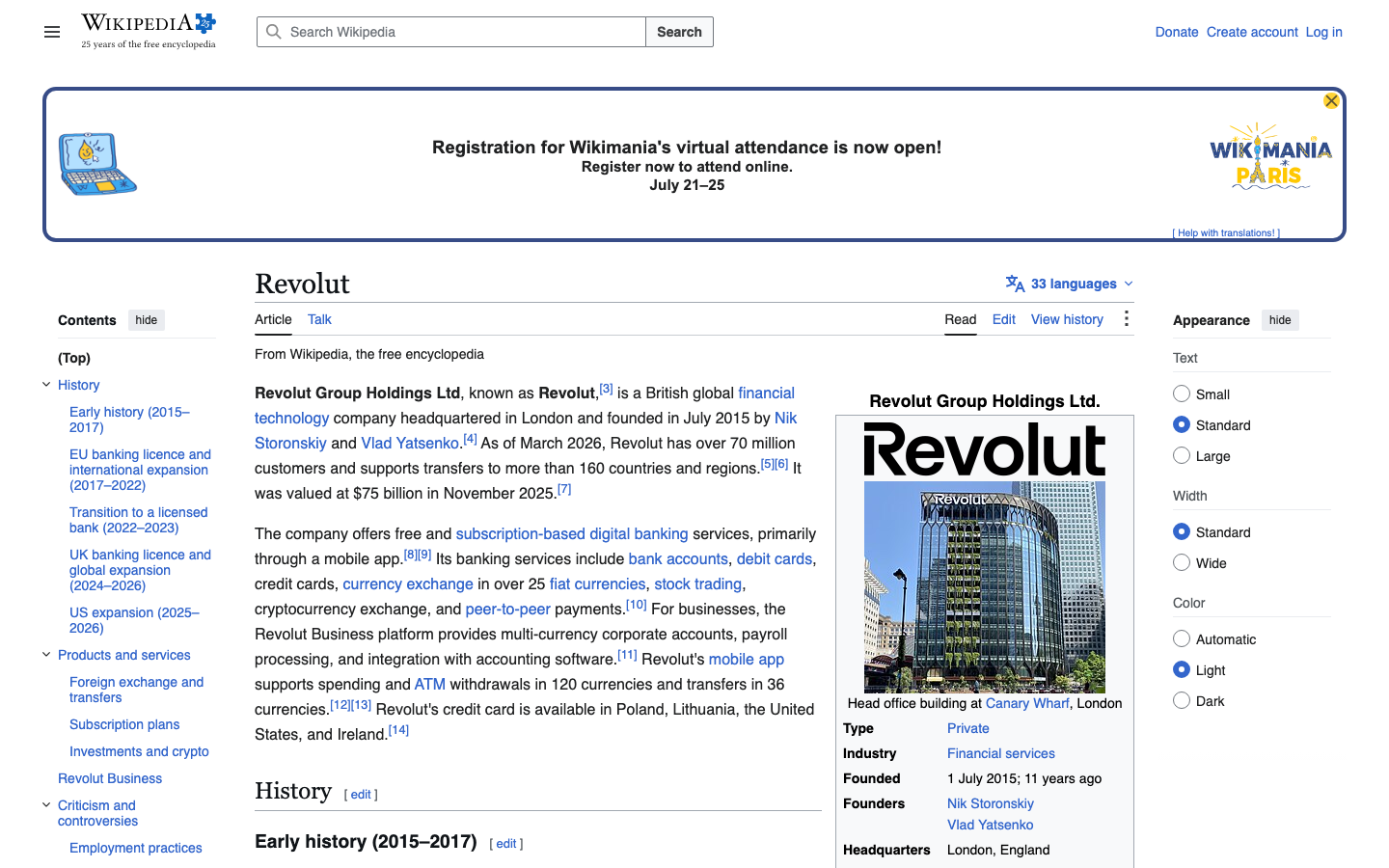
Independently confirmed this month against Revolut’s public company profile (its own site sits behind a bot-check, so Wikipedia’s sourced entry did the honours, cross-checked with the official FCA register): Revolut Group Holdings Ltd counted over 70 million customers as of March 2026, was valued at $75 billion in November 2025, and received its full UK banking licence on 11 March 2026 — ending a decade in which Britain’s biggest fintech wasn’t technically a British bank.
Revolut Casino FAQs
Do UK casinos accept Revolut?
Yes — every UKGC casino that accepts card deposits accepts a Revolut card, because it runs on the standard Visa/Mastercard rails. You will almost never see a Revolut logo in a cashier; you simply use it as a debit card.
How does the Revolut gambling block work?
It declines card transactions whose merchant category codes identify gambling. It ships off; you arm it in the app under Security. Lifting it takes a fixed 48-hour cooling-off period, app-only — support cannot shortcut it.
Can disposable virtual cards get around the gambling block?
No. A disposable number is still a Revolut card and the gambling merchant code still triggers the decline. That is by design, and it is the right design.
Is Revolut FSCS protected now?
Yes — Revolut received its full UK banking licence on 11 March 2026, and eligible deposits at the UK bank entity carry FSCS protection (the scheme limit rose to £120,000 in December 2025). Crypto and investment balances sit outside the scheme.
How fast are casino withdrawals back to Revolut?
At casinos running Visa Direct or Mastercard Send, typically within hours of approval — Revolut credits push payments quickly. At legacy-rail operators, allow 1–3 working days. The operator side is the variable.
Does Revolut charge fees for casino deposits?
Not in sterling — a GBP deposit at a UK casino is a plain card payment. Cross-currency play meets Revolut’s FX pricing, which is excellent midweek and carries a markup at weekends.
Can I use Revolut through Apple Pay or Google Pay at casinos?
Yes — load the card into either wallet and use the casino’s Apple Pay/Google Pay option. It is the same Revolut card underneath, tokenised, and the gambling block still applies.
Will casino transactions show in the Revolut app?
Instantly, each with a push notification, and the analytics categorise gambling spend as its own line. For players tracking their play, that visibility is genuinely useful.
Revolut or Monzo for casino use?
Functionally near-identical at the cashier. Monzo’s block requires a conversation with support to lift (plus 48 hours); Revolut’s is app-only with the same delay. Pick whichever you already bank with — neither is worth switching for.
Can I gamble with the crypto I hold in Revolut?
Not at licensed UK casinos — zero UKGC operators accept crypto in any form. You would have to sell into GBP first, at which point it is just money. Our crypto guide covers why the wall exists.
Do Revolut Pockets or spare accounts get around the gambling block?
No — the block operates at profile level across your Revolut cards, not per card or per balance. Money moved to a different bank entirely is outside its reach, which is why person-level tools like GAMSTOP belong alongside it rather than instead of it.
Can I set my own spending limit on gambling in Revolut without the full block?
Partially — per-transaction and category budget tools give you soft visibility and hard card-level caps, and pairing them with the casino’s own deposit limits covers the rest. The full block remains the only setting that declines gambling merchants outright.
Sources & Verification
Checked 10 July 2026 against: Revolut’s regulatory status on the FCA Financial Services Register (Revolut Bank UK Ltd; Revolut Ltd’s historical e-money authorisation); Revolut’s documented corporate history including the 11 March 2026 full banking licence (revolut.com itself blocks automated verification, so facts were cross-confirmed rather than assumed); Revolut’s published help-centre documentation on the gambling block’s 48-hour removal delay; the FSCS on the £120,000 deposit-protection limit effective 1 December 2025; and the Gambling Commission’s guidance on blocking gambling transactions.