
 By Will Fencer, Payments Editor · Published · Last updated
Debit cards are the default way to pay at UK online casinos: accepted by every UKGC-licensed site, instant to deposit with, free to use, and — since the credit-card ban of April 2020 — the only cards allowed in the cashier. Withdrawals return to the same card under the closed-loop rule, and on Visa Debit they increasingly arrive in under 30 minutes through Visa Direct. The catch nobody explains: whether your card is Visa or Mastercard quietly decides how fast you get paid.
Casinos that accept debit cards are every casino there is; the network printed on the front is what quietly decides your payout speed.
Casinos with Debit Card Payments
| Debit Card at a Glance | |
|---|---|
| Best for | Universal fallback — the one method every UKGC casino accepts |
| UKGC coverage | 100% of licensed operators |
| Deposit speed | Instant |
| Withdrawals | Via Visa Direct/Mastercard Send where supported, otherwise bank transfer |
| Fees | None at the cashier |
Every casino licensed by the Gambling Commission takes Visa Debit, and all but a handful take Debit Mastercard, so “which casinos accept debit cards” is the wrong question — the right one is which casinos treat debit-card players best once the money is in. The list below is chosen on exactly that: how fast card withdrawals are actually processed, how low the minimum deposit goes, and whether the cashier does anything silly like routing your winnings to a bank transfer form. Availability and terms checked 4 July 2026; cashier line-ups change, so re-check on site before you deposit.
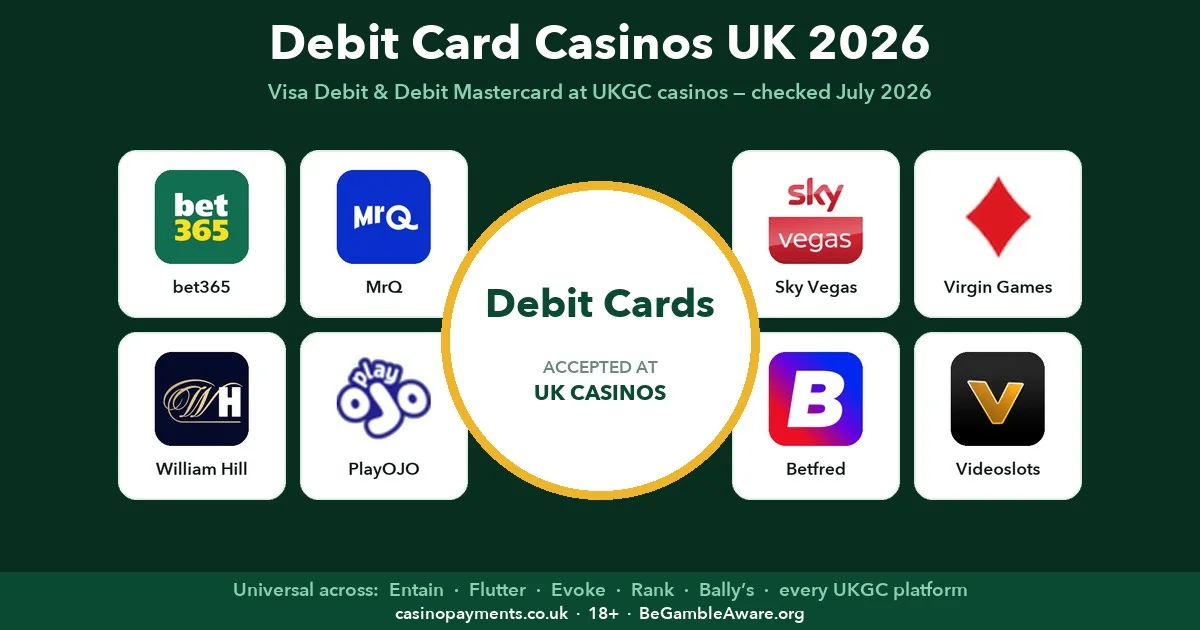
| Casino | Why it stands out for debit cards specifically | Min deposit |
|---|---|---|
 bet365 Casinobet365.com bet365 Casinobet365.com | Routes eligible Visa Debit withdrawals through Visa Direct and publishes bank-by-bank payout guidance rather than a vague "1–5 days" line. | £5 |
 MrQmrq.com MrQmrq.com | Card payouts regularly land inside the hour, and rewards are wager-free — so a debit deposit is never feeding a bonus you can't cash out. | £10 |
 William Hill Vegaswilliamhill.com William Hill Vegaswilliamhill.com | Openly documents its Visa Direct support; independent reviewers have timed card withdrawals landing in under 20 minutes. | £10 |
 PlayOJOplayojo.com PlayOJOplayojo.com | No-wagering bonus model plus fee-free card payouts — the whole site is built around not punishing the deposit method. | £10 |
 Sky Vegasskyvegas.com Sky Vegasskyvegas.com | One of the few big brands with a £5 card minimum, which matters if you use debit deposits as a budgeting tool. | £5 |
 Virgin Gamesvirgingames.com Virgin Gamesvirgingames.com | Simple card-first cashier and consistently quick processing of small card withdrawals without pestering for extra documents. | £10 |
 Betfredbetfred.com Betfredbetfred.com | Withdrawal team processes around the clock, so card payouts requested at night don't sit until morning. | £5 |
 Videoslotsvideoslots.com Videoslotsvideoslots.com | Processes withdrawal batches several times a day and supports unusually high limits for card players. | £10 |
 Grosvenor Casinosgrosvenorcasinos.com Grosvenor Casinosgrosvenorcasinos.com | The same debit card works online, in the app and on the actual casino floor — nobody else bridges the two like this. | £20 |
 All British Casinoallbritishcasino.com All British Casinoallbritishcasino.com | UK-only focus means the cashier is built entirely around GBP debit cards — no currency conversion edge cases. | £10 |
Checked 4 July 2026 · 18+ · UKGC-licensed operators only · begambleaware.org
Debit Cards at UK Casinos: Quick Facts
| Category | Bank-issued debit card (Visa and Mastercard networks) |
|---|---|
| UK gambling status | Accepted — the standard method at every UKGC-licensed casino |
| Deposits | Yes — instant |
| Withdrawals | Yes — closed-loop back to the deposit card (rare Mastercard exceptions, covered below) |
| Typical deposit speed | Instant |
| Typical withdrawal speed | Casino review (0–24h+) then Visa Direct often under 30 minutes; Mastercard minutes to 3 working days |
| Fees to the player | None — UK casinos don’t charge for debit deposits and banks treat them as ordinary purchases |
| Typical minimum deposit | £5–£10 |
| Maximum | Set by the casino and your own bank’s daily card limits, not the network |
| Devices | Everything — desktop, mobile web, apps; no wallet app or extra account needed |
| Bonus eligibility | Fully eligible — debit is never excluded the way Skrill and Neteller often are |
| Our score | 9/10 — see the verdict for sub-scores |
Visa, Mastercard, Amex, Maestro: Which Cards Actually Work?
“Debit card” hides more variety than the cashier logos suggest, and the UK rules treat each type differently. Here is the full family — including the ones that no longer work, and the one that never really did.

| Card type | At UK casinos? | The detail |
|---|---|---|
| Visa Debit | Yes | The default card in the British wallet and the cashier benchmark: accepted everywhere, instant deposits, and the fastest card payouts thanks to Visa Direct. |
| Debit Mastercard | Yes | Functionally identical for deposits; withdrawal support is broad but still patchier than Visa’s, as covered in the network section. |
| Prepaid Visa / Mastercard | Mostly | Cards like the Post Office or supermarket prepaid products run on the same rails and usually deposit fine. Two catches: anonymous gift-style cards can fail the casino’s source-of-funds checks, and many casinos can’t pay winnings back to prepaid cards — expect a bank-transfer fallback. |
| Virtual & disposable cards | Deposits, yes | Virtual debit cards from Monzo, Revolut and co. work like the plastic version. Avoid disposable numbers that regenerate after each use, though — the closed-loop rule wants to return winnings to the card you paid with, and a card number that no longer exists turns a routine payout into a support ticket. |
| Maestro | Fading fast | The old Switch successor is being retired across Europe — Mastercard stopped issuing new Maestro cards from mid-2023 — and UK banks abandoned it years earlier. A few cashiers still show the logo; almost nobody holds the card. |
| Visa Electron | No | Discontinued. Electron was the stricter no-overdraft sibling of Visa Debit, and UK issuers phased it out long ago — any Electron logo you spot in a cashier is archaeology, not availability. |
| Visa / Mastercard credit | Banned | Illegal for GB gambling since 14 April 2020, including credit cards hiding behind an e-wallet top-up. This is regulation, not casino policy — no UKGC site can take them. |
| American Express | No | Amex only issues credit and charge cards in the UK, so the 2020 ban rules it out entirely — and even before the ban, Amex’s higher merchant fees meant almost no UK casino accepted it anyway. There is no Amex debit card to fall back on. |
| Diners Club / Discover | No | Credit products with no meaningful UK gambling acceptance, before or after the ban. You will not find them in a UKGC cashier. |
The practical upshot: in 2026 the “which card?” decision has collapsed to Visa Debit vs Debit Mastercard, with prepaid as the budgeting wildcard. Everything else on the list is either banned, buried or a logo the cashier forgot to delete.
Debit Card vs PayPal vs Open Banking vs Apple Pay
These are the three methods most players weigh up against a straight debit card. The short version: nothing beats debit for universality and bonus eligibility, open banking is its equal on withdrawal speed, PayPal adds a privacy buffer at the cost of occasional bonus exclusions, and Apple Pay is really a faster way to use the same card — usually without the ability to withdraw.
| Debit card | PayPal | Open banking | Apple Pay | |
|---|---|---|---|---|
| Deposit speed | Instant | Instant | Instant | Instant |
| Withdrawals | Yes — closed loop | Yes | Yes | Rarely — usually routes to the underlying card |
| Typical payout time | Under 30 min (Visa Direct) to 3 days | Often within 24h | Minutes to hours | n/a at most casinos |
| Fees | None | None at the casino; FX fees possible | None | None |
| Bonus eligibility | Always eligible | Occasionally excluded | Almost always eligible | Usually eligible |
| Bank gambling block works? | Yes — fully | Partly — depends how the wallet is funded | Yes | Yes — it’s still your card underneath |
| Needs an extra account/app | No | Yes | No (your banking app) | Apple device only |
Full reviews of PayPal, open banking and Apple Pay at UK casinos are coming to this site shortly — each gets the same treatment as this page.
Debit card vs Every Other Payment Method
Every method on this site ultimately competes with the debit card already in your pocket, so here is the full-field view: where the default keeps its crown, and exactly what you would gain — and give up — by switching to each alternative.

| Against | Debit card wins on… | It wins on… |
|---|---|---|
| Open banking | No app hop — just enter, confirm, play | Payout pace straight into FSCS territory, something debit doesn’t offer |
| PayPal | No account to run or verify | The widest wallet acceptance on the high street, outpacing debit on this front |
| Apple Pay | Working whether or not the phone battery does | Face ID deposits in a couple of seconds, — debit’s blind spot |
| Google Pay | No handset dependence whatsoever | Tap-speed deposits across every Android, a lead over debit |
| Bank transfer | Instant deposits instead of reference-number ceremony | Heavyweight limits no wallet will match, where debit can’t follow |
| MuchBetter | Nothing new to sign up for | The category’s lightest fees and freshest security, — beyond debit here |
| Jeton | Acceptance the young wallet is still chasing | High-street listings and cash-code entry, where it out-does debit |
| MiFinity | Listings at literally every UKGC operator | Home-turf regulation with a cheap schedule, ground debit gives up |
| Skrill | Never appearing on a bonus exclusion list | Sheer coverage, deep into the casino long tail, still ahead of debit there |
| Neteller | No fee schedule to read, ever | The Net+ Mastercard and veteran reach, an area debit concedes |
| Paysafecard | No shop trip before the session | A ceiling set in banknotes at the till, which debit can’t claim |
| Pay by mobile | No £30-a-day handbrake | Needing nothing but a phone number, — not debit’s game |
| Payz | Zero tiers, zero admin, full coverage | The ecoVoucher door and tier rewards, something debit doesn’t offer |
| Neosurf | Payouts straight back to the same card | Shop-bought codes with hard budget edges, outpacing debit on this front |
| Prepaid cards | No loading step and payout returns everywhere | A ceiling your current account can’t impose |
The pattern in the grid: debit never wins on any single speciality and never loses on the fundamentals — which is what being the default means. The setup most players end up with pairs it with open banking: card for deposits, bank rail for the payout leg.
How Debit Card Casino Payments Work
Depositing with a debit card, step by step
The flow below is the standard UKGC cashier experience. From a saved card it’s four taps; first time through it looks like this:
- Open the cashier and choose Debit Card (some casinos label it “Visa/Mastercard”).
- Enter the long card number, expiry and CVV — the three digits on the signature strip.
- Enter an amount at or above the casino’s minimum (usually £5 or £10). If this is your first ever deposit, expect the site to prompt you to set a deposit limit first — that’s been a Gambling Commission requirement since 31 October 2025, not the casino being pushy.
- Confirm, and watch for a 3-D Secure challenge: most UK banks now fire a push notification to your banking app, or fall back to a one-time SMS code. This is Strong Customer Authentication and gambling deposits almost always trigger it.
- Approve in your banking app. The cashier confirms and the balance is playable instantly.
The transaction appears on your statement under the casino’s payment descriptor, coded as a gambling merchant (more on that code below — it’s how bank gambling blocks work). One thing you cannot do: use a card that isn’t in your name. Casinos cross-check the cardholder name against the account during KYC, and deposits from someone else’s card are grounds for voided winnings and a closed account.
Withdrawing to a debit card, step by step
- Verify your account if you haven’t already — ID and sometimes proof of address. Do this before you win; it’s the single biggest cause of “slow” withdrawals.
- Open the cashier, choose withdraw, and select the card you deposited with. Under the closed-loop rule you generally won’t be offered anywhere else to send it.
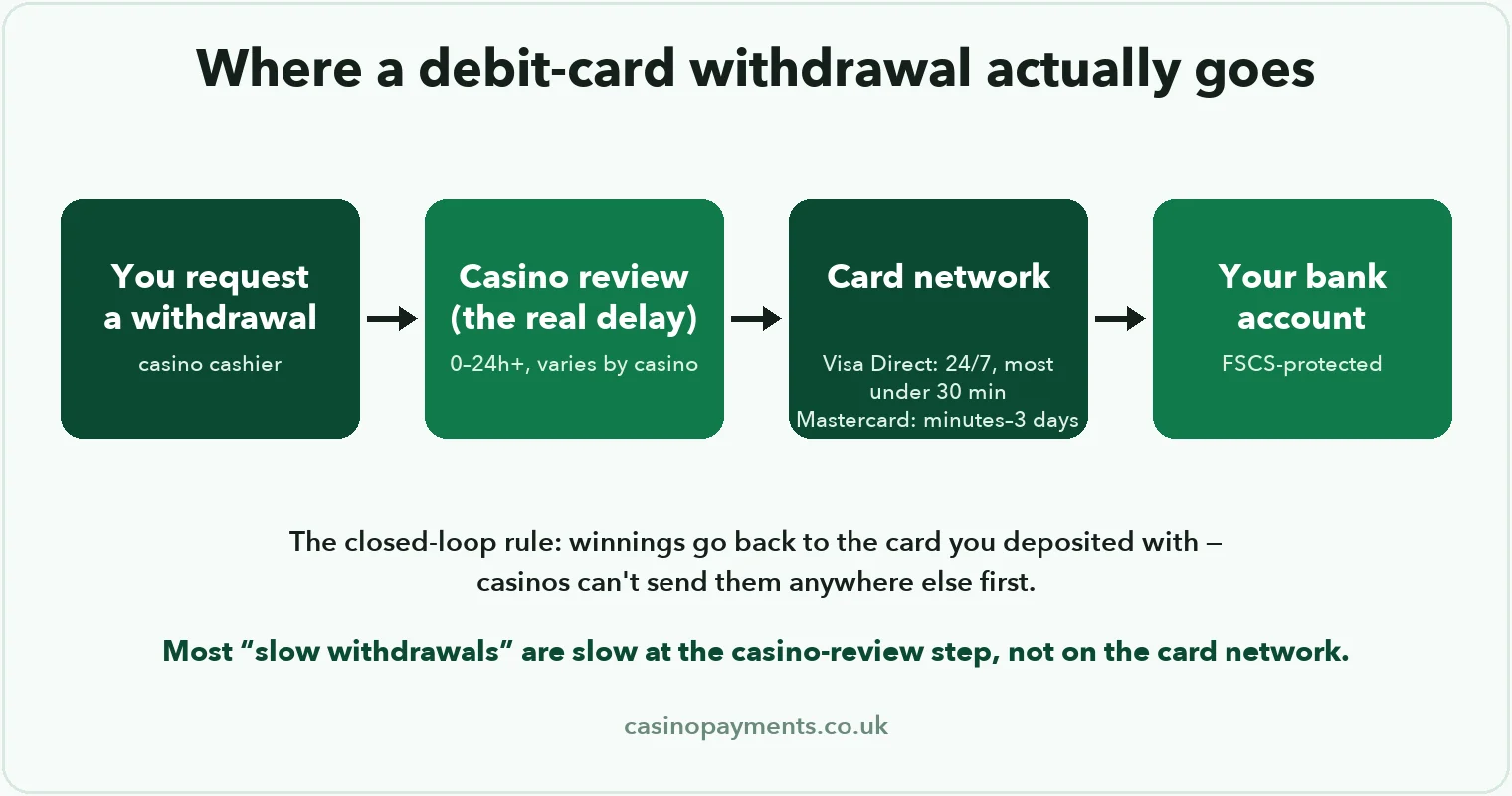
- Enter the amount and confirm. The request enters the casino’s pending/review queue — this is where the real waiting happens, anywhere from minutes at the fast sites to 24 hours or more at slow ones.
- Once approved, the payment is released to the card network. Eligible Visa Debit payouts travel over Visa Direct, which runs 24/7 and typically lands funds in under half an hour; other payouts settle like a refund, in one to three working days.
Under the hood
A debit deposit is an ordinary card-not-present purchase: the casino’s payment processor sends an authorisation to your bank across the Visa or Mastercard network, your bank checks funds and Strong Customer Authentication, and money moves from your current account within seconds. Nothing is “held on account” with the network — unlike an e-wallet there is no float, which is exactly why debit money benefits from full bank-account protection right up to the moment you press deposit.
Withdrawals are the interesting part. Traditionally casinos paid cards by refund-style credit, which trundles through settlement in 1–3 working days. What changed the game is push-payment rails — Visa Direct (and Mastercard’s equivalent, Mastercard Send) — which push money to the card in near-real time, around the clock, weekends included. William Hill’s own support pages, for example, state that eligible Visa withdrawals of £10,000 or less route via Visa Direct automatically. Whether you actually get the fast rail depends on three things: the casino has implemented it, your card’s network supports it, and your bank posts instant credits. That’s why two players at the same casino can report “10 minutes” and “2 days” for the same button.
Debit Card Casino Fees, Limits and Real Clearing Times
Debit is the cheapest method in the cashier, full stop. What follows is the honest breakdown of the few places money or time can still leak.
| Potential cost | Reality |
|---|---|
| Casino deposit fee | None at UKGC casinos — charging for deposits died out years ago |
| Casino withdrawal fee | None at any casino worth playing at; treat a card-payout fee as a red flag |
| Bank fee | None — debit gambling transactions are processed as standard purchases, not cash advances (that trap only ever applied to credit cards, which are banned anyway) |
| Currency conversion | The one genuine cost: if a casino bills in euros or dollars, your bank adds a non-sterling transaction fee, typically around 2.75–2.99%. UKGC sites bill in GBP; check if you play anything unusual |
| Interest | Never — it’s your money, not borrowed money. This is the entire point of the 2020 rule change |
Limits. Minimum deposits run £5–£10 depending on the casino. Maximums are set by the operator (often £5,000–£50,000 a day for cards, sometimes effectively uncapped) and by your own bank’s daily card-spending ceiling — the first limit most high rollers actually hit is their bank’s, not the casino’s. Since 30 June 2026 every UKGC site must also offer a true deposit limit — one counting only money in — and only that may be called a deposit limit; set one and it overrides everything else on this list.
Speeds. Deposits are instant, universally. For withdrawals, split the journey in two. Stage one is the casino’s internal review: the fast operators clear card payouts in minutes and the slow ones take a day or more — this gap is operator policy, nothing to do with your card. Stage two is the network: Visa Direct payouts run 24/7 and mostly land inside 30 minutes (independent tests have timed major UK brands between 1 and 30 minutes); non-eligible payouts settle in 1–3 working days. Mastercard’s fast-payout rail exists but reached UK casino cashiers later and less completely than Visa’s — which brings us to the section below.
Visa Debit vs Debit Mastercard: The Asymmetry Nobody Mentions
At the deposit screen the two networks are identical. At the withdrawal screen they historically weren’t, and at some casinos still aren’t. For years many UK operators could push instant payouts to Visa cards but not to Mastercards, and a few couldn’t return money to Mastercard debit at all — if you deposited with one, the cashier quietly steered you to a bank transfer instead. Mastercard’s own push-payment rollout has closed most of that gap, and in 2026 the large UK brands pay out to both networks, but the residue is real: Mastercard payouts are still more likely to fall back to the slower 1–3 day settlement route, and the odd cashier still won’t do them.
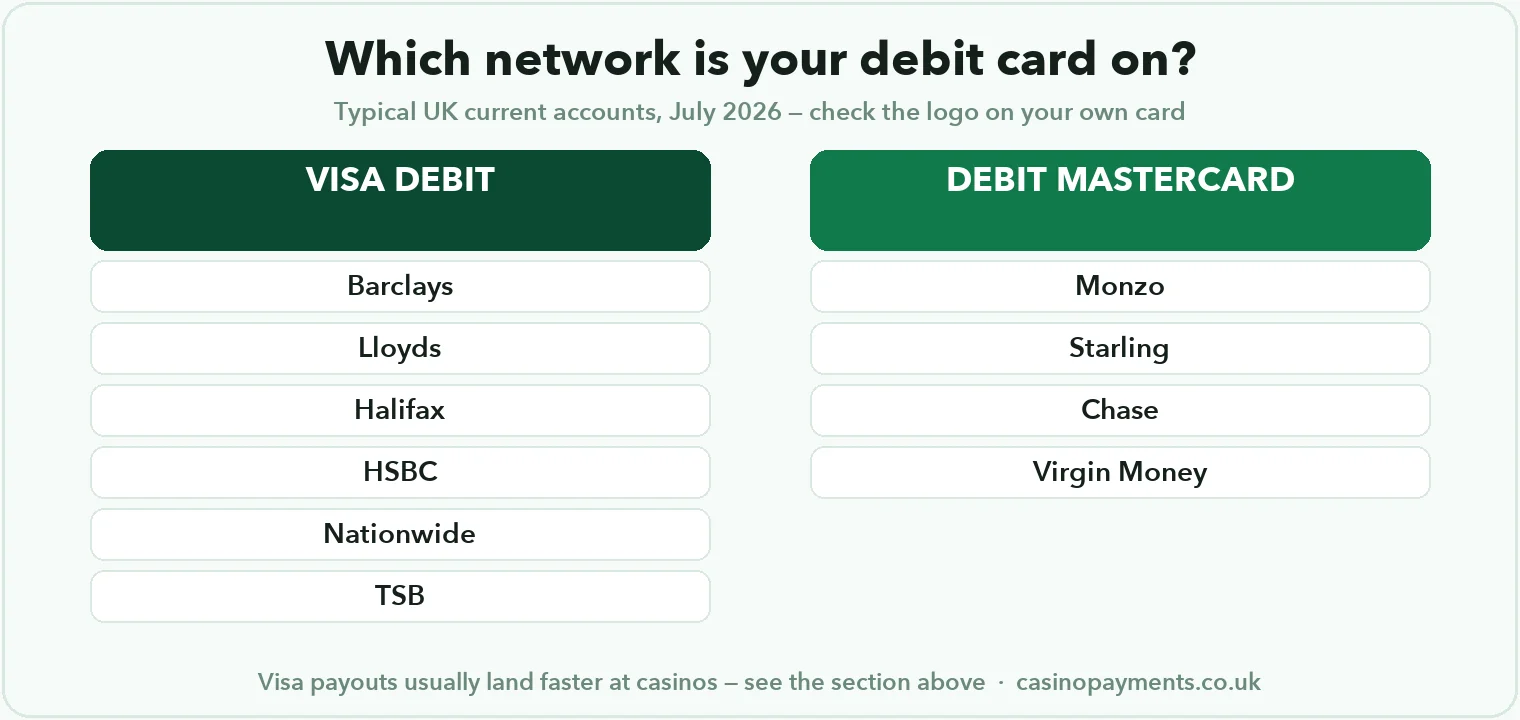
Why should you care? Because you often don’t choose your network — your bank does. As a rule of thumb among UK current accounts at the time of writing: Monzo, Starling, Chase and Virgin Money issue Debit Mastercard, while Barclays, Lloyds, Halifax, HSBC, Nationwide and TSB issue Visa Debit. If you bank with a Mastercard issuer and payout speed matters to you, it’s worth checking a casino’s withdrawal page for “Mastercard withdrawals supported” before depositing — or using open banking for the cash-out leg where the casino allows it.
Every Platform Takes Debit — But They Don’t Behave the Same
Debit acceptance is universal, so the platform question flips: it isn’t whether your card works, it’s how the network behind the casino treats it once you want money back. UK casinos cluster onto a dozen or so shared platforms, and payout behaviour is set at that level — which is why fifty different-looking Jumpman sites all pay you in exactly the same way.
| Platform / network | Example casinos | What debit players should know |
|---|---|---|
| bet365 (proprietary) | bet365 Casino | Publishes payout expectations bank by bank and routes eligible Visa payouts through Visa Direct |
| Flutter | Sky Vegas, Paddy Power Games, Betfair Casino | Strong fast-payout record on Visa Debit across the UK brands |
| Evoke | William Hill Vegas, 888casino | Documents its Visa Direct support openly; card payouts independently timed under 20 minutes |
| Rank Interactive | Grosvenor, Mecca | The rare network where one debit card serves web, app and the physical casino floor |
| Bally’s UK | Virgin Games, Monopoly Casino, Jackpotjoy | Reliable card processing with sensible £10 minimums across the family |
| Skill On Net | PlayOJO, Lord Ping | Card payouts carry no fees and no wagering strings on the OJO brands |
| Jumpman Gaming | Megaways Casino + 150-odd bingo/slots sites | Cards are the value pick here: the network’s pay-by-mobile alternative charges £2.50 a transaction |
| White Hat Gaming | Barz, 21Prive | Card-centric cashier with genuinely quick payouts — reviewers have timed Barz around the half-hour mark |
| ProgressPlay | Dozens of white-label skins | Card withdrawals typically settle 1–3 working days after the pending window — slower than the majors |
The pattern to take away: the majors compete hard on card payout speed, the white-label networks don’t, and no platform anywhere charges you to use a debit card. If payout time is your priority, pick the platform first and the brand second.
Chargebacks, 3-D Secure and What Your Bank Actually Covers
Paying by debit card means your money never touches an intermediary balance: it sits in your current account — where it enjoys FSCS protection up to £85,000 — until the moment a deposit is authorised. Compare that with e-wallets, whose balances are safeguarded under e-money rules but explicitly not FSCS-protected: a distinction most comparison sites skip and the single strongest security argument for debit.
Once money is inside a casino, protection changes hands. UKGC operators must tell you which of three player-fund protection levels they hold — basic (funds in the company accounts, you’re an unsecured creditor if it fails), medium (funds in separate accounts with some insurance or trust arrangement) or high (formal trust account) — and it’s stated in every casino’s terms. It applies identically whatever method you deposited with; the debit-card advantage is purely on the outside of the cashier.
On the transaction itself: card details are transmitted under PCI DSS rules, UK banks enforce Strong Customer Authentication on gambling deposits (the banking-app approval step), and modern cashiers tokenise your saved card so the casino never stores the full number. Two honest caveats. First, debit has no Section 75 — that consumer-credit protection applies only to credit cards. Chargeback rights exist under scheme rules for fraud and processing errors, but a chargeback is not a refund service for gambling losses: “I lost and regret it” claims fail, and firms promising otherwise for a fee are best avoided. Second, because a debit card draws on your whole balance in real time, it has no natural ceiling — the safer-gambling section below is not decoration; it’s the counterweight this method genuinely needs.
So, is a debit card safe for casino deposits? Yes — provided the casino holds a UKGC licence, it is the most directly protected route into a cashier that currently exists: regulated bank, regulated network, regulated operator, no intermediary holding your float.
A Short History of the UK Debit Card (and How It Conquered the Casino)
The debit card is such furniture that it’s easy to forget it’s younger than the Walkman. The UK got its first one in June 1987, when Barclays launched Connect; the rival Switch scheme followed in 1988, and for fifteen years “Switch or Delta?” was a question asked at every British till. Switch was folded into Maestro in 2002, Visa’s Delta branding faded into plain Visa Debit, and by the time contactless arrived in 2007 the UK was a two-network market — which it remains.
The milestones that shaped how you pay a casino today:
- 1987 — Barclays Connect: the UK’s first debit card.
- 1988 — Switch launches; debit becomes a mass-market product.
- 2002 — Switch merges into Maestro; Visa Debit and Debit Mastercard emerge as the two survivors.
- 2007 — First UK contactless cards.
- 2017 — Debit cards overtake cash as Britain’s most-used payment method — the same year they cement themselves as the default casino deposit.
- 14 April 2020 — The Gambling Commission bans credit cards for all remote gambling, including credit-funded e-wallet deposits. Overnight, debit becomes the only card in the cashier.
- October 2021 — Contactless limit rises to £100.
- 2022 — Strong Customer Authentication fully enforced on UK online payments; the banking-app approval step becomes routine on deposits.
- 2025–2026 — The deposit-limit era: prompts to set limits before a first deposit (31 October 2025), then standardised deposit limits at every site (30 June 2026).
The quiet story inside that timeline is the credit-card ban. The Commission estimated hundreds of thousands of players were gambling on borrowed money; removing it made the humble debit card the load-bearing wall of the entire UK cashier — and every rule since, from affordability prompts to deposit limits, has been built on top of it.
Debit Cards & Gambling Around the World
The UK is unusually debit-friendly: one regulator, one currency, and a rulebook that made debit the only card in the game. Elsewhere the same card behaves very differently. In regulated US states, debit is accepted but card declines are notoriously common — individual banks still refuse gambling-coded transactions at their own discretion, a hangover from the federal payment-blocking era, which is why US cashiers push bank-link methods so hard. Norway goes further than anyone: its payment-blocking rules require banks to decline gambling transactions to unlicensed operators outright, making the card network itself the enforcement tool. Ireland followed the UK’s lead on borrowed money, banning credit cards for gambling under its 2024 gambling reforms — debit remains fine. And across much of the EU, debit deposits work exactly as in the UK, with the local twist that some markets (Sweden, the Netherlands) pair them with national self-exclusion registers that block at the account level rather than the card level. If you ever gamble abroad, the lesson travels well: the card is global; the rules around it are ferociously local.
Beyond the Cashier: Two Networks You See Every Day
The two brands on Britain’s debit cards spend more on sport than most gambling companies earn. Mastercard has sponsored the UEFA Champions League since the 1990s and built one of advertising’s most durable campaigns around “Priceless”, which has run since 1997. Visa has been an Olympic partner since 1986 and a FIFA World Cup sponsor for most of this century — if you’ve watched a major final, you’ve watched their logos rotate on the hoardings behind the goal. There’s decent trivia in the names, too: Visa was chosen in the 1970s partly because it’s pronounceable in almost every language (the product began life in 1958 as the BankAmericard), while Mastercard’s interlocking red-and-yellow circles have been on cards since the 1960s Interbank era. None of this changes your withdrawal speed — but it explains why these two networks, and only these two, ended up in every UK wallet and therefore every UK cashier.
Bonuses & Debit Cards
Here debit holds a clean advantage: no UK casino excludes debit-card deposits from welcome offers. The exclusion lists you’ll find in bonus terms are aimed at Skrill and Neteller — a legacy of bonus-abuse wars the e-wallets lost — and debit is never on them. Deposit with your card and any advertised offer is yours to claim, subject to its own terms.
Two compliance points worth knowing as a player in 2026: since 19 January 2026 the Gambling Commission caps bonus wagering requirements at 10x — if you see anything above that advertised, the page you’re reading is out of date — and mixed-product promotions (casino + sports in one offer) are no longer permitted. Every offer must still carry its significant terms, 18+, and BeGambleAware signposting. None of this is debit-specific, but debit is the method most bonuses are claimed with, so it’s the context in which you’ll meet these rules.
Debit Cards & Safer Gambling: The Method With the Best Brakes
No payment method changes the odds of a single game — but debit is, by some distance, the method with the strongest external controls, because the brakes live in your bank rather than the casino.
The bank gambling block. Every major UK current account now includes a gambling block toggle in its app. It works at the network level: gambling merchants carry the card-scheme category code 7995, and with the block on, your bank declines the authorisation before the casino ever sees the money. Crucially, the good blocks have friction built in: Starling holds you to a 48-hour cooling-off before the block lifts, Barclays 72 hours, and Monzo lets you set a cool-down of up to a full year — its block stopped around £9 million of gambling transactions in 2024 alone. A cash-bought voucher can’t be blocked by anyone; your debit card can be, which is exactly why we rate it the more protective choice for anyone who might one day need the switch.
Deposit limits, now standardised. Since 31 October 2025 every UKGC site must prompt you to set a financial limit before your first deposit and re-prompt you to review it twice a year; since 30 June 2026 every site must offer a true deposit limit — counting only money in — and may only use that name for it. Set the limit at registration, before any winning or losing streak has opinions.
The honest caveat. Debit’s convenience is also its risk profile: it draws on your full current-account balance, instantly, at 2am. If that sentence lands uncomfortably, use the tools in this order — deposit limit at the casino, gambling block at the bank, GAMSTOP self-exclusion to close every UK site at once. The National Gambling Helpline is free on 0808 8020 133, 24/7. 18+.
What Players Actually Say About Card Payments
Read enough forum threads and Trustpilot patterns and the sentiment sorts into three piles. The biggest is quiet satisfaction — debit is the method people don’t post about, because deposits just work and Visa Direct has turned “3–5 working days” into “before the kettle boils” at the better sites. The second pile is withdrawal frustration, and read closely it’s almost never about the card: it’s pending-queue frustration — casinos that sit on requests for 24 hours, ask for documents after the withdrawal rather than before, or process only in office hours. The third pile is bank-side surprises: players discovering mid-deposit that they (or their bank) had a gambling block on, payments declined at 3DS because a banking app wasn’t to hand, and the occasional “money left my account but the casino says failed” — an authorisation hold that releases back within a few days.
The takeaway from the complaint patterns is genuinely useful: pick the casino for its processing speed, not the card — the card is the same everywhere; the queue isn’t.
Our Verdict on Debit Cards at UK Casinos
Overall: 9/10 — the default for a reason
| Sub-score | Rating | In one line |
|---|---|---|
| Deposit experience | 9.5 | Instant, universal, no extra account — the benchmark everything else is measured against |
| Withdrawal support & speed | 8.5 | Visa Direct is superb; the Mastercard asymmetry and casino pending queues cost it a point |
| Fees | 9.5 | Free in every normal case; only FX edge cases exist |
| Security & regulation | 9.5 | FSCS-protected until the moment of deposit, SCA on every transaction — no method is more directly protected |
| Casino availability | 10 | Every UKGC casino, no exceptions |
Who debit suits: almost everyone — and specifically players who want bonuses without exclusion clauses, anyone who values the bank gambling block as a backstop, and players who’d rather not open yet another account just to move their own money. Who should look elsewhere: players who want a privacy buffer between their bank statement and their casino (consider PayPal), and fast-cashout hunters whose bank issues Debit Mastercard, who may find open banking beats their card for the withdrawal leg. The one thing we’d change: nothing about the card — everything about the pending queues in front of it.
Debit Card Casino FAQs
Can I use a credit card at a UK online casino?
No. The Gambling Commission banned credit cards for all remote gambling on 14 April 2020, and the ban deliberately extends to e-wallet deposits funded by a credit card. Debit cards, prepaid methods and properly funded e-wallets are the lawful alternatives.
How long do debit card withdrawals really take?
Two stages: the casino’s review queue (minutes at the best sites, up to 24 hours or more at slower ones), then the payment itself — often under 30 minutes on Visa Debit via Visa Direct, or 1–3 working days on the traditional settlement route. The casino, not the card, is usually the bottleneck.
Why do my winnings have to go back to the same card?
The closed-loop rule: returning funds to the source of the deposit is standard anti-money-laundering practice, so cashiers won’t send your balance to a different card or account while the deposit card is still valid. If your card has expired or the account is closed, support will arrange a bank transfer after re-verification.
Why was I offered a bank transfer instead of a Mastercard withdrawal?
Some casinos still can’t push payouts to Debit Mastercard — the network’s fast-payout rail arrived in UK gambling later than Visa’s. Where card payout isn’t supported, the cashier falls back to bank transfer. If this matters to you, check the withdrawal page before depositing with a Mastercard.
Do casinos or banks charge fees for debit card deposits?
No. UKGC casinos don’t charge deposit or withdrawal fees on debit cards, and UK banks process gambling debits as ordinary purchases — no cash-advance fee, no interest. The only real-world cost is a currency-conversion fee if a casino bills in a non-GBP currency.
Can I deposit with my partner’s or a friend’s card?
No. UKGC casinos require the cardholder and account holder to match, and KYC checks compare the names. Third-party deposits are grounds for confiscated winnings and a closed account — it’s one of the most common ways players lose legitimate wins.
Will a bank gambling block stop my debit card working at casinos?
Yes — that’s its job. The block declines transactions to merchants coded as gambling (category code 7995) before they complete. Lifting it takes a deliberate wait: 48 hours at Starling, 72 at Barclays, and up to 12 months at Monzo if you chose a long cool-down.
Is Visa Debit better than Debit Mastercard for casinos?
For deposits they’re identical. For withdrawals, Visa still has the edge: Visa Direct support is near-universal at big UK brands and typically lands payouts in under half an hour, while Mastercard payouts are more likely to fall back to 1–3 day settlement — and a few cashiers won’t pay to Mastercard at all.
Can I use American Express at a UK online casino?
No. Amex issues only credit and charge cards in the UK, and all credit cards have been banned for GB gambling since April 2020. Even before the ban Amex was almost never accepted at UK casinos because of its higher merchant fees — and there’s no UK Amex debit card to use instead.
Do prepaid or virtual debit cards work at casinos?
Usually for deposits, with caveats. Prepaid Visa and Mastercard products run on the normal card rails, but anonymous gift-style cards can trip source-of-funds checks, and many casinos can’t send winnings back to a prepaid card, so withdrawals fall back to bank transfer. Virtual debit cards work like their plastic twins — just avoid disposable numbers, which break the closed-loop payout route.
Is my money FSCS-protected when I gamble with a debit card?
Your money is FSCS-protected (up to £85,000) while it sits in your bank account — right up to the moment you deposit. Once inside a casino it falls under the operator’s stated player-fund protection level (basic, medium or high) instead, whatever method you used. Money in e-wallets, by contrast, is never FSCS-protected even before you deposit.
Visa’s own UK homepage, checked directly this month, leads with its FIFA World Cup 2026 sponsorship — “The FIFA World Cup 2026™ is a Tap In with Visa” — a reminder that the scheme behind most UK casino deposits is simultaneously running global consumer campaigns at a scale no gambling-specific payment brand approaches.

Changelog: 9 July 2026 — added an at-a-glance box summarising the page's existing verified facts. Also added Visa's current UK homepage positioning with an official screenshot.
Sources & Verification
Key claims on this page trace to primary sources, checked 4 July 2026: the Gambling Commission’s credit-card ban and its e-wallet extension (gamblingcommission.gov.uk), the deposit-limit rules in force from 31 October 2025 and 30 June 2026 (gamblingcommission.gov.uk), bank gambling blocks and cooling-off periods (GamCare), and Visa Direct casino payout routing as documented by operators (William Hill support). Casino availability and minimum deposits verified against each operator’s cashier or terms on the date above; timings described as “independent tests” reference published timed-withdrawal reviews, not our own transactions.
Will spent three years on a payment processor's disputes desk before writing about casinos, which is why this page cares more about pending queues and chargeback reality than banner offers. Every fee, limit and rule here is checked against the operator's own terms and the Gambling Commission's published rules. More about Will →