Wise is the rare payment method whose own rules contradict themselves in a way that turns out to be entirely deliberate. Send money to a gambling business through Wise’s transfer service and you are breaching its Acceptable Use Policy. Spend at the same casino with the Wise card and you are inside the rules, because the card operates under a separate policy that permits any lawful transaction. Same company, same balance, two different answers.
Where Wise Works at Casinos, and Where It Doesn’t
| Wise at a Glance | |
|---|---|
| The Wise card at casinos | Permitted — lawful transactions in supported regions |
| Wise transfers to casinos | Against its Acceptable Use Policy |
| UK status | Not on Wise’s restricted-countries list |
| Regulatory basis | FCA-authorised electronic money institution |
| Protection | Safeguarded e-money — not FSCS-covered |
Verified 24 July 2026 against Wise’s own published gambling policy.
| What you’re asking | The split answer |
|---|---|
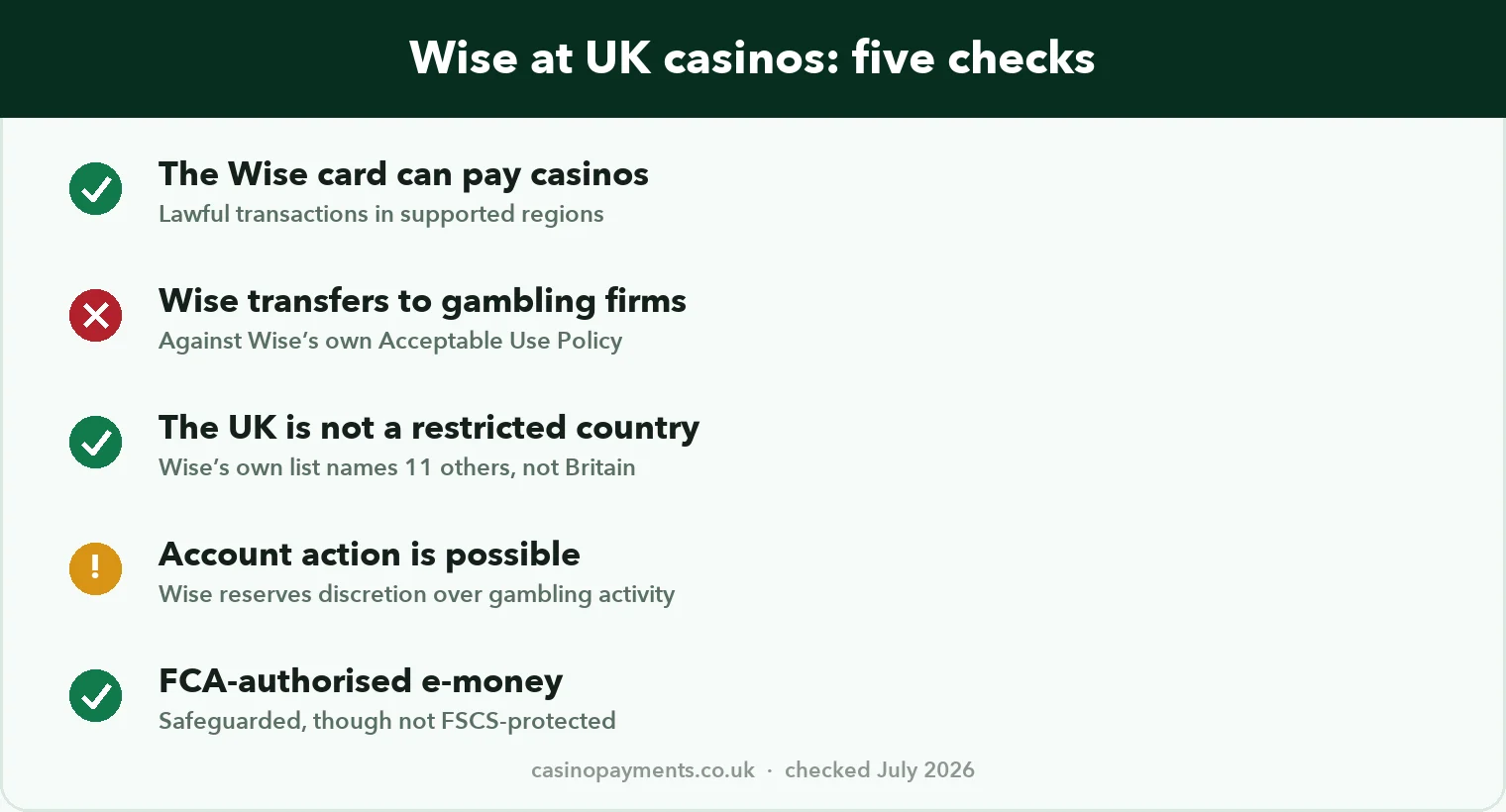
| Can I use the Wise card at a UK casino? | Yes — Wise’s card rules allow lawful spending, gambling included, wherever the card is supported |
| Can I transfer money to a casino with Wise? | No — payments to gambling businesses breach Wise’s Acceptable Use Policy |
| Is the UK a restricted country for Wise? | No — Wise names eleven others, and Britain isn’t among them |
| Will I find a Wise button in the cashier? | Never; the card deposits under the ordinary debit-card option |
| Any risk to my account? | Wise reserves discretion over gambling activity — worth knowing before you route large sums |
Verified 24 July 2026 · 18+ · UKGC-licensed operators only · begambleaware.org
Wise at UK Casinos: Quick Facts
| What it is | Multi-currency account and card, built around cheap cross-border transfers |
|---|---|
| Founded | 2011, London — as TransferWise; renamed Wise in 2021 |
| Regulatory status | FCA-authorised electronic money institution |
| Card at cashiers | Deposits as an ordinary debit card; no Wise-branded option |
| Transfers to casinos | Prohibited by Wise’s Acceptable Use Policy |
| Restricted countries | Eleven named by Wise — the UK is not one of them |
| Protection | Safeguarded customer funds; no FSCS cover |
| Withdrawals | Card payouts return to the card; casino-to-Wise transfers fall foul of the policy |
| Currency strength | Mid-market rates with an upfront fee — the product’s whole reason to exist |
Why One Company Has Two Rules
The contradiction dissolves once you see what Wise actually is: two products sharing a balance. The transfer service is a regulated money-remittance business that decides which merchants and corridors it will serve. The Wise card is a debit card on the mainstream schemes, and once a card is in the wild the merchant decides what it is used for, subject only to lawfulness and scheme rules.
So Wise’s Acceptable Use Policy governs what you can send: payments to online casinos and gambling businesses are out, as is receiving money from them. Wise’s card terms govern what you can spend: lawful transactions where the card is supported, which at a UKGC-licensed casino in Britain plainly includes a deposit.
Two practical consequences follow, and they are the reason this page exists. First, the working route for a UK player is the card, not a transfer — and that route is unremarkable, because the cashier sees an ordinary debit card. Second, withdrawals are the awkward direction: a casino paying winnings back to the card is a card refund and behaves normally, but arranging a bank-transfer payout into your Wise account means money arriving from a gambling business, which is exactly what the policy names. Deposit by card, take payouts back to that card, and you stay on the right side of both documents.
The Restricted List — and Why the UK Isn’t On It
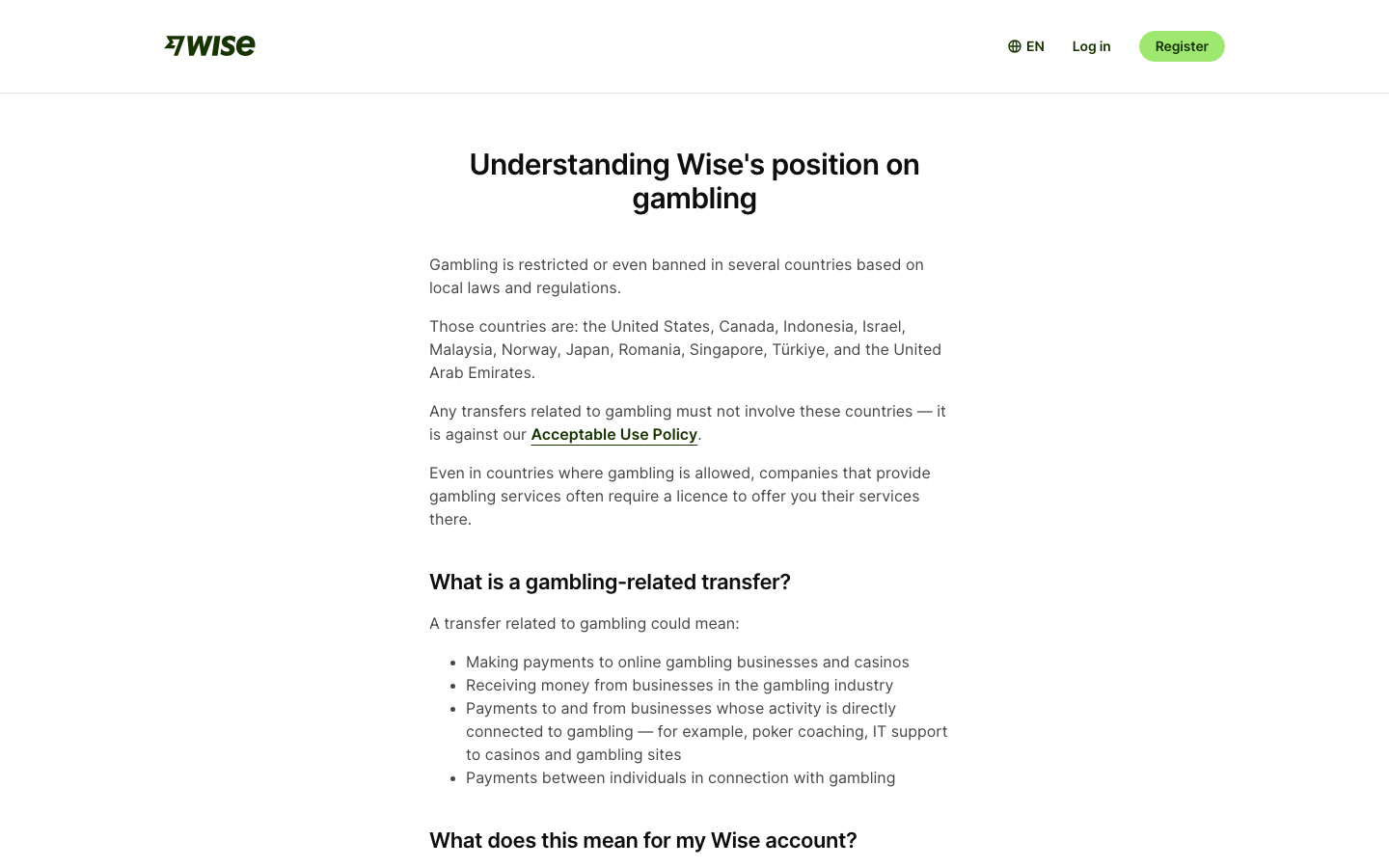
Wise publishes the countries where it will not touch gambling-related transfers at all: the United States, Canada, Indonesia, Israel, Malaysia, Norway, Japan, Romania, Singapore, Türkiye and the United Arab Emirates. The list mixes outright prohibition (several of those states ban or heavily restrict online gambling) with jurisdictions where licensing makes the compliance burden unattractive.
Britain’s absence is informative rather than permissive. The UK has one of the world’s most developed licensing regimes, so gambling here is lawful, supervised and unambiguous — there is no legal reason for a blanket country restriction. What remains is Wise’s own commercial policy on gambling businesses as counterparties, which is why the transfer rule still applies to a British player sending money to a British casino.
The page also flags something worth carrying into any decision: even where gambling is permitted, Wise notes that gambling companies generally need a licence to operate in a given market, and it reserves discretion over gambling-related activity. That reservation is not a threat so much as a reminder that an e-money provider is entitled to review unusual patterns, and that routing very large or very frequent gambling sums through any wallet invites attention it does not need.
Wise vs the Methods Built for This
Wise is excellent at what it was designed for. A casino deposit is not that thing.
| Wise card | Debit card | PayPal | Open banking | |
|---|---|---|---|---|
| Deposits at UKGC casinos | Yes, as a card | Yes, universal | Yes, very broad | Yes, near-universal |
| Provider permits gambling? | Card yes, transfers no | Yes | Yes | Yes |
| Withdrawals back in | Card refunds only | Yes, incl. fast rails | Yes, often same-day | Yes, Faster Payments |
| Deposit protection | Safeguarded, no FSCS | FSCS at your bank | Safeguarded, no FSCS | FSCS at your bank |
| Real strength | Multi-currency and FX | Universality | Trust layer | Speed both ways |
The honest positioning: if you already hold Wise for travel or cross-border work and want to use the card occasionally at a cashier, that is entirely workable. If you are choosing a gambling payment method from scratch, a normal debit card or open banking does the job with fewer policy edges and better payout options.
How a Wise Casino Payment Works
The route that works
- Hold a balance in GBP in your Wise account — converting at the point of deposit is where avoidable cost creeps in.
- At the cashier, choose the debit card option and enter your Wise card details, or use it through Apple Pay / Google Pay.
- The deposit clears instantly as an ordinary card payment; the casino sees a Mastercard or Visa debit, not “Wise”.
- Take winnings back to the same card under the closed-loop rule, which keeps you inside Wise’s card terms.
The route that doesn’t
- Sending a bank transfer from Wise to a casino’s account — a payment to a gambling business, which the Acceptable Use Policy names directly.
- Asking a casino to pay winnings into your Wise account by bank transfer — money received from a gambling business, equally named.
The currency trap
Wise’s appeal is the mid-market rate with a visible fee, and that advantage only exists when a conversion is actually needed. A UK player depositing sterling at a UK casino needs none: hold GBP, spend GBP, convert nothing. Where players lose money is holding a euro or dollar balance and letting the card convert at the point of sale, paying a conversion fee for a transaction that never had to cross a currency in the first place.
Safeguarding, Not FSCS — the Distinction That Matters
Wise is an FCA-authorised electronic money institution, not a bank. The difference is precise and worth understanding: customer money is safeguarded, meaning it is held in segregated accounts separate from Wise’s own funds and ring-fenced from its creditors. What it is not is FSCS-protected — there is no statutory compensation scheme standing behind an e-money balance the way there is behind a bank deposit.
In practice safeguarding is a solid regime and Wise is one of the largest, most scrutinised firms operating under it. But the ordering rule this site applies to every wallet applies here too: e-money is for moving, banks are for keeping. Winnings of any size belong in a bank account, not parked in a wallet balance, and that is a statement about the category rather than about Wise specifically.
Account security itself is current-generation: two-factor authentication, instant card freeze, virtual card numbers for single use, and real-time notifications. Combined with the closed-loop deposit route described above, a Wise card at a licensed cashier is a low-risk transaction — the residual risk sits in the policy layer, not the technology.
From Two Estonians’ Spreadsheet to a Listed Company
- 2011 — Kristo Käärmann and Taavet Hinrikus found TransferWise in London, after solving their own euro-to-sterling problem by matching transfers directly.
- 2013–2015 — The “hidden fees” campaign makes bank FX margins a public argument; growth follows the outrage.
- 2016 — Borderless accounts arrive, turning a transfer service into a multi-currency account.
- 2018 — The debit card launches — the product that makes this page necessary, and the one governed by separate terms.
- 2021 — Renamed Wise; lists directly on the London Stock Exchange, one of the UK’s largest tech listings.
- 2022–2024 — Wise Business and platform partnerships scale; the company becomes payments infrastructure for other fintechs.
- 2025–2026 — Continued expansion of local-account coverage; the gambling policy stays as documented on this page.
The through-line explains the split rule better than any policy document: Wise was built to move money across borders honestly and cheaply, and everything since — account, card, business tools — extends that. Gambling was never a market it courted, which is why the transfer service declines it and the card, operating on someone else’s rails, simply doesn’t have to care.
Wise Around the World
Wise operates in dozens of countries and holds licences across multiple regulators, which is why its gambling stance varies by geography rather than being a single global rule. In the eleven countries it names, gambling-related transfers are off the table entirely, whatever the local law happens to permit. Elsewhere, the transfer policy still excludes gambling businesses as counterparties while the card follows local lawfulness.
For a British player the practical implications are narrow but worth stating. Using the Wise card at a licensed casino abroad works the same way it does at home, subject to that country’s rules and with the usual reminder that acceptance is not protection — an offshore site taking your card imports no UKGC oversight. And multi-currency play is precisely where the FX advantage becomes real: if you genuinely play at a euro-denominated licensed casino, holding a euro balance converted at a moment of your choosing beats letting a UK bank card convert at the till. That is the one scenario where Wise is not merely adequate for gambling but actively better than a high-street card.
Where Wise Genuinely Earns Its Keep
Gambling is a footnote in Wise’s business and the company has never pretended otherwise. Its centre of gravity is people and businesses moving money across borders: freelancers invoicing in three currencies, families sending remittances, businesses paying overseas suppliers, and increasingly other fintechs using Wise’s infrastructure to offer international transfers under their own brands. The public campaign against hidden FX margins genuinely changed the market — comparison of the “real” mid-market rate is now standard consumer vocabulary, and high-street banks price travel money differently than they did in 2011 partly because of it.
The relevance to this site is a piece of financial hygiene rather than a payment tip: the same discipline that makes Wise valuable abroad — know the rate, know the fee, convert deliberately rather than by accident — is exactly the discipline that keeps a gambling bankroll from leaking money to conversions nobody chose. Whether or not you ever use the card at a cashier, that habit transfers.
Wise & Safer Gambling
Wise is a weaker safer-gambling proposition than a UK bank, and it is important to be straight about why. There is no gambling block of the kind Monzo, Starling, Revolut and Chase all ship — no merchant-category switch to arm, no cooling-off period, nothing to make a decision effortful when it needs to be. A Wise card is simply a card.
If control tooling matters to you, that absence should decide the question: use a UK bank card with a block available, and keep Wise for what it is good at. If you use the Wise card anyway, the compensating layers are the person-level ones — GAMSTOP closes every UKGC operator at once regardless of payment method, cashier deposit limits bound each site, and device-level blockers cover the rest. Our responsible gambling hub lays out the full kit. And if any part of the appeal here is that a wallet without a gambling block is easier to use than a bank account with one, that is worth naming honestly: the National Gambling Helpline is free and confidential on 0808 8020 133, any hour. 18+.
What Wise Users Run Into at Casino Cashiers
The Wise gambling threads are unusually confused, and now you know why: half the participants are describing the card and half are describing transfers, so both sides of every argument are correct. The card reports are mundane — deposits clear, cashiers see an ordinary debit card, nothing distinctive happens. The transfer reports are the opposite: attempts blocked, and occasionally accounts reviewed where gambling-related activity was substantial and obvious.
The second recurring genre is the currency one, and it is entirely self-inflicted. Players holding euro or dollar balances describe deposits costing more than expected, which is the conversion fee doing exactly what it says on the tin at a moment nobody chose. The fix is boring: hold sterling for sterling play.
The third genre is the payout question, where the folk wisdom has landed in the right place — take winnings back to the card that deposited them, and do not ask a casino to bank-transfer money into a Wise account, because that is the direction the policy names. Notably absent from the record is any pattern of Wise cards being rejected by licensed UK cashiers; the friction lives in the policy, not the payment rails.
What to Use Instead — and When Wise Is Genuinely Right
Reach for something else if you want a gambling block (any UK app bank), the fastest payouts (open banking or push payments to a debit card), or FSCS protection on the balance itself (a bank account, full stop).
Wise is genuinely the better tool if you play at licensed casinos denominated in another currency — holding that currency and converting deliberately at the mid-market rate beats a UK card converting at the till every time. That is a narrow scenario, but within it Wise is the strongest option on this site.
- Debit cards — the universal default, with bank-level controls attached.
- PayPal — a wallet layer that actually permits gambling in both directions.
- Revolut — the closest like-for-like: multi-currency, strong FX, plus the gambling block Wise lacks.
The Multi-Currency Case, Worked Through
This page has been fairly hard on Wise as a gambling method, so it is worth setting out properly the one scenario where it is genuinely the best option on this site — because within that scenario it is not close.
Consider a player who regularly uses a euro-denominated licensed casino. Deposit €100 with a normal UK debit card and the conversion happens at the moment of payment, at whatever rate and margin your bank applies, with no say in the timing. Do it repeatedly and the margin compounds quietly across a year of play.
Now do it through Wise. You convert sterling to euros when you choose — ideally a weekday, ideally when the rate suits — at the mid-market rate with a transparent, stated fee. You hold that euro balance. The card then spends euros against a euro balance, so the deposit involves no conversion at all. Winnings return to the card in euros, sitting ready for the next session or converted back on your terms.
The difference is not dramatic on a single €100 deposit; it is meaningful across a year of them, and it is the exact problem Wise was built to solve. Two conditions have to hold: the casino must be genuinely licensed in the market whose currency you are using, and you must actually hold the balance in advance rather than converting at the till. Miss the second and you have paid Wise’s conversion fee for the privilege of doing what your bank card would have done anyway.
For the overwhelming majority of British players — playing in sterling at UKGC casinos — none of this applies, and the debit card or open banking is the better answer. But the multi-currency player is real, and this is their page.
Our Verdict on Wise for UK Casino Players
Wise is a superb product being asked to do a job it was never built for, and it answers with a split decision that most write-ups get half-right. The card works at UK cashiers under Wise’s own card terms; the transfer service refuses gambling businesses under Wise’s own Acceptable Use Policy; the UK is not a restricted country either way. Deposit by card, take payouts back to that card, hold sterling for sterling play, and the whole thing is uneventful.
What it lacks is the safety furniture the UK app banks now treat as standard — no gambling block, no cooling-off period — and it swaps FSCS protection for safeguarding. For most British players that makes it a second-choice method rather than a first: perfectly usable if it is already in your wallet, not worth adopting for gambling. The exception is real though: if your casino play is genuinely multi-currency, Wise’s FX handling is the best on this site, and the card route is the way to use it.
Wise’s own help centre article, “Understanding Wise’s position on gambling”, checked directly this month, names the countries where it will not process gambling-related transfers: the United States, Canada, Indonesia, Israel, Malaysia, Norway, Japan, Romania, Singapore, Türkiye and the United Arab Emirates. The United Kingdom is conspicuously absent from that list. The same page defines a gambling-related transfer broadly — payments to online casinos, money received from gambling businesses, even payments between individuals connected to gambling — while Wise’s separate card terms permit any lawful transaction where the card is supported.
Wise Casino FAQs
Can I use Wise at UK online casinos?
The Wise card, yes — it deposits as an ordinary debit card at any UKGC cashier that accepts cards. Wise transfers to gambling businesses are a different matter and breach its Acceptable Use Policy.
Why does Wise allow the card but not transfers?
They operate under separate terms. The transfer service is a remittance business that chooses its counterparties and excludes gambling firms; the card runs on the mainstream schemes and permits any lawful transaction where supported.
Is the UK on Wise’s restricted gambling list?
No. Wise names the United States, Canada, Indonesia, Israel, Malaysia, Norway, Japan, Romania, Singapore, Türkiye and the UAE. Britain is not among them — but the transfer policy on gambling businesses still applies.
Can a casino pay my winnings into my Wise account?
A card payout back to the Wise card is a normal card refund and works. Asking for a bank transfer into your Wise account means receiving money from a gambling business, which is what the policy names — take payouts back to the card instead.
Is money in Wise FSCS-protected?
No. Wise is an e-money institution, so customer funds are safeguarded in segregated accounts rather than covered by FSCS. Safeguarding is a solid regime, but bank winnings rather than parking them in any wallet.
Does Wise have a gambling block?
No — unlike Monzo, Starling, Revolut and Chase, there is no merchant-category gambling block to arm. If control tooling matters to you, that absence is a good reason to use a UK bank card instead.
Will using Wise for gambling get my account closed?
Card spending at licensed casinos sits within Wise’s card terms. Transfers to or from gambling businesses breach the Acceptable Use Policy, and Wise reserves discretion over gambling-related activity — so keep to the card route and avoid routing large sums.
Does Wise charge fees for casino deposits?
Not for spending a sterling balance at a UK casino. Costs appear only when a currency conversion happens — hold GBP for GBP play and you meet no conversion fee at all.
Wise or Revolut for casino play?
Revolut, for most people: it is the closest equivalent on multi-currency and FX, but adds a gambling block and now holds a UK banking licence with FSCS cover. Wise wins only where genuinely multi-currency play makes its FX handling decisive.
Is the Wise card accepted at every UK casino?
At any cashier that takes debit cards, which is effectively all of them. There is no Wise-branded option to look for — you simply enter the card details like any other card.
Sources & Verification
Checked 24 July 2026 against: Wise’s own help-centre article “Understanding Wise’s position on gambling” (captured by screenshot the same day, including the eleven named restricted countries and the definition of a gambling-related transfer); Wise’s published Acceptable Use Policy and card terms; Wise Payments Limited’s authorisation on the FCA Financial Services Register; the FSCS on the safeguarding-versus-protection distinction; and the Gambling Commission’s payment-blocking guidance.