Gambling is stitched into Bitcoin’s origin story: within three years of the genesis block, a dice site was generating half the transactions on the entire chain. Seventeen years on, Britain’s regulated casinos accept precisely none of it. The gap between those two facts — the coin built by gamblers, refused by every licensed cashier — is the most instructive story in crypto gambling, and this page tells it without selling you anything offshore.
For the rule applying to digital currencies generally, start with our broader guide to cryptocurrency and UK-licensed casinos; this page covers Bitcoin-specific custody, transactions and availability.
Why No UKGC Casino Accepts Bitcoin
| Bitcoin & UK Casinos at a Glance | |
|---|---|
| UKGC acceptance | Zero operators, zero exceptions, zero movement |
| The core obstacle | Source-of-funds and AML duties that pseudonymous coins defeat |
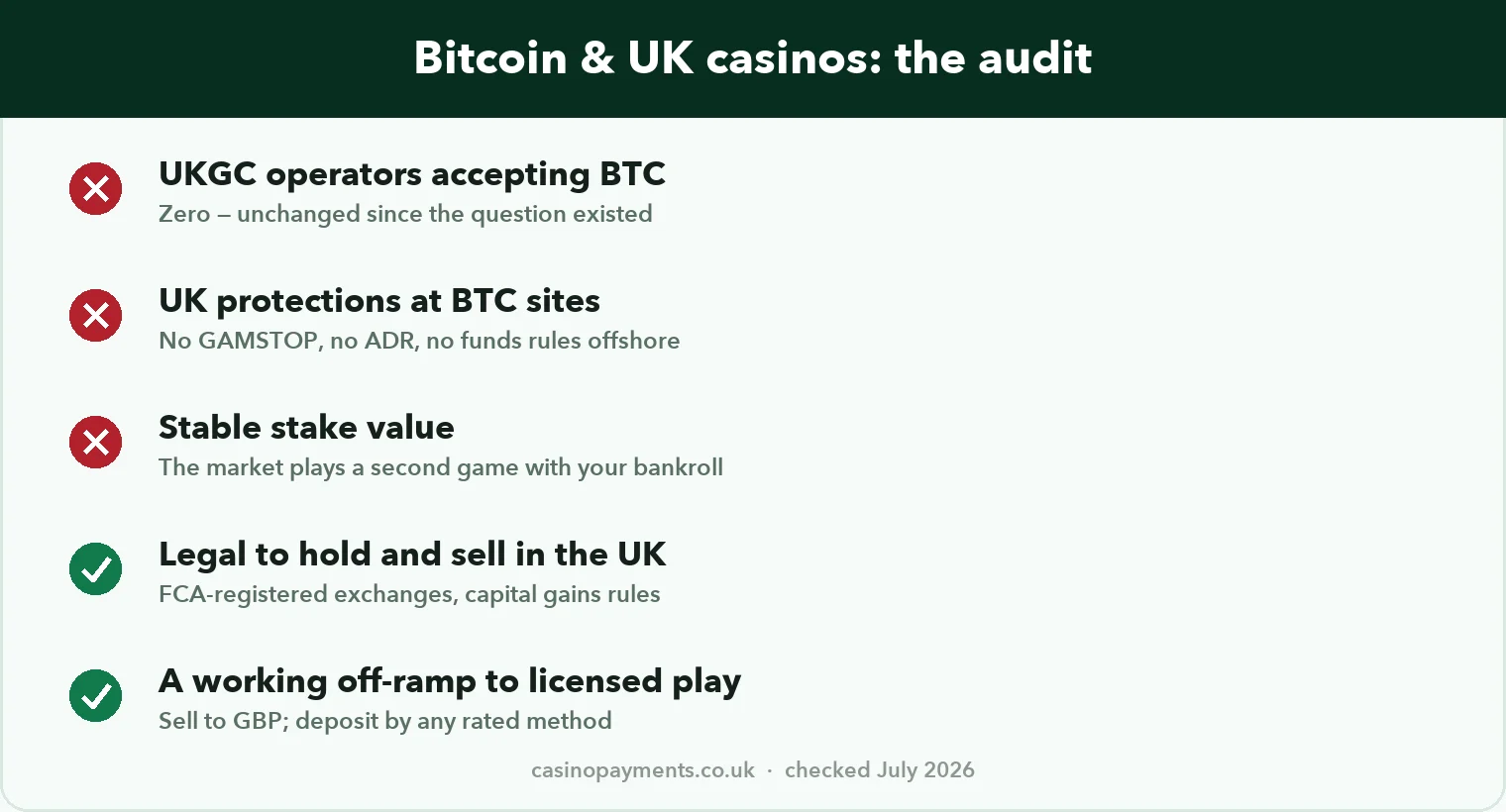
| Offshore BTC sites | Real and numerous — and outside GAMSTOP, ADR and funds protection entirely |
| Volatility factor | Your stake's value moves while you sleep — a second gamble under the first |
| Legitimate route | Sell for GBP at a regulated exchange; deposit like anyone else |
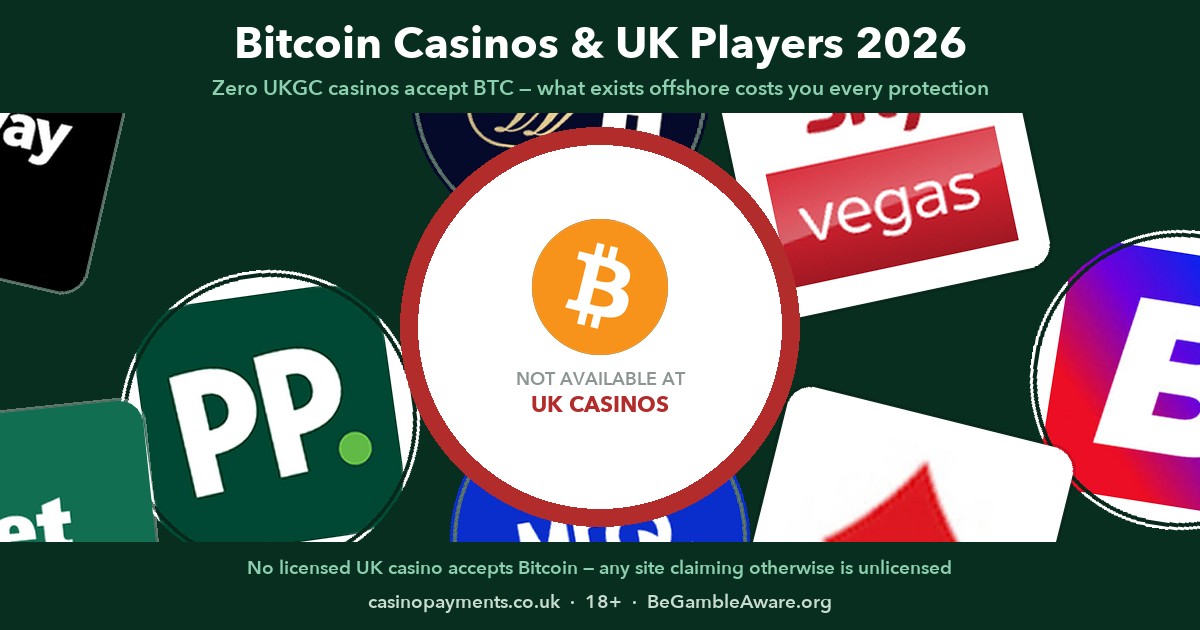
Position verified 10 July 2026, as it has been on every check this site has ever run: the number of licensed UK casinos taking BTC remains zero.
| Searching for | Finding |
|---|---|
| Bitcoin casinos with a UK licence | None exist. Not one UKGC operator accepts BTC — the count has been zero every year since the question was first asked |
| Why the blanket refusal? | Anti-money-laundering duties licensed operators can't square with pseudonymous coins |
| The sites that do take BTC? | Offshore, unlicensed for Britain — your deposit crosses out of every UK protection at the blockchain's edge |
| Selling BTC to play, then? | Perfectly workable — convert to pounds at a regulated exchange and any method on this site applies |
| Closest legal experience | Open banking for speed, vouchers for statement privacy |
Verified 10 July 2026 · 18+ · UKGC context · begambleaware.org
Bitcoin: Quick Facts
| Launched | January 2009 — the genesis block, mined by the pseudonymous Satoshi Nakamoto |
|---|---|
| What it is | The first cryptocurrency: a fixed-supply digital asset on a public, pseudonymous ledger |
| Gambling pedigree | SatoshiDice (2012) was the chain’s first mass-use application |
| UKGC casino acceptance | None — and none pending |
| FCA stance on crypto | High-risk; consumers warned to be prepared to lose everything invested |
| Where BTC gambling lives | Offshore licences (Curaçao and similar) with no UK standing |
| Volatility | Double-digit percentage swings in a week are unremarkable |
| Transaction speed/cost | ~10-minute blocks; fees float with congestion — Lightning improves both, offshore support varies |
| UK-legal use for players | As an asset to sell — proceeds in GBP deposit anywhere |
SatoshiDice: When Gambling Was Bitcoin’s Killer App
In April 2012, a site called SatoshiDice launched with a mechanic of beautiful crudity: send coins to an address, and the blockchain itself rolled your dice — a payout transaction back if you won, silence if you lost. No account, no cashier, no operator in any meaningful sense. Within months it was famously responsible for around half of all transactions on the Bitcoin network — the young chain’s single biggest use case wasn’t buying anything; it was betting.
The episode matters to this page for two reasons. First, it explains the cultural deep link: crypto gambling isn’t a marketing bolt-on, it’s the community’s founding pastime, and the modern offshore BTC casino is SatoshiDice’s direct descendant with better graphics. Second, it demonstrated the exact property regulators would later refuse to license: permissionlessness. Nobody verified a SatoshiDice player’s age, identity, affordability or source of funds — nobody could — and the whole apparatus of British gambling regulation is a machine for doing precisely those things before money touches a game.
Bitcoin’s first great application, in other words, was a working prototype of everything the UKGC exists to prevent. The zero in this page’s title was written in 2012; Westminster just hadn’t read it yet.
Bitcoin vs the Methods That Work Here
For a UK player the comparison is between a locked door and open ones — but the properties are still worth tabling, because they explain the offshore pull.
| Bitcoin | Debit card | Open banking | paysafecard | |
|---|---|---|---|---|
| UKGC cashiers | Zero | All | Nearly all | Most |
| Stake stability | Floats with the market | A pound stays a pound | ||
| Statement visibility | Exchange trades visible; chain isn’t | Full | Full | None past the shop |
| Player protections | None offshore | The full UKGC stack | ||
| Dispute route if wronged | Effectively nil | Operator → ADR → regulator | ||
The privacy column deserves honesty: statement-shy players are a real constituency, and the legal answer is the voucher aisle (paysafecard, Neosurf) — cash-bought, licence-protected — not a pseudonymous chain feeding an unaccountable operator. Our crypto overview maps the whole category; this table is the BTC-specific cut.
How Bitcoin Gambling Works — Where It Exists
The offshore mechanics, described not endorsed
- A player buys BTC at an exchange (the regulated ones apply full KYC — identity checks crypto’s reputation forgets).
- Coins move to the casino’s deposit address; confirmations take minutes to an hour depending on fees paid and congestion.
- Play is denominated in BTC or a pegged chip; the operator’s software is whatever the operator says it is — “provably fair” claims vary from genuine to decorative.
- Withdrawals reverse the flow, minus network fees, at the operator’s pleasure — and pleasure is the operative legal standard offshore.
What the mechanics conceal
Every step above swaps a British protection for a convenience. The exchange leg is regulated; everything after it answers to a licence Britain doesn’t recognise. Age and affordability checks are cursory or absent. GAMSTOP self-exclusion means nothing there. Disputed winnings meet terms of service written by the counterparty, enforceable in jurisdictions selected for that purpose. And the volatility layer runs underneath it all: a winning session in BTC can be a losing week in pounds before the withdrawal confirms — a second, unchosen gamble stacked on the first.
None of this requires villainy to go wrong — though the sector has villains. It’s simply what gambling looks like with the safety apparatus unbolted: fine until the moment it isn’t, with no one to call at that moment.
The Offshore Cost, Itemised
“No UK protections” is easy to write and easy to skim, so here is the itemised bill a BTC deposit actually signs. GAMSTOP: void — offshore operators don’t consult it, so self-exclusion, the system’s last line, simply isn’t wired in. Funds protection: void — UKGC segregation ratings don’t exist; a failing operator’s player balances are unsecured IOUs on a server. Dispute rights: void — no ADR body, no ombudsman, no regulator with jurisdiction; the complaints process is an email address the operator owns. Affordability and age gates: nominal — the checks Britain mandates before meaningful losses are marketing choices there. Chargeback leverage: void by design — blockchain settlement is final; there is no issuer to petition, which is precisely why the sector prefers it.
Set against that ledger, the pitch — anonymity, big bonuses, “instant” payouts — reads differently: the bonuses are priced by the absent obligations, and the payout is instant until the account flags at exactly the moment it holds real money. Fifteen years of forum archaeology says the pattern is not hypothetical. The security section of this page is therefore one sentence long in practice: the safest amount of offshore Bitcoin gambling is none.
Seventeen Years in Nine Lines
- 2008 — The white paper: Satoshi Nakamoto proposes peer-to-peer electronic cash.
- 2009 — Genesis block mined in January; the network runs on hobbyist laptops.
- 2012 — SatoshiDice makes gambling the chain’s dominant activity.
- 2013–2014 — First boom, first bust, first offshore BTC casinos with lobbies and licences of convenience.
- 2017 — The $20,000 winter: crypto gambling scales with the mania.
- 2020 — Britain bans credit-card gambling the same era the FCA hardens its crypto-risk warnings — two regulators converging on borrowed money and volatile money alike.
- 2021 — Institutional adoption peaks alongside a $69,000 high; UKGC acceptance remains zero throughout.
- 2024 — US spot ETFs mainstream BTC as an asset class — the investment story and the gambling story finish diverging.
- 2026 — Bitcoin is respectable portfolio furniture and still not a UK gambling payment; both facts look permanent.
The through-line: every year made Bitcoin more legitimate as an asset and no more acceptable as a stake — because the obstacle was never respectability. It was verifiability.
Bitcoin Gambling Around the World
The global map is a patchwork of postures. Curaçao remains the sector’s licence mill — low-cost, low-scrutiny, and the paper behind most BTC casinos courting international traffic; its recent reform programme has tightened paperwork without much changing the player’s practical remedies. Malta and Gibraltar permit regulated operators limited crypto flexibility under conditions strict enough that mainstream adoption stays thin. The United States mirrors Britain at the state level: regulated books take dollars, not coins. Outright bans on crypto exchange in several countries push the activity fully underground there. And a telling counter-example: Ontario, whose regulated market resembles the UKGC’s philosophically, likewise fields no crypto cashiers — wherever gambling regulation takes identity and source-of-funds seriously, the answer converges on the same zero. Britain’s position isn’t insular caution; it’s the standard conclusion of a certain kind of question. UK players encountering “licensed” BTC casinos should read the licence’s country of issue as the disclosure it is.
Bitcoin’s Uses Beyond a Casino Balance
Strip gambling out and Bitcoin’s 2026 résumé is genuinely substantial: a trillion-dollar-class asset held by ETFs, corporate treasuries and central-bank-curious governments; a settlement network processing value transfers no institution can censor; and the Lightning layer quietly making small payments workable in places card networks neglect. The FCA’s registration regime has slowly legitimised UK on-ramps, and holding BTC in Britain is as lawful as holding gold — with tax treatment (capital gains on disposals) that surprises players who thought of their coins as casino chips rather than assets. That mainstream arc is exactly why this page’s zero persists without controversy: the asset graduated, the payment-method question closed, and the only people still insisting Bitcoin belongs in a cashier are the operators whose business model requires the absence of anyone checking.
Safer Gambling & the Crypto Corner
The safer-gambling case against offshore BTC play is structural, not moralising: it is gambling with the brakes removed. No GAMSTOP means self-exclusion — the tool of last resort — doesn’t reach it; no affordability checks means the system never asks the question a struggling player most needs asked; volatility means even disciplined stakes carry a hidden second exposure; and the on-chain finality that markets itself as freedom is, for someone chasing losses at 3am, simply the absence of every friction that might have interrupted. If crypto’s appeal is partly that it sidesteps blocks you set yourself — bank gambling blocks don’t see exchange withdrawals clearly, GAMSTOP doesn’t see offshore at all — treat that appeal as the loudest possible signal. GAMSTOP plus bank blocks plus device-level tools like Gamban close most of the perimeter; our responsible gambling hub maps it. And the National Gambling Helpline — 0808 8020 133, free, confidential, always staffed — has heard the crypto version of the story many times. 18+.
What Players Actually Report
Forum archaeology on BTC gambling sorts into eras. The romantic early threads — SatoshiDice bets narrated block by block — read now like frontier diaries, equal parts wonder and lost-coin regret (the dice winnings of 2012, held, would have outperformed the dice). The boom-era threads industrialise: bonus comparisons across offshore lobbies, payout-speed brags, and the first recognisable genre of confiscation stories — accounts flagged at withdrawal, “security reviews” that never conclude, support that answers until the balance matters. The modern record adds two sober notes. Players tallying the double exposure — sessions won in BTC, months lost in GBP terms — and the GAMSTOP-gap testimonies: self-excluded players describing how easily offshore crypto sites re-admitted the exact behaviour they’d locked themselves away from, usually posted in the past tense of hard-won hindsight. Set against the entire archive, the scarcity of “it went wrong and someone made it right” stories is the dataset’s loudest finding — there is no such genre, because there is no such someone.
The Legal Routes for a Coin-Holding Player
Holding BTC and fancying a licensed flutter are entirely compatible; the bridge is just conventional:
- Sell to sterling at your FCA-registered exchange, withdraw to your bank (Faster Payments makes this same-day), and deposit by debit card or open banking like anyone else. Note the tax point: disposing of BTC is a capital-gains event whether the proceeds buy spins or shares.
- Want the statement-privacy crypto promised? The voucher aisle delivers it legally — paysafecard bought with cash puts nothing gambling-shaped on any bank record, inside the full protection stack.
- Want the speed? Modern rails already match the pitch: open-banking deposits are instant, and push-payment withdrawals land in the hour. The offshore speed advantage is a decade out of date.
What has no legal bridge is the third appeal — gambling outside the rules — and this site declines to build one. The rules are the product.
Pricing the Second Gamble: A Worked Example
“Volatility layers a second bet under your first” is this page’s refrain; here it is with numbers attached. A player converts £500 to bitcoin on a Monday and deposits it offshore. Across the week they play conservatively and finish dead level in BTC terms — the first gamble, the one they chose, is a wash. Meanwhile the coin has one of its unremarkable weeks and drifts eight percent. If it drifted down, the level bankroll withdraws as £460: forty pounds lost at the tables where they lost nothing, paid to a market that never knew they existed. Drifted up, they bank £540 and credit their casino skill with what was beta all along — a subtler cost, since misattributed wins teach exactly the wrong lesson about how the money was made.
Scale the arithmetic and it darkens. Double-digit weekly swings are within bitcoin’s normal register, so a £2,000 bankroll can gain or shed a couple of hundred pounds between deposit and withdrawal independent of every spin. No staking plan accounts for it; no house-edge calculation includes it; and the psychological accounting is worse than the financial — wins and losses stop mapping to decisions, and the feedback loop players use to regulate themselves quietly breaks.
The stablecoin sector exists precisely because operators noticed this — our USDT page covers that pivot and why it still doesn’t reach Britain. The sterling player, for the record, runs this entire experiment every week with a volatility of zero: the pound in a licensed cashier is the same pound at both ends, and the only game in the room is the one they chose to play.
Five Questions Before Any Crypto-Gambling Decision
If a BTC casino pitch has you halfway persuaded, run it through this list in order — each question has ended the conversation for someone:
- Who licenses the operator, and could I name the regulator’s country before reading the footer? If the answer arrives via a Curaçao seal, you have your disclosure.
- If my withdrawal is refused, what is my next step — specifically? Write the actual step down. “Email their support” is not a dispute route; it’s a hope.
- Would I still play here if deposits were in pounds? If the coin is doing the persuading, ask what the coin is persuading you past.
- Does any tool I’ve set up — GAMSTOP, bank block, deposit limits — reach this site? If the honest answer is none, notice that the venue’s appeal and your safeguards’ absence are the same fact.
- What has this stake cost in pounds by the time it settles? Price the volatility and the exit before playing, not after — the market doesn’t pause for your session.
Any answer that made you wince is the page’s conclusion arriving early. The licensed route two sections down requires none of these questions, which is rather the point of it.
Our Verdict on Bitcoin for UK Casino Players
Bitcoin earns its place in financial history and no place in a British cashier, and after seventeen years the two verdicts are equally settled. The coin whose first mass application was a dice game turned out to be structurally unlicensable for regulated gambling — not because regulators fear novelty, but because its founding feature, permissionless pseudonymity, is the negation of everything a gambling licence certifies. What exists instead is an offshore sector selling the removal of protections as liberation, priced in bonuses and settled in stories that end at an unanswerable support desk. Our advice holds no suspense: hold BTC if you believe in the asset, sell it through regulated rails when you want to play, and give the “Bitcoin casino” tab the same click you’d give any shop whose defining feature is that no law applies inside. The zero isn’t Britain lagging the future — it’s Britain reading the 2012 prototype correctly.
Bitcoin.org — the project’s original public site, checked directly this month — still opens with the line that has anchored it for over a decade: “Bitcoin is an innovative payment network and a new kind of money.” Both halves are true, and neither impresses a UK gambling regulator: it’s the network’s pseudonymity, not the money’s novelty, that keeps every UKGC cashier closed to it.

Bitcoin Casino FAQs
Are there any Bitcoin casinos licensed in the UK?
No — zero UKGC operators accept BTC or any cryptocurrency, and none has applied to. Every “Bitcoin casino” open to UK players operates offshore, outside British protections.
Why won’t the UKGC allow Bitcoin?
Licensed operators owe strict anti-money-laundering and source-of-funds duties. A pseudonymous bearer asset defeats those checks, so crypto acceptance is effectively incompatible with holding the licence.
Is it illegal for me to gamble at an offshore Bitcoin casino?
The legal burden sits on operators, not players — but “not prosecuted” and “protected” are different things. You’d gamble without GAMSTOP, dispute rights, funds protection or affordability checks, and with no recourse when it matters.
What was SatoshiDice?
A 2012 dice game where bets were bare Bitcoin transactions — at its peak roughly half the network’s activity. It proved both crypto gambling’s demand and the permissionless property regulators would never license.
Can I fund a normal casino by selling Bitcoin?
Yes — sell at a regulated exchange, withdraw GBP to your bank, deposit by any method on this site. Note that disposing of BTC is a capital-gains tax event in the UK.
Does Bitcoin’s volatility really matter for gambling?
Materially: a stake denominated in BTC changes value independently of your results. Players have finished up at the tables and down in pounds — a second gamble layered under the first.
Are “provably fair” Bitcoin casinos actually fair?
The cryptography can genuinely verify individual game outcomes — but fairness of a spin was never the main risk. Withheld withdrawals, voided winnings and vanishing operators are, and no hash proves those away.
Do bank gambling blocks stop Bitcoin gambling?
Poorly — blocks see card and bank payments to gambling merchants, not exchange transfers or on-chain movement. That gap is precisely why crypto appeals to some players who’ve set blocks, and why it deserves extra caution from them.
Will UK casinos ever accept Bitcoin?
Nothing points that way: the AML architecture, FCA risk posture and the Gambling Act review era all run in the opposite direction. Treat any change as years away at minimum, and this page will record it if it comes.
What about Lightning — doesn’t it fix the speed and fees?
Technically it improves both, and some offshore sites support it. It changes nothing about licensing: the UK obstacle is identity and accountability, not transaction throughput.
Sources & Verification
Checked 10 July 2026 against: bitcoin.org (homepage captured by screenshot the same day); the FCA’s published consumer warnings on cryptoassets; the Gambling Commission’s LCCP anti-money-laundering framework underpinning the acceptance position, plus its payment-blocking guidance; documented SatoshiDice history for the 2012 network-share record; and live UKGC operator cashiers confirming zero crypto acceptance on the date above.