
Bitcoin and British casinos have run on parallel lines for seventeen years: crypto built a vast offshore gambling economy, and the number of UKGC-licensed sites accepting it sits today where it started — zero. That’s not regulatory slowness; it’s a wall built from anti-money-laundering rules that crypto’s design can’t satisfy. This page explains the wall honestly, tours what players actually give up when they climb it, and maps the legal routes for crypto holders who still want the protections a licence buys.
Why No UKGC Casino Accepts Cryptocurrency
| Crypto at UK Casinos at a Glance | |
|---|---|
| UKGC-licensed casinos accepting crypto | Zero |
| Why | AML/KYC incompatibility with crypto's pseudonymous transfers |
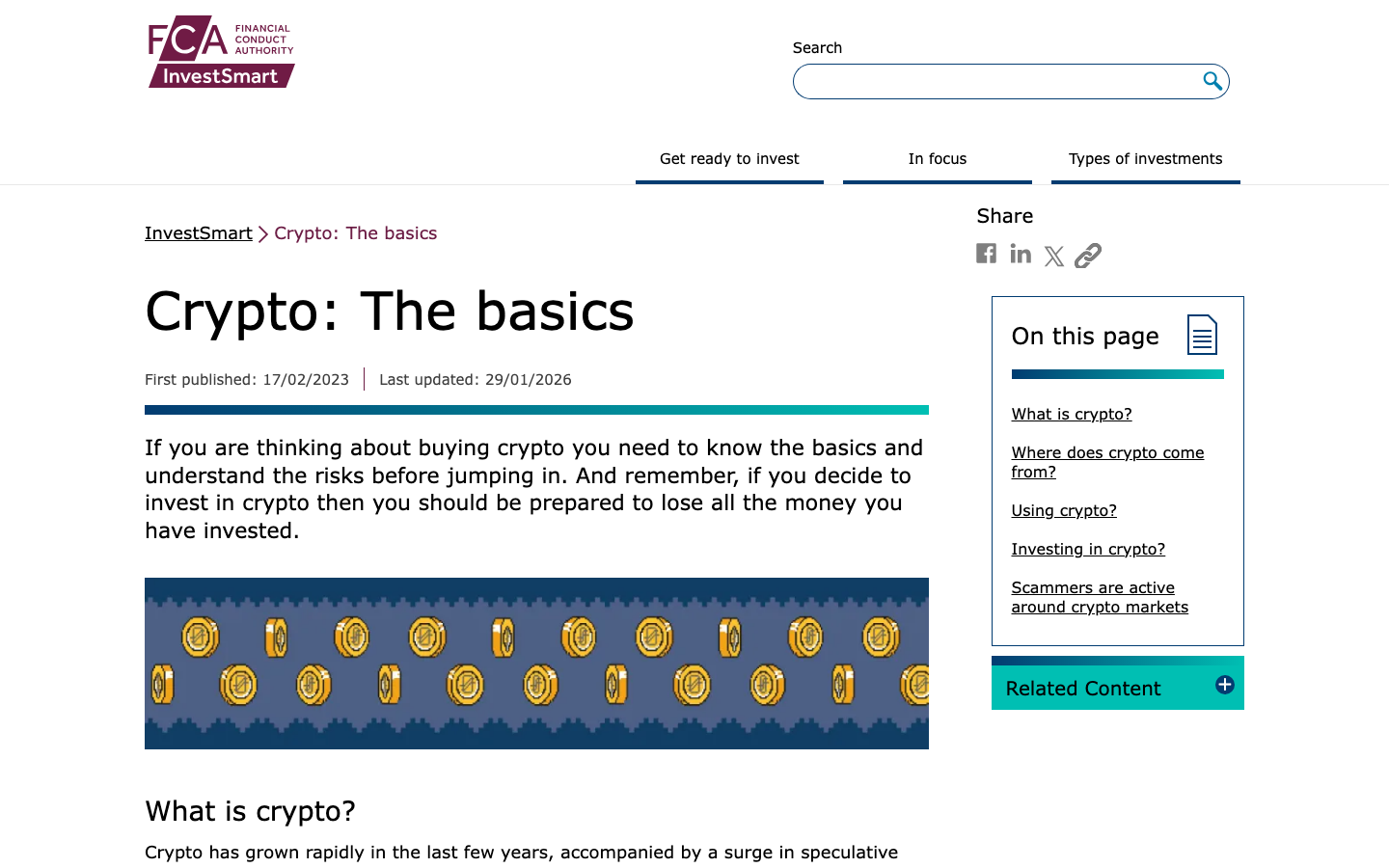
| FCA position | “Be prepared to lose all your money” if investing in crypto — not FSCS-covered |
| Offshore crypto casinos | Unlicensed in the UK — no consumer protection if something goes wrong |
| Legal route for crypto holders | Convert to GBP via a licensed exchange, then deposit normally |
Checked 5 July 2026. Five questions, five answers, and the rest of the page is the evidence behind them.

| Question | The 2026 position |
|---|---|
| Can I deposit Bitcoin at a UK-licensed casino? | No. Not one UKGC operator accepts direct cryptocurrency deposits — the count has been zero since licensing began |
| Is crypto gambling illegal for me? | Playing isn't an offence — but every crypto casino serving UK players is operating here unlicensed, and all your protections vanish with the licence |
| Why does no licensed site take it? | Anti-money-laundering source-of-funds rules, volatility, and Commission expectations make compliant crypto cashiers effectively impossible |
| What about "crypto-friendly UK casinos" in search results? | Offshore operators, every time — no GAMSTOP, no dispute rights, no fund protection, winnings confiscatable at whim |
| Selling crypto first, then depositing the pounds? | Perfectly legal — cash out at a regulated exchange, deposit by debit or open banking, expect source-of-funds questions at scale |
That table settles the availability question — but the crypto-casino economy is enormous, aggressively marketed at British players, and the single largest generator of horror stories in gambling forums. So this page does the full job: why the wall exists, what actually happens on the other side of it, how the offshore sites work, and the legal routes for crypto-holding players who want to gamble with licensed protection intact.
Status verified 5 July 2026 · 18+ · UKGC-licensed operators only · begambleaware.org
Crypto & UK Gambling: Quick Facts
| UKGC casinos accepting crypto | Zero — no licensed operator takes direct coin deposits, and none has applied to |
|---|---|
| The core obstacle | AML source-of-funds rules: operators must know where money came from, and chain-hopped coins defeat the audit |
| Commission’s position | Long-standing: crypto acceptance is possible in principle, but the compliance bar has proven commercially unmeetable |
| Is playing offshore a crime for players? | No — the offence sits with the unlicensed operator; the losses sit with you |
| FCA angle | Crypto promotions regulated since 2023; the “high-risk, be prepared to lose it all” framing applies before any gambling begins |
| Offshore crypto casino protections | None that bind: no GAMSTOP, no ADR, no fund segregation, no affordability rules, no ombudsman |
| Legal path for crypto holders | Sell at a regulated exchange, withdraw pounds to your bank, deposit by any method on this site |
| Chargebacks on crypto | Impossible by design — transfers are final; no bank can recall a coin payment |
Why No Licensed Casino Takes Coins
The wall has three courses of brick. The heaviest is anti-money-laundering law: UKGC operators must establish source of funds for the money they take, and cryptocurrency is engineered against exactly that question — coins arrive from pseudonymous addresses whose history can span mixers, cross-chain swaps and jurisdictions with no records to subpoena. An operator who can’t answer “where did this money come from?” can’t take the deposit; with crypto, at scale, they can’t answer it.
The second course is volatility: player-fund protection, deposit limits and affordability thresholds are all denominated in pounds, and a balance that moves double digits in a week breaks every one of those mechanisms in both directions. Stablecoins soften this brick and leave the AML one untouched. The third is supervisory reality: the Commission has never banned crypto outright — it has set expectations (blockchain analytics, enhanced due diligence, volatility management) that no operator has judged worth the cost against sterling rails that already work. Zero licensed crypto cashiers isn’t a prohibition; it’s a market verdict on a compliance bar, seventeen years running.
Offshore Crypto Casino vs Licensed UK Casino
The comparison that matters isn’t Bitcoin vs debit — it’s what surrounds the deposit.
| Offshore crypto casino | Any UKGC casino on this site | |
|---|---|---|
| Licence binding UK conduct | None | UKGC, with enforcement teeth |
| Winnings if the operator refuses to pay | Gone — no ombudsman, no ADR, no court worth the airfare | ADR scheme, Commission complaints route, real leverage |
| GAMSTOP self-exclusion | Ignored entirely | Binding across every licensed site |
| Deposit limits & affordability checks | None | Mandatory under the 2026 regime |
| Fund protection if the operator folds | None — balances vanish with the site | Segregation disclosed and rated |
| Game fairness oversight | Unaudited RTP claims; “provably fair” verifies the shuffle, not the odds | Tested RNGs, audited returns, licensed studios |
| Payment reversibility | Zero — coin transfers are final | Bank rails with dispute mechanisms |
One row deserves the emphasis players learn too late: “provably fair” — the crypto casino movement’s flagship feature — proves the game executed the odds it claimed; it says nothing about whether those odds were fair, whether withdrawals get honoured, or whether the operator exists next Tuesday. Cryptographic proof of a shuffle is not consumer protection, and the confusion between the two funds a large share of the industry’s marketing.
How Crypto Casinos Actually Work
Clear-eyed mechanics, because informed readers make better decisions than warned ones:
- Registration is typically an email or a wallet connection — the no-KYC onboarding that’s the genre’s main advertised feature. Note the asymmetry that defines everything downstream: identity is optional to deposit and routinely demanded — suddenly, thoroughly — at withdrawal time.
- Deposits are on-chain transfers or Lightning payments to the operator’s address; confirmation takes seconds to minutes; the transaction is final the moment it settles. No bank, no block, no recall.
- Play runs on the operator’s own game stack plus grey-market copies of mainstream slots — licensed studios don’t knowingly supply unlicensed operators, so the “same games” on offer are often neither same nor audited.
- Withdrawals are where the model shows its nature: the “verification” demands, the terms-clause confiscations, the tiered limits that turn one win into fifty weekly payments — the forum record’s greatest hits all live at this step, and none of them has an appeal route.
The honest kernel: the deposits genuinely are fast, private and cheap. Everything else in the stack is the licensed world’s protections, removed — and the removal is the business model, not a growing pain.
What You Give Up, Item by Item
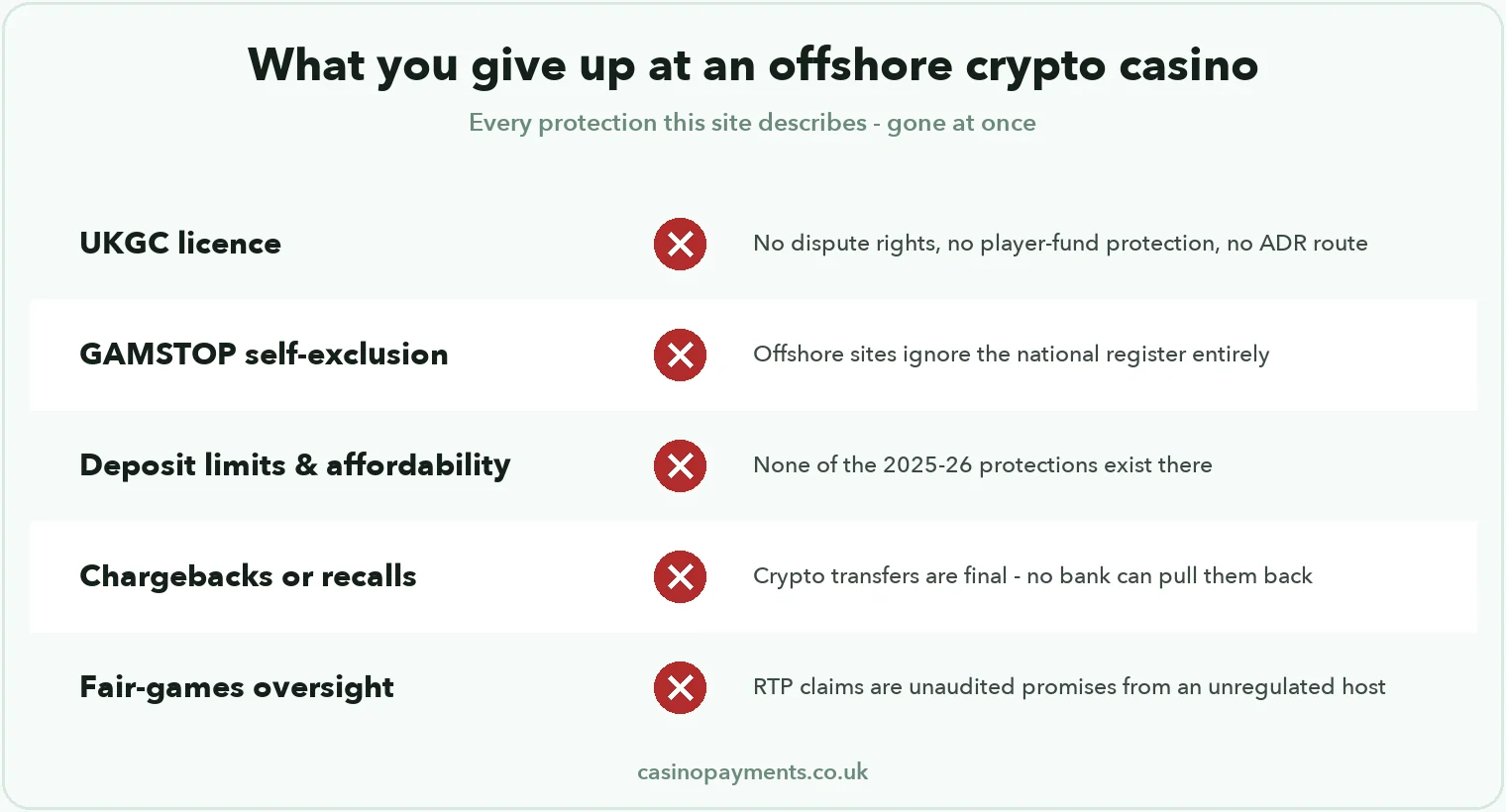
The itemised bill for climbing the wall. Dispute rights: a UKGC casino that stiffs you faces ADR, the Commission and enforcement history; an offshore crypto site faces your angry forum post. Fund safety: licensed operators disclose segregation of player balances; offshore balances are unsecured loans to an anonymous company, and the genre’s periodic overnight disappearances turn them to zero without a creditor’s meeting. Self-exclusion: GAMSTOP’s register binds every licensed site — and no others; for excluded players the offshore crypto sector functions as a purpose-built bypass, which is the single darkest fact in this page’s subject.
Payment finality: every rail this site reviews has some recall path — card disputes, bank complaints, wallet mediation; a coin transfer has none, by proud design, so every dispute becomes a donation. Data safety: the withdrawal-time KYC ambush means the anonymity that justified everything ends with your passport scan held by an unregulated operator in an unnamed jurisdiction — the worst possible custodian of exactly the document set identity theft runs on. Each item is the absence of something a licence forces into existence; stacked, they’re the whole reason licensing exists. The wall, from this side, looks less like a restriction and more like the fence at the cliff edge.
Seventeen Years of Parallel Lines
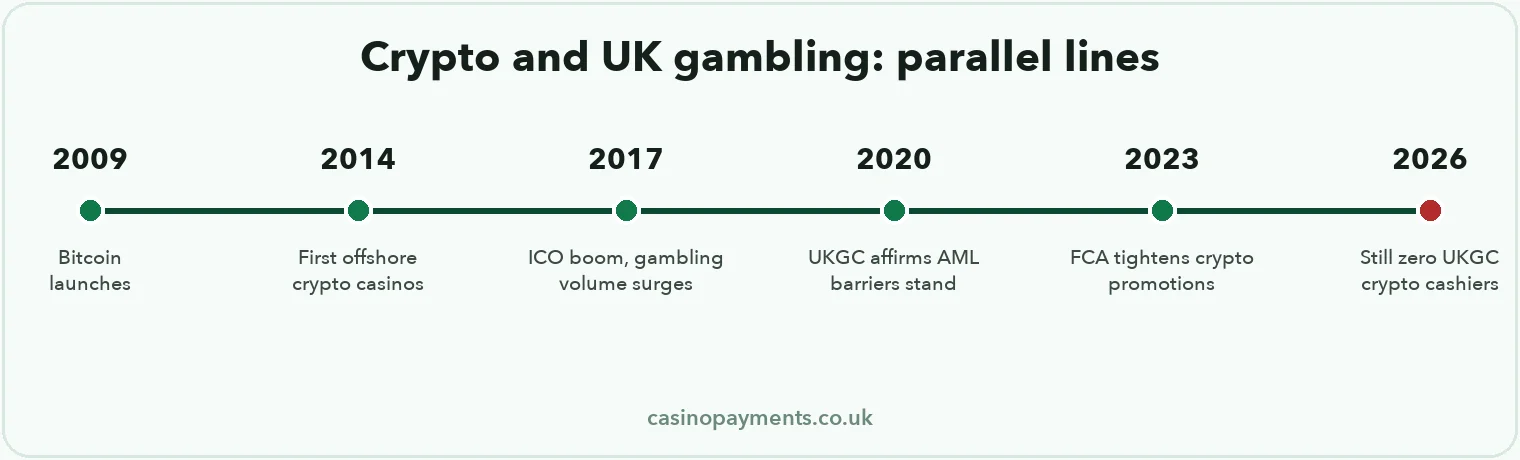
- 2009 — Bitcoin launches; within two years, dice sites are its first killer app — gambling and crypto have never since been separable.
- 2012–2014 — The first true crypto casinos; “provably fair” is coined and becomes the genre’s founding marketing claim.
- 2017 — The ICO boom floods the sector; offshore crypto gambling volume surges past most licensed markets’ totals.
- 2020 — The UKGC’s AML expectations harden into the practical wall: compliant crypto acceptance is theoretically permitted, commercially impossible. The licensed count stays zero.
- 2021–2022 — The celebrity-sponsorship era pushes crypto casinos into mainstream feeds; UK players arrive in numbers, and so does the horror-story genre.
- 2023 — The FCA’s financial-promotions regime brings crypto marketing to heel domestically — while offshore casino marketing, beyond its reach, rolls on.
- 2024–2025 — Blockchain-analytics maturity narrows the technical gap; the commercial verdict doesn’t move. Stablecoins solve the volatility brick and leave the AML one standing.
- 2026 — Zero licensed crypto cashiers, seventeen years in — the most stable number in this site’s entire subject.
The FCA’s own consumer guidance, updated 29 January 2026 and checked directly on fca.org.uk this month, is unambiguous: “If you decide to invest in crypto then you should be prepared to lose all your money,” and “it is highly unlikely you will be covered by the Financial Services Compensation Scheme.” The same page notes Bitcoin fell 30.44% between October and December 2025 alone — the volatility that makes crypto structurally unworkable for a regulated casino balance, not just an AML problem.
Crypto Gambling Rules Around the World
The global map has three colours. Prohibition-by-compliance — the UK’s model — covers most serious licensing regimes: Sweden, the Netherlands, Spain and their peers all arrive at the same zero by the same AML route. Explicit accommodation is rare and instructive: Curaçao’s licensing — the offshore sector’s paper of choice — historically asked little and enforced less, though even its 2024 reform era has tightened the letterhead; a handful of small jurisdictions market crypto-gambling licences as products. The middle experiments: Malta has piloted frameworks for DLT gaming with heavy analytics requirements, and isolated US states have probed stablecoin rails — none of it producing a major-market licensed crypto cashier at scale. The pattern mirrors this page’s thesis: wherever consumer-protection law has teeth, crypto deposits fail the source-of-funds test and stay out; wherever they’re welcomed, the welcome is itself the warning. For UK players the jurisdictional bottom line never moves: the site’s location doesn’t matter, its UKGC licence does, and no crypto casino holds one.
Crypto Beyond the Cashier
None of this page is a verdict on cryptocurrency itself — regulated UK crypto exchanges are FCA-registered for AML purposes, institutional adoption is unremarkable news in 2026, and holding coins is as legal as holding shares. The technology’s legitimate uses — settlement experiments, tokenised assets, cross-border transfers where banking rails fail — proceed on their own merits entirely apart from the offshore casino trade that happens to share a blockchain with them. That separation cuts both ways and is worth stating precisely: crypto being legitimate doesn’t legitimise unlicensed casinos that accept it, and unlicensed casinos being dangerous doesn’t indict the asset class they bank with. The FCA’s standing consumer framing — high-risk, unprotected, be prepared to lose everything invested — applies to the holding; this page’s framing applies to the gambling; a reader doing both is stacking the two risk statements, and deserves to know it. The one crossover fact that matters practically: your legally-held coins convert to legally-depositable pounds at any regulated exchange, which is the bridge the alternatives section is built on.
Safer Gambling: The Bypass Problem
Crypto’s safer-gambling section carries the heaviest warning on this site: the offshore crypto sector is a functioning bypass of every UK protection at once — and for GAMSTOP-registered players specifically, it is where relapse goes to happen invisibly. No licensed-market tool reaches it: bank blocks can’t see exchange-hopped coins, GAMSTOP doesn’t bind unlicensed operators, deposit limits don’t exist there, and the anonymity that markets the sites also hides the spending from everyone who might notice it early — including you, in currency your brain doesn’t price like rent money.
If you’re excluded and the crypto route has started looking like a door: that impulse is the relapse, arriving in technical clothing, and it’s treatable at the impulse stage. The National Gambling Helpline — 0808 8020 133, free, confidential, 24/7 — has this exact conversation daily; GamCare and our responsible gambling hub carry the fuller toolkit, and blocking software (Gamban and peers) covers offshore sites GAMSTOP can’t. For everyone else the section’s takeaway is preventative: the licensed system’s frictions — the checks, the limits, the verification — are the protections, experienced from the inside. The place with none of them isn’t freer; it’s just unguarded. 18+.
What Players Report From the Other Side
The offshore crypto forum record is the largest cautionary literature in gambling, and its genres are stable enough to catalogue. The withdrawal ambush dominates: deposits taken with no questions, five-figure wins met with sudden KYC demands, then the terms-clause confiscation — “irregular play”, “bonus abuse”, “multi-accounting” — with no ombudsman to test the claim against. The disappearance genre runs second: sites, balances and Discord servers gone between sessions, sometimes resurrected under new branding with the same game stack. The slow-drain genre is subtler: withdrawal caps of a few hundred pounds weekly turning one win into a year of instalments, each one contingent on the operator’s continued existence and goodwill.
Two quieter threads complete the record. The GAMSTOP-bypass confessionals — excluded players describing the crypto route in the past tense, from the far side of the damage — are the sector’s true cost ledger, and the reason this page’s safer-gambling section is written the way it is. And the defence threads exist too, in fairness: players reporting years of smooth small-stakes play at the bigger crypto brands — almost always at modest sums, almost always ending with some version of “but I’d never leave real money there overnight”, which is less a defence of the sector than a correctly-priced description of it. The record’s single consistent lesson: the deposits always work; it’s only ever the money coming back that tests what the operator is.
The Legal Routes for Crypto Holders
Holding coins and wanting licensed play aren’t in tension — the bridge is one conversion:
- The standard route, step by step:
- Sell at an FCA-registered exchange and withdraw the pounds to your own bank account.
- Deposit by debit card or open banking like any other player.
- Keep the exchange statements — crypto-origin funds at meaningful scale reliably prompt source-of-funds questions, and documentation answers them in one upload.
Clean, legal, and every UKGC protection intact from the first spin.
- For crypto-ish privacy on licensed rails — a wallet layer: PayPal, Jeton or MiFinity keeps casino transactions off your bank statement, with two-way support and every protection intact.
- For the hard-ceiling discipline crypto never had — paysafecard or a loaded prepaid card: budget physics instead of volatility.
- What no legal route replaces — anonymous, limit-free, exclusion-proof play. That’s not a gap in the market; it’s the protections doing their job, and the sections above are the case for wanting them.
Reading Offshore Crypto Marketing: The Red Flags
The offshore sector’s UK-facing marketing is professional enough to deserve a literacy guide. The tells, in rough order of reliability:
“No KYC” as a headline feature — the clearest flag there is: identity checks are what licensed protection is made of, and their absence is being sold to you as convenience. Remember the asymmetry the forums document — no questions at deposit, sudden “verification” at withdrawal.
“Licensed and regulated” with no regulator named — or naming a letterhead jurisdiction. If the licence mattered to your protection, the page would say UKGC, because nothing else binds an operator serving Britain.
“UK players welcome” — on a crypto cashier, this phrase is a confession: no licensed operator needs to say it, and no crypto operator can say it licitly. The welcome is the warning.
Bonuses an order of magnitude beyond licensed norms — 200% matches and five-figure packages exist because the wagering terms attached are unenforceable promises from an operator no ombudsman audits. The generosity is priced in confiscations.
“Provably fair” doing the work a licence should — covered in full above; wherever the phrase appears as the only trust signal, it’s because the real ones are unavailable.
None of these flags requires research to spot — they’re all on the landing page, which is rather the point: the sector tells you what it is immediately, in terms that only sound like features until you’ve read a page like this one.
The Jargon, Decoded for Cashier Purposes
Offshore marketing leans on vocabulary; here’s the working translation of the terms that matter at deposit time. “Provably fair” — cryptographic proof a game round executed its stated odds; proves nothing about the odds’ fairness, payout willingness or operator survival. “No-KYC casino” — identity checks deferred, not absent: expect them at withdrawal, at the operator’s discretion, with your documents as the ransom. “VPN-friendly” — an operator advertising indifference to its own geo-compliance; consider what else it’s indifferent to. “Instant withdrawals” — true for the on-chain leg only; the approval decision before it is where the forum record’s delays and refusals all live. “Licensed” (unnamed) — a letterhead jurisdiction until proven otherwise; only a UKGC licence binds an operator serving Britain. “Degen-friendly limits” — the absence of every affordability protection, marketed as generosity. The pattern is uniform: each term names a removed safeguard in the vocabulary of a feature — which makes the glossary double as this page’s summary.
The Verdict on Crypto at UK Casinos
Seventeen years of parallel lines earn a plain verdict: for UK players, crypto casino deposits are an offshore-only proposition, and offshore is precisely what’s wrong with them. The wall isn’t prejudice — it’s the source-of-funds question crypto was engineered not to answer — and what waits over it is the licensed system’s protections subtracted one by one, with the forum record itemising the cost in confiscated withdrawals, vanished balances and bypassed exclusions. The honest credit — genuinely fast, private, cheap deposits — buys nothing when the money coming back is the unprotected leg. Crypto holders have a clean bridge: convert at a regulated exchange and every method on this site opens up, wallet privacy included. And the number to watch remains the easiest prediction in this site’s catalogue: licensed UK crypto cashiers — zero last decade, zero today, and nothing in law, technology or commerce pointing anywhere else. When that changes, this page will be rewritten the same month. Don’t hold your coins waiting.
Crypto Casino FAQs
Can I deposit Bitcoin at a UK-licensed casino?
No — zero UKGC operators accept direct cryptocurrency deposits, a count unchanged since Bitcoin launched. Anti-money-laundering source-of-funds rules make compliant crypto acceptance commercially impossible, and no operator has cleared the bar.
Is it illegal for UK players to use offshore crypto casinos?
Playing isn’t a criminal offence for you — the offence is the operator’s, for serving Britain unlicensed. But legality-for-you buys nothing: no GAMSTOP, no dispute rights, no fund protection, and winnings recoverable only at the operator’s pleasure.
Why exactly won’t the Gambling Commission allow crypto?
It technically does allow it — with AML expectations (verified source of funds, blockchain analytics, volatility management) that no operator has found worth meeting against sterling rails that already work. The zero is a market verdict on a compliance bar, not a ban.
What does “provably fair” actually prove?
That the game executed the odds it claimed for that round — a cryptographic verification of the shuffle. It proves nothing about whether the odds were reasonable, whether withdrawals get paid, or whether the operator exists next month. It is not consumer protection.
Can offshore casinos see I’m on GAMSTOP?
No — and that’s the danger, not a feature. GAMSTOP binds licensed operators only; the offshore crypto sector functions as a bypass of UK self-exclusion. If you’re registered and the crypto route tempts you, treat that as the relapse warning and call 0808 8020 133.
What happens if a crypto casino won’t pay my winnings?
Usually nothing you can force: no ADR scheme, no ombudsman, no UK enforcement reach, and coin transactions can’t be recalled. The forum record’s dominant genre — deposits smooth, withdrawals ambushed — exists because the recourse doesn’t.
Can I sell crypto and deposit the pounds at a licensed casino?
Yes, entirely legally: convert at an FCA-registered exchange, withdraw to your bank, deposit by debit or open banking. Keep exchange statements — casinos ask source-of-funds questions about crypto-origin money at meaningful scale, and documentation answers them.
Are stablecoin deposits any different?
They solve the volatility objection and leave the bigger AML one untouched — a stablecoin’s chain history is as unauditable as Bitcoin’s. No UKGC operator accepts them either; the wall’s load-bearing brick was never the price chart.
Do any countries license crypto casinos properly?
No major consumer-protection regime does. Curaçao papers most of the offshore sector, with historically light oversight; Malta has piloted heavy-requirement frameworks without mainstream uptake. Wherever licensing has teeth, the AML logic lands UK-style: zero.
Will UK casinos ever accept crypto?
Never say never — but nothing points there: the AML wall has held for seventeen years, analytics maturity hasn’t moved the commercial verdict, and sterling rails keep improving. Treat any “UKGC crypto casino” claim you encounter today as false by definition.
Changelog: 9 July 2026 — added an at-a-glance box, the FCA's current risk-warning wording and volatility data, and a screenshot of its official guidance page.
Sources & Verification
Primary sources checked 5 July 2026: the Gambling Commission’s published positions on money-laundering risk and blockchain-derived funds; the FCA’s cryptoasset consumer warnings (re-verified 9 July 2026, last updated by the FCA 29 January 2026) and financial-promotions regime; GAMSTOP scheme documentation for the exclusion-bypass sections; UKGC register sampling across major operators confirming the zero-acceptance count.

Will has read more crypto-casino confiscation threads than anyone should, and this page is their distillation: the wall explained without moralising, and the bridge for coin holders who'd rather keep the protections. More about Will →