Chase arrived in Britain in 2021 with JPMorgan’s balance sheet behind it and 1% cashback in front of it. At a casino cashier the card behaves like any other Debit Mastercard — universally accepted, instant, free. What differs is everything around it: a gambling block that takes a phone call and then two days to undo, and a cashback scheme that pays on almost everything you buy except a casino deposit.
Casinos that accept Chase cards are no different from any other Mastercard cashier; the block is the part worth reading about.
Casinos with Chase Payments
| Chase at a Glance | |
|---|---|
| Casino acceptance | Universal — deposits as a standard Debit Mastercard |
| Gambling block | Phone call to customer care, then a 48-hour delay |
| Cashback on gambling | None — betting and gambling are excluded categories |
| Owner | JPMorgan Chase — the largest bank in the United States |
| Protection | UK-licensed bank; FSCS applies to eligible deposits |
Checked 24 July 2026 against Chase’s own published support pages.
| Question | Answer |
|---|---|
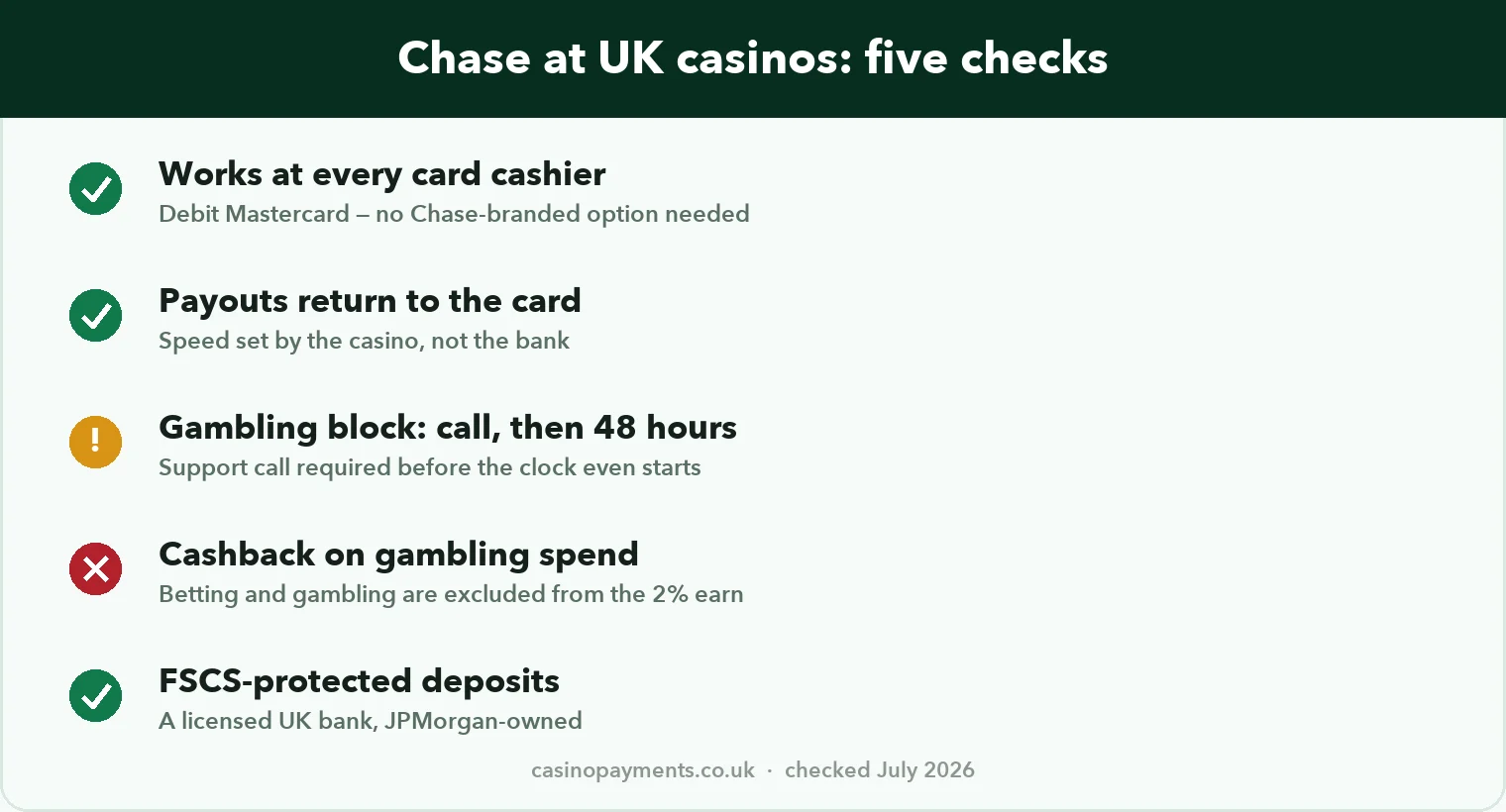
| Can I deposit at UK casinos with Chase? | Yes — it issues a Debit Mastercard, accepted at every cashier that takes cards |
| Is there a Chase option in the cashier? | No, and none is needed — you use the debit card route |
| Do payouts come back to it? | Yes, like any debit card; arrival speed is the casino’s doing, not Chase’s |
| The catch? | Its gambling block needs a phone call to remove, then a further 48 hours |
| What about the cashback? | Gambling is explicitly excluded from Chase’s cashback — casino spend earns nothing |
Checked 24 July 2026 · 18+ · UKGC-licensed operators only · begambleaware.org
Chase at UK Casinos: Quick Facts
| What it is | UK digital bank; casino deposits ride its Debit Mastercard |
|---|---|
| Launched in the UK | September 2021 — JPMorgan’s first overseas consumer bank |
| Parent | JPMorgan Chase & Co. |
| Protection | FSCS-eligible deposits, like any authorised UK bank |
| Cashier route | The debit-card option; no named Chase method exists |
| Withdrawals | Back to the same card under closed-loop rules |
| Gambling block | In-app to switch on; phone call + 48 hours to switch off |
| Block blind spots | Supermarket lottery tickets and casino ATM withdrawals, per Chase’s own notes |
| Cashback | Gambling and betting excluded from earning |
The Block, the Phone Call and the Two Days
Every UK app bank now ships a gambling block. Chase’s is worth singling out because it is, by a small margin, the most effortful to remove of any bank on this site — and it says so plainly in its own documentation rather than burying it.
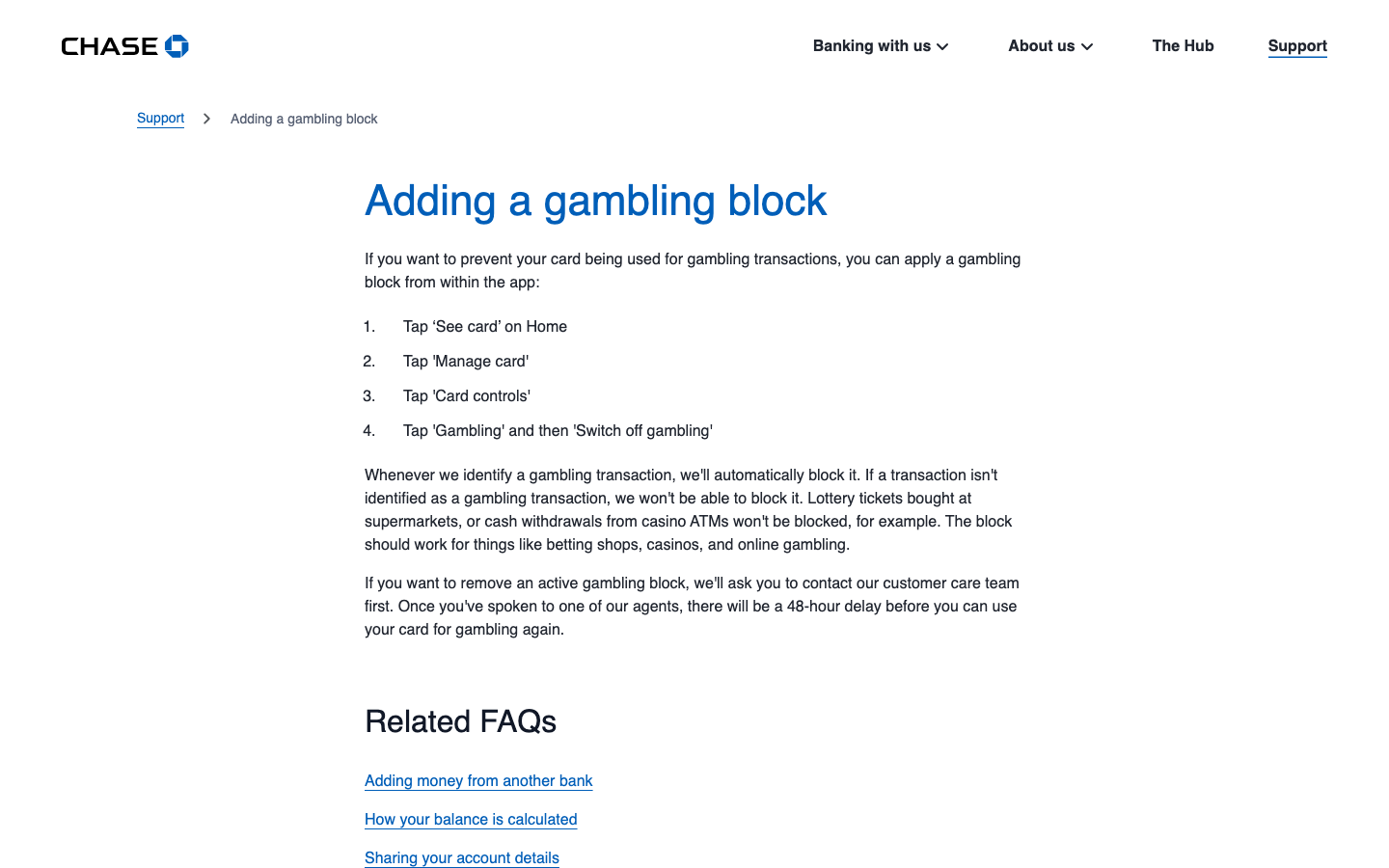
Switching it on is four taps and instant. Switching it off requires you to contact customer care and speak to an agent; only once that conversation has happened does a 48-hour delay begin. Monzo asks for a support chat plus 48 hours; Starling and Revolut automate the whole thing behind a 48-hour timer. Chase combines a human conversation with the full delay, which makes it the strictest configuration in the market and, for anyone who wants the friction, the most useful.
Its honesty about the gaps deserves equal credit. The block works on merchant category codes, so Chase spells out what escapes them: a lottery ticket bought at a supermarket till is coded as groceries, and cash pulled from an ATM on a casino floor is coded as a cash withdrawal. Neither trips the block. That is true of every bank block in Britain; Chase is unusual only in printing it on the support page instead of letting customers discover it.
The Cashback Exclusion Nobody Mentions
Chase’s cashback is the reason a lot of people opened the account, and it is precisely the feature a casino deposit will not touch. The terms exclude gambling and betting from earning, so a £100 deposit that would return cashback at the supermarket returns nothing at a cashier.
This is standard across the industry rather than a Chase peculiarity — card issuers treat gambling as a cash-equivalent or excluded category almost universally, and Amex’s reward programmes did the same long before the UK banned credit-card gambling entirely. But it is worth stating plainly here because the arithmetic occasionally tempts people: no, you cannot farm cashback by cycling money through a casino, and any spreadsheet suggesting otherwise has the exclusion missing from it.
The current scheme also carries balance and payment-count conditions to reach its headline rate, with a monthly cap on what can be earned. Since gambling spend counts towards none of it, the practical upshot for a casino player is simple: your deposits are ordinary card payments with no reward layer, and the account’s appeal at a cashier rests entirely on the block and the banking behind it.
Chase vs Monzo, Starling and Revolut
Four app banks, one Mastercard rail (Revolut varies), four philosophies about how hard it should be to undo a decision.
| Chase | Monzo | Starling | Revolut | |
|---|---|---|---|---|
| Removing the block | Phone call then 48h | Support chat + 48h | App only, 48h | App only, 48h |
| UK bank licence | 2021 | 2017 | 2016 | 2026 |
| Cashback/rewards | Yes — but not on gambling | No standard cashback | No standard cashback | Plan-dependent |
| Owner | JPMorgan Chase | Independent | Independent | Independent |
| At the cashier | Identical — all deposit as ordinary debit cards | |||
Full guides: Monzo · Starling · Revolut. If the strength of the block is what you are choosing on, Chase edges it. On everything else these four are interchangeable at a cashier, and you should bank wherever suits the rest of your life.
How Chase Casino Payments Work
Depositing
- Choose the debit card option at any UKGC cashier — Chase needs no special handling.
- Enter the card details, or pay through the casino’s Apple Pay / Google Pay button with the Chase card loaded.
- Funds land instantly; the app posts a real-time notification.
- Set the deposit limit the cashier prompts for on first use, and set it at a number you would defend to yourself sober.
Withdrawing
- Payouts return to the depositing card under the closed-loop rule every UK operator follows.
- At casinos running Mastercard Send, expect the credit within hours of approval; Chase posts incoming card credits as they arrive.
- On older processing, one to three working days — the operator’s choice of rail, not the bank’s speed.
Worth knowing
Chase’s account structure separates a current account from linked saver pots, and money in a saver is not card-spendable until moved back — the same deliberate-transfer friction that makes Monzo Pots and Starling Spaces useful for bankroll separation. The round-up feature, which sweeps spare change into a saver, is the other quiet ally: it works on ordinary spending, and it means the account nudges money away from the card rather than towards it.
Licence, Protection & the JPMorgan Question
Chase UK operates under a UK banking licence, so eligible deposits carry FSCS protection on the same statutory basis as any high-street bank, and its conduct is FCA-supervised. The distinguishing feature is what stands behind that licence: JPMorgan Chase, the largest bank in the United States by assets, which launched Chase UK in 2021 as its first international consumer retail venture. For a depositor, the practical read is straightforward — this is not a startup running on funding rounds.
Card-side security is contemporary standard: instant freeze, per-category card controls (the gambling block among them), real-time notifications and app-based management. The boundary this site draws on every bank page applies unchanged: FSCS protects money at the bank. The moment a deposit lands on a casino’s books it is governed by that operator’s UKGC funds-protection rating instead, which is a materially weaker promise. Deposit what a session needs, withdraw what it returns, and the protection gap barely opens.
From Wall Street to the British High Street
- 1799 — The Manhattan Company, the earliest ancestor of today’s JPMorgan Chase, is chartered in New York.
- 2000 — J.P. Morgan & Co. merges with Chase Manhattan, creating the modern group.
- 2008 — The financial crisis makes JPMorgan a consolidator, absorbing Bear Stearns and Washington Mutual.
- 2021 — Chase launches in the UK in September — the group’s first consumer bank outside America, digital-only from day one, with 1% cashback as the hook.
- 2022 — Nutmeg, the UK robo-adviser JPMorgan bought in 2021, is folded into the Chase proposition.
- 2023 — Saver rates and account features expand; the customer base passes the first million.
- 2024–2025 — The cashback scheme is restructured around balance and activity conditions rather than a flat rate.
- 2026 — Chase sits among Britain’s established app banks, with the strictest gambling block of the group.
The entry that matters here is 2021: a bank with two centuries of American history arrived in Britain and, within its first product generation, shipped merchant-level gambling controls as standard. That tells you how thoroughly the idea Monzo introduced in 2018 became a baseline expectation of UK retail banking.
Chase Abroad
Chase UK serves UK residents, and the card’s foreign behaviour is one of the account’s selling points: no fees on overseas spending, converted at the Mastercard rate. At a licensed casino abroad it behaves as any UK Mastercard debit would — accepted where cards are, governed by that country’s regulator rather than the UKGC. The gambling block travels with it, since merchant category codes are international; a Las Vegas cashier and a Maltese one trip it identically.
Worth separating clearly: Chase in America is a different proposition entirely — branches, credit cards, the full retail suite — and US gambling rules differ state by state. Nothing on this page transfers to a US Chase account. And the standing caution applies here as everywhere: a card working at an offshore site imports no British protections to it. GAMSTOP does not reach outside the UKGC’s licensees, dispute routes evaporate, and the fact that a deposit went through proves only that a payment cleared.
Where a Chase Account Helps Outside the Casino
Chase’s wider UK story is a test of whether a global banking giant can win retail customers on product rather than branch networks. The answer so far is a qualified yes: competitive saver rates, fee-free travel spending, round-ups and a clean app have built a substantial base without a single high-street branch. The Nutmeg acquisition added investing; the cashback scheme has been repeatedly reworked as the economics of paying customers to spend proved harder than the launch marketing implied.
The gambling-relevant footnote is cultural rather than commercial. When Monzo shipped the first UK bank gambling block in 2018, it was a startup’s bet that customers would value being protected from themselves. That a JPMorgan-backed entrant launched three years later with the same control — and a stricter removal process than the startup that invented it — is the clearest evidence available that the idea graduated from fintech novelty to banking table stakes.
Chase & Safer Gambling
If the strength of a bank block is what you are optimising for, Chase currently offers the strongest configuration in UK retail banking: a human conversation and a 48-hour wait, with no app-only shortcut. Used deliberately, that is a genuinely useful piece of friction.
Use it with clear eyes about the gaps, which Chase itself documents: supermarket lottery tickets and casino ATM withdrawals are not coded as gambling and are not blocked, and money moved to another bank is beyond any card control’s reach. Layer accordingly — GAMSTOP excludes the person from every UKGC operator at once, cashier deposit limits bound each individual site, and device-level blockers cover the offshore fringe. Our responsible gambling hub assembles the full stack. If the reason you are reading this section is that the block keeps coming off, that pattern is the message: the National Gambling Helpline is free, confidential and open around the clock on 0808 8020 133. 18+.
What Chase Customers Report About Gambling Transactions
Chase threads divide neatly in two. The payments half is uneventful in the way good infrastructure should be: deposits work, notifications are instant, card payouts post the moment operators release them, and there is no recurring genre of Chase-specific declines at licensed cashiers.
The other half is about the block, and it is the most emphatic testimony of any bank on this site. Players who armed it and later wanted it gone describe the phone call as the moment the decision became real — harder to complete casually than a chat message, let alone a toggle. Some post that as frustration; a striking number post it as gratitude, usually in the past tense. The recurring practical complaint is different and worth knowing: people who armed the block for a specific short period and then found the removal process longer than the period they had in mind. And the cashback discovery makes its own small genre — a player checking why a large deposit earned nothing, then finding the exclusion sitting in the terms exactly where it always was.
Best Pairings for Chase Users
The card handles the mainstream case. Sensible companions:
- Open banking — deposits authorised inside your banking app, no card number typed anywhere, with Faster Payments withdrawals that frequently beat the card route home.
- Apple Pay / Google Pay — the same Chase card, tokenised, for cashiers you would rather not hand raw details to.
- paysafecard — if the block is armed and you want a strictly cash-budgeted route, vouchers are the honest answer rather than a workaround.
And the deliberate non-recommendation: do not open a second bank account to route around the block’s phone call. The friction is the product working, and defeating it answers a question about your gambling that deserves the tools above instead.
Using Chase Savers as a Bankroll Wall
Chase’s account structure has a feature worth deliberately misusing. The current account and its linked saver accounts are separate balances, and money in a saver is not spendable by card — it has to be moved back to the current account first. That transfer takes seconds, but it is a decision, and a decision is exactly what an impulse deposit lacks.
Run properly, this gives you a self-managed bankroll system with no extra apps and no reliance on the gambling block. Payday arrives; whatever you have decided is entertainment money goes to a dedicated saver; the current-account balance shows only what is genuinely available to spend. A planned session means consciously moving funds across, which is a two-step act rather than a reflex. Round-ups add a small, steady drift in the useful direction, pulling spare change out of the spendable balance without any effort at all.
The advantage over the gambling block is that this arrangement doesn’t fight you — there is no phone call, no 48-hour wait, no conversation with an agent. It simply makes the default state of your account “most of the money is elsewhere”, which suits players who want structure rather than prohibition. The disadvantage is the mirror image: anything you build yourself, you can dismantle yourself, in the moment it is doing the most good.
So use both, for different jobs. Savers are architecture for ordinary months. The block, GAMSTOP and the helpline in the section above are for the months when architecture is not enough — and knowing which situation you are in is more valuable than either tool.
Our Verdict on Chase for UK Casino Players
At the cashier Chase is unremarkable in the best sense — a Debit Mastercard accepted everywhere, instant in, ordinary out, backed by the biggest bank in America and covered by FSCS. What distinguishes it is the safety furniture: the strictest gambling block in UK retail banking, documented candidly enough to admit its own blind spots. Set against that, the cashback that drew many customers in is worth precisely nothing on casino spend, and it is better to know that before the maths than after.
Existing Chase customers should use it with confidence and arm the block if control is any part of the picture. Nobody should switch banks for its casino performance, because there is nothing at a cashier to switch for — but anyone choosing an app bank who wants the hardest-to-undo protection has a clear winner here, and the phone call is the feature, not the flaw.
Chase’s own support page, checked directly this month, sets out the block in its own words: apply it via See card → Manage card → Card controls → Gambling, after which “whenever we identify a gambling transaction, we’ll automatically block it.” It is equally candid about the limits — lottery tickets bought at supermarkets and cash withdrawals from casino ATMs won’t be blocked, because they aren’t coded as gambling. And to remove it: “we’ll ask you to contact our customer care team first… there will be a 48-hour delay before you can use your card for gambling again.”
Chase Casino FAQs
Do UK casinos accept Chase?
Yes — Chase issues a Debit Mastercard, so every UKGC casino that takes card deposits accepts it. There is no Chase-branded cashier option; you simply use the debit card route.
How do I remove the Chase gambling block?
You must contact Chase customer care and speak to an agent first. Only after that conversation does a 48-hour delay begin, after which gambling transactions work again. There is no app-only shortcut.
Does Chase cashback apply to casino deposits?
No. Gambling and betting are excluded categories in Chase’s cashback terms, so casino deposits earn nothing regardless of how much you deposit or which rate you qualify for.
What does the Chase gambling block miss?
Chase says so itself: lottery tickets bought at supermarkets and cash withdrawals from casino ATMs are not coded as gambling transactions, so they are not blocked. That limitation applies to every UK bank block, not just Chase.
Is money in Chase FSCS-protected?
Yes — Chase UK holds a UK banking licence, so eligible deposits carry FSCS protection. Money sitting on a casino’s books is covered only by that operator’s UKGC funds-protection rating, which is weaker; withdraw winnings promptly.
How fast are casino withdrawals to Chase?
Chase posts incoming card credits as they arrive. Casinos using Mastercard Send typically deliver within hours of approving a payout; operators on older rails take one to three working days. The variance belongs to the casino.
Does the block stop Apple Pay casino deposits?
Yes — a tokenised Chase card is still the Chase card, and the gambling merchant code triggers the same decline whether details were typed or tapped.
Are there fees for using Chase at casinos?
None from Chase on sterling deposits. Abroad, spending converts at the Mastercard rate with no Chase surcharge — one of the account’s genuine strengths.
Chase or Monzo for casino use?
Functionally identical at the cashier. Chase’s block is marginally stricter (phone call plus 48 hours versus Monzo’s support chat plus 48 hours). Pick whichever you already bank with; neither is worth switching for.
Can I use Chase savers to control gambling spend?
Yes, and it works well: money in a linked saver is not card-spendable until you move it back, so funding a session becomes a deliberate two-step act. Combined with round-ups pulling change out of the current account, it makes “most of my money is elsewhere” the default state.
Does Chase charge for using the card abroad at casinos?
No — Chase converts at the Mastercard rate with no added fee, which is one of the account’s genuine strengths. Remember that a card working at an offshore casino imports no UK protections to that site.
Does the Chase block affect the linked credit card too?
Card controls apply per product, so check each card’s settings separately rather than assuming one covers the other. If control is the goal, verify every card on the account rather than the one you use most.
Why was my Chase casino deposit declined?
Check the gambling block first in card controls — it is by far the most common cause. After that, ordinary card checks and available balance. Remember money held in a linked saver is not card-spendable until you move it back.
Sources & Verification
Checked 24 July 2026 against: Chase UK’s own support page on adding a gambling block (captured by screenshot the same day, including the customer-care requirement, the 48-hour delay and the stated block exclusions); Chase UK’s published cashback terms and conditions for the gambling exclusion; Chase Bank UK’s authorisation on the FCA Financial Services Register; the FSCS for deposit-protection scope; and the Gambling Commission’s guidance on blocking gambling transactions.