
Qiwi grew from a Russian payment-kiosk network into a NASDAQ-listed e-wallet used by tens of millions across Russia and the CIS, before the Bank of Russia revoked its banking licence on 21 February 2024 — citing anti-money-laundering failures that explicitly named transfers to illegal online casinos and bookmakers among the violations. It was never available at a UK casino even at its peak. This page covers what Qiwi was, the regulatory finding that ended it, and the properly licensed e-wallets UK players should use instead.
Why Qiwi Is Gone Everywhere, Not Just the UK
| Qiwi at a Glance | |
|---|---|
| Status | Licence revoked by the Bank of Russia, 21 February 2024 |
| UK casino availability | None, ever — and now defunct even in its home market |
| Why it matters here | A cautionary case study in unregulated e-wallet risk |
| Regulator that acted | Bank of Russia (Tsentrobank), the national central bank |
| UK equivalent | Skrill or Neteller — FCA-regulated, not central-bank-revoked |
Checked 5 July 2026 — Qiwi’s banking licence is revoked and its wallet no longer functions, so this table reflects a closed chapter rather than a live status.
| Question | The reality |
|---|---|
| Can I still use Qiwi? | No — the Bank of Russia revoked Qiwi Bank's licence on 21 February 2024, cutting off wallets and payments |
| Was Qiwi ever available at UK casinos? | No — Qiwi was always a Russia/CIS-focused wallet, never offered at any UKGC-licensed casino |
| Why was the licence revoked? | The Bank of Russia cited anti-money-laundering failures and "high-risk operations" explicitly including transfers to illegal online casinos and bookmakers |
| Is that unusual? | Very — most methods on this site closed for commercial reasons; Qiwi is the one shut down by a regulator over illegal gambling-linked transactions specifically |
| What should a UK player use instead? | Skrill or PayPal — established, regulated e-wallets already standard at UK casinos |
So "Qiwi casino UK" was never a real question, and it's now doubly moot — the wallet itself stopped functioning in February 2024. What makes Qiwi worth a page of its own, rather than a footnote, is exactly why it was shut down: not commercial pressure like giropay, but a Russian central-bank finding that explicitly named illegal gambling payments among its violations. That's a genuinely different kind of closure story than anything else covered on this site, and it's worth understanding precisely.
Facts verified 5 July 2026 · 18+ · UKGC-licensed operators only · begambleaware.org
Qiwi: Quick Facts
| What Qiwi was | A Russian e-wallet and payment-kiosk network, founded 2007, later listed on NASDAQ in 2013 |
|---|---|
| Status | Banking licence revoked by the Bank of Russia on 21 February 2024 — the wallet and Contact money-transfer service both stopped functioning |
| UK casino availability | Zero, both before and after the revocation — Qiwi never operated at any UKGC-licensed casino |
| Reason for closure | Bank of Russia cited systematic anti-money-laundering violations and “high-risk operations,” explicitly naming transfers to illegal online casinos, bookmakers and crypto exchanges |
| Peak scale | Around 15 million active wallets and over 167,000 kiosks/terminals by late 2013, serving over 60 million monthly users across the network |
| Founders | Sergey Solonin, Boris Kim and Andrey Romanenko, 2007 |
| What to use instead in the UK | Skrill or PayPal — properly regulated, established UK e-wallets |
Qiwi vs Licensed UK E-Wallets
Qiwi and UK e-wallets like Skrill or PayPal solved a similar surface-level problem — a digital wallet standing between a bank account and a merchant — but the regulatory outcomes couldn’t be more different. Skrill and Neteller are both regulated e-money institutions under the Financial Conduct Authority, with safeguarded customer balances and a documented compliance history serving UKGC-licensed casinos for well over a decade. Qiwi, by contrast, lost its banking licence entirely after the Bank of Russia found systemic anti-money-laundering failures.
| Qiwi (defunct) | Skrill/PayPal (UK) | |
|---|---|---|
| Regulatory status | Banking licence revoked, Feb 2024 | FCA-regulated e-money institutions |
| UK casino use | Never available | Long-established at UK cashiers |
| Compliance history | Central bank found systemic AML failures | Ongoing FCA supervision, no equivalent finding |
| Gambling-linked transactions | Explicitly named in the regulator’s findings | Restricted to UKGC-licensed operators only |
The contrast matters beyond simple availability: Qiwi’s story is a genuine cautionary example of what happens when a payment provider’s compliance controls fail badly enough, whereas Skrill and PayPal represent the regulated alternative UK players already rely on.
How Qiwi Used to Work
Qiwi began as a network of physical payment kiosks scattered across Russian cities — a genuinely distinctive starting point compared to most e-wallets on this site, which launched as purely digital products. Users could feed cash into a Qiwi terminal to top up a virtual wallet, pay utility bills, or fund online accounts, before the company layered a full digital wallet and mobile app on top of that physical network as internet and smartphone use grew across Russia and the CIS.
A typical Qiwi transaction, back when the service still functioned, worked roughly like this:
- Fund your Qiwi wallet, either via a physical kiosk with cash or a linked bank card.
- Select Qiwi at a participating merchant or online checkout.
- Confirm the payment from your wallet balance.
- Funds transferred instantly to the merchant or recipient.
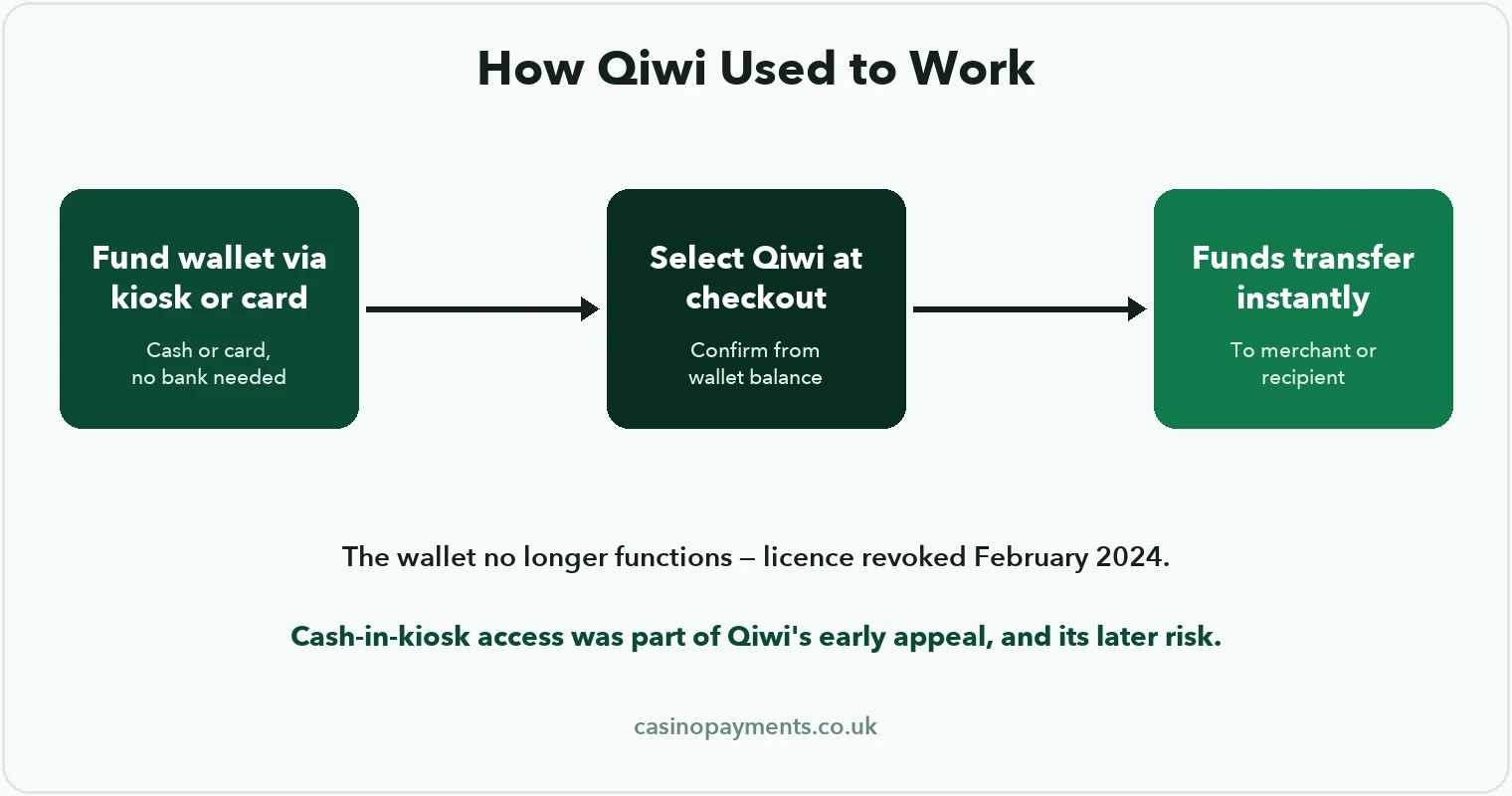
That cash-friendly, low-verification design was part of Qiwi’s early appeal — and, as the 2024 revocation showed, part of what eventually made it attractive for exactly the kind of illicit transactions regulators exist to prevent.
Compare that cash-first architecture to how UK payment methods generally work: every mainstream UK casino cashier option, from debit cards to open banking to e-wallets, ultimately traces back to a verified UK bank account with its own know-your-customer checks already completed. Qiwi’s kiosk-cash entry point meant a wallet could, in principle, be funded and used with considerably less identity verification than that baseline, which is precisely the kind of structural gap the Bank of Russia’s findings suggest bad actors exploited at scale. It’s a useful illustration of why “how do you fund the wallet in the first place” matters just as much as how the wallet pays out, when assessing any payment method’s underlying safety, and it is a distinction worth remembering the next time a wallet advertises how easy and unverified its top-up process is.
Why the Bank of Russia Revoked Qiwi’s Licence
On 21 February 2024, the Bank of Russia revoked the banking licence of JSC Qiwi Bank, the entity underpinning the Qiwi wallet and the company’s Contact money-transfer service. The central bank’s own statement was unusually explicit: it found that Qiwi Bank had “systematically violated legal requirements in anti-money laundering and countering the financing of terrorism,” and specifically that its activities were “characterized by involvement in high-risk operations aimed at settlements between individuals and the black market, including transfers of funds to crypto exchanges, illegal online casinos, bookmakers, etc.”
That last clause is precisely why this page exists in the form it does: unlike every other closed or discontinued payment method covered on this site, Qiwi’s shutdown was triggered by a regulator explicitly naming illegal gambling payments as one of the problems. Clients were immediately blocked from moving funds to and from their wallets; the Contact transfer system suspended operations; and Qiwi’s outdoor payment terminals, along with online payment processing for telecom services at partner banks including Raiffeisenbank, were all disrupted the same day. An arbitration court subsequently completed Qiwi Bank’s formal liquidation process, closing the chapter entirely by late 2025.
The revocation also needs to be read against the wider backdrop of Russia’s regulatory environment for online payments. The Bank of Russia has taken an increasingly aggressive stance against payment providers it judges to be facilitating illicit finance, treating banking licences as conditional privileges that can be pulled entirely rather than merely fined or restricted when violations are judged severe enough. Qiwi’s case was notable for its scale — a NASDAQ-listed company with tens of millions of users, not a small or obscure provider — which made the revocation a significant moment in Russian financial-sector enforcement rather than a routine compliance action against a minor player.
The AML Findings in Detail
The Bank of Russia’s language is worth reading precisely rather than paraphrasing loosely, because it distinguishes between different categories of risk. “Settlements between individuals and the black market” describes person-to-person transfers effectively laundering money through informal or illegal commerce. “Transfers of funds to crypto exchanges” flags a common money-laundering route regulators worldwide watch closely. And “illegal online casinos, bookmakers” refers specifically to unlicensed gambling operators — sites with no legitimate Russian gambling licence, processing player funds through a route the central bank determined Qiwi’s own controls failed to adequately screen for.
This is a genuinely instructive case for UK readers assessing “is this payment method safe,” because it shows what actually happens when a payment provider’s anti-money-laundering controls fail seriously enough: not a fine or a warning, but the complete revocation of the banking licence underpinning the entire wallet, cutting off millions of legitimate users along with whatever illegal activity the regulator was targeting. It’s also a direct illustration of exactly why UKGC-licensed casinos are restricted to FCA-regulated, properly vetted payment providers — the entire point of that restriction is to prevent a UK player’s money ever passing through a provider with the kind of compliance failures Qiwi was found to have.
Worth stressing again for absolute clarity: the “illegal online casinos, bookmakers” language refers to unlicensed operators processing bets through improper channels, not to gambling itself, and it has nothing to do with the properly licensed, UKGC-regulated casinos this site covers. The distinction matters because it would be easy to misread this finding as evidence that gambling payments generally carry elevated risk, when the actual finding is far narrower: it’s specifically about payments to operators with no legitimate licence at all, exactly the category of site the UKGC’s own licensing regime exists to keep UK players away from in the first place.
QIWI’s Rise and Regulatory Collapse
Qiwi was founded in 2007 by Sergey Solonin, Boris Kim and Andrey Romanenko, building on an existing Russian payment-kiosk network to create a combined cash-and-digital payment platform. The company grew rapidly through the following decade, expanding its terminal network across Russia and the wider CIS region while layering digital wallet and mobile functionality on top of its physical kiosk base.
- 2007 — Sergey Solonin, Boris Kim and Andrey Romanenko found Qiwi.
- 2013 — Qiwi completes an Initial Public Offering on NASDAQ in May, reaching roughly 15 million wallets and over 167,000 kiosks and terminals by year end.
- 2010s — The wallet and Contact money-transfer service expand across Russia and the CIS as smartphone adoption grows.
- 2024 — The Bank of Russia revokes Qiwi Bank’s banking licence on 21 February, citing systemic anti-money-laundering failures including transfers to illegal gambling operators.
- 2024 — Wallet access, Contact transfers and kiosk payments all cease functioning immediately following the revocation.
- 2025 — An arbitration court completes Qiwi Bank’s formal liquidation, closing the process entirely by November.
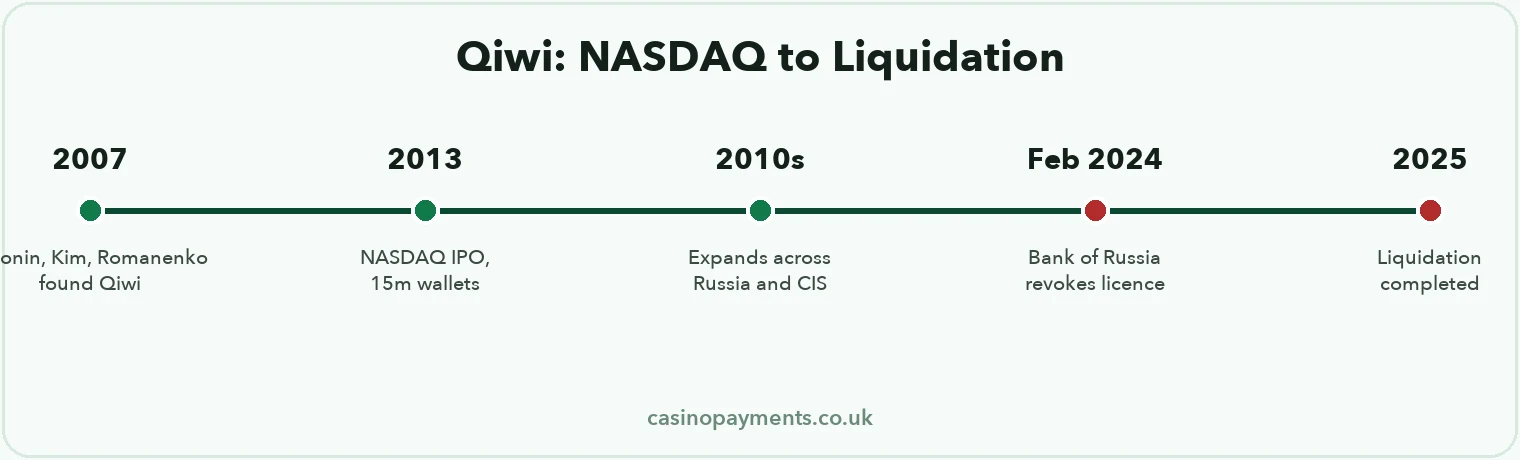
Qiwi’s arc — kiosk network to NASDAQ-listed public company to regulator-forced closure — is a markedly different trajectory from giropay’s considered commercial retirement or iDEAL’s managed migration into Wero. It’s the one closure on this site driven by a hard regulatory intervention rather than a business decision.
Where Qiwi Operated
Qiwi operated primarily within Russia and the wider CIS region throughout its existence, built around Russian payment infrastructure and Russian banking licensing. It never launched a UK version and had no meaningful presence in Western European online gambling markets even at its commercial peak, when tens of millions of active wallets made it one of the larger e-wallets in its home region.
That regional confinement, combined with the 2024 licence revocation, means Qiwi has zero relevance to any UK reader in either direction: it was never accessible from Britain, and it no longer functions anywhere at all following the Bank of Russia’s action. Its story belongs on this site purely as a cautionary, well-documented example of payment-provider failure rather than as a method any UK player could ever have considered.
It’s worth placing Qiwi alongside this site’s other Russia-adjacent coverage for context: no currently active UK-relevant payment method traces any lineage back to Qiwi or its former partner networks, and none of the regulated e-wallets UK players use today share any corporate history, ownership, or technical infrastructure with Qiwi whatsoever. The two worlds simply never intersected, which is precisely why this page functions as a standalone case study rather than a comparison point against anything currently live.
Qiwi Beyond Gambling
At its peak, Qiwi was genuinely significant infrastructure across Russia and the CIS: its kiosk network let people without bank accounts or cards pay bills, top up mobile credit, and move money using cash alone, filling a real gap in regions where traditional banking penetration lagged behind Western Europe. That cash-accessible model made it popular well beyond any single use case, from utility payments to online gaming top-ups to informal peer-to-peer transfers.
The 2024 collapse rippled beyond individual wallet holders: partner banks including Raiffeisenbank had integrated Qiwi’s payment processing for telecom services, and the sudden licence revocation disrupted those partner integrations the same day it hit ordinary users, illustrating how deeply embedded a single payment provider’s infrastructure can become in a wider financial ecosystem before a regulatory failure exposes just how much depended on it.
Qiwi’s 2013 NASDAQ listing is itself worth dwelling on, since it’s a detail that makes the eventual outcome more striking rather than less. Public companies listed on major international exchanges face ongoing disclosure and governance obligations specifically designed to give investors confidence in a company’s internal controls, yet those obligations evidently weren’t enough to prevent the compliance failures the Bank of Russia later identified. That gap between public-market scrutiny and the actual quality of a payment provider’s anti-money-laundering controls is a useful reminder that a stock listing, in itself, is not a substitute for direct regulatory oversight of the specific payment activity a company handles.
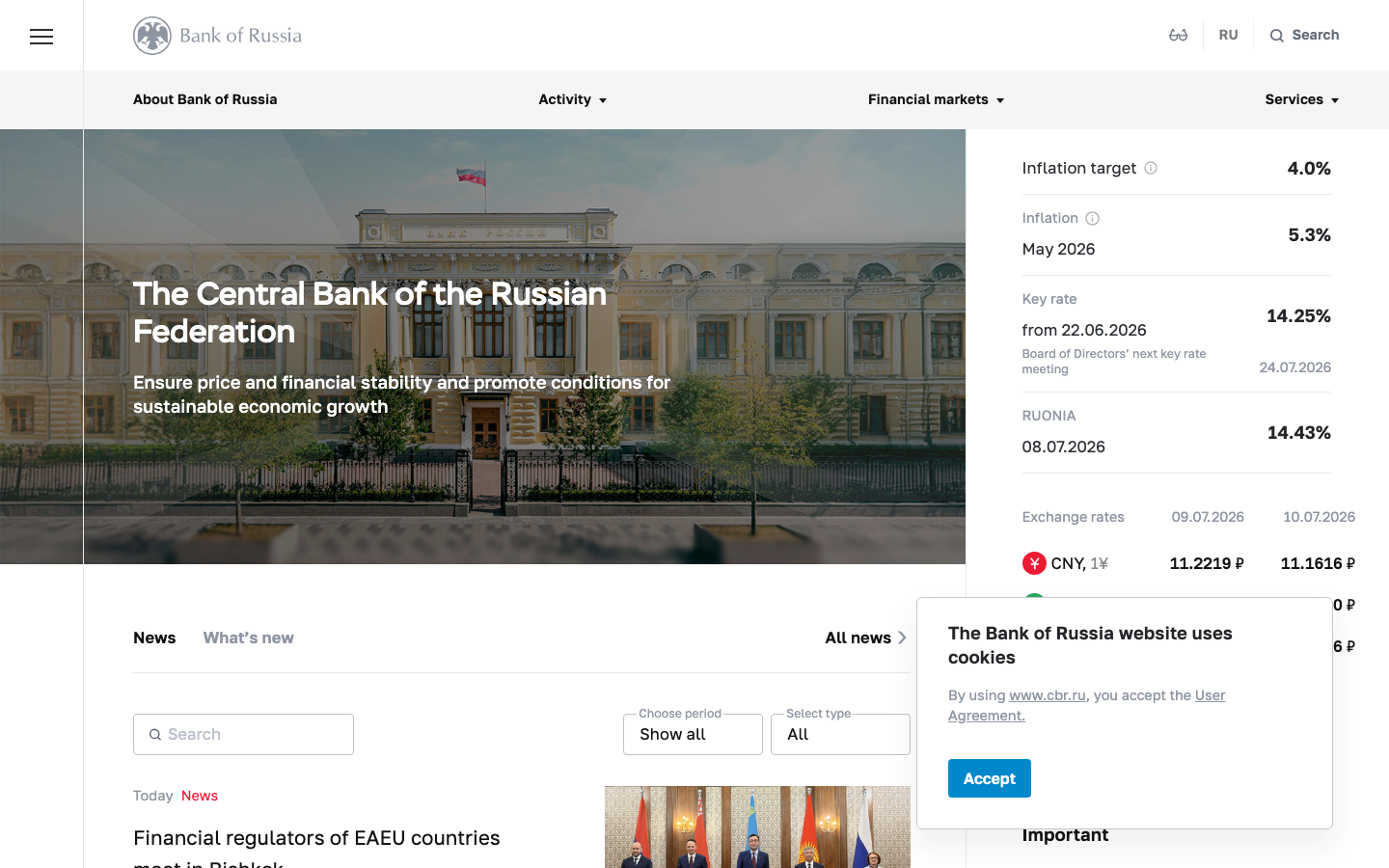
The Bank of Russia’s own English-language homepage, checked directly this month, still functions as the country’s live monetary-policy and financial-stability portal — publishing current key-rate, inflation and exchange-rate data in real time. It is the same regulator whose 2024 licence revocation ended Qiwi Bank’s ability to operate, illustrating that a central bank’s ordinary published functions and its enforcement powers sit on the same site.
Safer Gambling and Qiwi
Qiwi’s relevance to safer gambling isn’t about UK bank-level protections failing to reach it, the way most methods on this site work — it’s more direct than that. The Bank of Russia’s own findings explicitly linked Qiwi to illegal gambling operator transactions, which is precisely the kind of unregulated-operator risk the UKGC’s licensing system and this entire site’s “UKGC-licensed operators only” standard exist to keep UK players away from.
For UK readers, the practical takeaway isn’t a payment-method comparison so much as a reminder of why licensing matters: a properly regulated e-wallet like Skrill or PayPal operating at a UKGC-licensed casino carries none of the risk a defunct wallet with a documented history of illegal-gambling-linked transactions ever did. UK players should continue relying on GAMSTOP, bank-level gambling blocks and deposit limits set through their own regulated UK bank — protections that only exist because the underlying payment and licensing infrastructure is properly regulated in the first place.
What Russian Users Said About Qiwi
Coverage of the February 2024 shutdown described genuine disruption for millions of ordinary users with no connection to the illegal activity the Bank of Russia’s findings targeted — people who used Qiwi for everyday bill payments and transfers suddenly found their wallets frozen and unusable, a reminder that regulatory action against a payment provider’s compliance failures inevitably affects legitimate customers alongside whatever illicit activity prompted the intervention. Reporting at the time focused heavily on the scramble to access frozen funds and migrate to alternative payment providers in the weeks following the revocation.
None of that experience is actionable for a UK reader, since it describes Russian and CIS users navigating a Russian regulatory action with no bearing whatsoever on UK gambling or UK-licensed payment providers. If there’s a lesson worth carrying over, it’s a general one rather than anything Qiwi-specific: keeping meaningful balances parked in any single wallet, in any country, carries a small but real concentration risk if that provider’s own compliance position ever turns out to be weaker than it appeared from the outside.
What UK Players Should Use Instead of QIWI
For the e-wallet experience Qiwi used to offer, without any of its regulatory history, Skrill and PayPal are both long-established, FCA-regulated options already standard at UKGC-licensed casinos, with documented compliance track records spanning well over a decade.
For a bank-direct alternative instead of a wallet, open banking (Trustly, Brite, Volt) moves money straight from your bank account with strong authentication. And debit card remains the universal option every single UKGC casino accepts.
Setting up a properly regulated e-wallet like Skrill or PayPal for UK casino use takes only a few steps:
- Create an account with your chosen regulated e-wallet provider.
- Link a UK bank account or card to fund your wallet.
- Select the wallet at the casino cashier and log in to confirm.
- Funds appear in your casino balance within moments.
Our Verdict on Qiwi for UK Players
Qiwi’s story is the one genuinely cautionary tale among the defunct and discontinued methods covered on this site: a wallet that grew from Russian payment kiosks into a NASDAQ-listed company, only to have its banking licence revoked by the Bank of Russia in 2024 over anti-money-laundering failures that explicitly named illegal gambling operators among the problems. It was never available at a UK casino, and it no longer functions anywhere at all. There’s no “closest equivalent” worth chasing here — UK players should simply use properly regulated options like Skrill or PayPal, which carry none of Qiwi’s documented compliance history.
Qiwi Casino FAQs
Is Qiwi still working?
No. The Bank of Russia revoked Qiwi Bank’s banking licence on 21 February 2024, immediately cutting off wallet access, the Contact transfer service, and kiosk payments. An arbitration court completed the bank’s formal liquidation by late 2025.
Was Qiwi ever available at UK casinos?
No — Qiwi was always focused on Russia and the CIS region and was never offered at any UKGC-licensed casino, even at the height of its popularity before the 2024 revocation.
Why exactly was Qiwi shut down?
The Bank of Russia found systematic anti-money-laundering violations, describing “high-risk operations aimed at settlements between individuals and the black market, including transfers of funds to crypto exchanges, illegal online casinos, bookmakers, etc.”
Did Qiwi’s closure have anything to do with legal, licensed gambling?
No — the regulator’s findings specifically named illegal, unlicensed gambling operators as one problem among several, not licensed casinos. It’s an entirely separate situation from UKGC-regulated gambling in the UK.
What happened to people’s money when Qiwi shut down?
Reports described significant disruption for ordinary users, whose wallets were frozen when the licence was revoked, separate from the illegal activity the central bank’s findings targeted — a common consequence when a payment provider’s licence is pulled for compliance failures.
What should I use instead of Qiwi at a UK casino?
Skrill or PayPal — both FCA-regulated e-wallets with over a decade of established, compliant operation at UKGC-licensed casinos, carrying none of Qiwi’s regulatory history.
Who founded Qiwi?
Sergey Solonin, Boris Kim and Andrey Romanenko founded the company in 2007, building on an existing Russian payment-kiosk network before it grew into a digital wallet and eventually listed on NASDAQ in 2013.
How big was Qiwi before it shut down?
At its peak around 2013, Qiwi had roughly 15 million active wallets and over 167,000 kiosks and terminals, serving more than 60 million people using the network at least monthly.
Changelog: 9 July 2026 — added an at-a-glance box and an official Bank of Russia homepage screenshot, confirming the regulator's site and enforcement record remain live and consistent.
Sources & Verification
Checked 5 July 2026 against: the Bank of Russia’s own press release (re-verified against its live site 9 July 2026) announcing the licence revocation; The Moscow Times and TASS coverage of the 2024 shutdown; documented Qiwi company history; and the UK Gambling Commission’s guidance on setting up a bank gambling block.

A payment provider's own central bank explicitly naming illegal gambling operators in its shutdown order is precisely the kind of cautionary case study this beat exists to document honestly, however far removed from UK players it ultimately is. More about Will →