
Payforit was once the badge on every phone-bill deposit in Britain — the carriers’ common standard that let a casino charge £10 to your mobile account with two taps. It was also quietly retired around 2020–21, which the internet has largely declined to notice: ‘Payforit casinos’ pages still rank, still recommend, and still describe a scheme no cashier has processed for half a decade. Here’s the real story — what it was, why it went, and what actually answers the phone-bill deposit question in 2026.
Why Payforit No Longer Exists at Any Casino
| Payforit at a Glance | |
|---|---|
| Status | Retired — closed in 2021 |
| UK casino availability | None, ever again — replaced by direct carrier billing |
| Current regulator of the category | Ofcom (replaced the Phone-paid Services Authority, 1 Feb 2025) |
| Why it matters here | A reliable stale-content detector — any "Payforit casino" guide is out of date |
| Modern equivalent | Pay by mobile via Boku or Fonix |
Checked 5 July 2026 — though the answer stopped changing when the scheme wound down.

| Question | The 2026 answer |
|---|---|
| Can I deposit with Payforit today? | No — the scheme was wound down around 2020–21; no live UK cashier processes a Payforit payment |
| But sites still advertise "Payforit casinos"? | Stale pages or bait — the checkout behind them runs Boku or Fonix, or the site is best avoided entirely |
| What replaced it? | Direct carrier billing under pay by mobile — Boku and Fonix, same idea on cleaner rails |
| Do the old limits still apply? | Yes — the ~£30 daily phone-bill cap carried over intact; it was regulatory, not Payforit's |
| Still deposit-only? | Yes — then and now, nothing pays out to a phone bill; winnings exit by bank transfer |
So Payforit is a search fossil: a brand that outlived its scheme because a decade of casino guides never got updated. This page does what those pages won't — explains what Payforit was, why the carriers retired it, exactly what runs in its place, and how to spot the stale pages that keep its ghost in your search results.
Status verified 5 July 2026 · 18+ · UKGC-licensed operators only · begambleaware.org
Payforit: Quick Facts
| What it was | The UK mobile networks’ common standard for charging purchases to phone bills, launched 2006 |
|---|---|
| Who ran it | The carriers jointly — a scheme and trustmark, not a company; accredited intermediaries processed the payments |
| Status | Wound down around 2020–21 as carriers moved to direct billing relationships |
| Casino role in its day | The badge behind most “pay by phone bill” deposits of the 2010s, bingo and slots especially |
| The cap | ~£30 per day chargeable to a phone bill — regulatory, and inherited intact by its successors |
| Withdrawals | Never — deposit-only by design, then and now |
| Modern successors | Boku and Fonix direct carrier billing — see our pay by mobile guide |
| If a site advertises it today | The page is stale by at least five years — audit anything else it claims before trusting it |
What Payforit Actually Was (Most Guides Got It Wrong)
The detail that decade-old casino pages consistently fumbled: Payforit was never a payment company. It was a scheme — a common rulebook and trustmark created by the UK mobile networks in 2006 so that charging a purchase to a phone bill worked identically whichever network you were on. The actual processing ran through accredited intermediaries; the casino’s cashier just showed the badge; your consent was two taps on a standardised payment screen; the charge landed on your next bill or came off your PAYG credit.
That structure explains both its 2010s ubiquity and its quiet death. Ubiquity: one integration reached every UK network, at a time when a huge slice of casino traffic — bingo especially — came from players without cards to hand or with a preference for keeping deposits off bank statements. Death: when the carriers’ commercial arrangements evolved toward direct billing partnerships with aggregators like Boku and Fonix, the common badge became redundant plumbing — the networks stopped requiring it, the intermediaries migrated, and the scheme wound down with no press release worth the name. Nothing failed; the standard simply finished its job and was absorbed by its successors.
Payforit Then vs Pay by Mobile Now
Feature by feature, what changed and what didn’t:
| Payforit (2006–~2021) | Boku / Fonix today | |
|---|---|---|
| Charge to phone bill | Yes — via the scheme’s screens | Yes — direct carrier billing |
| Daily cap | ~£30 — regulatory | Same cap, same reason |
| Card or bank details needed | None | None |
| Withdrawals | Never | Still never — bank transfer exit |
| Checkout feel | Redirect to scheme payment screens | Phone number + SMS confirm, slicker |
| Who you’ll see named in cashiers | The Payforit badge | Usually just “Pay by Mobile” |
The comparison’s honest summary: nothing a player valued was lost in the transition — the cap, the card-free simplicity and the deposit-only rule all carried over — and the checkout got cleaner. Full details, live casino list included, in our pay by mobile guide; this page’s job is only to redirect the fossil traffic there.
How a Payforit Deposit Worked
For the record — and because “how it worked” explains its successors’ design choices:
- Choose pay by phone bill in a 2010s cashier; the Payforit badge appeared on the payment screen that followed.
- Enter or confirm your mobile number; on-network detection often pre-filled it — a convenience that doubled as the scheme’s main fraud-complaint generator.
- Two standardised confirmation taps — the scheme’s signature consent flow, designed so every phone-bill charge in Britain looked identical.
- The charge joined your next bill (or debited PAYG credit); the casino balance credited instantly; the £30 daily ceiling governed everything.
- Winnings, then as now, left by bank transfer after verification — a phone bill can be charged but never credited.
Design historians of payments will note what the successors kept and cut: Boku and Fonix kept the number-plus-confirmation core and the regulatory cap, and cut the redirect-heavy scheme screens — the part users tolerated rather than liked. The two-tap consent pattern, meanwhile, became the template for a decade of UK carrier-billing rules. Schemes die; their UX patterns are immortal.
Why It Was Retired (And Nothing Replaced the Badge)
Payforit’s retirement had three unglamorous causes. Commercial evolution: the carriers found more value in direct billing partnerships — Boku’s and Fonix’s aggregator model — than in maintaining a jointly-owned scheme whose rulebook slowed product changes to the speed of four-way agreement. Regulatory convergence: the Payment Services Regulations and the phone-paid services regulator’s rules came to govern carrier billing directly, making the scheme’s self-regulatory layer redundant — the £30 cap, consent standards and complaint routes all now lived in actual regulation. The smartphone: Payforit was designed for a WAP-and-feature-phone world; by 2020, app-store billing and contactless had eaten most of its non-gambling use cases, leaving a shrinking niche not worth a standing consortium.
The security postscript matters for anyone who remembers the scheme’s rougher edges: the 2010s subscription-trap complaints — recurring charges consented to by mis-tap — were the badge’s biggest reputational wound, and the modern regime addressed them with stricter consent and spending-control rules on today’s direct billing. Phone-bill payments in 2026 are meaningfully better-policed than in the badge’s heyday — one of the quiet consumer wins buried in this transition.
From Carrier Consortium to Search Fossil
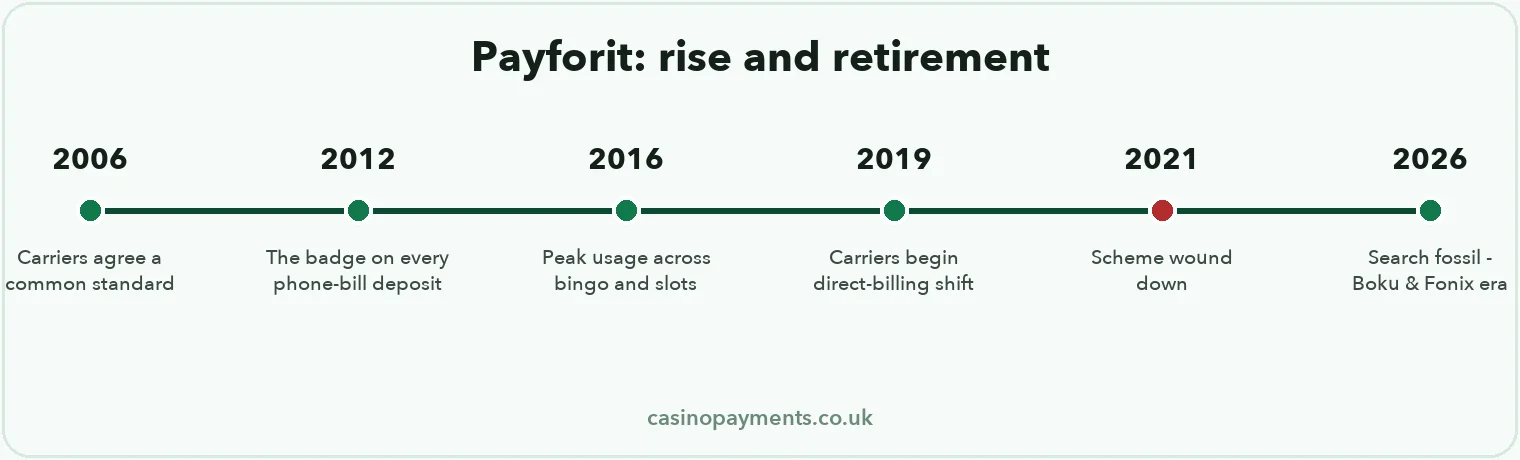
- 2006 — The UK networks launch Payforit as a common standard for phone-bill charging, trustmark and all.
- 2008–2012 — Adoption spreads through mobile content, then gambling; the badge becomes the default face of “pay by phone bill” at UK bingo and slots sites.
- 2013–2016 — Peak years: a huge share of small-stakes casino deposits ride the scheme; the £30 cap shapes an entire low-stakes play culture.
- 2017–2019 — The aggregator shift: Boku and Fonix build direct carrier relationships; new cashier integrations increasingly bypass the scheme.
- 2020–2021 — Wind-down: carriers withdraw from the common standard; the badge disappears from payment screens with barely an announcement.
- 2022–2025 — The fossil era: affiliate pages recommending a dead scheme keep ranking; “Payforit casinos” becomes a reliable stale-content detector.
- 2026 — The search term outlives the scheme by half a decade — hence the page you’re reading.
Regulatory update, checked directly this month: the Phone-paid Services Authority, the body whose rules originally governed Payforit’s spending caps, was itself wound up — Ofcom took over direct regulation of UK phone-paid services from 1 February 2025. The old psauthority.org.uk domain no longer resolves at all, which is a fittingly literal illustration of this page’s core point: even the regulator of a retired payment scheme can retire.

Phone-Bill Gambling Payments Around the World
Payforit was a UK peculiarity — a joint carrier scheme is the kind of thing four networks in one regulatory market can sustain — but carrier billing for gambling follows the same pattern worldwide, wherever it’s permitted at all. The constants travel: low regulatory caps (phone bills are a form of short-term credit, and regulators everywhere cap them accordingly), deposit-only design, and a strong skew toward low-stakes verticals. The variations are instructive: several European markets prohibit gambling on phone bills entirely under the credit logic Britain applies to cards; others never developed the infrastructure. The UK’s position is actually the interesting middle — phone-bill gambling deposits survived the 2020 credit-card ban because the cap and the billing structure were judged sufficiently contained, a distinction our pay by mobile guide covers properly. For this page’s purposes the jurisdictional note is one line: nowhere in the world does a Payforit payment still exist — the fossil is global.
The Wider Lesson: How Payment Methods Die
Payforit earns its page less for what it was than for what its afterlife teaches. Payment methods don’t die with announcements; they die with migrations — and the content ecosystem around gambling is terrible at noticing. Five years after the last Payforit screen, pages recommending it still rank, some freshly copy-edited with current years in their titles, their authors having never checked whether the method processes a payment. That makes “Payforit casinos” one of the most useful searches in this site’s subject: any page recommending it live has just failed the most basic verification test, and everything else it says — casino ratings, bonus claims, licence assertions — deserves the same scepticism. The heuristic generalises, and this site stakes its name on the other side of it: every method page here carries a checked date, every status table is re-verified against live cashiers, and when a method dies — as AstroPay paused, as Payforit ended — the page says so the month it matters. Fossils belong in the history sections, labelled as such.
Safer Gambling: What the £30 Cap Understood
Payforit’s accidental legacy is a safer-gambling insight its successors inherited: the hard daily cap worked. The ~£30 ceiling — imposed because phone bills are credit and regulators cap credit — created a payment method structurally incapable of catastrophic single-session loss, and an entire culture of small-stakes play formed inside it. That legacy lives on in today’s pay by mobile rails, which remain the lowest-ceiling deposit route in any UK cashier — worth knowing for players who want their limits enforced by architecture rather than willpower.
The caveats travel too: phone-bill deposits are still short-term credit (the charge precedes the bill), still invisible to bank-level gambling blocks, and a capped method only caps itself — nothing stops topping up by card alongside. The full apparatus applies regardless of rail: deposit limits at every UKGC operator under the 2026 regime, GAMSTOP’s single registration, and the network-level spending controls every UK carrier now offers. Our responsible gambling hub holds the toolkit; the National Gambling Helpline — 0808 8020 133 — is free, confidential and open around the clock. 18+.
What Players Remember (And Keep Asking)
Payforit’s forum afterlife has two populations. The rememberers are gentle: threads reminiscing about £10 bingo deposits charged to a Nokia’s bill, the two-tap screens, the month-end reckoning when the phone bill arrived carrying a session’s history — small-stakes nostalgia for a scheme that mostly worked and never bankrupted anyone in an afternoon, which is more than several methods on this site can claim. Their consistent complaint from the era matches the record: the subscription traps and mis-tap recurring charges that clung to the badge’s reputation, since fixed by tighter consent rules on the successor rails.
The askers are why this page exists: a steady stream of “is Payforit still a thing?” and “why won’t my casino show it?” threads, usually triggered by one of the fossil guides, reliably answered by someone pointing at Boku. The community’s collective answer has hardened into the same redirect this page performs — the idea lives at pay by mobile, the badge is history, and any guide still recommending it should be read the way you’d read a restaurant review of somewhere that closed in 2021. As payment-method epitaphs go, “fondly remembered, promptly replaced, endlessly search-optimised” is a strange one — but it’s accurate.
What to Use Instead of Payforit
By what drew players to the badge in the first place:
- The phone-bill deposit itself — Pay by mobile (Boku/Fonix): the direct successor — same charge-to-bill mechanics, same ~£30 cap, cleaner checkout, live casino list in the guide.
- Card-free deposits generally — Open banking for bank-app payments with no card numbers, or Apple Pay / Google Pay for the tap-to-pay feel.
- The cash-adjacent privacy Payforit half-offered — paysafecard or Neosurf: genuinely off-bank-statement, with the one-way trade stated openly.
- The low-ceiling discipline — pay by mobile again (the cap survives there), or a deliberately small-loaded prepaid card.
Migrating from a fossil guide takes three steps:
- Open your casino’s cashier and look for “Pay by Mobile” — the badge’s successor hides behind the generic label.
- Enter your number and confirm the SMS prompt; the charge joins your next bill under the same ~£30 daily ceiling the scheme had.
- Set up the bank-transfer exit for winnings at registration — the deposit-only rule survived the badge, so the exit still needs planning.
For nine in ten Payforit searchers, the first link is the whole answer — the method never really died; it just stopped wearing the badge.
How to Spot a Fossil Guide (Using Payforit as the Test)
Payforit’s afterlife makes it the perfect calibration tool for judging any casino-payments page, and the method generalises. The checks, applicable in under a minute:
The present-tense test. Does the page describe depositing “via Payforit” as something you can do today? Instant fail — the scheme stopped processing payments around 2021, and a guide that missed a five-year-old discontinuation has no live verification behind anything else it claims.
The screenshot test. Fossil guides recycle payment screens from the badge era — scheme-branded confirmation pages, pre-2020 cashier layouts, sometimes visibly old handset chrome. Current pages show current cashiers, or none.
The mechanism test. Pages that call Payforit “a payment company” or “an e-wallet” never understood the scheme even when it existed — it was a carrier standard with accredited intermediaries. Wrong taxonomy is a reliable proxy for wholesale copying from other wrong pages.
The successor test. Does the page mention Boku or Fonix — the rails actually processing every UK phone-bill deposit since the wind-down? A “phone bill casinos” page with no mention of either is describing a payments landscape that no longer exists.
The date test, properly applied. A current year in the title means nothing — fossil pages update titles annually by search-engine reflex. Look instead for a checked date attached to specific, falsifiable claims: named casinos, verified caps, live status tables. Claims nobody could re-verify are claims nobody did.
Run those five checks on any payments guide — including this site’s — and you’ll sort the maintained from the embalmed in under a minute. That’s Payforit’s genuinely useful legacy: the dead scheme became the live test.
What Each Part of the Ecosystem Did Next
Wind-downs scatter their participants, and following the pieces explains today’s phone-payment landscape better than any org chart. The carriers kept charging things to phone bills — they simply did it through direct commercial agreements with billing aggregators, trading the consortium’s common rulebook for bilateral flexibility. Every “pay by mobile” deposit today runs on those agreements. The intermediaries — the accredited processors who actually moved Payforit’s money — consolidated hard: the UK gambling niche effectively resolved into Boku and Fonix, whose names now sit (mostly invisibly) behind the generic cashier label. The regulator’s rulebook outlived the scheme it once duplicated: the phone-paid services rules absorbed the consent standards, spending caps and complaint routes, which is why the consumer experience tightened rather than loosened after the badge vanished.
The merchants — bingo and slots operators above all — barely noticed: cashier plugins swapped beneath the “phone bill” button, and deposit flows continued uninterrupted, which is precisely why the public wind-down was so silent. And the brand itself passed into the only afterlife available to a trustmark: search-engine ghosthood, sustained by the fossil guides this page’s earlier section teaches you to spot. The whole dispersal took roughly two years and lost nothing a player would miss — a case study in how payment infrastructure dies properly: functions first rehomed, badge last to fade.
The Verdict on Payforit in 2026
Payforit gets the verdict reserved for the honourably retired: a genuinely useful scheme in its day — card-free, capped, universal across networks — that solved a 2006 problem, shaped a decade of small-stakes play, and was absorbed by better implementations of its own idea around 2021. Nothing about its end was scandalous, which makes its zombie afterlife the only scandal in the story: half a decade on, pages still recommend a method that cannot process a payment, and every one of them is a live demonstration of why checked dates and verified status tables matter. If you arrived here wanting a phone-bill deposit, pay by mobile is the same idea alive and regulated, cap and all. If you arrived from a guide recommending Payforit in the present tense — now you know exactly how much to trust the rest of that guide.
Payforit Casino FAQs
Can I still use Payforit at casinos?
No — the scheme wound down around 2020–21 and no UK cashier has processed a Payforit payment since. Phone-bill deposits themselves live on through Boku and Fonix direct carrier billing, covered in our pay by mobile guide.
What was Payforit exactly?
Not a company — a common standard and trustmark created by the UK mobile networks in 2006 so purchases could be charged to any network’s phone bill through identical consent screens. Accredited intermediaries did the processing; the badge guaranteed the rules.
Why was Payforit discontinued?
Three quiet reasons: carriers shifted to direct billing partnerships with aggregators like Boku and Fonix, formal regulation absorbed the scheme’s self-regulatory job, and the smartphone era shrank its non-gambling uses. It was absorbed rather than abolished.
What replaced Payforit at UK casinos?
Direct carrier billing under the generic “pay by mobile” label — Boku and Fonix are the rails. Same charge-to-phone-bill idea, same ~£30 daily cap, deposit-only as ever, with a cleaner phone-number-plus-SMS checkout.
Why do some casino sites still advertise Payforit?
Stale content — guides written in the 2010s that keep getting cosmetic year-updates without anyone verifying the method exists. Treat a live Payforit recommendation as a reliability test the page just failed, and audit its other claims accordingly.
Could I ever withdraw winnings to my phone bill?
Never — under Payforit or its successors. Phone bills can be charged, not credited, so winnings have always exited by bank transfer after standard verification. Plan for that if you deposit by mobile today.
Does the £30 daily limit still exist on phone deposits?
Yes — the cap was regulatory (phone-bill charges are short-term credit, and credit gets capped), so it transferred intact to Boku and Fonix. It remains the lowest structural ceiling of any UK deposit method — a feature, for budget-first players.
Was Payforit affected by the 2020 credit card ban?
Not directly — phone-bill deposits survived the ban because the tight cap and billing structure were judged sufficiently contained, a carve-out its successors inherit. The scheme’s wind-down was commercial, not regulatory; the timing was coincidence.
Is pay by mobile as safe as Payforit was?
Safer, on the record — the consent and spending-control rules that govern today’s direct carrier billing were tightened specifically in response to the subscription-trap complaints of the badge era. The cap, meanwhile, is unchanged.
Where should a Payforit search actually lead in 2026?
To our pay by mobile guide — the live casino list, the Boku/Fonix mechanics and the cap all live there. This page exists to make the redirect explicit: the badge is history; the idea never went anywhere.
Did Payforit ever support casino withdrawals?
Never — phone bills can be charged but not credited, so the scheme was deposit-only for its entire life, with winnings exiting by bank transfer. Its Boku and Fonix successors inherit the same asymmetry unchanged.
I’ve seen a cashier screen with the Payforit logo recently — how?
Almost certainly a screenshot in a stale guide rather than a live cashier — recycled badge-era images are one of the fossil tells this page catalogues. If a live site genuinely shows the badge, treat the whole operation as unmaintained at best.
Were Payforit deposits covered by the credit card gambling ban?
No — phone-bill deposits survived the April 2020 ban because the tight daily cap and billing structure were judged sufficiently contained, and that carve-out passed to Boku and Fonix. The scheme’s wind-down a year later was commercial coincidence, not regulatory fallout.
Changelog: 9 July 2026 — corrected the regulator reference: the Phone-paid Services Authority was replaced by Ofcom from 1 Feb 2025, and its old domain (psauthority.org.uk) no longer resolves. Added an at-a-glance box and an Ofcom homepage screenshot.
Sources & Verification
Primary sources checked 5 July 2026: archived Payforit scheme documentation and carrier announcements from the wind-down period; the Phone-paid Services Authority’s former rules governing carrier billing and spending caps (the PSA has since been replaced by Ofcom, confirmed 9 July 2026); Boku’s and Fonix’s published UK carrier-billing documentation for the successor mechanics; live cashier sampling across major UKGC operators confirming the scheme’s absence; the Gambling Commission’s gambling-block guidance for the safer-gambling sections.

Will deposited by phone bill more than once in the badge era and has been correcting 'Payforit casinos' listicles ever since the scheme quietly died — this page is the correction given a permanent address. More about Will →