
Six rival Swedish banks built Swish together in 2012, and it grew so fast that street performers and churches now routinely take donations through it — a country moving toward cashlessness faster than almost anywhere else. None of that reaches a UK casino: Swish only works through Swedish mobile numbers verified against Swedish BankID. This page covers what Swish is, its role in Sweden’s regulated betting market, the fraud pattern that comes with instant bank apps, and the UK method that plays the same role.
Why Swish Stays Inside Sweden
| Swish at a Glance | |
|---|---|
| UK casino availability | None — Swedish BankID-linked bank accounts only |
| Operator | Consortium of Swedish banks, via Getswish AB |
| Where used | Sweden's Spelinspektionen-licensed betting market since 2019 |
| Distinct feature | Every payment is bank-authenticated via BankID, no card or wallet layer |
| UK equivalent | Open banking does the same bank-authenticated job |
Checked 5 July 2026 — and reliably checkable indefinitely, since Swish’s dependence on Swedish BankID makes UK access structural, not policy.
| Question | The reality |
|---|---|
| Can I pay a UK casino with Swish? | No — Swish only connects Swedish mobile numbers to Swedish bank accounts through BankID |
| Why not? Is it banned? | Not banned — simply Swedish. There's no UK equivalent of BankID, and no UK bank belongs to the consortium that owns Swish |
| Is Swish used for gambling anywhere? | Yes — many Spelinspektionen-licensed Swedish casinos offer it for deposits and withdrawals via mobile number |
| Could a UK casino add it later? | Only by connecting to Sweden's BankID and bank-owned settlement system, which no UK operator does |
| What should a UK player use instead? | Open banking — the closest match: instant, bank-authenticated, no card numbers |
So "Swish casino UK" has no legitimate destination — the app that near enough replaced cash in Sweden was built entirely around Swedish banking and Swedish national ID infrastructure. What's genuinely worth understanding is how six rival banks built one shared app that pushed Sweden further toward cashlessness than almost anywhere else on earth, how it slotted into Sweden's own regulated betting market, and the fraud pattern that comes with any instant, authenticated payment app. That's what this page covers.
Facts verified 5 July 2026 · 18+ · UKGC-licensed operators only · begambleaware.org
Swish: Quick Facts
| What Swish is | A mobile payment app built jointly by six major Swedish banks, launched in 2012 with Sweden’s central bank and clearing house Bankgirot |
|---|---|
| Owning banks | Danske Bank, Handelsbanken, Länsförsäkringar, Nordea, SEB and Swedbank |
| UK casino availability | Zero — every payment requires a Swedish mobile number linked to a Swedish bank account via BankID |
| Adoption | Around 8 million users as of 2022, against a Swedish population of roughly 10.2 million — near-universal among banked adults |
| Cost to users | Free for private individuals since launch; small per-payment and annual fees apply to businesses |
| Swedish gambling role | A standard deposit and withdrawal method at Spelinspektionen-licensed online casinos since Sweden’s market re-regulated on 1 January 2019 |
| What to use instead in the UK | Open banking (Trustly/Brite/Volt) — the nearest UK equivalent |
Swish vs UK Bank-Authenticated Payments
Swish and UK open banking both let a shopper pay directly from their bank account with strong authentication instead of a card number, but Swish adds a distinctly Swedish layer that has no UK parallel: BankID, the national digital identity system nearly every Swedish adult uses to log into banking, government services and healthcare portals alike. A Swish payment authenticates through the same BankID app a Swede uses for their tax return, which is a level of infrastructure integration the UK has never built — there’s no single UK digital-identity scheme that banks, government and private payments all share.
| Swish (Sweden) | Open banking (UK) | |
|---|---|---|
| Who built it | Six Swedish banks plus the Riksbank and Bankgirot | Private fintechs (Trustly, Brite, Volt) under PSD2 |
| Identifier | Recipient’s mobile number, authenticated via BankID | Your own online banking login |
| Adoption | ~8 million of ~10.2 million Swedes | A smaller but steadily rising share of UK casino deposits |
| Underlying identity system | BankID — shared across banking, government and healthcare | No single equivalent; each bank runs its own login |
If the appeal of Swish was authenticating a payment through your own bank rather than typing a card number, open banking delivers the same principle at a UK cashier — just without a national digital-ID layer underneath it. The UK’s proposed digital identity initiatives have discussed something conceptually closer to BankID over the years, but nothing has reached anywhere near Swedish-style universal adoption across banking and public services, so this remains one of the more genuinely distinctive gaps between the two countries’ payment infrastructure rather than something the UK is quietly catching up on.
How Swish Actually Works
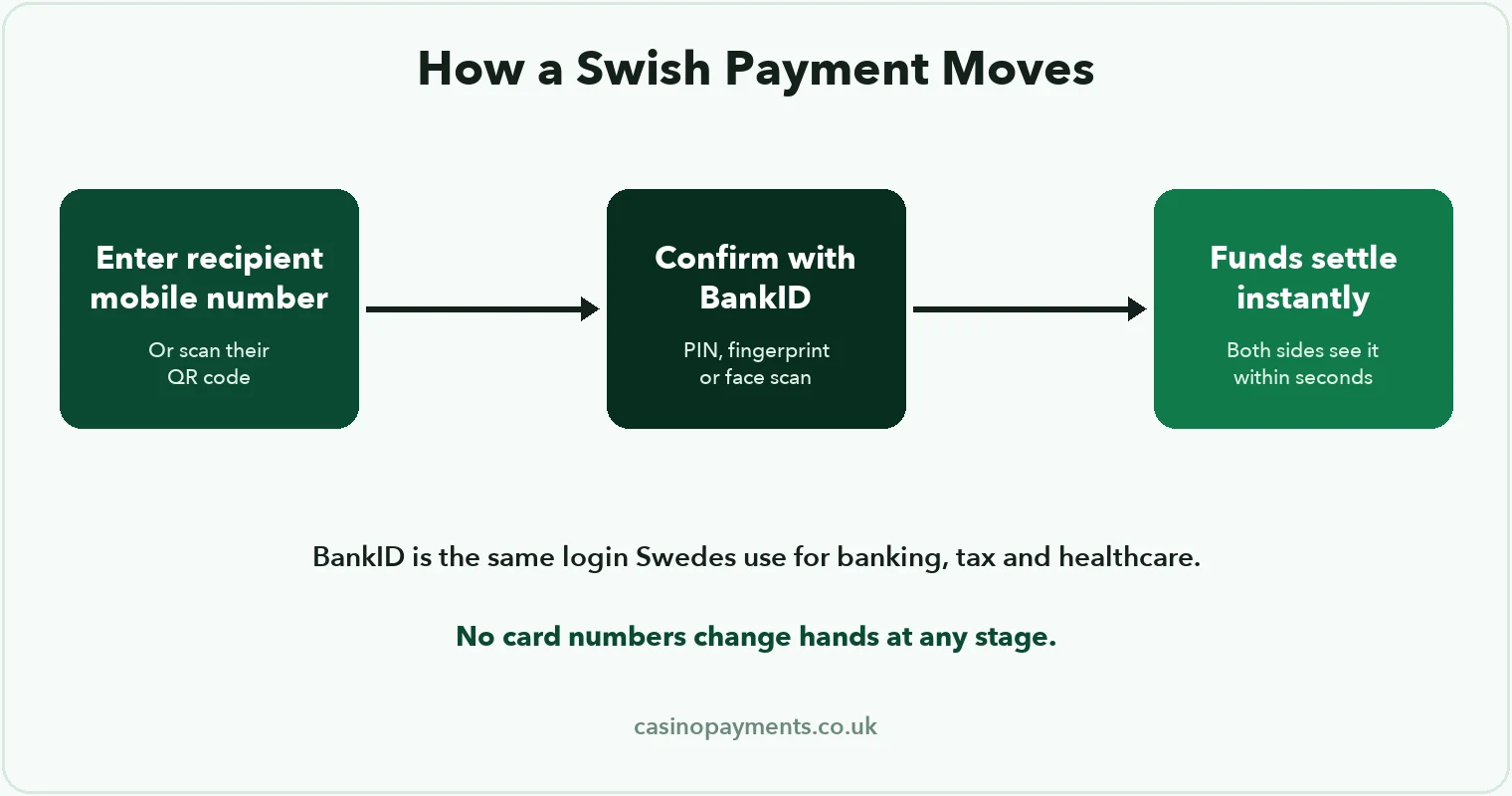
Swish links a Swedish mobile phone number to a bank account, then uses BankID — Sweden’s near-universal digital identity app — to authenticate every transfer. To pay someone, a Swish user enters the recipient’s mobile number (or scans a QR code encoding it) and the amount, then confirms with BankID using a PIN, fingerprint or face scan. The recipient’s phone buzzes with the payment moments later — genuinely real-time, unlike many “instant” payment systems that still take a few minutes in practice.
Step by step:
- Open the Swish app and enter the recipient’s mobile number or scan their QR code.
- Enter the amount and confirm the payment details.
- Authenticate with BankID using your PIN, fingerprint or face recognition.
- Funds move instantly — both sender and recipient see the transaction complete within seconds.
For a Swedish casino cashier, that means deposits clear before the page refreshes, and where an operator supports it, withdrawals can return the same way — a genuine two-way rail rather than a deposit-only convenience.
Swish in Sweden’s Regulated Gambling Market
Sweden re-regulated its online gambling market on 1 January 2019 under the Gambling Act (2018:1138), ending decades of state monopoly and opening licensing to competing operators under the Spelinspektionen (Swedish Gambling Authority). The reform came with some of Europe’s stricter consumer-protection rules attached, most visibly Spelpaus.se, a national self-exclusion register that, once a player signs up, blocks their access to every licensed Swedish gambling site simultaneously — a single-registration system considerably more centralised than the UK’s own GAMSTOP, though built on a similar principle.
Swish sits naturally inside that regulated market because Swedish banks increasingly extended cooperation agreements to licensed operators once the reform passed, letting sites offer Swish deposits and, at a growing number of operators, Swish withdrawals too — both authenticated through the same BankID layer that already secures the player’s online banking. For Swedish bettors, that means a licensed casino’s cashier works exactly like paying for anything else in daily life: mobile number, BankID, done.
The market’s protective streak showed clearly during the pandemic: from 2 July 2020, Sweden imposed a temporary SEK 5,000 weekly deposit cap and a SEK 100 bonus limit across licensed online operators, reasoning that people confined at home faced a heightened gambling-harm risk. Spelinspektionen itself publicly questioned how enforceable a per-licence (rather than per-player) limit really was, since a player could simply register with several licensed casinos and deposit the maximum at each — a loophole the regulator acknowledged rather than concealed. The restrictions were repeatedly extended before finally lifting in November 2021, and the episode remains a reference point in Swedish debate over whether harm-reduction limits belong at the operator level or the player level, a question UK regulators have wrestled with in different form through the UKGC’s own affordability-check proposals.
BankID Security and Swish-Related Scams
BankID authentication is generally considered robust — each transaction requires the same biometric or PIN-based confirmation Swedes use for banking and government services, and Swish itself has no history of a system-wide breach. The real risk sits with social engineering rather than the technology: Swedish police and banks regularly warn about scams where a fraudster convinces a victim to open BankID and “confirm” what they’re told is a harmless request, when it actually authorises a real payment out of the victim’s account. Because BankID confirmation feels routine — Swedes use it dozens of times a month for entirely mundane tasks — that familiarity is exactly what scammers exploit, coaching victims through a live call to approve a transaction they don’t fully understand.
The practical lesson mirrors any instant-payment system: verify who you’re paying and why before confirming, because a Swish transfer, like a UK open-banking payment, settles immediately and is difficult to claw back once approved. Sweden’s banks have responded with warning screens inside the BankID and Swish apps themselves, flagging unusual payment patterns before a user confirms — a mitigation UK banks have adopted in similar form for open banking and faster payments.
There’s a broader lesson in how central BankID has become to Swedish life: because the same app authenticates banking, tax filings, healthcare bookings and Swish payments alike, a compromised BankID session is a far more valuable target than a compromised login to any single UK bank would be. That concentration of trust in one identity layer is precisely why Swedish authorities treat BankID-adjacent fraud as a national priority rather than a niche banking-security issue, and why any UK reader evaluating “how safe is Swish” should weigh not just the payment mechanism itself but the sheer amount of everyday Swedish life that authentication layer now underpins.
Why Swish’s Origin Matters to UK Players
Swedish banks launched Swish in 2012 around Swedish accounts, mobile numbers and BankID. That domestic design explains why it can be widespread in Sweden without providing a general payment route for a UK bank account or UK casino cashier.
Where Swish Works
Swish is tied to Swedish banking and identity infrastructure. It is not a standard payment option for UK-licensed casino accounts; British visitors should compare UK-supported methods in the payment-method library.
Swish’s own homepage, checked directly this month, is promoting a genuinely new consumer feature: easier bill-splitting with multiple people directly in the app, alongside its long-standing personal and business payment options — evidence the banks behind Swish continue actively developing the product rather than treating it as finished infrastructure.

Safer Gambling and Swish
None of the UK’s bank-side safer-gambling tools — a voluntary card block, a GAMSTOP-linked bank alert, deposit limits set through a UK current account — can see a Swish transaction, because the payment never touches UK banking at any point in its life. That’s not a shortcoming specific to Swish; it’s the same structural gap that applies to any payment method genuinely built outside UK infrastructure.
Sweden addresses safer gambling at the licensing and national-register level instead: Spelinspektionen requires licensed operators to support Spelpaus.se, the country’s centralised self-exclusion system, and to build in deposit limits and other responsible-gambling tools regardless of which payment method — Swish, card, or otherwise — a player uses to fund their account. UK players should lean on the UK-side equivalents that actually function within British banking: GAMSTOP, a bank-level gambling block, and deposit limits agreed directly with your own bank.
What Swedish Players Say About Swish
Search Swedish gambling forums and Swish barely registers as a talking point on its own — the conversation almost always moves straight to which licensed operator processes withdrawals fastest, treating Swish itself as a given rather than a feature worth comparing. That’s consistent with how deeply Swish sits inside ordinary Swedish financial life: asking a Swedish bettor whether they like paying with Swish is a bit like asking a UK player whether they like their debit card working at the till — it’s assumed, not evaluated.
None of that translates into anything actionable for a UK reader, since it describes Swedish bettors interacting with Swedish-licensed sites through Swedish banking, not a route into any UKGC cashier. The closest a UK player gets to that same “it just works” feeling is precisely the open-banking experience covered below.
The UK Equivalents of Swish
Swap the BankID confirmation screen for a UK bank login and Swish’s whole appeal maps almost exactly onto open banking at a British cashier — different plumbing entirely, no national digital-ID system underneath, yet the player still finishes a deposit by approving it inside their own banking app rather than typing a card number.
Want something even closer to a plain bank transfer? Faster Payments handles that, usually clearing within minutes. And where an operator’s open-banking option doesn’t cover your bank, debit card is the one method guaranteed to work everywhere.
Swapping a Swish habit for a UK open-banking deposit takes the same shape:
- Pick open banking from the cashier’s payment list, rather than card or wallet.
- Pick your bank from the provider’s list.
- Authenticate through your own banking app, using whatever login or biometric method your bank normally requires.
- Play instantly once your casino balance updates, typically within seconds to a couple of minutes.
Our Verdict on Swish for UK Players
Swish is a genuine Swedish success story — six competing banks choosing cooperation, a near-universal digital-identity layer in BankID, and a country moved further toward cashlessness than almost anywhere else — but none of that reaches a UK casino, because every transaction depends on Swedish BankID and a Swedish bank account with no international equivalent. This isn’t a rule that could lift with a policy change; it’s infrastructure built for one country, much like Brazil’s PIX or Canada’s Interac. UK players drawn to the “authenticate through your own bank, no card” idea should head straight to open banking, which delivers the same experience on UK rails.
Swish Casino FAQs
Can I use Swish to deposit at a UK online casino?
No. Every Swish transaction needs a Swedish mobile number tied to a Swedish bank account through BankID, and UKGC-licensed operators have no way to plug into that system — nobody currently offers it, and nothing suggests that will change.
Is Swish banned in the UK?
No ban is involved — Swish simply has no technical presence outside Sweden, since every transaction depends on Swedish BankID authentication that no UK bank participates in.
What is BankID?
Sweden’s near-universal digital identity system, used to authenticate banking, government services, healthcare access and Swish payments alike through a single app most Swedish adults already have installed.
Is Swish safe to use?
The technology itself has a strong security record, but Swish-linked social engineering scams are a documented problem in Sweden — fraudsters talk victims into approving a payment via BankID under false pretences, exploiting how routine the confirmation step feels.
Why do Swedish casinos offer Swish?
Because it’s the payment method nearly every Swedish adult already uses for everyday life, and Spelinspektionen-licensed operators built cashiers around that expectation once Sweden’s market re-regulated in January 2019.
What’s the closest UK equivalent to Swish?
Open banking (Trustly, Brite, Volt) — authenticate a payment directly through your own bank, no card numbers involved. It lacks a BankID-style national identity layer, but the player experience is very similar.
Who owns Swish?
A consortium of six Swedish banks — Danske Bank, Handelsbanken, Länsförsäkringar, Nordea, SEB and Swedbank — built and launched it jointly in 2012 with cooperation from Sweden’s central bank and clearing house.
How widely used is Swish in Sweden?
Around 8 million people out of a population of roughly 10.2 million had used it as of 2022 — among the highest adoption rates of any national payment app anywhere.
Changelog: 9 July 2026 — added an at-a-glance box, Swish's current homepage feature news, and an official homepage screenshot; replaced a gambling-trade-press source mention with Spelinspektionen's own reporting, per this site's source policy.
Sources & Verification
Checked 5 July 2026 against: documented Swish history and ownership; the Spelinspektionen (Swedish Gambling Authority) for Sweden’s 2019 regulatory framework; Spelpaus.se, Sweden’s national self-exclusion register; Spelinspektionen’s own published reporting on the 2020 pandemic-era deposit and bonus restrictions; and the UK Gambling Commission’s own page on setting up a bank-level gambling block, referenced for the UK safer-gambling comparison.

Six rival banks quietly building the payment layer that turned street busking cashless is exactly the kind of infrastructure story worth telling, even one that will never touch a UK cashier. More about Will →