

MobilePay and Vipps spent years as rival mobile payment apps from competing Nordic banks before merging into a single company, Vipps MobilePay, in November 2022 — now serving roughly 11.5 million users across Denmark, Norway and Finland. None of that reaches a UK casino: every account requires a Nordic bank connection neither app has ever extended to Britain. This page covers what MobilePay and Vipps are, their very different relationships with Danish and Norwegian gambling regulation, the 2022 merger, and which UK method actually fills the gap.
Why MobilePay and Vipps Stay in the Nordics
| MobilePay/Vipps at a Glance | |
|---|---|
| UK casino availability | None — Danish/Norwegian bank accounts only |
| Corporate structure | Merged entity since 2022, EU-approved |
| Where used | Denmark (MobilePay) and Norway (Vipps), separate regulatory markets |
| Norway note | State gambling monopoly — very different from Denmark's licensed market |
| UK equivalent | Open banking or Swish-style mobile pay |
Checked 5 July 2026 — and reliably checkable indefinitely, since both apps’ dependence on Nordic banking makes UK access structural rather than a policy choice.
Any roster of MobilePay casinos or Vipps casinos you come across will be Danish or Norwegian — no UK operator can offer either app.

| Question | The reality |
|---|---|
| Can I pay a UK casino with MobilePay or Vipps? | No — both apps only connect to bank accounts in Denmark, Norway and Finland |
| Are MobilePay and Vipps the same thing? | They merged in November 2022 into Vipps MobilePay, and are steadily unifying onto one app while keeping separate names by country |
| Is either used for gambling anywhere? | MobilePay is offered at Denmark's private licensed operators; Vipps sits inside Norway's state-run gambling monopoly instead of a competitive market |
| Could a UK casino add it later? | Only by joining the Nordic bank consortium that owns Vipps MobilePay, which no UK operator does |
| What should a UK player use instead? | Try open banking at the cashier — it authenticates through your own bank the way both Nordic apps do |
So "MobilePay casino UK" and "Vipps casino UK" both lead nowhere — two national mobile payment apps that merged into one Nordic company still have no route into British banking. What's worth understanding is how a Danish app and a Norwegian one, once bitter rivals launched by competing banks, ended up merging into a single company, why Norway's own gambling market works nothing like Denmark's next door, and which UK payment method fills the gap these two apps leave behind. That's what this page covers.
Facts verified 5 July 2026 · 18+ · UKGC-licensed operators only · begambleaware.org
MobilePay/Vipps: Quick Facts
| What they are | Two national mobile payment apps — MobilePay (Danske Bank, launched Denmark 2013) and Vipps (DNB, launched Norway 2015) — now merged into one company |
|---|---|
| Merger | EU Commission approved the merger 21 October 2022, effective 1 November 2022, forming Vipps MobilePay, headquartered in Oslo |
| Ownership | A consortium of Norwegian banks (led by DNB) holds 72.2%; Danske Bank holds the remaining 27.8% |
| UK casino availability | Zero — every account requires a Danish, Norwegian or Finnish bank connection |
| Combined scale | Roughly 11.5 million users across Denmark, Norway and Finland as the platforms unify onto one app |
| Gambling role | MobilePay serves Denmark’s competitive licensed betting market; Vipps sits inside Norway’s state gambling monopoly instead |
| What to use instead in the UK | Open banking (Trustly/Brite/Volt) — the nearest UK equivalent |
MobilePay/Vipps vs UK Open Banking
MobilePay and Vipps both link a mobile phone number to a bank account and authenticate payments through the user’s own banking credentials — the same basic principle UK open banking providers deliver, just arriving in the Nordics roughly a decade earlier and built by the banks themselves rather than by third-party fintechs responding to EU regulation.
| MobilePay/Vipps (Nordics) | Open banking (UK) | |
|---|---|---|
| Who built it | Danske Bank (MobilePay) and DNB (Vipps), now a merged joint venture | Private fintechs (Trustly, Brite, Volt) under PSD2 |
| How you’re identified | By phone number, tied to your bank behind the scenes | By logging directly into your own bank’s app |
| Coverage | ~11.5 million users across three countries | Growing but still a minority share at UK cashiers |
| Ownership model | Bank consortium, majority Norwegian-owned | Independent private companies |
If the appeal was paying straight from your own bank via mobile without a card, open banking is the UK’s version of that same idea, arriving on different infrastructure entirely.
How MobilePay and Vipps Work
Both apps follow the same basic pattern: link your mobile number to your bank account once during setup, then use that number (or a QR code encoding it) to send or receive money instantly. A payer opens the app, enters the recipient’s number or scans their code, confirms the amount with their phone’s PIN, fingerprint or face unlock, and the transfer clears in real time — no card number ever changes hands.
Step by step:
- Open MobilePay or Vipps and select the recipient by mobile number or QR code.
- Enter the amount to send.
- Confirm with your phone’s own security — PIN, fingerprint or face recognition, tied to your bank login.
- Funds move instantly, visible to both parties within seconds.
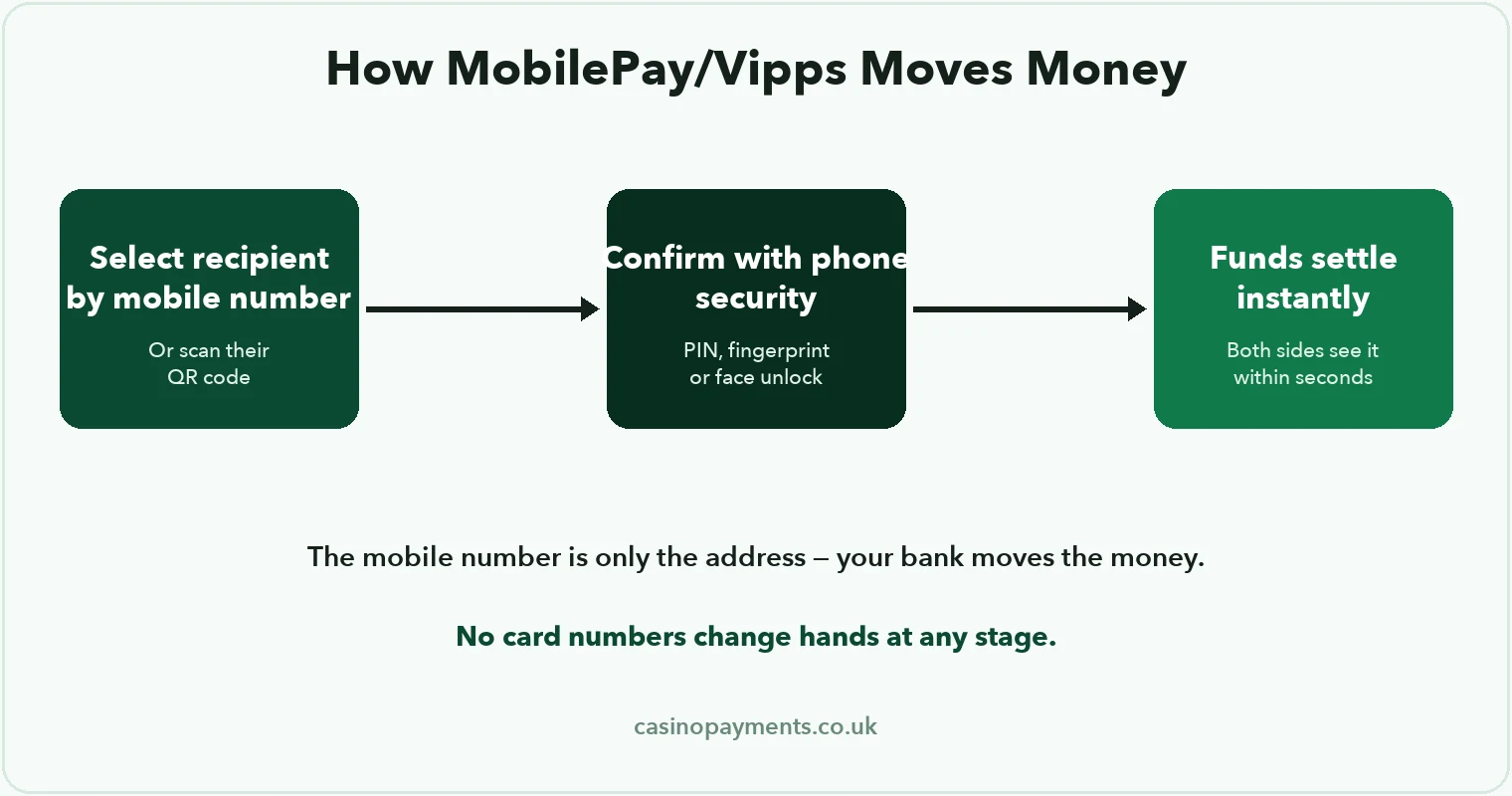
At a Danish licensed casino, that means MobilePay deposits clear in seconds; Vipps, inside Norway’s state-run system, works the same way technically but through Norsk Tipping’s own channels rather than a competitive private cashier.
Denmark and Norway: Two Very Different Gambling Markets
This is the one payment method on this site where the two halves of its own user base sit in genuinely different regulatory worlds. Denmark liberalised its gambling market on 1 January 2012, becoming one of Europe’s earlier movers away from a state monopoly: Danske Spil (the former sole licence-holder, founded 1948) suddenly had to compete with international operators like Bet365 and Ladbrokes under a new licensing regime. MobilePay, launched the following year by Danske Bank, became a standard deposit method at these newly licensed private operators as the competitive Danish market matured.
Norway took the opposite path and has stuck with it: Norsk Tipping (games and lotteries) and Norsk Rikstoto (horse-race betting) hold an exclusive state monopoly on commercial gambling, and Norway enforces that monopoly aggressively — payment blocking against offshore operators, DNS-level site blocking, and advertising restrictions all feature in its playbook. Vipps, as Norway’s dominant mobile payment app, naturally appears within Norsk Tipping’s own official channels, but there is no competitive private licensing market in Norway the way there is in Denmark, Sweden or the UK. A UK reader used to thinking of “regulated gambling markets” as inherently competitive should treat Norway as the clear exception among the countries covered across this site.
The contrast runs deeper than payment methods. Denmark’s regulator, Spillemyndigheden, licenses private operators under a framework that, in broad structure, resembles the UKGC’s own competitive model: multiple operators, standardised responsible-gambling requirements, and ongoing debate over advertising rules much like the UK has had. Norway’s approach instead treats the state monopoly itself as the primary safer-gambling tool — the reasoning being that a single state-run operator with no commercial incentive to maximise player spend produces better player-protection outcomes than a competitive licensed market ever could. Whether that reasoning holds up is genuinely debated even within Norway itself, with critics questioning how effectively a monopoly can protect players who simply gamble offshore instead, while supporters argue the alternative is ceding the market entirely to unregulated operators — which is precisely what Norway’s aggressive payment-blocking and DNS-blocking measures exist to prevent.
Security and the 2022 Merger
Both apps authenticate through the user’s own phone security and underlying bank login, which is generally considered robust, and neither has a public record of a system-wide breach. The more relevant security story for 2026 is organisational rather than criminal: since the November 2022 merger, Vipps MobilePay has been consolidating two previously separate technology platforms into one shared system, a process that reached a milestone in March 2024 when roughly 4.5 million Danish MobilePay users migrated onto the new unified app and platform alongside existing Norwegian and Finnish users.
Migrations of this scale carry their own transitional risk: users adjusting to a new app interface are, as with any rebrand, more vulnerable to phishing attempts that exploit unfamiliarity with what a genuine app update or security prompt should look like. Vipps MobilePay has published guidance during the transition period specifically warning users to verify app updates come through official app-store channels rather than links sent by text or email — standard advice, but particularly relevant during an active platform migration spanning multiple countries and currencies.
Running two national payment systems on genuinely separate infrastructure across three countries and two currencies for the better part of two years after a merger was announced also says something about how conservatively regulated financial infrastructure changes tend to move, even after ownership questions are settled. A UK reader used to relatively quick app updates from consumer tech companies should note that payment infrastructure serving tens of millions of people, across bank relationships in three separate national systems, simply cannot move at the same pace without risking exactly the kind of outage or data-integrity problem that would undermine trust in the merged brand before it had even finished forming.
MobilePay’s Nordic Rise and Vipps Merger
MobilePay and Vipps began as rivals, not partners. Danske Bank launched MobilePay in Denmark in 2013, and it quickly became the country’s dominant mobile payment app. DNB, Norway’s largest bank, launched Vipps in Norway on 30 May 2015; Vipps reached 1 million users within roughly six months, becoming Norway’s own dominant app in turn. For years, MobilePay attempted to expand into Norway and Vipps was closed down there when it couldn’t compete, while Danske Bank and Nordea took a partial ownership stake in Vipps back in October 2017 — an early sign that outright competition between the two apps was giving way to consolidation.
- 2013 — Danske Bank launches MobilePay in Denmark.
- 2015 — DNB launches Vipps in Norway on 30 May, reaching 1 million users within months.
- 2017 — Danske Bank and Nordea take a partial ownership stake in Vipps, and DNB spins Vipps off into a separately owned company.
- 2022 — The EU Commission approves the merger of MobilePay and Vipps on 21 October; it takes effect 1 November, forming Vipps MobilePay.
- 2024 — Around 4.5 million Danish users migrate onto the unified app and platform in March, joining roughly 11.5 million total users across Norway, Finland and Denmark.
- 2024–2026 — Cross-border peer-to-peer payments between Denmark, Norway and Finland roll out, letting users in different countries pay each other directly for the first time.
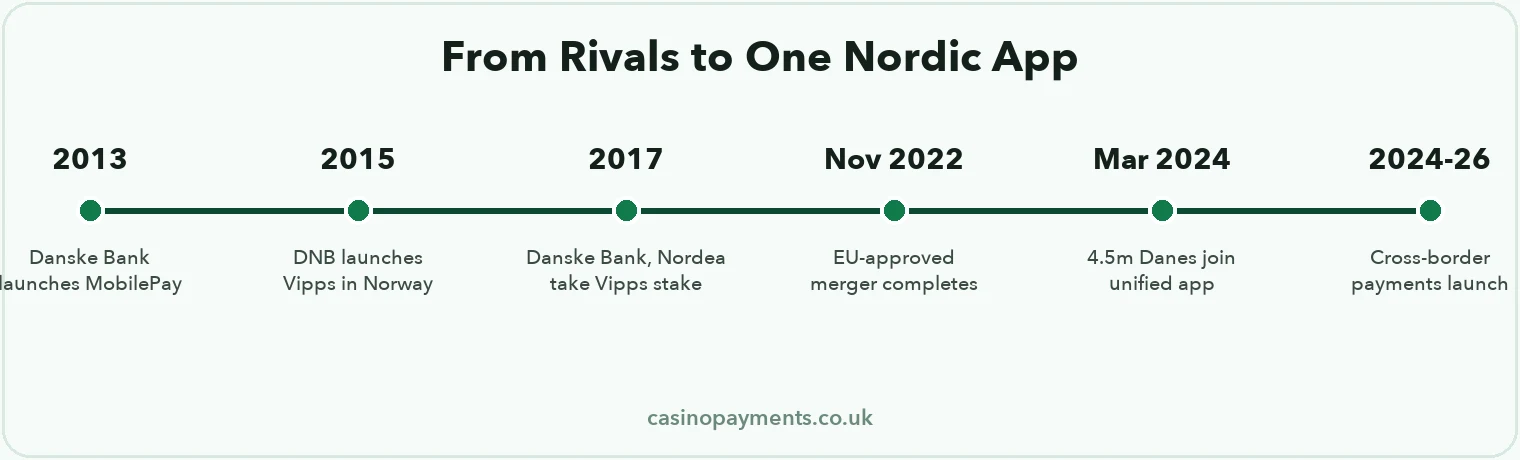
The ownership split that emerged from the merger tells its own story: Norwegian banks hold 72.2% of the combined company against Danske Bank’s 27.8%, meaning the smaller, later-launched Vipps effectively became the senior partner in the deal, with the merged headquarters landing in Oslo rather than Copenhagen.
That outcome is worth pausing on for anyone who assumes mergers always favour the larger or earlier-launched party: MobilePay had a two-year head start and an established Danish user base when Vipps launched, yet within a decade the Norwegian app’s owners ended up holding the controlling stake in the combined company. It’s a reminder that early-mover advantage in payments infrastructure doesn’t automatically translate into lasting negotiating leverage once a national banking consortium the size of Norway’s decides consolidation makes commercial sense.
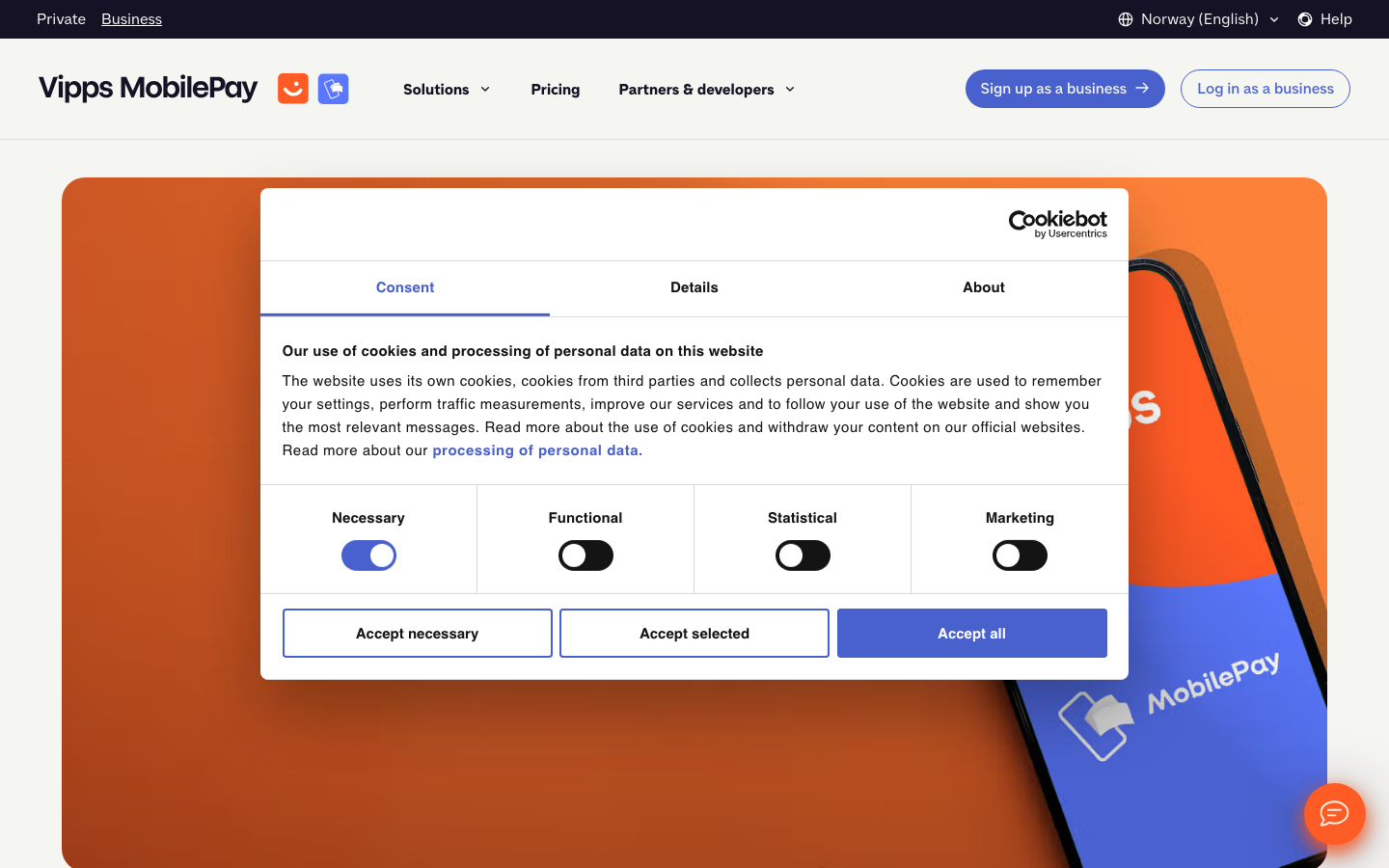
The merged company’s own branding, confirmed directly on vippsmobilepay.com this month, keeps both consumer-facing names live — MobilePay in Denmark, Vipps in Norway — under one corporate entity offering business solutions, pricing and partner/developer tools from a single site, evidence the 2022 merger consolidated the company without forcing a jarring consumer rebrand in either market.
Where MobilePay and Vipps Work
The combined Vipps MobilePay footprint covers exactly three countries: Denmark, Norway and Finland, each requiring a bank account in that specific country to hold an account. There’s no version that extends to the UK or any market beyond these three, and nothing in the merger’s stated strategy suggests British expansion is under consideration — the entire post-merger effort has gone into unifying the existing Nordic footprint onto one platform rather than growing into new territories.
That narrow, deliberately Nordic-only footprint is exactly why no UK casino can simply add MobilePay or Vipps as a cashier option: there’s no scheme membership a UK bank or operator could join, and the underlying mobile-number-to-bank-account link only works within the three countries’ own banking infrastructure. A Dane or Norwegian living in the UK who retains a home bank account could technically keep using the app from British soil, but that has nothing to do with what any UKGC-licensed cashier can offer.
It’s also worth noting how narrow the footprint stayed even within the Nordics themselves. Iceland, geographically and culturally close to the other Nordic countries, has its own separate mobile payment landscape rather than adopting either MobilePay or Vipps, and the newly launched cross-border payments feature covers only Denmark, Norway and Finland — not the wider Nordic-Baltic region some commentators expected a merged company of this scale to eventually pursue. That restraint suggests Vipps MobilePay’s leadership sees genuine value in depth over breadth: fully unifying three national systems before considering a fourth, rather than chasing expansion while the existing merger integration is still an active, multi-year project.
MobilePay and Vipps Beyond Gambling
Both apps occupy the same everyday-life role Swish plays in Sweden and iDEAL plays in the Netherlands: splitting bills, paying a babysitter, buying from a street market stall, or checking out online, all handled through a mobile number rather than a card. Vipps in particular became Norway’s default way to pay for almost anything peer-to-peer within months of launch, reaching a million users faster than most comparable apps anywhere achieve that milestone.
The 2022 merger and subsequent multi-year technical unification is itself a notable case study in Nordic financial cooperation: rather than one app simply buying out and shutting down its rival, Vipps MobilePay has spent years migrating tens of millions of users across three currencies and three regulatory jurisdictions onto shared infrastructure, a genuinely complex undertaking that the March 2024 Danish migration represented only one stage of.
The cross-border peer-to-peer feature that followed — letting a Norwegian Vipps user pay a Danish MobilePay user directly, and vice versa — is arguably the more technically interesting outcome of the merger than the shared app itself. Most national mobile payment apps stay strictly domestic even when they cooperate commercially; Vipps MobilePay instead built genuine interoperability between what were, until 2022, two entirely separate national payment systems running on different banking rails in different currencies. That’s a meaningfully harder engineering problem than simply rebranding two apps to look the same, and it’s the part of the merger story that has the most relevance for anyone watching how European payment consolidation might unfold elsewhere — EPI’s own Wero project, discussed on this site’s iDEAL page, is attempting something conceptually similar across a much larger set of countries.
Safer Gambling, MobilePay and Vipps
Ask a UK bank to flag or block gambling-related spending and it can only ever act on transactions that pass through British banking — a MobilePay or Vipps payment settles entirely within Danish, Norwegian or Finnish infrastructure and simply never crosses that boundary for a UK bank to see.
Denmark and Norway handle this differently given their different market structures. Denmark’s licensed private operators build responsible-gambling tools into their licensing conditions regardless of payment method. Norway’s monopoly model routes everything through Norsk Tipping directly, which as a state-owned operator has its own extensive self-exclusion and spending-control systems built around Norwegian national ID rather than depending on competitive-market licensing rules. A UK player gets none of that from a Nordic app either, which is exactly why the UK’s own toolkit — signing up to GAMSTOP, asking your bank to switch on its gambling block, agreeing deposit limits directly with your bank — is the only set of protections actually worth relying on if you’re playing at a UKGC-licensed site.
What Danish and Norwegian Players Say
Danish bettor commentary on MobilePay mirrors what Dutch and Swedish players say about iDEAL and Swish: it’s simply assumed rather than praised, a baseline expectation at any licensed operator rather than a differentiator worth discussing. Norwegian commentary is different in character, since there’s no competitive licensed market to review in the first place — Norwegian gambling discussion tends to focus on the monopoly’s own restrictions and the ongoing debate about whether Norway should liberalise the way Denmark and Sweden already have, rather than on payment-method preference.
Neither conversation gives a UK reader anything actionable, since both describe Nordic bettors within Nordic regulatory systems entirely separate from UKGC licensing.
The UK Mobile Routes That Stand In for MobilePay
Take away the mobile-number address book and MobilePay/Vipps is fundamentally a bank-authenticated payment — which is exactly the territory UK open banking providers occupy at a British cashier, just reached by typing your bank name into a list rather than a phone number.
For a plainer transfer, Faster Payments bank transfer covers similar ground, usually clearing within minutes. And the one method every UKGC casino accepts without exception remains debit card.
Making a UK open banking deposit takes a similar number of steps to a MobilePay or Vipps transfer:
- Choose open banking at the casino cashier.
- Select your bank from the provider’s list.
- Approve the payment in your own banking app, using its normal login method.
- Your balance updates within seconds to a couple of minutes.
Our Verdict on MobilePay/Vipps for UK Players
Two rival bank-built apps merging into a single company spanning three countries and 11.5 million users is a rare thing in payments, and MobilePay and Vipps managed it. Neither will ever reach a UK cashier: each account hangs off a Danish, Norwegian or Finnish bank connection, with no international arm to extend. The more interesting detail sits right beside it. Denmark and Norway run sharply different gambling regimes on either side of the same merged app, which tells you how little payment infrastructure actually determines regulation. For the pay-by-identifier flow with your bank behind it, open banking is the closest British match.
MobilePay/Vipps Casino FAQs
Can I use MobilePay or Vipps at a UK online casino?
No. Both require a bank account in Denmark, Norway or Finland, and no UKGC-licensed operator connects to that Nordic banking infrastructure. Neither app is offered at any UK casino, now or in any announced plan.
Are MobilePay and Vipps the same company now?
Yes — they merged into Vipps MobilePay in November 2022 and have been unifying onto one shared app and technology platform since, though the two brand names are still used in their original countries during the transition.
Is MobilePay/Vipps banned in the UK?
No ban is involved. The apps simply have no UK presence because every account requires a Nordic bank connection that no British bank participates in.
Why is Vipps not used at Norwegian gambling sites the way MobilePay is used in Denmark?
Because Norway runs a state gambling monopoly through Norsk Tipping and Norsk Rikstoto rather than a competitive licensed private market the way Denmark does — Vipps appears within that state system rather than at competing private operators, since there are none.
Is MobilePay/Vipps safe to use?
Both apps have a solid security record built on the user’s own phone authentication and bank login. The main risk during 2024-2026 has been phishing attempts exploiting the ongoing platform migration between the two merged apps.
What’s the closest UK equivalent to MobilePay/Vipps?
Open banking (Trustly, Brite, Volt) — pay directly from your own bank account with strong authentication, no card numbers involved, though without the mobile-number-as-identifier mechanic these Nordic apps use.
Who owns Vipps MobilePay?
A consortium of Norwegian banks led by DNB holds 72.2%, and Danske Bank holds the remaining 27.8%, following the November 2022 merger of the two previously separate companies.
How many people use MobilePay/Vipps?
Roughly 11.5 million people across Denmark, Norway and Finland, as the two formerly separate user bases migrate onto one unified app and platform.
Changelog: 9 July 2026 — added an at-a-glance box, confirmed the merged brand structure directly on vippsmobilepay.com, and added a screenshot.
Sources & Verification
Checked 5 July 2026 against: Vipps MobilePay’s own site and its merger announcement (re-verified 9 July 2026) of the EU-approved 2022 merger; documented Vipps launch history; PYMNTS on the ownership split; independent reporting on Norway’s gambling monopoly and Denmark’s 2012 market liberalisation; the UK Gambling Commission’s page on blocking gambling transactions with your bank.

Two rival Nordic apps merging into one company, with the smaller Norwegian side ending up as majority owner, is the kind of consolidation story that rarely gets told outside trade press — even one destined to stay entirely outside UK banking. More about Will →