

UPI is India’s real-time bank-transfer system, built by NPCI and used through Paytm, PhonePe and Google Pay to move rupees between Indian accounts in seconds. It has never reached a UK casino, since it runs entirely on Indian banking rails, and since 2025 India’s own gaming law has barred UPI and banks from processing real-money gambling too. This page covers how UPI works, what changed in Indian law, and the UK method filling the same gap.
For the British equivalent, compare the current options in our UK casino payment-method library.
Why UPI Cannot Reach a UK Casino
| UPI at a Glance | |
|---|---|
| UK casino availability | None — Indian bank accounts only |
| Operator | National Payments Corporation of India (NPCI), launched April 2016 |
| Where used | India's real-money gaming sector, now banned nationally since the 2025 Act |
| Scale | World's largest real-time payment system by volume |
| UK equivalent | Open banking does the identical instant bank-transfer job |
Checked 5 July 2026, including India’s own new restrictions on UPI and real-money gaming.
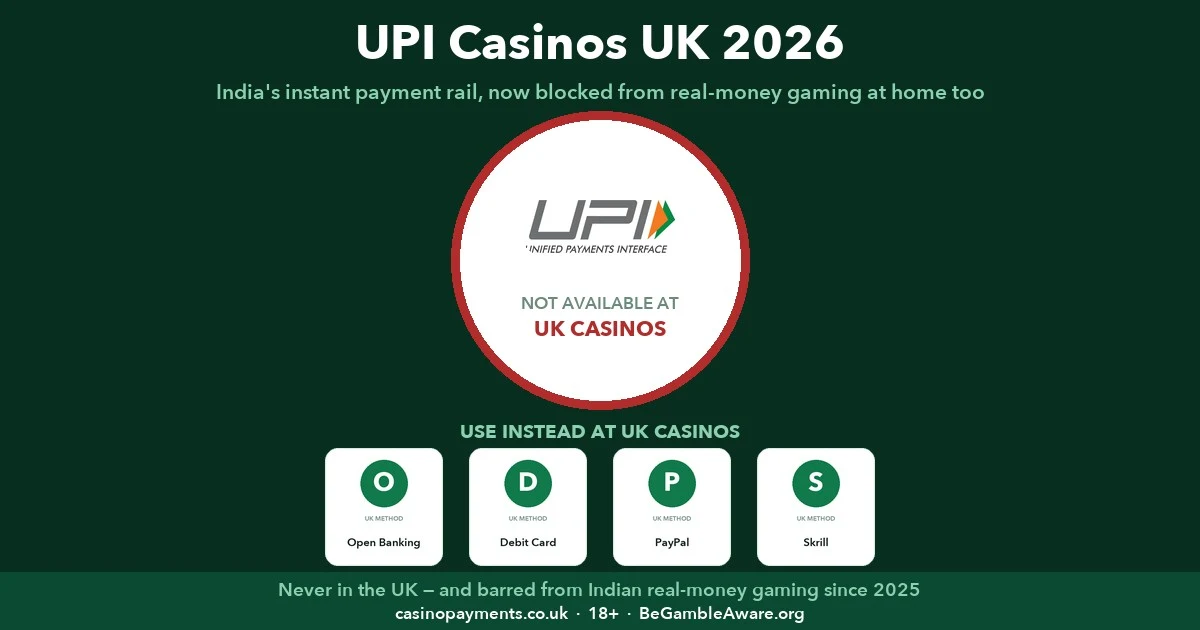
| Question | The reality |
|---|---|
| Will a UK casino ever take UPI? | No — UPI is built exclusively for Indian rupee transfers between Indian bank accounts |
| What are Paytm and PhonePe, exactly? | Apps that run on top of UPI — the underlying transfer rail is the same either way |
| Can UPI fund real-money gambling in India itself? | No longer — India's Promotion and Regulation of Online Gaming Act 2025 bans banks and UPI from processing online money-gaming payments |
| Could a UK operator add UPI? | Only by connecting to NPCI's Indian banking network directly, which no UK casino does |
| What's the UK equivalent? | Open banking — the same instant, bank-authenticated transfer idea, built on UK rails |
"UPI casino UK" has nowhere to go, and as of 2026 neither does "UPI casino India" for real-money games — India's own regulator has now cut UPI off from that use case too. What's left is a genuinely fascinating case study: a payment rail so successful domestically that its own government moved to wall gambling entirely out of it, rather than the other way around.
Facts verified 5 July 2026 · 18+ · UKGC-licensed operators only · begambleaware.org
UPI: Quick Facts
| What it is | India’s real-time bank-to-bank transfer system, run by the National Payments Corporation of India (NPCI) |
|---|---|
| Launched | Piloted 11 April 2016, opened to the public 25 August 2016 |
| Apps that use it | PhonePe, Google Pay, Paytm and others — all route through the same underlying UPI rail |
| UK casino availability | Zero — settles exclusively in Indian rupees through Indian bank accounts |
| Indian gambling status (2026) | Banned for real-money games under the Promotion and Regulation of Online Gaming Act 2025, in force from 1 May 2026 |
| UK equivalent | Open banking (Trustly, Brite, Volt) |
What jumps out from that table is the last two rows sitting side by side: the same category of payment — instant, bank-to-bank, no card numbers involved — is treated as a banned category for gambling in one country and a mainstream, welcomed one in the other. That isn’t a technical difference between UPI and open banking; it’s a purely regulatory choice each country’s lawmakers made about the same underlying transaction type.
UPI vs UK Open Banking
UPI and UK open banking solve the identical problem — an instant, bank-authenticated transfer with no card numbers changing hands — using entirely separate national infrastructure. Reading the two side by side shows just how closely the underlying idea matches, even though the rails themselves share nothing.
| UPI (India) | Open banking (UK) | |
|---|---|---|
| Who runs it | NPCI, overseen by the Reserve Bank of India | Regulated under PSD2/UK Open Banking standards |
| How you use it | Paytm, PhonePe, Google Pay and similar apps | Trustly, Brite, Volt and similar providers |
| Speed | Seconds, around the clock | Seconds, around the clock |
| Gambling use | Blocked by law for real-money games (2025 Act) | Standard, legal deposit method at every UKGC casino |
That last row is the real difference worth dwelling on: it isn’t that UPI is technically incapable of handling a gambling transaction — it’s that India’s government has now deliberately legislated it out of that role, whereas the UK has taken the opposite path and built open banking directly into regulated gambling as a mainstream, welcomed deposit option.
It’s also worth noting how much faster India moved on this than most comparable payment-and-gambling questions elsewhere: UPI itself only launched in 2016, reached mass adoption within a handful of years, and by 2025 its own government had already legislated a specific carve-out preventing it from touching one particular use case. Few payment rails anywhere have gone from launch to a targeted, sector-specific legal restriction quite that quickly, which says as much about how fast UPI’s growth alarmed policymakers as it does about gambling policy itself.
How UPI Actually Works
UPI lets an Indian bank customer send money using a simple, human-readable “virtual payment address” (something like name@bankhandle) instead of a full account number and sort code, or by scanning a QR code at a till. The customer opens their chosen app — Paytm, PhonePe, Google Pay, or one of dozens of others — enters the amount and recipient, confirms with a UPI PIN, and the transfer completes in seconds. Behind the scenes, NPCI’s own switching infrastructure routes the request between the sender’s and receiver’s banks regardless of which app either side used, which is precisely why a Paytm user can pay a PhonePe user directly with no friction: both apps are just different front doors onto the same underlying rail.
Step by step, a typical UPI payment looks like this:
- Open a UPI app (Paytm, PhonePe, Google Pay, or another) linked to an Indian bank account.
- Enter the recipient’s UPI ID or scan a QR code, and the amount to send.
- Confirm with a UPI PIN — a short code set up separately from online banking credentials.
- Funds move instantly between the two banks via NPCI’s switching network.
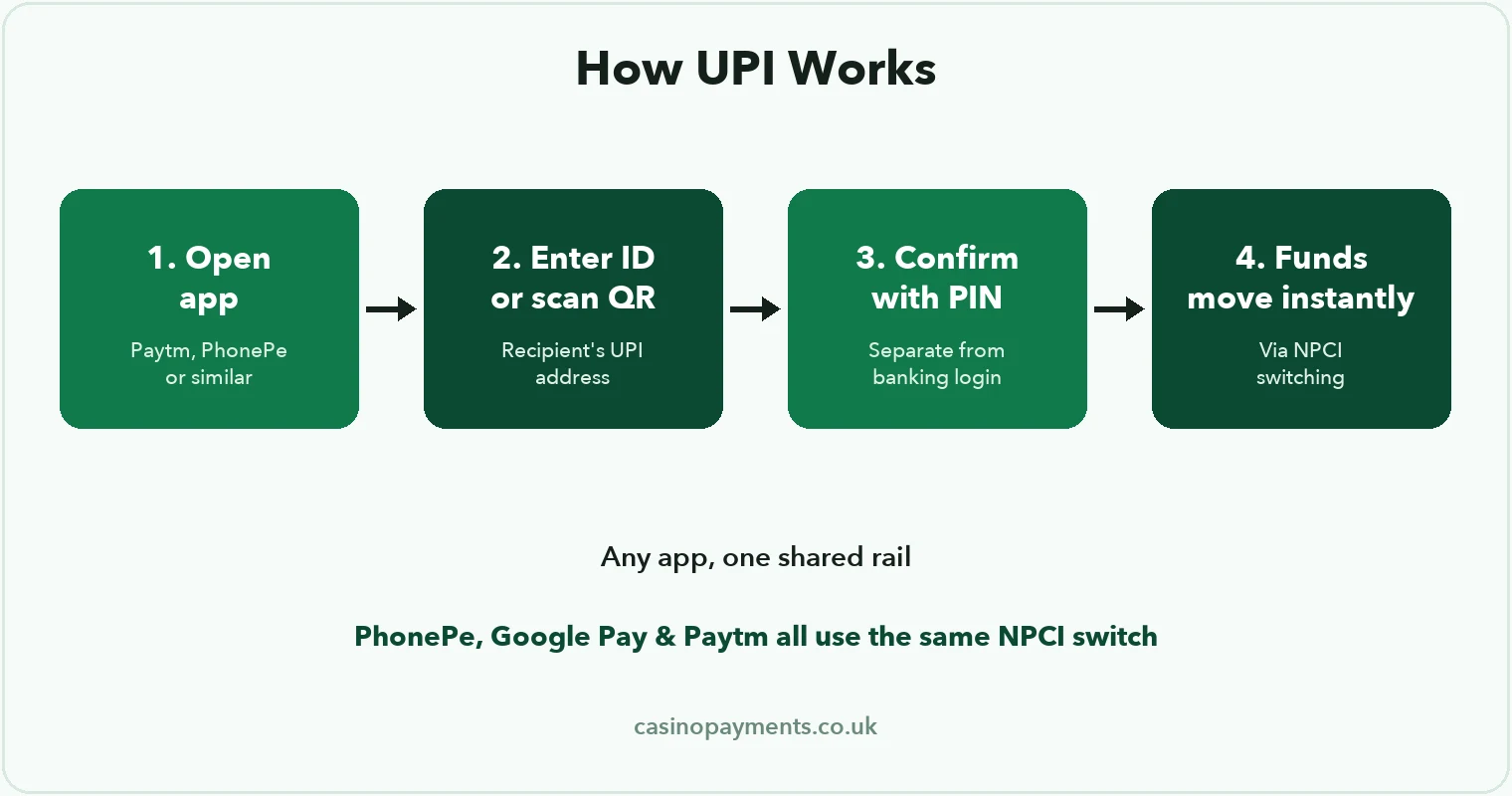
That app-agnostic design is arguably UPI’s single biggest achievement: because NPCI itself, not any individual app, owns the switching layer, competition between Paytm, PhonePe, Google Pay and newer entrants happens entirely on user experience and rewards, with zero risk of a customer being locked into one company’s closed network the way older wallet systems elsewhere often work.
A UPI virtual payment address is itself worth a brief explanation, since it’s a genuinely elegant piece of design: rather than sharing an account number, sort-code equivalent (IFSC code) and bank name every time, a customer sets up a single memorable handle once, and that handle stays fixed even if they later switch which UPI app they use day-to-day, provided it’s still linked to the same bank account. That portability — a payment identity that survives an app switch — is something UK open banking still doesn’t quite replicate, since a UK payer typically re-selects their bank fresh at each merchant rather than carrying a single persistent handle across services.
India’s 2025 Real-Money Gaming Ban
This is the section that makes UPI a genuinely different story from every other regional method on this site: rather than simply being unavailable in the UK, UPI has now been legislated out of real-money gambling in its own home market too. Parliament passed the Promotion and Regulation of Online Gaming Act on 21 August 2025, and the accompanying Promotion and Regulation of Online Gaming Rules came into force on 1 May 2026, together banning “online money games” — real-money poker, rummy, fantasy sports and betting — nationwide, while carving out a separate, permitted category for e-sports and social gaming played without cash stakes.
Crucially for this page, the Act doesn’t stop at banning the games themselves: it explicitly prohibits banks, UPI and other payment intermediaries from processing transactions linked to online money games at all, closing off the payment rail rather than relying solely on enforcement against operators. The penalties attached are genuinely severe by international standards — up to three years’ imprisonment and a fine of up to ₹1 crore (roughly £95,000) for offering an online money game, rising to a minimum of three years (extendable to five) and fines between ₹1 crore and ₹2 crores for repeat offences, with financial institutions that knowingly facilitate such transactions facing the same imprisonment and fine bands as operators.
The upshot: a UK reader researching “UPI casino” won’t just find that UPI isn’t offered by any UKGC-licensed site — they’ll find that, as of this page’s checked date, using UPI for real-money gambling isn’t legally available anywhere, including in India, the very market UPI was built for.
It’s worth being precise about scope here, since the Act draws a genuine line rather than banning gaming outright: e-sports and social games played without real-money stakes remain permitted and are explicitly promoted as the sector the government wants to see grow, while any game where a user pays a fee or stake with a reasonable expectation of monetary return falls into the banned “online money games” category regardless of whether it’s styled as a casino game, poker, rummy or sports betting. That distinction — skill-based or social framing doesn’t exempt a game if real money changes hands on the outcome — closes off a loophole some operators had previously used to argue their real-money product was a game of skill rather than gambling.
UPI PIN Security and India’s Fraud Picture
UPI transactions are authenticated through a UPI PIN set independently of online banking credentials, combined with device-level checks tying the payment to the specific phone the app is registered on, which limits how far a stolen password alone can go without also compromising the physical device. NPCI and the Reserve Bank of India have progressively tightened UPI’s fraud controls over the years, including tools letting banks flag suspicious high-frequency transfers and, more recently, provisions specifically aimed at cutting off payment flows to unlicensed online money-gaming operations under the 2025 Act.
The most relevant security point for a UK reader, though, isn’t a technical one: since no UPI transaction can reach a UK bank account or a UKGC-licensed casino’s cashier in the first place, none of UPI’s fraud-prevention design has any bearing on a British player’s experience. Any site inviting a UK visitor to pay via UPI, Paytm or PhonePe is, by definition, not routing that payment through UK-regulated banking at all.
NPCI has also periodically introduced limits on UPI transaction values and daily volumes for particular categories of payment as a fraud-containment measure, adjusting the specific caps over time as usage patterns and fraud typologies shift. Those caps sit alongside the newer 2025 gaming restriction as one more example of NPCI treating UPI as critical national infrastructure requiring active, ongoing risk management, rather than a fixed piece of technology left unchanged since 2016.
How UPI Became India’s Payment Backbone
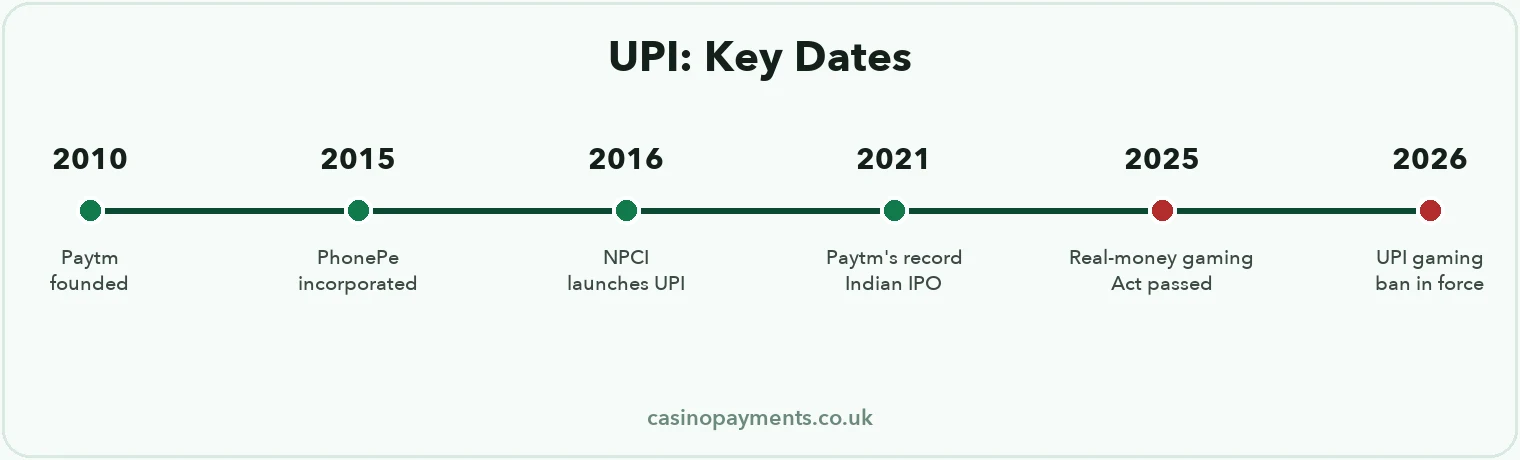
NPCI piloted UPI with a handful of banks on 11 April 2016 and opened it to the public on 25 August 2016, building it as shared infrastructure any Indian bank or licensed payment app could plug into, rather than a single company’s proprietary product. Paytm predates UPI by six years, founded in August 2010 by Vijay Shekhar Sharma under his existing company One97 Communications, initially as a prepaid mobile recharge platform before adding its wallet in 2014 and later UPI support. PhonePe came later: incorporated in December 2015 by three former Flipkart executives (Sameer Nigam, Rahul Chari and Burzin Engineer), acquired by Flipkart in April 2016 for under $20m, and built from the outset as a UPI-first app, which helped it grow into the largest single UPI app by transaction volume within a decade.
- 2010 — Paytm founded by Vijay Shekhar Sharma as a prepaid recharge platform.
- 2015 — PhonePe incorporated by three former Flipkart executives.
- 2016 — NPCI pilots UPI in April, opens it publicly in August; Flipkart acquires PhonePe.
- 2021 — Paytm’s parent, One97 Communications, completes what was then India’s largest-ever IPO.
- 2025 — Parliament passes the Promotion and Regulation of Online Gaming Act on 21 August, banning real-money online gaming and barring UPI/banks from processing it.
- 2026 — The Act’s Rules take effect 1 May, and by this page’s checked date PhonePe holds roughly 46% of UPI volume against Google Pay’s 33% and Paytm’s 8%.
- Ongoing — NPCI continues capping any single app’s share of UPI volume at 30%, extending the compliance deadline more than once as PhonePe and Google Pay’s combined dominance proved slow to unwind.
Where UPI Works
UPI is an exclusively Indian system: every UPI ID is tied to an account at a bank operating under Indian regulation, and NPCI’s switching infrastructure has no presence outside India’s own banking network. India has begun extending UPI acceptance to a handful of overseas markets for tourists and remittances — parts of the UAE, Singapore, France and a few others have piloted accepting UPI QR payments from visiting Indian nationals — but that’s a narrow merchant-acceptance arrangement for travellers, not a way for a UK bank account holder to send or receive money through UPI themselves.
No UK bank participates in NPCI’s network, and no UKGC-licensed casino has any technical route to accept a UPI payment, regardless of these overseas pilot schemes. A British player would need an Indian bank account and an Indian-registered UPI app to use the system at all, at which point India’s own 2025 ban on gaming-related UPI transactions would apply just as it would to any Indian resident.
The tourist-focused overseas pilots are worth understanding precisely because they’re so often misread: they let a specific merchant in, say, Dubai or Singapore accept a UPI QR-code scan from a visiting Indian traveller, with the payment still settling from that traveller’s Indian bank account back through NPCI’s Indian infrastructure. Nothing about that arrangement creates a foreign bank account capable of sending UPI payments, and nothing about it opens a route for a non-Indian resident, UK-based or otherwise, to use UPI at all.
UPI, Paytm and PhonePe Beyond Gambling
UPI’s scale is genuinely remarkable: it now processes tens of billions of transactions a month, having grown from a standing start in 2016 into the backbone of everyday Indian commerce, from splitting a restaurant bill to paying a street vendor to settling business invoices. Paytm expanded well beyond its original recharge-and-wallet roots into banking, insurance distribution and stock broking, while PhonePe built out its own adjacent businesses including PhonePe Pulse (a widely-cited digital-payments data and insights platform) and insurance products, all layered on top of the same UPI rail that handles its core payment volume.
NPCI has capped how much of total UPI volume any single third-party app can carry, precisely to avoid over-concentration risk in critical national payments infrastructure — PhonePe and Google Pay have periodically sought extensions to the compliance deadline for that 30% cap, underlining just how dominant those two apps became relative to Paytm and the many smaller entrants competing for the remaining share.
Beyond the two market leaders, a long tail of newer UPI apps — including bank-backed entrants and products from companies like Navi and Flipkart’s own super.money — have carved out meaningful single-digit shares since launching, showing that NPCI’s shared-rail model keeps genuine competition alive even against two heavily entrenched incumbents. That contestability is arguably UPI’s most transferable lesson for other countries’ payment regulators: build the switching layer as neutral public infrastructure, and let commercial apps compete on top of it rather than around it.
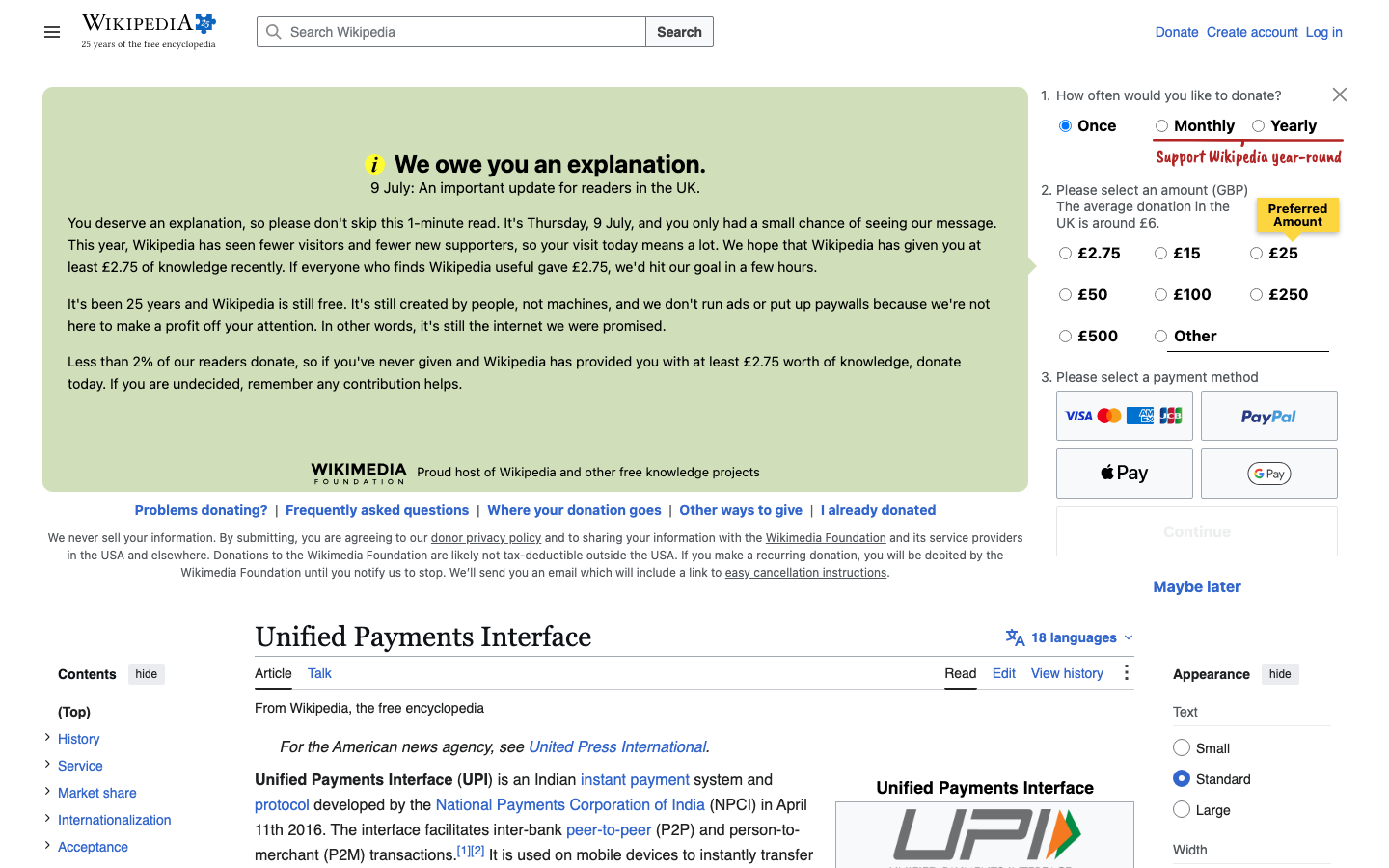
NPCI’s own site continues to block automated verification (a 403 response), so this month’s check instead re-confirmed the core facts independently via Wikipedia’s Unified Payments Interface entry: UPI was developed by the National Payments Corporation of India and launched in April 2016, and the article’s acceptance section documents integrations reaching well beyond India itself — including Singapore, the UAE, France and several other countries where Indian residents and tourists can now pay directly via UPI.
Safer Gambling and UPI
Because UPI never touches UK banking, standard British safer-gambling tools — a bank-arranged gambling block, GAMSTOP registration, deposit limits set through a UK banking app — simply have nothing to intercept where UPI is concerned, since there’s no UK-side transaction for them to act on. That’s a structural fact about UPI’s confinement to Indian banking, not a specific loophole.
What’s more directly relevant is the reverse: India’s 2025 Act effectively builds a nationwide payment-level safer-gambling measure of its own, cutting real-money gaming operators off from UPI and bank transfers entirely rather than relying on operator-level self-exclusion tools the way the UK’s regulatory model does. A UK player has no reason to interact with either system, but the contrast is a useful one — it shows two very different regulatory philosophies (UK: license, permit and layer in consumer protections; India, as of 2025: prohibit real-money play and cut off the money supply) arriving at the same underlying goal from opposite directions.
There’s a lesson in there for how payment infrastructure and gambling policy interact more broadly: the UK’s approach assumes a regulated operator can be trusted to build in protections and be held accountable if it doesn’t, whereas India’s newer approach assumes the safest control point is the payment rail itself, since a payment block is far harder for an unlicensed operator to route around than an operator-level self-exclusion request. Neither approach is obviously superior in the abstract, but they lead to very different day-to-day experiences for a player in each country.
What Indian UPI Users Say
Indian consumer discussion of UPI itself is overwhelmingly positive and rarely gambling-related at all — most commentary concerns everyday convenience, cashback promotions run by Paytm or PhonePe, or occasional outage complaints when NPCI’s infrastructure experiences peak-load slowdowns during major shopping events. Discussion specifically touching on real-money gaming has shifted markedly since the 2025 Act: forum and social-media conversation now centres on operators scrambling to find alternative payment rails, or shutting down Indian operations altogether, rather than on which UPI app processes deposits fastest, since that option has been legislated away.
None of that Indian conversation, in either its older or its post-2025 form, has any bearing on a UK player’s experience, since UPI was never reachable from a UKGC cashier to begin with and India’s own regulatory shift doesn’t change anything about British banking or licensing.
One recurring thread in that conversation is worth flagging anyway, since it echoes a pattern seen with other newly-restricted payment methods on this site: some Indian users report gambling operators pivoting toward cryptocurrency or informal, harder-to-trace transfer arrangements once UPI access closed off, which regulators and consumer advocates in India have flagged as a predictable but concerning side effect of a payment-level ban rather than an operator-level one. A UK reader has no direct stake in that dynamic, but it’s a useful reminder of why the UKGC’s model of licensing and monitoring individual operators, rather than blanket payment-rail bans, has its own trade-offs too.
The UK Instant-Payment Route Closest to UPI
Open banking (Trustly, Brite, Volt) is the direct UK match for what UPI offers: an instant transfer straight from a checking account, authenticated through the bank’s own login rather than a separate password, with no card details ever shared with the casino. It’s built into every major UKGC-licensed casino’s cashier as a mainstream option, not a niche add-on.
The steps look almost identical to a UPI payment, just running on UK rails instead of NPCI’s:
- Choose open banking at the casino cashier.
- Select your UK bank from the provider’s list.
- Log in and approve the payment through your own banking app.
- The deposit clears immediately, no card numbers involved.
Anyone drawn to UPI’s speed and simplicity, in other words, already has an equivalent built into UK gambling — and unlike UPI in its home market, using it for gambling is entirely legal and actively encouraged by UKGC-licensed operators.
Worth adding, for anyone comparing the two directly: open banking withdrawals work just as smoothly as deposits at most UKGC casinos that offer the method, landing back in the same account within minutes to a day depending on the operator, which is a meaningful practical advantage over cash-voucher-style alternatives that only cover the deposit side.
Our Verdict on UPI for UK Players
UPI, Paytm and PhonePe are genuine payments success stories — a shared national rail that turned India into one of the world’s largest real-time payment markets within a decade — but none of the three has ever reached a UK casino, since all settle exclusively through Indian rupees and Indian banking. As of 2025/2026, India’s own government has additionally barred UPI from real-money gaming entirely, making this one of the few payment methods on this site that’s now restricted in its home market too, not just absent from the UK. UK players wanting the same instant, bank-authenticated experience should use open banking, already standard at every UKGC-licensed casino, with no need to track India’s fast-moving gaming law at all.
UPI Casino FAQs
Can I use UPI, Paytm or PhonePe at a UK online casino?
No. All three settle exclusively in Indian rupees through Indian banking, and no UKGC-licensed operator has any way to accept them.
Is UPI the same as Paytm or PhonePe?
No — UPI is the underlying instant-transfer rail built by India’s NPCI. Paytm and PhonePe are competing apps that both run on top of that same shared rail.
Has India banned UPI for gambling?
India banned UPI (and banks generally) from processing transactions for real-money online games under the Promotion and Regulation of Online Gaming Act 2025, in force from 1 May 2026 — this applies to real-money gaming specifically, not to UPI as a whole.
Is UPI banned in the UK?
It isn’t banned — it simply has no UK presence, since it’s built entirely around Indian banking infrastructure with no bridge to British banks.
What’s the UK equivalent of UPI?
Open banking — Trustly, Brite and Volt all move money straight from a UK current account with the bank’s own login as authentication, no card numbers involved, and it’s standard at UKGC-licensed casinos.
Who owns Paytm?
Paytm is run by One97 Communications, founded by Vijay Shekhar Sharma in 2010; the company listed on Indian stock exchanges in November 2021.
Who owns PhonePe?
PhonePe was founded in 2015 by three former Flipkart executives and acquired by Flipkart in 2016; Flipkart itself is majority-owned by Walmart.
What happens to Indian real-money gambling sites now?
Under the 2025 Act, offering, facilitating or advertising real-money online gaming in India carries criminal penalties, and banks/UPI are legally barred from processing related payments — pushing that entire market outside legal operation rather than merely restricting one payment option.
When did UPI launch?
NPCI piloted UPI with a small group of banks on 11 April 2016 and opened it to the wider public on 25 August 2016.
Are e-sports and fantasy sports also banned in India now?
Not automatically — the 2025 Act distinguishes real-money games (banned) from e-sports and social games played without cash stakes (permitted), based on whether a user pays to enter with an expectation of monetary winnings.
Changelog: 9 July 2026 — added an at-a-glance box; NPCI's own site still blocks automated verification, so independently re-confirmed UPI's NPCI origin and international acceptance via Wikipedia, with a screenshot, rather than leaving an unverifiable citation in place.
Sources & Verification
Checked 5 July 2026 against: NPCI’s own UPI product overview (npci.org.in blocks automated access; core facts independently re-confirmed via Wikipedia 9 July 2026); the Promotion and Regulation of Online Gaming Act, 2025 and its accompanying government rules; independent reporting on Wikipedia: Unified Payments Interface (transaction statistics); company histories of Paytm/One97 Communications and PhonePe; and the Gambling Commission’s own guidance, for UK readers, on setting up a bank-level block on gambling payments.

A payment rail so successful its own government had to legislate gambling back out of it is a genuinely unusual arc, and a useful contrast to how the UK regulates the same underlying transaction type. More about Will →