
 By Will Fencer, Payments Editor · Published · Last updated
M-Pesa is Safaricom’s mobile-money system, letting anyone with a basic phone store and send money with no bank account, and it’s become the default way East Africans fund a betting wallet via Paybill. It has never reached a UK casino, since it runs entirely on Safaricom and Vodacom’s African network. This page covers how M-Pesa works, its role in Kenyan betting tax policy, and the UK methods covering the same ground.
Why M-Pesa Cannot Reach a UK Casino
| M-Pesa at a Glance | |
|---|---|
| UK casino availability | None — Kenyan/East African mobile-money accounts only |
| Operator | Safaricom (Kenya), Vodacom (wider Africa), joint venture since 2020 |
| Where used | Kenya, Tanzania, Ghana and other African licensed betting markets |
| Distinct feature | Hakikisha recipient-name confirmation and transaction-reversal support |
| UK equivalent | Open banking or pay by mobile |
Checked 5 July 2026 — M-Pesa’s confinement to African mobile networks makes this one of the more durable “not available” verdicts on this site.
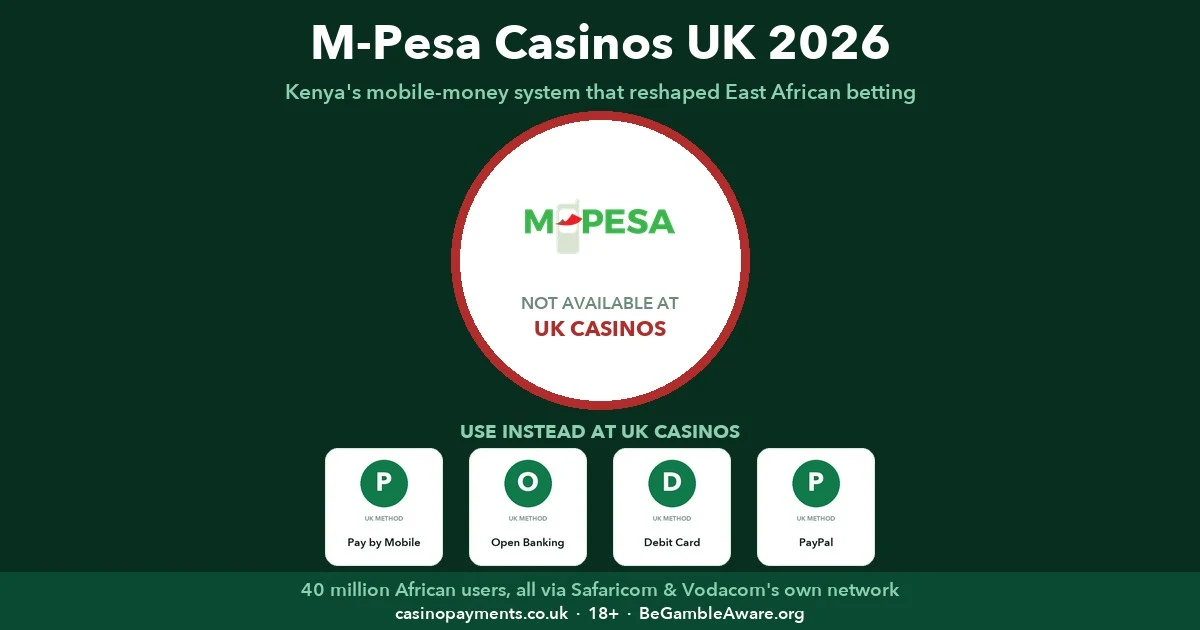
| Question | The reality |
|---|---|
| Will a UK casino ever take M-Pesa? | No — M-Pesa moves East African mobile-money balances, not sterling from a UK bank |
| Is M-Pesa a bank? | No — it's a mobile-money wallet tied to a phone number, run by Safaricom and Vodacom's M-Pesa Africa joint venture |
| Is it used for gambling in Kenya? | Yes — heavily, via Paybill and Till Number payments straight into betting-site wallets, with tax now collected at the point of deposit |
| Could a UK operator add M-Pesa? | Only by connecting into Safaricom/Vodacom's East African mobile-money network directly, which no UK casino does |
| What's the UK equivalent? | Pay by mobile for the phone-linked idea; open banking for the instant-transfer part |
"M-Pesa casino UK" isn't a real search anyone in Britain needs an answer to — M-Pesa is a Kenyan-born mobile-money system with no UK banking connection whatsoever. What makes it worth its own page is how completely it reshaped Kenyan betting: Paybill numbers are now the default way millions of Kenyans fund a betting wallet, and Kenya's tax authorities have restructured betting duty specifically around that mobile-money deposit moment.
Facts verified 5 July 2026 · 18+ · UKGC-licensed operators only · begambleaware.org
M-Pesa: Quick Facts
| What it is | A mobile-money wallet tied to a phone number, letting users store, send and receive money without a bank account |
|---|---|
| Who runs it | M-Pesa Africa, a 50/50 joint venture between Safaricom and Vodacom, following a full buyout of Vodafone’s stake |
| Launched | 6 March 2007 in Kenya, by Vodafone’s associate Safaricom |
| UK casino availability | Zero — moves Kenyan shillings and other African currencies through African mobile networks only |
| Users | Around 40 million across seven countries, processing over a billion transactions monthly |
| Kenyan betting role | The dominant deposit method at Kenyan betting sites via Paybill and Till Number payments |
| UK equivalents | Pay by mobile and open banking |
Two figures from that table are worth sitting with for a moment: 40 million users is a genuinely enormous share of East Africa’s adult population, and a billion-plus monthly transactions puts M-Pesa in the same conversation as some of the world’s largest payment networks by volume, despite running on infrastructure built for a market the traditional banking industry had largely written off as unbankable only two decades ago.
M-Pesa vs Its UK Equivalents
M-Pesa doesn’t map onto a single UK payment method quite as cleanly as some other regional systems on this site, since it blends two ideas the UK keeps largely separate: a phone-linked payment identity (like pay by mobile) and an instant account-to-account transfer (like open banking). In Kenya, both live inside the same app; in the UK, they’re two different products a player would choose between.
| M-Pesa (East Africa) | UK equivalent | |
|---|---|---|
| Tied to | A phone number and SIM card, no bank account required | Pay by mobile works the same way |
| Speed | Instant, 24/7 | Both open banking and pay by mobile match this |
| Withdrawals | Cash out at any of hundreds of thousands of agent kiosks | No UK equivalent needed — UK banking already handles cash access |
| Gambling deposit method | Paybill/Till Number direct into a betting wallet | Open banking transfer into a casino cashier |
The agent-kiosk network is genuinely the piece with no UK parallel: M-Pesa built physical cash-in/cash-out points across Kenya on a scale British banking simply never needed, since the UK already had widespread bank branches, ATMs and card acceptance when mobile money elsewhere was solving a much deeper access gap.
It’s also worth noting where the comparison breaks down: pay by mobile in the UK is generally treated as a smaller-stakes, casual deposit method layered on top of an existing card and banking relationship, whereas M-Pesa in Kenya is frequently a customer’s primary or only financial account. That difference in role — supplementary convenience versus core financial infrastructure — is exactly why M-Pesa carries so much more weight in Kenyan gambling than pay by mobile does in UK gambling, even though the phone-linked mechanics look superficially similar.
How M-Pesa Actually Works
Opening an M-Pesa account is done through a Safaricom SIM card rather than a bank application — the phone number effectively is the account. A user deposits cash by visiting one of hundreds of thousands of M-Pesa agent kiosks, handing over cash, and having it credited instantly to their phone-linked balance; from there they can send money to any other M-Pesa user by phone number, pay a business through a Paybill number (for organisations taking recurring or account-specific payments) or a Till Number (for straightforward retail purchases), or withdraw cash back out at any agent.
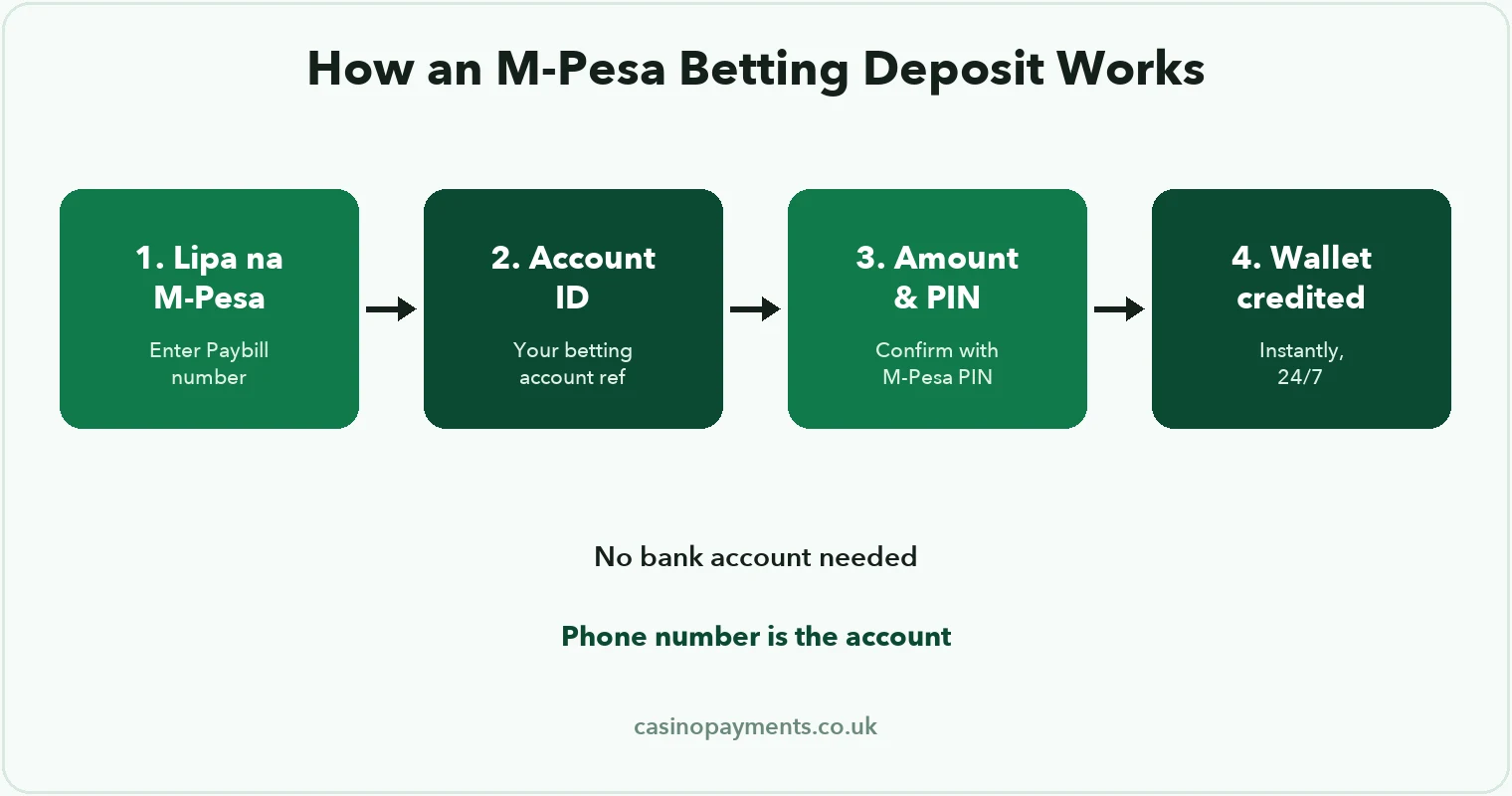
For betting specifically, Kenyan operators register a Paybill number, and a customer deposits by dialling that Paybill, entering their betting account ID as the reference, and confirming the amount with their M-Pesa PIN — the funds land in the betting wallet within seconds. Withdrawals typically run the same way in reverse, requested from inside the betting site and paid back out to the customer’s M-Pesa number.
The Paybill/Till distinction is worth understanding on its own terms, since it isn’t unique to gambling: Paybill numbers are built for businesses that need to know which specific customer or account a payment belongs to (a betting site matching a deposit to the right player wallet, a utility company matching a payment to the right household), while Till Numbers are simpler retail-style payments where no separate account reference is needed, more like tapping a card at a shop till. Betting operators overwhelmingly use Paybill rather than Till precisely because they need that account-matching step to credit the right customer’s wallet automatically.
Step by step, a typical M-Pesa betting deposit looks like this:
- Select “Lipa na M-Pesa” and enter the operator’s Paybill number.
- Enter your betting account ID as the account/reference number.
- Enter the deposit amount and confirm with your M-Pesa PIN.
- The balance appears in your betting wallet within seconds.
Kenya’s Betting Tax and M-Pesa
Kenya regulates gambling through the Betting Control and Licensing Board (BCLB), which is in the process of handing over to a new Gambling Regulatory Authority (GRA) under the Gambling Control Act 2025, expected to complete around February 2026. What makes Kenya’s setup distinctive for this page, though, is how directly its betting tax policy has become tied to the M-Pesa deposit moment itself: rather than taxing winnings or turnover after the fact, Kenya cut its excise duty on bets from 15% down to 5%, but restructured collection so that duty is now taken at the point a customer moves money from their M-Pesa wallet into a betting account, rather than when the bet itself is placed.
A separate 5% withholding tax applies on the way back out, deducted when winnings are withdrawn from a betting account back to M-Pesa. The practical effect is that the Paybill transfer a Kenyan bettor makes isn’t just a deposit mechanic — it’s the exact moment Kenya’s tax authorities have chosen to intervene, specifically because M-Pesa’s transaction records give them a reliable, hard-to-evade collection point that a purely cash-based betting market never offered.
That tax-at-the-rail approach has drawn genuine debate within Kenya: supporters argue it captures revenue from an enormous, fast-growing betting market far more reliably than trying to audit individual operators after the fact, while critics point out that collecting duty at the point of deposit effectively taxes the stake itself regardless of outcome, hitting frequent small-stakes bettors harder in relative terms than occasional large bettors. Kenya’s National Assembly has revisited the exact excise rate more than once in recent years, suggesting the policy is still being actively tuned rather than settled.
Kenya’s regulatory transition is worth understanding on its own terms, too, since it’s happening at the same time as the tax changes rather than separately from them: the Betting Control and Licensing Board, Kenya’s regulator since the 1960s, is being wound down in favour of a purpose-built Gambling Regulatory Authority under the 2025 Gambling Control Act, intended to bring licensing, advertising standards and player protection under one modern framework rather than legislation originally drafted for a much smaller, largely land-based betting industry. Betting operators, and by extension the Paybill numbers they register, will need to migrate their licences across to the new authority as the handover completes.
M-Pesa PIN Security and Agent Fraud
M-Pesa transactions are authenticated with a PIN tied to the customer’s specific SIM card, and Safaricom’s fraud systems monitor for the classic mobile-money scam patterns common across the region: fake “reversal” messages tricking a shopkeeper into refunding a payment that was never actually sent, or SIM-swap fraud where a criminal fraudulently takes control of a victim’s phone number to hijack their M-Pesa balance. Safaricom and the other M-Pesa Africa markets have invested heavily in SIM-swap detection and transaction-pattern monitoring specifically because the stakes-account link (a phone number is both your identity and your bank) makes SIM-swap fraud unusually damaging compared with card-based systems.
None of that has any bearing on UK banking, since M-Pesa transactions never route anywhere near a British bank or a UKGC-licensed casino’s cashier. A UK reader’s practical takeaway is simply that any site accepting M-Pesa from a UK visitor is operating entirely outside UK licensing and UK banking oversight.
Kenyan regulators have also leaned on Safaricom’s own transaction-monitoring capability as an enforcement tool in its own right, since M-Pesa’s records make it comparatively straightforward to identify Paybill numbers tied to unlicensed betting operations and request they be suspended — a form of payment-level enforcement that echoes, on a smaller scale, the approach India has more recently taken with UPI and real-money gaming, even though the two systems and legal frameworks are otherwise unrelated.
Safaricom has also periodically introduced daily and per-transaction value limits on M-Pesa as both a fraud-containment and anti-money-laundering measure, adjusting specific thresholds as usage and regulatory expectations evolve. Combined with mandatory SIM registration tied to a verified national ID, those limits give Kenyan authorities a considerably more traceable picture of large-value betting flows than a purely cash-based system would ever have offered, which is part of why M-Pesa became such a natural lever for the tax changes described above.
How M-Pesa Reinvented Money in Kenya
Vodafone backed early development of a mobile-money product for East Africa with UK government development funding, and its Kenyan associate Safaricom launched the resulting service, M-Pesa, commercially on 6 March 2007. Kenya’s central bank took a deliberately permissive, risk-based regulatory approach at launch, since no formal mobile-money regulation existed anywhere at the time — a genuinely unusual piece of regulatory courage that let M-Pesa grow into what became the templates most of the world’s mobile-money systems now follow. Ownership shifted decisively in 2020, when Safaricom and Vodacom formed a joint venture, M-Pesa Africa, to buy the M-Pesa brand and platform outright from Vodafone for roughly Sh2.1 billion, splitting it 50/50; Vodafone completed its final exit in April 2023, selling its remaining M-Pesa holding company to Safaricom for a nominal $1, a mostly symbolic transaction reflecting how thoroughly African-owned the platform had already become in practice.
That ownership arc is worth pausing on: a service originally seeded with UK development funding and a British telecoms group’s backing ended up, within about sixteen years, fully in the hands of the African companies that had actually built its day-to-day success. Vodacom has since increased its own shareholding in Safaricom itself to a majority stake, tightening the two companies’ ties even further rather than loosening them, which suggests the joint-venture structure around M-Pesa Africa is likely to persist rather than fragment.
- 2007 — Safaricom launches M-Pesa in Kenya on 6 March, with Vodafone’s backing.
- 2010s — M-Pesa expands into Tanzania, Mozambique, Lesotho, DRC, Ghana and Egypt.
- 2010s — Paybill and Till Number payments become the default way Kenyan betting sites take deposits.
- 2020 — Safaricom and Vodacom form M-Pesa Africa, buying the brand from Vodafone for around Sh2.1bn.
- 2023 — Vodafone sells its remaining M-Pesa holding company to Safaricom for $1, completing its exit.
- 2025–2026 — Kenya passes the Gambling Control Act, transitioning oversight from the BCLB to a new Gambling Regulatory Authority, alongside a restructured betting excise tax collected at the M-Pesa deposit stage.
- Ongoing — Vodacom Tanzania completed a multi-million-dollar platform upgrade in 2026, moving M-Pesa off its original legacy infrastructure to support continued growth in transaction volume.

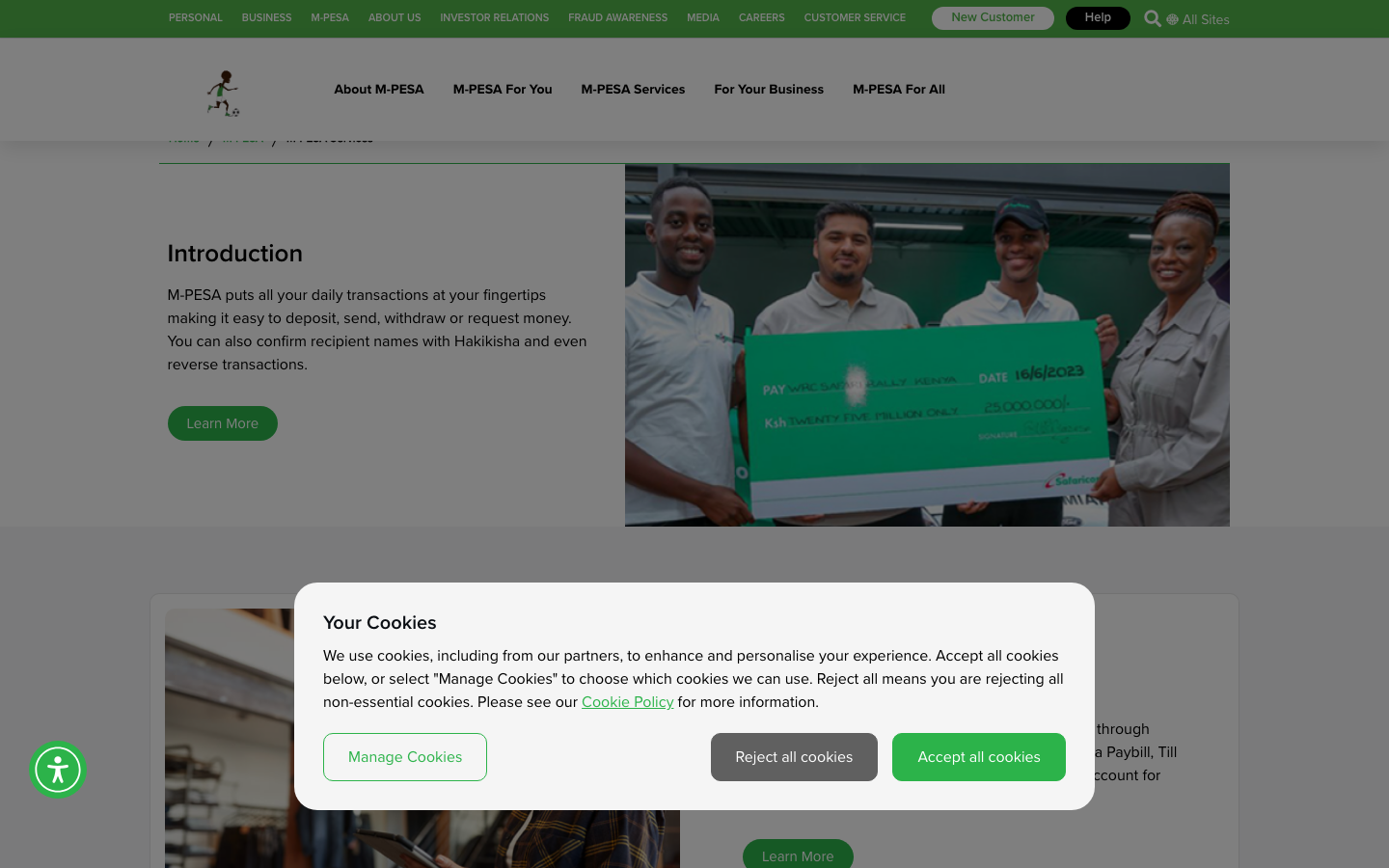
Safaricom’s own M-PESA page, checked directly this month, describes the service in terms that go well beyond simple transfers: “M-PESA puts all your daily transactions at your fingertips” — deposit, send, withdraw or request money, confirm recipient names with Hakikisha, and even reverse transactions — a level of built-in consumer protection most Western mobile-money apps still don’t offer directly.
Where M-Pesa Works
M-Pesa operates across Kenya, Tanzania, Mozambique, Lesotho, the Democratic Republic of Congo, Ghana and Egypt, run locally by Safaricom in Kenya and by Vodacom subsidiaries elsewhere, all tied together under the M-Pesa Africa joint venture. Each market runs its own registered mobile-money entity under local financial regulation, meaning an M-Pesa balance in Kenya and an M-Pesa balance in Tanzania are technically separate systems that happen to share a brand and underlying technology, rather than one single pan-African account.
None of those seven markets includes the UK, and no UK mobile network or bank has any equivalent partnership with Safaricom or Vodacom. A Kenyan expatriate living in Britain who still holds an active Kenyan M-Pesa number could technically use it to manage money back in Kenya, but that has no bearing on what a UKGC-licensed casino’s cashier can accept from a UK resident.
It’s worth flagging that each market’s M-Pesa presence developed at a different pace and scale: Kenya remains by far the deepest and most mature market, with Tanzania and Mozambique following at meaningful scale, while Ghana, Lesotho, DRC and Egypt represent smaller or more recently established footprints. Betting-specific Paybill-style integrations are correspondingly most developed in Kenya, where the tax and regulatory framework described above has had the most time to mature around it.
M-Pesa Beyond Gambling
M-Pesa’s significance to East African life goes well past payments: independent development research has repeatedly credited it with measurably lifting Kenyan households out of extreme poverty by giving them a safe, low-cost way to save money and smooth out unpredictable income and expenses, particularly for women running small informal businesses who previously had no practical access to formal banking. Today’s M-Pesa has grown into a genuine financial-services platform in its own right, layering in savings products, microloans (M-Shwari and Fuliza among the best known), and merchant payments through Till Numbers that let even the smallest Kenyan kiosk accept a digital payment.
That breadth is precisely why Kenyan betting operators standardised so heavily on Paybill: it wasn’t a bespoke gambling integration, but simply plugging into the payment rail nearly every adult Kenyan was already using daily for everything from electricity bills to school fees, which meant near-total population reach from day one rather than the slower adoption curve a purpose-built gambling payment system would have faced.
Academic and development-sector research into M-Pesa has become something of a case study in its own right, frequently cited in discussions of how mobile technology can leapfrog missing traditional infrastructure entirely — rather than East Africa needing to build a dense network of bank branches before financial inclusion could improve, M-Pesa let millions gain access to secure money storage and transfer using infrastructure (basic mobile phones and agent kiosks) that was already comparatively cheap and widespread.
Safer Gambling and M-Pesa
Because M-Pesa transactions never touch UK banking, the protections a British bank can attach to an account — a card-scheme gambling block, a self-exclusion flag shared with GAMSTOP, a spending limit set through a UK banking app — have no M-Pesa transaction to act on in the first place. That’s a consequence of the system sitting entirely within East African mobile networks, not a specific weakness in M-Pesa’s own design.
Kenya’s regulatory shift toward the Gambling Regulatory Authority includes its own responsible-gambling requirements for licensed Kenyan operators, layered on top of (not instead of) the tax changes described above, though the overall consumer-protection framework remains considerably younger than the UK’s. UK players should rely entirely on protections that actually reach them: GAMSTOP registration, a bank-arranged gambling block, and deposit limits set directly through UK banking.
There’s an argument that Kenya’s payment-level tax and enforcement approach functions as an indirect friction on problem gambling too, since every deposit now carries a visible duty deduction and every withdrawal a visible withholding tax, making the true cost of frequent betting more immediately apparent than it would be under a system where tax was invisible to the player. Whether that’s an intended consumer-protection effect or simply a side effect of a revenue-focused tax redesign is genuinely debated, but it’s a distinctive feature of the Kenyan market a UK reader won’t encounter in domestic gambling regulation.
What Kenyan Bettors Say About M-Pesa
Kenyan betting forums and social media discussion of M-Pesa centres overwhelmingly on speed and convenience — topping up a betting wallet via Paybill takes seconds from anywhere with phone signal, a genuinely transformative experience for anyone who remembers the cash-and-agent betting shops M-Pesa displaced. The most common complaints concern network congestion during high-traffic periods (major football fixtures reliably slow M-Pesa’s confirmation times) and the layered tax deductions now visible on both the deposit and withdrawal side following Kenya’s 2025 tax restructuring, which some bettors argue erodes smaller stakes disproportionately.
None of that conversation has any bearing on a UK player’s experience, since it describes Kenyan bettors navigating Kenyan-licensed operators through a mobile-money network with no reach into UKGC cashiers.
A theme that does recur often enough to be worth noting is how normalised betting itself has become in parts of Kenyan youth culture specifically because M-Pesa made the barrier to entry so low — no bank account, no minimum balance, just a phone and a few shillings. Kenyan public-health researchers and journalists have raised genuine concern about that ease of access contributing to gambling-related harm among young people, a debate that has fed directly into the push for the stronger Gambling Regulatory Authority framework described earlier in this page.
The UK Routes That Fill M-Pesa’s Role
For M-Pesa’s phone-linked, no-bank-account convenience, pay by mobile is the closest UK match, letting a deposit be added straight to a phone bill or pay-as-you-go balance rather than requiring bank details at all. For the instant, direct-transfer side of what M-Pesa does, open banking (Trustly, Brite, Volt) delivers the same speed straight from a UK current account.
A UK pay-by-mobile deposit runs through noticeably fewer steps than a Kenyan Paybill transfer, if only because there’s no separate app or agent network involved:
- Pick pay by mobile at the casino cashier.
- Confirm your phone number via a one-time code.
- Choose your deposit amount, added to your phone bill or PAYG balance.
- Play instantly — settle the charge later through your phone provider.
And for anyone wanting a two-way method that also covers withdrawals cleanly, debit card and open banking both remain universally accepted fallbacks at every UKGC casino.
It’s worth being honest about where the UK alternatives don’t fully replicate M-Pesa’s role: no UK payment method doubles as a person’s entire financial identity the way M-Pesa often does in Kenya, since UK banking already gives nearly every adult a full current account. That’s not a shortcoming of the UK options so much as a reflection of how different a problem each system was originally built to solve.
Our Verdict on M-Pesa for UK Players
Few payment systems have reshaped a society the way M-Pesa reshaped Kenya’s, and the claim that it changed how tens of millions of East Africans handle money, betting included, is not marketing. None of it touches you. The whole system runs on Safaricom and Vodacom’s African mobile networks, with no UK banking connection now or in prospect. Split its appeal in two, though, and both halves are already solved here: for phone-based convenience use pay by mobile, and for instant bank-to-bank speed use open banking.
M-Pesa Casino FAQs
Can I use M-Pesa at a UK online casino?
No. M-Pesa moves money exclusively through Safaricom and Vodacom’s African mobile-money networks, and no UKGC-licensed operator has any way to accept it.
Is M-Pesa banned in the UK?
It isn’t banned — it simply has no UK presence, since it’s tied entirely to African SIM cards and mobile-money infrastructure with no bridge to British banking.
Is M-Pesa used for gambling in Kenya?
Yes, extensively — Paybill and Till Number payments are the dominant way Kenyan bettors fund an account, and Kenya now collects betting excise duty at the point that M-Pesa deposit is made.
Do I need a bank account to use M-Pesa?
No — that’s the whole point of the system. An M-Pesa account is tied to a phone number and SIM card, letting users store and move money with no bank account required.
Who owns M-Pesa?
M-Pesa Africa, a 50/50 joint venture between Safaricom and Vodacom, which bought the brand and platform from Vodafone in 2020; Vodafone completed its final exit in 2023.
What’s the UK equivalent of M-Pesa?
Pay by mobile covers the phone-linked, no-bank-account side; open banking covers the instant bank-transfer side. Both are standard at UKGC-licensed casinos.
How many people use M-Pesa?
Around 40 million users across seven countries — Kenya, Tanzania, Mozambique, Lesotho, DRC, Ghana and Egypt — processing over a billion transactions a month.
When did M-Pesa launch?
Safaricom launched M-Pesa commercially in Kenya on 6 March 2007, with early development backing from Vodafone.
What is a Paybill number?
A merchant code Kenyan betting sites (and many other businesses) register with M-Pesa so customers can deposit and have the payment automatically matched to their specific account or betting wallet.
Is Kenyan betting regulation changing?
Yes — Kenya is transitioning oversight from the long-standing Betting Control and Licensing Board to a new Gambling Regulatory Authority under the Gambling Control Act 2025, expected to complete around February 2026.
Changelog: 9 July 2026 — added an at-a-glance box, Safaricom's own current product description (Hakikisha, transaction reversal), and an official page screenshot.
Sources & Verification
Checked 5 July 2026 against: Safaricom’s own M-PESA site and its journey timeline (re-verified 9 July 2026); Vodafone’s statement on the 2020 M-Pesa Africa joint venture; independent reporting on Kenya Revenue Authority: Excise Duty on Betting and the BCLB-to-GRA regulatory transition; and for UK safer-gambling context, the Gambling Commission’s guidance on blocking gambling payments through your bank.
Watching a national tax authority redesign its entire betting-duty collection process around a specific mobile-money deposit step is a level of payment-and-policy integration that has no real UK parallel. More about Will →