

Boleto Bancario has moved cash payments in Brazil since 1993 — print or generate a barcoded slip, pay it at a bank, lottery agent or supermarket till, and wait one to three business days for confirmation. It’s never reached a UK casino, since every Boleto is issued and settled entirely within Brazilian banking. This page covers what Boleto is, why PIX has been steadily eating its market share, its ongoing role serving Brazil’s unbanked population, and the UK method that solves the same underlying problem.
Why Boleto Cannot Reach a UK Casino
| Boleto Bancario at a Glance | |
|---|---|
| UK casino availability | None — Brazilian reais only, no UK retail or currency bridge |
| Major processor | EBANX — 500+ global merchants, active in 20+ countries |
| Where used | Brazil, deposit-only, losing share to PIX |
| Withdrawals | Not supported — a bank-slip instrument has no receiving account |
| UK equivalent | paysafecard or Neosurf |
Checked 5 July 2026 — and reliably checkable indefinitely, since Boleto’s confinement to Brazilian banking is structural, not a policy that could change.
| Question | The reality |
|---|---|
| Does any UKGC casino take Boleto? | None do — Boleto is a Brazilian bank-document standard, payable only through Brazilian banks and retailers in reais |
| Why not? Is it banned? | Not banned — simply Brazilian. There's no UK bank or retailer network that issues or accepts a Boleto |
| Is Boleto used for gambling anywhere? | To some extent at Brazil-facing operators, though its use is declining fast as PIX takes over — Boleto's payment-transaction share fell from around 7% in 2022 to roughly 4% in 2024 |
| Why is it declining? | PIX offers instant settlement; Boleto takes one to three business days to confirm and up to 3-15 days just to pay, making it the slow option in its own home market now |
| What's the nearest UK option? | Reach for paysafecard or Neosurf instead — both do the cash-in, no-bank-account job on UK high streets |
So "Boleto casino UK" has no legitimate destination — a Brazilian bank-slip standard has no UK counterpart to plug into. What's genuinely interesting is that Boleto is now a declining payment method even in its own country, watching PIX (covered elsewhere on this site) eat into its share year after year, while still surviving because it solves a specific problem — reaching Brazil's unbanked population — that instant payment rails don't fully replace. That's what this page covers.
Facts verified 5 July 2026 · 18+ · UKGC-licensed operators only · begambleaware.org
Boleto Bancario: Quick Facts
| What Boleto is | A standardised Brazilian bank-payment slip (a “ticket”), regulated by FEBRABAN (the Brazilian Federation of Banks), launched 1993 |
|---|---|
| How it’s paid | At a bank, lottery agency, supermarket or post office till, or via online banking — scanning the slip’s barcode |
| UK casino availability | Zero — Boleto only settles through Brazilian banking, in Brazilian reais |
| Speed | Slips are typically valid 3–15 days; payment confirmation itself takes 1–3 business days once paid |
| Market share trend | Falling — from around 7% of Brazilian payment transactions in 2022 to roughly 4% in 2024, as PIX takes over |
| Why it survives | Serves Brazil’s unbanked and underbanked population, and remains common for B2B and larger purchases |
| What to use instead in the UK | paysafecard or Neosurf — cash-based, no bank account required |
Boleto vs UK Cash Vouchers
Boleto and UK cash vouchers like paysafecard or Neosurf both let someone without easy card or bank access still pay for something online, but they arrived at the idea from different directions. Boleto is a formal bank-document standard, regulated by Brazil’s banking federation and payable at a huge range of physical locations including banks themselves. paysafecard and Neosurf are private prepaid-voucher products, bought at a single retail till in one transaction rather than generated as a document to pay later.
| Boleto (Brazil) | paysafecard/Neosurf (UK) | |
|---|---|---|
| Format | A generated bank-slip document with a barcode, paid later | A prepaid code bought and used in one transaction |
| Speed | 1–3 business days to confirm once paid | Instant once purchased |
| Withdrawals | No — deposit-only, like all cash-based methods | No — also deposit-only |
| Market trend | Declining as PIX grows | Stable, established niche use |
The underlying need — pay with cash, no bank account or card required — is exactly what paysafecard and Neosurf already deliver at a UK cashier, just faster and in a single step.
How Boleto Actually Works
Paying with Boleto starts with a merchant or operator generating a slip — a document containing a barcode, the amount due, and an expiry date, typically valid for somewhere between 3 and 15 days. The customer then takes that slip (printed or shown digitally) to a bank branch, ATM, supermarket, lottery agency or post office, or pays it through their own online banking by scanning the barcode. Crucially, payment isn’t instant even once made: confirmation back to the merchant typically takes one to three business days, since it routes through Brazil’s traditional bank clearing processes rather than an instant-settlement rail like PIX.
Step by step, a typical Boleto payment looks like this:
- Generate the Boleto at checkout, receiving a barcoded slip with an expiry date.
- Take the slip to a payment point — a bank, supermarket, lottery agent or post office — or pay via your own online banking.
- Pay the amount shown, in cash or from your bank account.
- Wait one to three business days for the payment to confirm and credit the merchant or operator.

That multi-day wait is precisely why Boleto has lost ground so quickly once Brazilians had an instant, equally accessible alternative in PIX.
One detail worth understanding for anyone comparing Boleto to other cash-based methods on this site: unlike paysafecard or Neosurf, where the voucher itself carries the value the moment it’s purchased, a Boleto slip carries no value at all until it’s actually paid — generating a slip costs nothing and creates no financial obligation by itself. That makes it structurally closer to an invoice than a prepaid voucher, and it’s exactly why a Boleto can expire unpaid with no financial consequence to anyone, whereas an unredeemed prepaid voucher still represents real spent money sitting unused. That subtle difference in how the two payment types handle unused value is easy to overlook, but it explains why a Boleto is genuinely lower-risk to generate speculatively compared to buying a voucher you might never end up using, since an unpaid slip simply expires quietly with nothing genuinely lost on either side of the transaction, a small but genuinely useful piece of consumer-friendly design baked into a payment format most people think of as old-fashioned rather than genuinely, quietly well thought through by whoever originally standardised it back in 1993.
Boleto’s Steady Decline Against PIX
Boleto’s story over the past five years is really the story of PIX’s rise, told from the losing side. Boleto’s share of Brazilian payment transactions fell from around 7% in 2022 to roughly 5% in 2023, stabilising near 4% through 2024 — a genuine, sustained decline rather than a temporary dip, driven by exactly the comparison this page has already drawn: PIX settles in seconds for free, while Boleto takes days and, for merchants, carries processing costs a purely digital instant-payment rail avoids.
What’s kept Boleto from disappearing entirely is its continued relevance to Brazilians outside PIX’s ideal use case: people without a bank account at all (PIX still requires one, even though it’s free and instant once you have it), businesses handling large B2B transactions where a formal payable document suits accounting processes better than an instant transfer, and situations where a buyer wants a fixed-date payment obligation rather than an immediate debit. Brazil’s payments industry increasingly frames Boleto as a persistent niche tool rather than a mainstream method in transition to obsolescence, similar to how cash itself persists in most economies well after cards and instant payments become dominant.
It’s worth being precise about what the percentage decline actually measures, since headline “market share” figures can mislead. Boleto’s falling share is measured against total Brazilian payment-transaction volume, a pool PIX has itself dramatically expanded by making instant payment genuinely free and universal — so Boleto isn’t necessarily processing fewer absolute transactions than it once did, it’s processing a shrinking slice of a much bigger overall pie that PIX largely created. That distinction matters for anyone assessing whether Boleto is truly “dying” versus simply being outgrown by a faster-growing alternative sitting alongside it in the same market.
Security and Fraud Considerations
Boleto payments are generally considered secure and, notably, irreversible once confirmed — a genuine advantage for merchants, since it eliminates the chargeback risk cards carry, but it also means a Boleto paid in error or under duress has no built-in recall mechanism, the same trade-off every cash-based payment method on this site shares. The most common fraud pattern associated with Boleto involves fraudulent slips: scammers generate fake Boleto documents with the fraudster’s own payment details substituted for the legitimate merchant’s, hoping a victim pays the fake slip without checking closely. Brazilian banks and consumer-protection guidance consistently advise verifying a Boleto’s issuing details match the expected merchant before paying, particularly for anything received via an unsolicited email or message.
Because Boleto requires no login credentials or card details to pay — only cash or a straightforward bank payment at a till — it avoids the phishing and credential-theft risks that affect login-based payment methods, but that same simplicity is exactly what makes fake Boleto slips a viable scam in the first place.
Brazilian banks have progressively tightened Boleto’s verification standards over the years, including cross-checking the payee details encoded in a slip’s barcode against a central registry before releasing funds, specifically to make the fraudulent-substitution scam harder to pull off at scale. That’s a useful reminder that a payment method’s security profile isn’t fixed at launch: Boleto in 2026 carries meaningfully better fraud safeguards than the same document format did a decade earlier, even though the basic user experience of taking a slip to a till has barely changed.
How Boleto Became Brazil’s Default Payment Slip
Boleto Bancario has been part of Brazilian commerce since 1993, standardised and regulated by FEBRABAN, the Brazilian Federation of Banks, to give merchants and consumers a common, bank-verified payment document that worked whether or not the payer held a bank account of their own. That design goal — serving unbanked and underbanked Brazilians alongside conventional bank customers — has remained central to Boleto’s role for over three decades, even as the payments landscape around it transformed repeatedly.
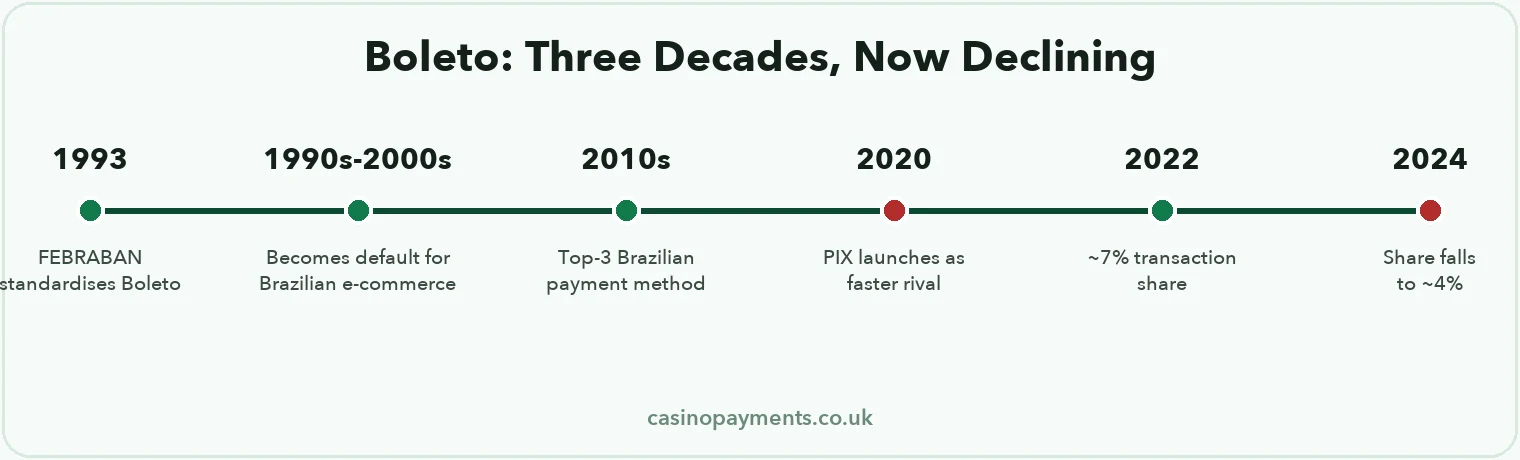
- 1993 — FEBRABAN standardises Boleto Bancario as a common bank-payment document across Brazilian banks.
- 1990s–2000s — Boleto becomes a default option for Brazilian e-commerce, serving both banked and unbanked consumers.
- 2010s — Boleto remains a top-three Brazilian payment method alongside cards, particularly strong for cross-border and unbanked-consumer transactions.
- 2020 — PIX launches, offering free, instant bank-to-bank payment as a direct, faster alternative to Boleto’s multi-day settlement.
- 2022 — Boleto holds roughly 7% of Brazilian payment-transaction share as PIX adoption accelerates.
- 2024 — Boleto’s share stabilises near 4%, having lost significant ground to PIX but retaining a persistent niche role.
Boleto’s history is a useful counterpoint to PIX’s story covered elsewhere on this site: PIX shows how fast a well-designed, centrally-run instant-payment system can capture a market, while Boleto shows how a genuinely useful, decades-old standard can persist in a shrinking niche rather than disappearing outright, because it still solves a real problem for a real segment of the population.
EBANX, the payments infrastructure company behind much of Boleto’s cross-border processing, describes itself as solving “payments for global brands in emerging markets” with over 500 global merchants (including Uber, Spotify and Booking.com) and an “11-year track record” across 20+ countries, holding ISO 27001, 27018 and 27701 certification for information security and data protection.

Where Boleto Works
Boleto is a Brazil-specific bank-document standard, regulated by FEBRABAN and payable only through Brazilian banks, retailers and payment points. There is no international version, and no licensing route lets a UK bank or retailer issue or accept a Boleto — it exists purely to serve Brazilian commerce, denominated in reais, cleared through Brazilian bank infrastructure.
That confinement is exactly why no UK casino can simply add Boleto as a payment option: there’s no scheme membership to join, and the slip’s barcode only resolves within Brazil’s own banking clearing system. Cross-border e-commerce platforms sometimes offer Boleto specifically to reach Brazilian customers from abroad — a genuinely significant use case, since a large share of Brazilian cross-border online purchases still use Boleto — but that’s a merchant accepting payment FROM Brazil, not a route for a UK player to pay a UK-facing operator.
It’s a distinction worth being explicit about, since the direction of the transaction matters entirely here. A UK-based online retailer selling into Brazil might reasonably add Boleto to its own checkout, letting a Brazilian customer pay for a UK product using a payment method familiar to them. That’s the mirror image of what this page is about: a UK casino cannot accept Boleto FROM a UK player, because the entire clearing mechanism runs through Brazilian banks regardless of which country the merchant itself is based in. Boleto flows into Brazilian bank accounts, full stop, which is precisely why it works for Brazil-facing merchants and never for UK-facing ones, no matter how the merchant itself happens to be structured or where its head office actually sits, and regardless of the currency the same business quotes prices in anywhere else in the world.
Boleto Beyond Gambling
Boleto’s real significance in Brazilian commerce has always been financial inclusion: by some estimates it remains a meaningful access point for tens of millions of Brazilians who lack full banking access, letting them pay utility bills, make online purchases, and settle debts without needing a bank account, a credit history, or a card. That inclusion role is precisely why Boleto hasn’t vanished even as PIX has captured the mainstream instant-payment use case — PIX still fundamentally requires a bank account, however free and fast it is once you have one, while Boleto’s cash-payment option at a supermarket till doesn’t.
Boleto also remains genuinely significant in Brazilian B2B commerce, where a formal, dated payment document fits established accounting and invoicing workflows better than an instant transfer does, and in cross-border e-commerce, where international merchants selling into Brazil often add Boleto specifically because a meaningful share of Brazilian online shoppers still prefer or need it.
That cross-border dimension deserves its own emphasis: payments-industry data has put Boleto at around 68% of cross-border e-commerce transactions into Brazil, and it’s been credited with giving roughly 50 million otherwise unbanked Brazilians a route into online commerce — both figures far above what its shrinking overall domestic transaction share alone would suggest. International merchants who drop Boleto as an option, assuming PIX alone now covers the Brazilian market adequately, risk losing exactly the unbanked and cash-preferring customer segment Boleto was built for in the first place — a genuine commercial lesson for any business selling into Brazil, not just a historical footnote about a fading payment method.
Safer Gambling and Boleto
Because Boleto never touches UK banking, it sits entirely outside UK bank-level protections such as voluntary gambling blocks or GAMSTOP-linked alerts — the same structural point that applies to any payment method confined to a different country’s banking infrastructure.
For UK players, the relevant safer-gambling toolkit remains entirely UK-side regardless: GAMSTOP registration, a bank-level gambling block arranged with your own UK bank, and deposit limits set directly through your banking app. None of these tools have any interaction with Boleto, since the two systems never overlap.
What Brazilian Users Say About Boleto
Brazilian commentary on Boleto increasingly frames it in exactly the terms this page has used: reliable but slow, a fallback rather than a first choice now that PIX exists. Where Boleto still draws genuine appreciation is specifically among unbanked users and for larger, planned purchases where the multi-day wait doesn’t matter, and among businesses that prefer a formal payable document over an instant transfer for accounting reasons. Younger, digitally-native Brazilian consumers overwhelmingly favour PIX where the choice is available, leaving Boleto’s remaining user base skewing toward those it was originally designed to serve.
Little of that reads across to a British audience, though — it’s a conversation between Brazilian consumers comparing Brazilian payment options, entirely disconnected from anything a UKGC-licensed cashier could ever offer. If there’s a parallel worth drawing, it’s to how UK players talk about bank transfer versus open banking: the older, slower method survives specifically for the segment of users it still serves best, not because habit alone keeps it alive.
What UK Players Use in Place of Boleto
For the same cash-based, no-bank-account-required logic Boleto offers, paysafecard and Neosurf are both widely available at UK shops, bought instantly with cash rather than generated as a document to pay later.
If it was the “pay through my own bank” side of Boleto that appealed, UK bank transfer or open banking both settle far faster — minutes rather than days. And debit card remains the universal option every UKGC casino accepts.
Using a UK prepaid voucher takes far fewer steps than a Boleto payment:
- Buy a paysafecard or Neosurf voucher with cash at a UK shop.
- Note the PIN printed on the voucher or receipt.
- Enter the PIN at the casino cashier.
- Your balance updates instantly — no multi-day wait required.
Our Verdict on Boleto for UK Players
Three decades in, Boleto still carries real weight in Brazil: unbanked customers, B2B invoicing, and a slice of e-commerce that PIX has not yet swallowed. Watching PIX erode it is genuinely instructive if you want to see how quickly a well-built instant-payment scheme can rewrite a country’s habits. As a payment option for you, though, it is a dead end. Every slip is generated and settled inside Brazilian banking, and that is the whole of it. For the same cash-in-hand, no-bank-account approach, paysafecard and Neosurf are the British answer, and they clear a good deal faster.
Boleto Bancario Casino FAQs
Can I use Boleto to deposit at a UK online casino?
No. Boleto only settles through Brazilian banks and retailers in Brazilian reais, and no UKGC-licensed operator has any way to accept or process one.
Is Boleto banned in the UK?
No ban is involved — Boleto simply has no UK presence because it’s a Brazilian bank-document standard with no technical way to reach UK payments.
Why is Boleto losing popularity in Brazil?
Because PIX offers free, instant settlement, while Boleto takes one to three business days to confirm once paid and up to 3-15 days of validity before that — Boleto’s transaction share fell from roughly 7% in 2022 to about 4% in 2024.
Is Boleto disappearing entirely?
Unlikely in the near term — it still serves Brazilians without bank accounts, plus B2B commerce and cross-border e-commerce, use cases PIX doesn’t fully replace despite its dominance elsewhere.
Can I withdraw casino winnings via Boleto?
No — Boleto is a payment instrument for making a payment, not a bank account that can receive funds, so it’s deposit-only like every cash-based method on this site.
What’s the UK equivalent of Boleto?
paysafecard or Neosurf — cash-bought prepaid vouchers available at UK shops, delivering the same “pay without a bank account or card” outcome, just instantly rather than over several days.
Who regulates Boleto?
FEBRABAN, the Brazilian Federation of Banks, which standardised the Boleto format in 1993 so it works consistently across all Brazilian banks and payment points.
Is Boleto safe to use?
Generally yes, and payments are irreversible once confirmed, but fraudulent Boleto slips with a scammer’s payment details substituted in are a known scam — always verify a slip’s issuing details match the expected merchant before paying.
Changelog: 9 July 2026 — added an at-a-glance box, EBANX's own scale/certification detail, and an official homepage screenshot.
Sources & Verification
Checked 5 July 2026 against: EBANX’s own site and its Boleto Bancario overview (re-verified 9 July 2026); PPRO’s payment-methods data on Brazilian cross-border usage; independent reporting on Boleto’s declining share against PIX; and, for the safer-gambling comparison, the Gambling Commission’s guidance on arranging a bank-level gambling block.

Watching a thirty-year-old payment standard visibly lose ground to its own country's instant-payment revolution, year by year, is a rarer thing to document properly than a simple launch-and-adoption story. More about Will →