Bank gambling blocks are the most effective payment-level control most people have access to, and the hardest to reverse in a hurry, which is the entire point of them. Every bank that offers one builds in a delay of 48 or 72 hours before gambling payments work again, and several state plainly that no member of staff can shorten it. This page sets out the wait at each bank from their own guidance, what the block does and does not catch, and what to do if a gambling payment slipped through one.
What the Block Actually Does
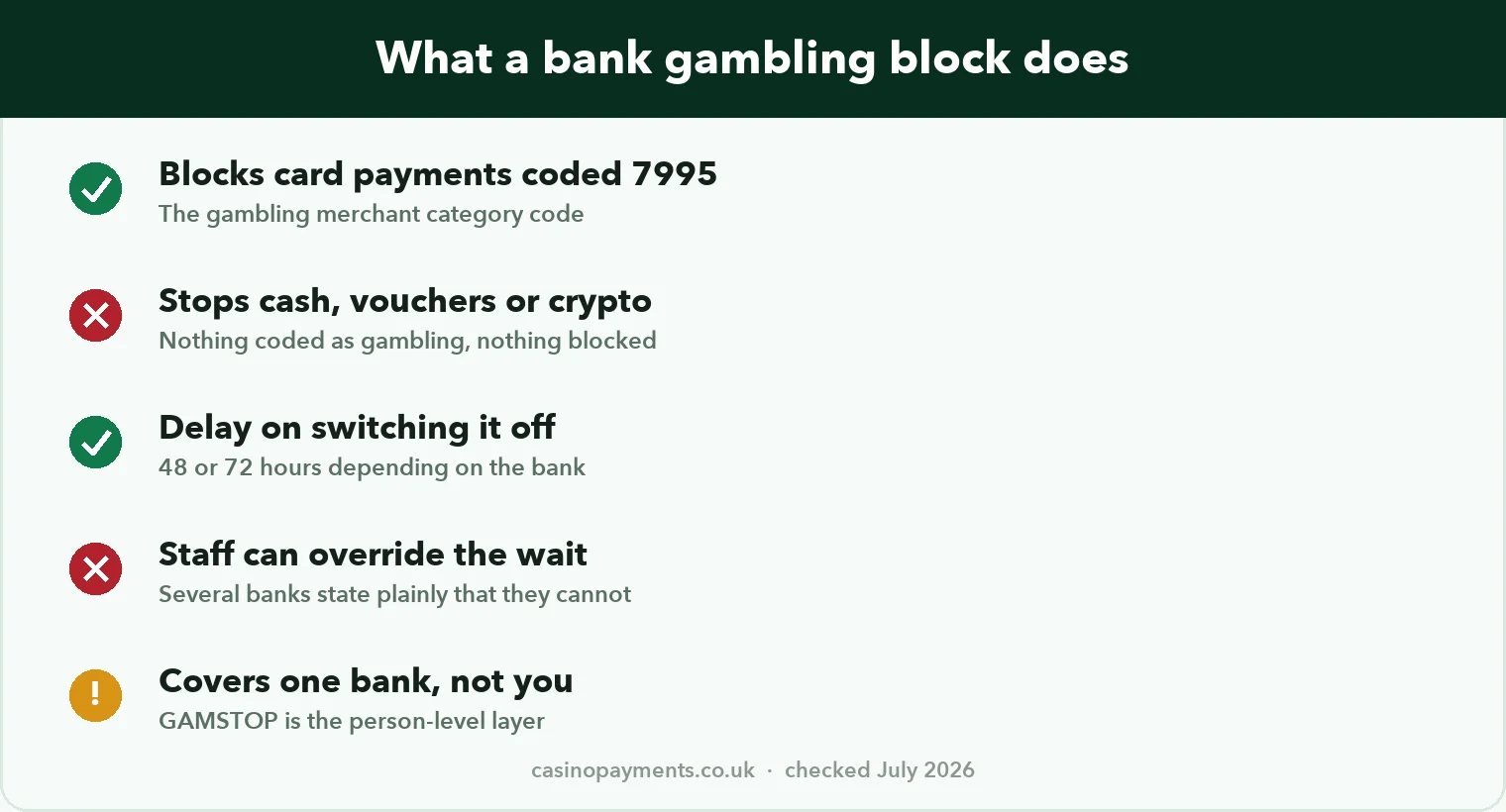
A bank gambling block works off the merchant category code attached to every card transaction. Gambling has its own, 7995, and the block simply declines anything carrying it. That is the whole mechanism, and it explains both its strength and its limits: it is automatic, instant and impossible to talk your way past, and it is completely blind to anything not coded as gambling.
It also means the block operates on the card and the bank, not on you. Open an account elsewhere and the block does not follow. That is the gap GAMSTOP exists to close, and the two are meant to be used together rather than as alternatives.
The Cooling-Off Wait at Each Bank
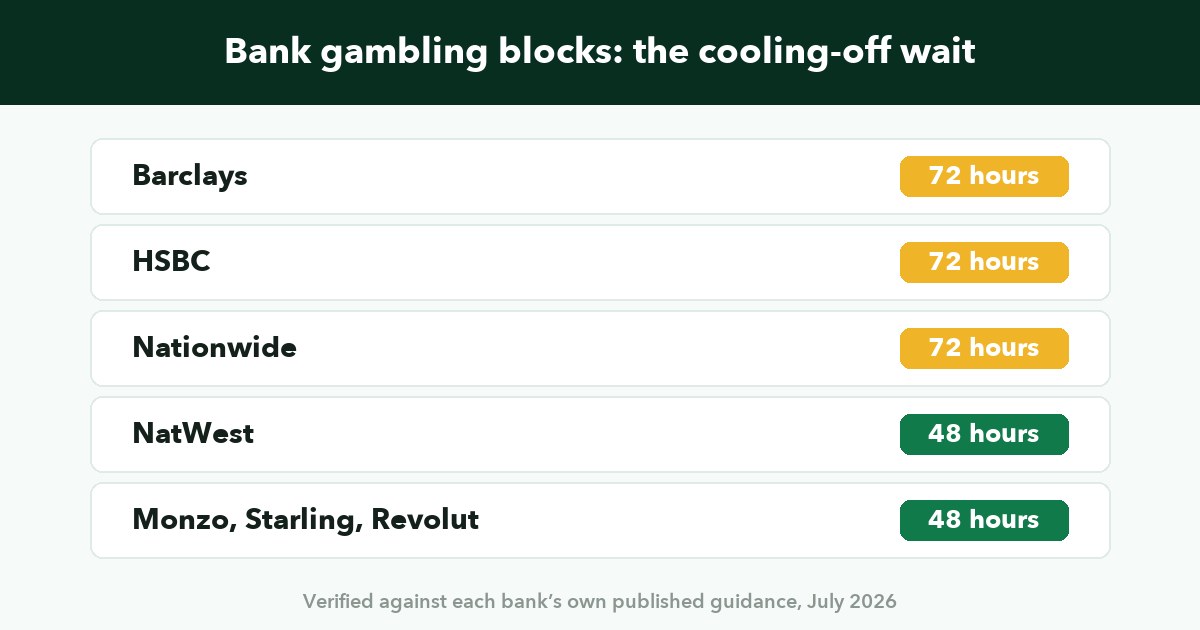
These figures come from each bank’s own published guidance, checked in July 2026. Switching the block on is instant everywhere. It is switching it off that carries the delay.
| Bank | Wait before gambling works again | Notes |
|---|---|---|
| Barclays | 72 hours | Set in the Cards section of the app, under merchant controls |
| HSBC | 72 hours (3 days) | You can re-enable the block immediately if you change your mind |
| Nationwide | 72 hours | States it cannot turn the block off any quicker, even by phone or in branch |
| NatWest | 48 hours | App only, and no staff member can override the period |
| Monzo | 48 hours | The bank that pioneered the feature |
| Starling | 48 hours | Instant to switch on, deliberately slow to switch off |
| Revolut | 48 hours | Disposable virtual cards do not bypass it |
| Chase | 48 hours after a call | Support call required before the clock even starts |
Two honest gaps. Lloyds, Halifax, Bank of Scotland, Santander and TSB all offer gambling controls, but we could not confirm their cooling-off periods from their own published guidance, and the figures circulating for them come from sites we do not treat as sources. If you bank with one of those, the app’s own card controls screen will tell you, and it is worth reading before you rely on it.
Why Staff Cannot Override It
The delay is the feature. A block you can remove the moment you want to gamble is not a block, it is a preference. Banks build the wait in so that the decision is made by a version of you that is at least a couple of days removed from the impulse, and several have gone out of their way to say that no amount of asking will shorten it.
That is worth knowing before you spend an afternoon on the phone. If you are reading this because you want the block gone today, the honest answer is that you cannot have it gone today at any UK bank offering the feature, and the reason is that people in exactly that position asked for the delay to exist.
How to Turn One Off
- Open your banking app and find card controls or merchant controls, usually under the card itself rather than in settings.
- Switch the gambling toggle off. At most banks this is the only route, and phone or branch staff cannot do it for you.
- Wait out the cooling-off period, 48 or 72 hours depending on your bank. Transactions will keep declining until it expires.
- Expect no reminder. The block lifts silently when the clock runs out.
- Changed your mind? Re-enabling is instant everywhere, including part-way through a cooling-off period.
What a Block Does Not Stop
This is where people are caught out, because the gaps are not obvious.
- Cash and vouchers. A paysafecard bought over a shop counter is a retail purchase, coded as the shop, not as gambling.
- Pay by mobile. The charge lands on your phone bill and never touches your bank card at all.
- E-wallets. Topping up a wallet is coded as the wallet. What you then do inside it is invisible to your bank.
- Another bank. The block covers one institution’s cards, not you as a person.
- Miscoded merchants. Rare, but a transaction coded as something other than 7995 passes straight through.
None of these are secrets, and listing them is not a workaround guide. They are the reason a bank block on its own is a partial answer, and why GAMSTOP plus a deposit limit plus a bank block is the combination that actually holds.
If a Gambling Payment Got Through Anyway
Occasionally a payment clears despite an active block. That is worth raising rather than shrugging at, because it usually means the transaction was not coded as gambling, which is a genuine issue for your bank to look into.
Check first whether the payment was one of the gaps above, since a voucher or phone-bill charge working is expected behaviour rather than a failure. If it was a straightforward card payment to a casino, contact your bank, quote the transaction, and ask what merchant category code it carried. Our guide to reading a gambling charge on your statement explains how to find the detail, and why casino deposits get declined covers the reverse situation.
Layering Blocks Properly
| Layer | What it covers | Speed to reverse |
|---|---|---|
| Bank block | Card payments at one bank, coded 7995 | 48 to 72 hours |
| Deposit limit | One operator’s cashier, counted gross | 24 to 72 hours to raise; instant to lower |
| GAMSTOP | Every UKGC-licensed site, at the person level | Minimum six months |
They cover different things and reverse at different speeds, which is exactly why using one is weaker than using all three. The bank block catches the payment, the deposit limit caps the account, and GAMSTOP is the one that follows you rather than your card.
Verdict
Bank gambling blocks are genuinely good tools: instant to switch on, automatic, and impossible to argue past. The 48 to 72 hour wait to remove one is not an inconvenience in the design, it is the design, and no bank offering the feature will shorten it however you ask.
If you came here to get a block removed, it is worth sitting with the fact that the delay exists because people wanted protection from the version of themselves making that request. There is no judgment in that, and there is free, confidential help at any hour from BeGambleAware and the National Gambling Helpline on 0808 8020 133. Our responsible gambling page sets out the full set of tools, including the ones that reach further than a single bank card.
Gambling Block FAQs
How long does it take to remove a gambling block?
Between 48 and 72 hours depending on your bank. NatWest, Monzo, Starling, Revolut and Chase apply 48 hours; Barclays, HSBC and Nationwide apply 72. Switching a block back on is instant everywhere.
Can I get my bank to remove the gambling block immediately?
No. Several banks state directly that no member of staff can shorten the cooling-off period, and Nationwide notes it cannot be done any quicker by phone or in branch. The delay is deliberate.
How do I turn a gambling block off?
Through your banking app, under card or merchant controls rather than general settings. At most banks the app is the only route, and phone or branch staff cannot do it for you.
Does a gambling block stop paysafecard or pay by mobile?
No. A voucher bought in a shop is coded as that retailer, and pay by mobile charges your phone bill rather than your card. Neither carries the gambling merchant code the block relies on.
Will a gambling block stop me using a different bank?
No. The block applies to one institution’s cards, not to you as a person. GAMSTOP is the layer that works at person level across every UKGC-licensed site.
A gambling payment went through despite my block. Why?
Usually because it was not coded as gambling: a voucher, a phone-bill charge or an e-wallet top-up. If it was an ordinary card payment to a casino, contact your bank and ask what merchant category code it carried.
Do Lloyds, Halifax, Santander and TSB have cooling-off periods?
They all offer gambling controls, but we could not confirm their cooling-off periods from their own published guidance, so we have not published figures for them. Your banking app’s card controls screen will state the position.
Can I re-enable the block during the cooling-off period?
Yes, immediately, at every bank we checked. Turning protection back on is never delayed; only turning it off is.
Sources & verification: cooling-off periods checked 25 July 2026 against each bank’s own published guidance: Barclays’ announcement of its 72-hour delay, HSBC’s gambling restrictions support page (3 days), Nationwide’s gambling support pages (72 hours, not reducible by phone or in branch) and the NatWest support centre (48 hours, app only, no staff override). Figures for Lloyds, Halifax, Bank of Scotland, Santander and TSB are deliberately omitted because no primary source confirmed them. Merchant category code 7995 is the gambling classification the blocks act on. 18+ · begambleaware.org