

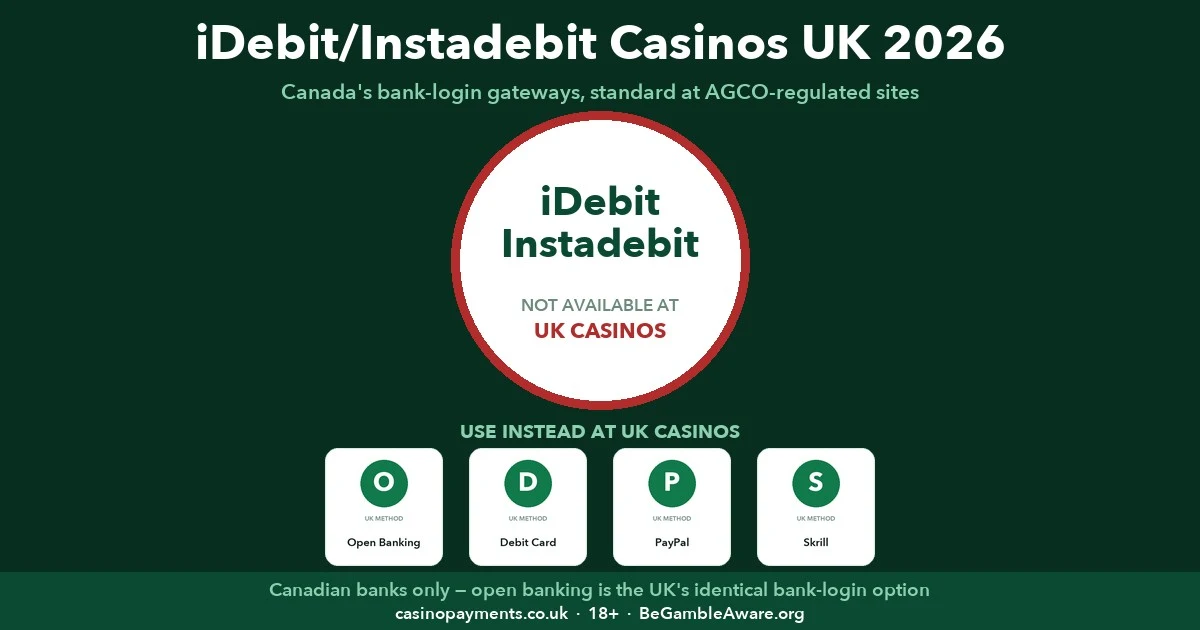
iDebit and Instadebit are two separate Canadian payment gateways that let a customer pay by logging into their own bank account and approving the transaction, no e-wallet balance or card involved. Both are standard at AGCO/iGaming Ontario-regulated sites and most Canadian-facing offshore casinos, working with major banks like RBC, TD, BMO and Scotiabank. Neither has ever reached a UK casino, since both settle only in Canadian dollars. This page explains how they work, how they differ from Interac, and the UK method filling the identical role.
For methods available to British players, compare the current options in our UK casino payment-method library.
Update, 9 July 2026: Instadebit has now shut down. Its own site confirms deposits stopped on 27 February 2026 and the service closed fully on 30 April 2026, with any remaining balance auto-transferred to the linked bank account after 28 days of inactivity; Instadebit itself names Interac as the replacement. iDebit is a separate company and remains active — the rest of this page's Instadebit-specific detail is kept for historical/reference purposes and clearly marked below.
Why iDebit and Instadebit Stay in Canada
| iDebit/Instadebit at a Glance — Updated 9 July 2026 | |
|---|---|
| UK casino availability | None for either — Canadian dollars only |
| iDebit status | Active — iDebit Payments Inc, Toronto |
| Instadebit status | Discontinued — deposits stopped 27 Feb 2026, fully shut down 30 Apr 2026 |
| Instadebit's own replacement pick | Interac |
| UK equivalent | Open banking does the identical bank-login job |
Checked 5 July 2026 — both gateways’ confinement to Canadian banking makes this a durable, structural “not available” verdict.
Lists of iDebit casinos found elsewhere are Canadian sites, not UK ones — and with Instadebit now shut down, half the category is history anyway.
| Question | The reality |
|---|---|
| Will a UK casino ever take iDebit or Instadebit? | No — both connect exclusively to Canadian bank accounts and settle only in Canadian dollars |
| Are they e-wallets? | Not really — neither lets you hold a pre-loaded balance the way Skrill or Neteller does; both are pass-through gateways to your own bank |
| Are iDebit and Instadebit the same company? | No — separate companies, often described as sister products because they solve the identical problem the same way |
| Are they widely used in Canadian gambling? | Yes — both are standard at AGCO/iGaming Ontario-regulated sites and most offshore-facing Canadian casinos |
| What's the UK equivalent? | Open banking — the same bank-login-and-approve idea, built on UK rails |
"iDebit casino UK" and "Instadebit casino UK" both lead nowhere, since both payment gateways are wired directly into Canadian banking with no UK counterpart. What's genuinely useful to understand is how they differ from Canada's other major payment method, Interac (already covered on this site) — iDebit and Instadebit verify and pay through a bank-login redirect, closer to how UK open banking works, rather than Interac's email-based money transfer.
Facts verified 5 July 2026 · 18+ · UKGC-licensed operators only · begambleaware.org
iDebit/Instadebit: Quick Facts
| What they are | Two separate Canadian payment gateways connecting a customer’s bank login directly to a merchant, without a card or stored e-wallet balance |
|---|---|
| iDebit | Founded 2006 by Charlie Holland; now owned by Toronto-based Paramount Commerce |
| Instadebit | Founded 2003; owned by Instadebit International Solutions Ltd, headquartered in Toronto and Malta |
| UK casino availability | Zero — both settle exclusively in Canadian dollars through Canadian banks |
| Fees | Typically around $1.95–$2 per deposit or withdrawal transaction |
| Canadian gambling role | Standard at AGCO/iGaming Ontario-regulated sites and most Canadian-facing offshore casinos |
| UK equivalent | Open banking (Trustly, Brite, Volt) |
iDebit/Instadebit vs UK Open Banking
The underlying idea behind iDebit, Instadebit and UK open banking is identical: authorise a payment by logging into your own bank rather than handing over card numbers to the merchant. The differences that remain are mostly about scale, regulation and how long each has been operating.
| iDebit/Instadebit (Canada) | Open banking (UK) | |
|---|---|---|
| Mechanism | Log into your bank via the gateway, approve payment | Log into your bank via the provider, approve payment |
| Regulatory basis | Provincial gambling regulation (e.g. AGCO) plus standard Canadian payments law | PSD2/UK Open Banking standards |
| Withdrawal speed | 1–5 business days typically | Often same-day to a few days, operator-dependent |
| Fees to the player | Around $1.95–$2 per transaction, typically | Usually free at the point of use |
That fee row is worth a second look, since it’s a genuine point of difference: UK open banking transactions are typically free to the player, with providers like Trustly and Brite earning revenue from the operator side instead, whereas iDebit and Instadebit both charge the player directly at each deposit and withdrawal, a legacy of how the Canadian gateway model was originally built and priced.
It’s also worth flagging the withdrawal-speed gap, since it’s the other genuine practical difference: UK open banking withdrawals frequently land same-day at operators that support them, whereas both Canadian gateways typically take one to five business days once a withdrawal request clears the casino’s own processing queue. Neither gap reflects a technical limitation so much as how each ecosystem evolved — UK open banking rails were built more recently, directly against a modern instant-payments standard, while iDebit and Instadebit’s withdrawal plumbing dates back to an earlier generation of Canadian banking infrastructure.
How iDebit and Instadebit Work
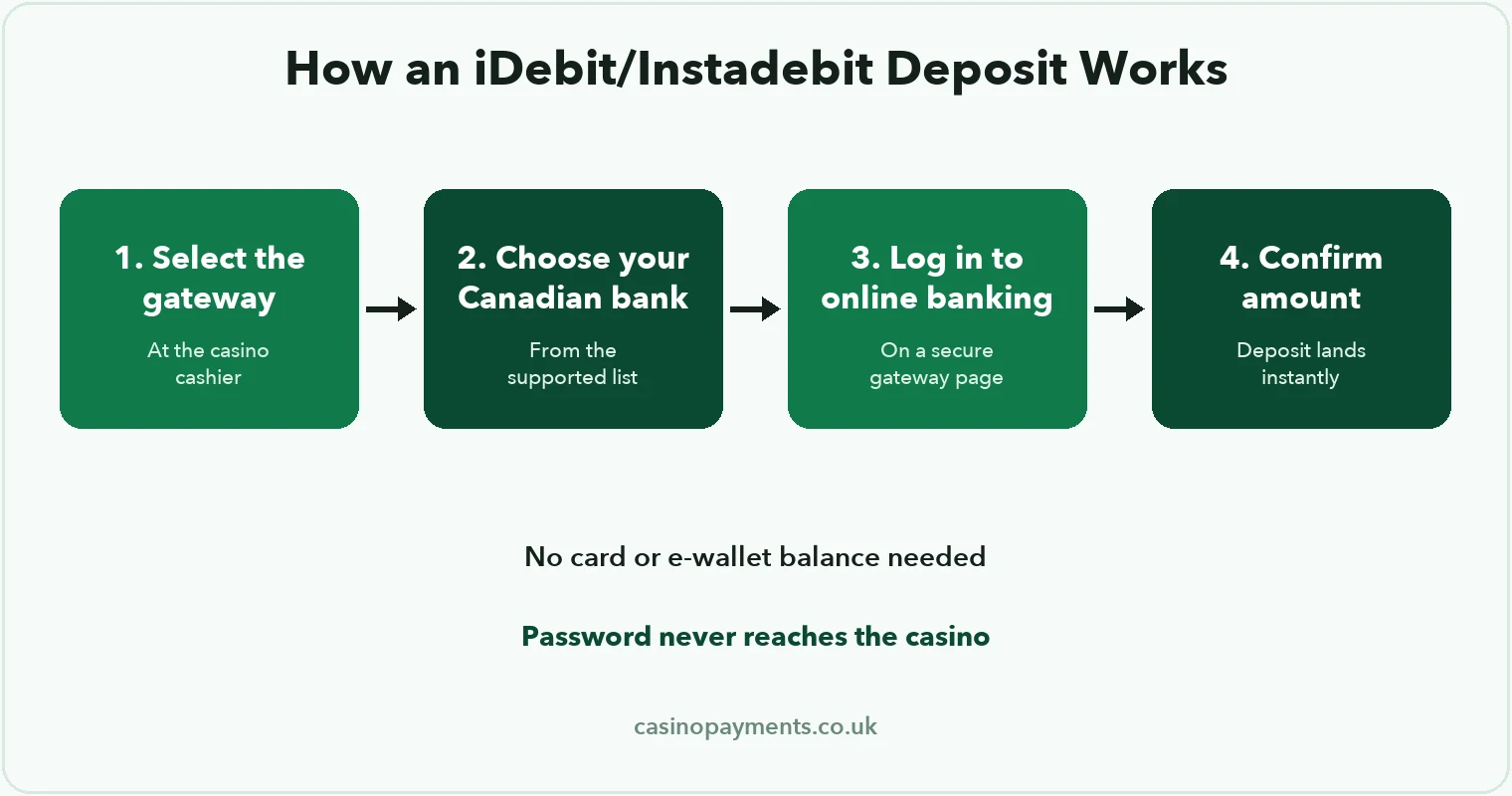
Both gateways work almost identically from a customer’s perspective: select iDebit or Instadebit at the casino cashier, choose your Canadian bank from the list, and log in using your normal online banking credentials on a secure page hosted by the gateway rather than the casino itself. Once the login and payment amount are confirmed, the gateway verifies the account and processes the transfer, crediting the casino account without ever passing the customer’s actual banking password to the operator.
Instadebit specifically doesn’t function as a true e-wallet for deposits — funds move directly from the bank to the merchant rather than sitting in an Instadebit balance first — though withdrawals do land in an Instadebit account first, which a customer then transfers onward to their own bank, typically within one to five business days. iDebit works on a broadly similar pass-through basis, with its own bank-verification step confirming sufficient funds and account ownership before authorising the payment.
Both gateways support a wide roster of Canadian financial institutions beyond just the five biggest national banks, extending to numerous credit unions and smaller regional banks, which is part of why they’ve become such a dependable fallback across Canadian-facing casino sites: a player whose specific bank isn’t supported by one gateway can often still find it covered by the other. Step by step, a typical deposit looks like this:
- Pick iDebit or Instadebit from the casino’s cashier menu.
- Find your bank in the gateway’s dropdown of participating Canadian institutions.
- Sign into your account the same way you normally would, on the gateway’s own secure page.
- Confirm the deposit total — the casino balance updates once the small transaction fee is applied.
iDebit/Instadebit vs Interac
Since this site also covers Interac separately, it’s worth being precise about how the three Canadian methods actually differ, since all three get lumped together loosely as “Canadian bank payment options” despite working in genuinely different ways. Interac e-Transfer moves money by email or phone-number reference between two bank accounts, similar in spirit to a peer-to-peer payment; iDebit and Instadebit instead redirect the customer to log into their own bank specifically to authorise a one-off merchant payment, closer to how a card payment or UK open banking transaction is authorised.
In practice, that means a Canadian bettor might genuinely prefer one over the others depending on the specific operator and how quickly they want funds to move: Interac Online, where available, sometimes settles faster for deposits, while iDebit and Instadebit’s broader bank coverage and consistent gateway experience make them a common fallback across a wider range of casino sites than Interac Online alone supports.
There’s also a subtler distinction in how each method is perceived by Canadian players specifically: Interac carries the everyday familiarity of the network Canadians already use to e-Transfer money to friends and family, while iDebit and Instadebit feel closer to a dedicated payment-processing product built specifically for merchant transactions, a distinction that mirrors, in a smaller way, the difference this site draws elsewhere between a peer-to-peer transfer app and a purpose-built instant-payment rail.
None of that is to say one method is objectively better than the others for a Canadian bettor — it genuinely comes down to which specific operator supports which gateway, how quickly a given player wants to move money, and how comfortable they are with each provider’s particular interface. Canadian casino reviewers frequently recommend simply registering for whichever combination of Interac, iDebit and Instadebit a player’s own bank supports, since having more than one option ready removes the risk of being stuck without a working deposit method if one gateway experiences downtime.
iDebit’s Bank-Login Security Trade-Off
Confirmed directly on Instadebit’s own site this month: a banner notice states the deposit and shutdown dates above in Instadebit’s own words, not third-party reporting.

Both gateways use a redirect model specifically so the customer’s actual online banking password never reaches the casino or, in principle, even the gateway’s own permanent storage — the login happens on a secure page dedicated to that single transaction. That design gives Canadian players a meaningful privacy advantage over sharing card details directly with an unfamiliar operator, particularly useful, as several reviewers note, when dealing with a less established or overseas-facing casino site where trust hasn’t been established yet.
Both companies also build in transaction-level verification against the customer’s actual bank records at the moment of payment, rather than relying solely on stored card details that could be stolen and reused elsewhere. That real-time check is one of the underlying reasons both gateways are viewed as comparatively low-fraud-risk payment options within the Canadian gambling-payments industry, even though neither markets itself primarily as a security product.
Both companies are subject to standard Canadian financial services and anti-money-laundering requirements, and Instadebit’s expansion into Malta brought it under additional EU-adjacent regulatory scrutiny for its international operations. None of this has any bearing on UK banking, since neither gateway’s transactions ever reach a UKGC-licensed casino’s cashier.
iDebit’s Place in Canadian Online Payments
Instadebit launched first, in 2003, built by a group of Canadian financial-services professionals aiming to give online shoppers a card-free way to pay directly from their bank account; it went on to partner with all of Canada’s major banks (BMO, CIBC, RBC, TD Canada Trust and Scotiabank among them) and later expanded internationally, eventually operating under an international headquarters in Malta alongside its original Toronto base, processing more than a billion dollars in transactions annually. iDebit followed in 2006, founded by Charlie Holland, and built a similar bank-redirect model that went on to become a fixture of the Canadian online casino cashier; it’s now owned and operated by Paramount Commerce, a Toronto fintech originally founded in 2003 under the name Element Financial Technology Inc.
That both major gateways trace their origins back to 2003 is a small but telling coincidence: it places the birth of Canada’s bank-redirect payment model right at the early wave of e-commerce security concerns that also, around the same period, drove other markets toward similar bank-login payment products — Sofort, covered elsewhere on this site, launched in Germany just two years later in 2005 pursuing an almost identical underlying idea, entirely independently and with no connection to either Canadian company.
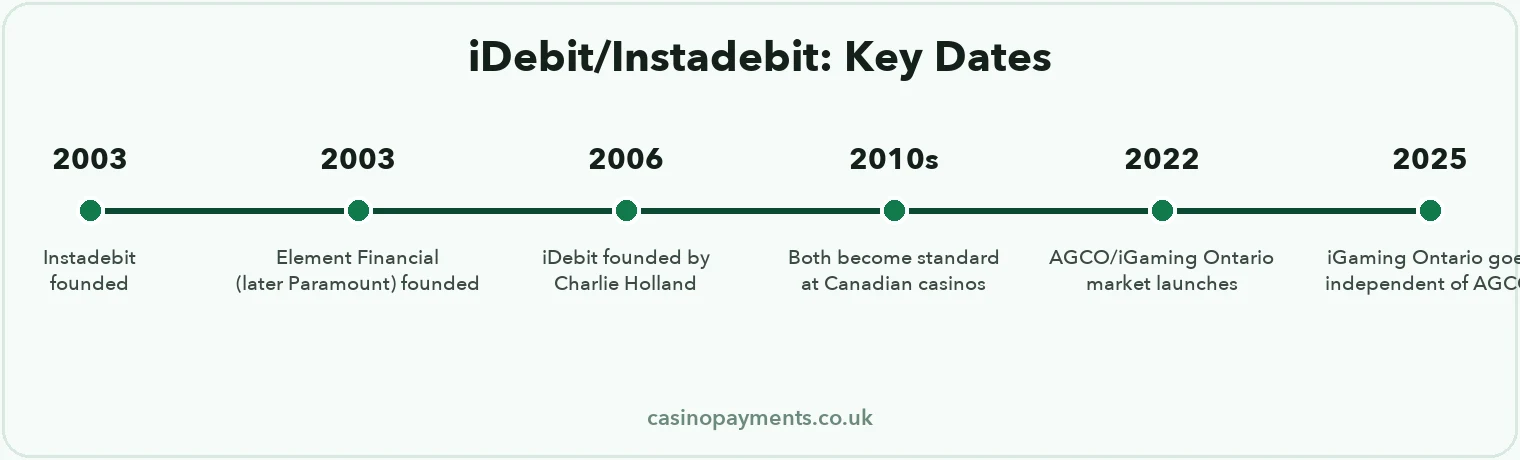
- 2003 — Instadebit is founded in Canada.
- 2003 — Element Financial Technology Inc (later Paramount Commerce) is founded in Toronto.
- 2006 — iDebit is founded by Charlie Holland.
- 2010s — Both gateways become standard deposit options across Canadian-facing online casinos.
- 2022 — Ontario’s AGCO and iGaming Ontario launch the province’s regulated commercial iGaming market on 4 April, with both gateways among the standard accepted methods.
- 2025 — iGaming Ontario becomes formally independent from the AGCO in May.
Where iDebit and Instadebit Work
Both gateways connect exclusively to Canadian bank accounts and settle only in Canadian dollars, tied to Canada’s major banks and a range of smaller credit unions. Instadebit’s operational presence in Malta primarily supports its international payment-processing business rather than extending the core Canadian-banking gateway to European bank accounts.
No UK bank participates in either gateway’s network, and no UKGC-licensed casino has any technical route to accept a payment from either. A Canadian expatriate in the UK with an active Canadian bank account could, in principle, still use iDebit or Instadebit to manage funds tied to that account, but that has no bearing on what a UK-resident player can use at a UKGC-licensed cashier.
Within Canada itself, coverage isn’t perfectly uniform either: not every smaller credit union or regional bank participates in both gateways, so a Canadian player occasionally finds their specific institution supported by one but not the other, which is part of why casino cashiers in Canada commonly list iDebit, Instadebit and Interac side by side rather than picking just one to integrate.
iDebit and Instadebit Beyond Gambling
Both gateways market themselves as general e-commerce payment tools well beyond gambling, serving Canadian shoppers who prefer paying directly from a bank account over sharing card details with online merchants, particularly for higher-risk or lesser-known e-commerce sites where a customer might be more cautious about card fraud. Instadebit’s billion-dollar-plus annual processing volume reflects that broader merchant base, of which gambling is a significant but not exclusive slice.
Paramount Commerce, iDebit’s owner, has built out a broader suite of Canadian payment infrastructure products beyond the original iDebit gateway itself, and its recent membership milestones within Canadian payments industry bodies suggest continued investment in the underlying business rather than treating iDebit as a legacy product left to run on its own.
That continued investment matters for Canadian players specifically, since a payment gateway’s long-term stability is a genuine consideration when choosing where to route recurring gambling deposits: a gateway actively maintained and expanded by its owner is considerably less likely to disappear overnight than one left to run on outdated infrastructure with no ongoing development.
Instadebit’s own merchant base extends across sectors that value the same card-free, bank-verified payment model, including subscription services and other online businesses that see meaningful benefit from lower chargeback risk compared with card payments, since a bank-authenticated transaction is generally harder for a customer to later dispute fraudulently than a card charge can be.
Safer Gambling and iDebit/Instadebit
Because neither gateway ever touches UK banking, standard British protections — a bank-arranged gambling block, GAMSTOP-linked flags, deposit limits set through a UK banking app — have no iDebit or Instadebit transaction to act on, a structural fact about where both operate rather than a specific gap in their design.
AGCO/iGaming Ontario licensing imposes its own responsible-gambling requirements on registered operators regardless of payment method, including self-exclusion tools specific to Ontario’s regulated market, layered alongside whatever national Canadian consumer-protection rules apply. A UK player is better served focusing on what’s actually within reach: registering with GAMSTOP, asking a UK bank to flag gambling merchants, and setting a personal cap through the banking app itself.
What Canadian Bettors Say
Canadian player discussion generally rates both gateways as reliable and straightforward, with the most common comparison being speed: Instadebit is often described as marginally faster on withdrawals, while iDebit’s deposit fee is sometimes noted as slightly lower, though neither difference is large enough to be a deciding factor for most players. Complaints, where they surface, mostly concern the 1-to-5-business-day withdrawal window feeling slow compared with instant e-wallet withdrawals elsewhere, and the per-transaction fees adding up for frequent small deposits.
A recurring point of praise, especially among more cautious or privacy-conscious Canadian players, is that neither gateway ever exposes a full bank account number or sort-code-style routing detail to the casino itself, only a confirmation that the payment succeeded. That’s frequently cited as a reason to prefer either gateway over a direct bank-transfer option at a newer or less-reviewed casino site, where a player might reasonably want an extra layer between their banking details and the operator.
None of that discussion has any bearing on a UK player, since both gateways describe Canadian bettors navigating Canadian-licensed and offshore-facing operators through banking infrastructure with no reach into a UKGC cashier.
Reviews of both gateways within Ontario’s newer regulated market specifically tend to be more positive than those describing older, offshore-facing Canadian casino experiences, likely reflecting the generally higher standard of operator conduct AGCO licensing requires compared with the largely self-regulated offshore market many Canadian players used before 2022.
The UK Bank-Login Route That Replaces iDebit
Open banking (Trustly, Brite, Volt) is the direct UK match for what iDebit and Instadebit offer: log into your own bank, approve the payment, and the casino balance updates without any card details or e-wallet registration involved. It’s a mainstream, typically fee-free option at every UKGC-licensed casino, in contrast to the modest per-transaction charges both Canadian gateways apply.
The privacy benefit both Canadian gateways offer carries over cleanly, too: UK open banking similarly never exposes a customer’s full account number to the casino, sharing only payment confirmation back to the merchant, so a UK player switching from thinking about iDebit or Instadebit to open banking loses none of that protection in the process.
Depositing via UK open banking runs through the same basic steps as an iDebit or Instadebit transaction:
- Select open banking at the casino cashier.
- Pick your UK bank from the list of participating providers.
- Log in and approve the payment through your own banking app.
- The deposit lands instantly, with no per-transaction fee at most operators.
Our Verdict on iDebit/Instadebit for UK Players
iDebit and Instadebit are two well-established, genuinely useful Canadian payment gateways, standard at AGCO/iGaming Ontario-regulated sites and most Canadian-facing casinos, but both are built entirely around Canadian banking with no route into Britain. UK players wanting the same bank-login, no-card-details experience should use open banking, which does the identical job at UKGC-licensed casinos, typically without the per-transaction fees both Canadian gateways charge. The broader pattern worth noting is that the bank-login redirect model iDebit and Instadebit pioneered in Canada, and Sofort separately pioneered in Germany around the same period, has essentially become the international default for card-free online payment two decades later, just implemented slightly differently depending on the specific country’s banking regulation.
iDebit/Instadebit Casino FAQs
Can I use iDebit or Instadebit at a UK online casino?
No. Both connect exclusively to Canadian bank accounts and settle only in Canadian dollars, and no UKGC-licensed operator has any way to accept either.
Are iDebit and Instadebit the same company?
No — they’re separate businesses, sometimes described as sister products because they solve the identical problem the same way, through a bank-login redirect rather than a stored e-wallet balance.
Is iDebit or Instadebit the same as Interac?
No — Interac e-Transfer moves money by email or phone reference between accounts. iDebit and Instadebit instead redirect you to log into your own bank to authorise a one-off merchant payment, closer to how UK open banking works.
Are iDebit and Instadebit e-wallets?
Not really — deposits move straight from your bank to the merchant with no stored balance, though Instadebit withdrawals do land in an Instadebit account first before you transfer them onward.
What’s the UK equivalent of iDebit or Instadebit?
Open banking (Trustly, Brite, Volt) — log into your own UK bank to approve a payment, with no card details or e-wallet registration required.
Who owns iDebit?
Paramount Commerce, a Toronto-based fintech, owns and operates iDebit; the gateway itself was founded in 2006 by Charlie Holland.
Who owns Instadebit?
Instadebit International Solutions Ltd, headquartered in Toronto and Malta; the company was founded in 2003.
Are there fees for using iDebit or Instadebit?
Yes — typically around $1.95 to $2 per deposit or withdrawal transaction, charged directly to the player.
How long do iDebit/Instadebit withdrawals take?
Typically 1 to 5 business days once the casino approves the withdrawal request, noticeably slower than most e-wallet withdrawals.
Is Ontario’s iGaming market regulated separately from the rest of Canada?
Yes — Ontario runs its own open-licence regulated market under the AGCO and iGaming Ontario, launched in April 2022, distinct from how gambling is regulated in other Canadian provinces.
Changelog: 9 July 2026 — corrected Instadebit's status to discontinued (confirmed directly on instadebit.com: deposits stopped 27 Feb 2026, service fully closed 30 Apr 2026, Interac named as the replacement); iDebit itself remains active and unaffected. Added an at-a-glance box and a screenshot of Instadebit's own shutdown notice.
Sources & Verification
Checked 5 July 2026, re-verified 9 July 2026 against: Instadebit’s own site (confirming its service discontinuation, deposits stopped 27 Feb 2026, shutdown complete 30 Apr 2026); AGCO’s overview of Ontario’s regulated iGaming market; AGCO’s explanation of its role alongside iGaming Ontario; independent reporting on iDebit Payments Inc’s Toronto operations; and, for UK safer-gambling context, the Gambling Commission’s guidance on blocking gambling payments through your bank.

Two Canadian gateways solving the identical bank-login payment problem, competing as sister products for two decades, is a reminder that a good idea in payments rarely stays a monopoly for long — even before UK open banking arrived to do the same job here. More about Will →