
Interac e-Transfer moves more purchase transactions in Canada than Visa or Mastercard individually — a domestic payment network out-competing two global card giants on their own turf. None of that reaches a UK casino: Interac only connects Canadian bank accounts to Canadian bank accounts, with no international arm a UK operator could join. This page covers what Interac actually is, how central it’s become to Ontario’s regulated betting market, the e-transfer fraud pattern worth knowing about, and the UK method that does the same job.
Why Interac Doesn’t Cross to a UK Cashier
| Interac at a Glance | |
|---|---|
| UK casino availability | None — Canadian bank accounts only |
| Operator | Interac Corp. — a private consortium owned/governed by Canadian banks |
| Where used | Canada's default online casino and sports-betting payment method |
| Withdrawals | Yes, via Interac e-Transfer, where supported |
| UK equivalent | Open banking does the identical bank-to-bank job |
Checked 5 July 2026 — and checkable indefinitely, since the reason Interac stops at the Canadian border is structural, not a policy that could change.
| Question | The reality |
|---|---|
| Will any UKGC casino let me pay with Interac? | None do, and none will — e-Transfer only settles between accounts held at Canadian banks and credit unions |
| Is that a UK ban, or something else? | Something else entirely: it's a membership network for Canadian financial institutions, and no British bank belongs to it |
| Is Interac used for gambling anywhere? | Yes — it's a core deposit and withdrawal method at Ontario's regulated online casinos and sportsbooks |
| Could a UK casino add it later? | Only by joining Canada's bank-owned settlement network, which no UK operator does or realistically could |
| What should a UK player use instead? | Open banking or bank transfer — both do the same "straight from your bank" job on UK rails |
So "Interac casino UK" has no legitimate destination — the network simply doesn't extend beyond Canadian banking. What's worth understanding is how a domestic bank consortium built a payment brand that now out-competes Visa and Mastercard combined inside its own country, how it became central to Canada's fast-growing regulated online gambling market, and the fraud pattern that comes with any instant, hard-to-reverse transfer system. That's what this page covers.
Facts verified 5 July 2026 · 18+ · UKGC-licensed operators only · begambleaware.org
Interac: Quick Facts
| What Interac is | A payments network owned by Canadian banks and credit unions, formed as Interac Corporation in 2018 from a 1984 nonprofit consortium |
|---|---|
| Best-known product | Interac e-Transfer — email/phone-based person-to-person and merchant transfers, moving money directly bank-to-bank |
| UK casino availability | Zero — no card numbers, no international rail, no UK bank connects to Interac’s network |
| Scale in Canada | Interac Debit alone accounts for roughly 37.6% of Canadian card-brand purchase transactions, ahead of Visa (36.5%) and Mastercard (23.9%) |
| e-Transfer volume | 1.4 billion transactions in 2024 worth $563 billion Canadian, up 17% year on year |
| Canadian gambling role | A core deposit/withdrawal method at Ontario’s AGCO/iGaming Ontario-regulated online casinos and sportsbooks |
| What to use instead in the UK | Open banking or bank transfer — the same bank-to-bank idea on UK rails |
Interac vs the UK’s Own Bank-to-Bank Methods
Interac and the UK’s open-banking cashiers solve the same problem — move money directly between bank accounts without a card number in the middle — but they were built by very different routes. Interac is a joint venture of Canada’s own banks and credit unions: founding members RBC, CIBC, Scotiabank, TD and Desjardins built it together in 1984, and membership grew past 80 institutions within decades. The UK never built an equivalent single national brand; instead, providers like Trustly, Brite and Volt deliver the same “authorise from your own bank” experience on top of the UK’s Faster Payments network and the EU-derived PSD2 open-banking rules.
| Interac (Canada) | Open banking (UK) | |
|---|---|---|
| Who built it | A consortium of Canadian banks and credit unions | Private fintechs (Trustly, Brite, Volt) on top of PSD2 and Faster Payments |
| Identifier | Recipient’s email or phone number, with a security question or Autodeposit | Your own online banking login — no separate identifier needed |
| Speed | Typically under 30 minutes | Seconds to minutes |
| Reversibility | Once accepted, effectively final — a known fraud risk (see below) | Same principle: authorised push payments are hard to reverse |
| Market position | Canada’s single largest payment brand by transaction share | Fast-growing but still behind cards and PayPal at UK cashiers |
If what appealed about Interac was moving money straight from a bank account with no card involved, open banking is the direct UK equivalent, just running on different rails.
The “who built it” column matters more than it looks. A bank consortium answers to its member institutions, which is why Interac has stayed a not-for-profit utility for most of its life, adding fees only where running the network genuinely requires it. UK open banking providers are venture-backed private companies competing for casino contracts, which is a different commercial incentive entirely — not necessarily worse for the player, since competition has pushed those providers to keep cashier fees at zero, but a structurally different relationship between the payment rail and the institutions using it.
How Interac e-Transfer Works
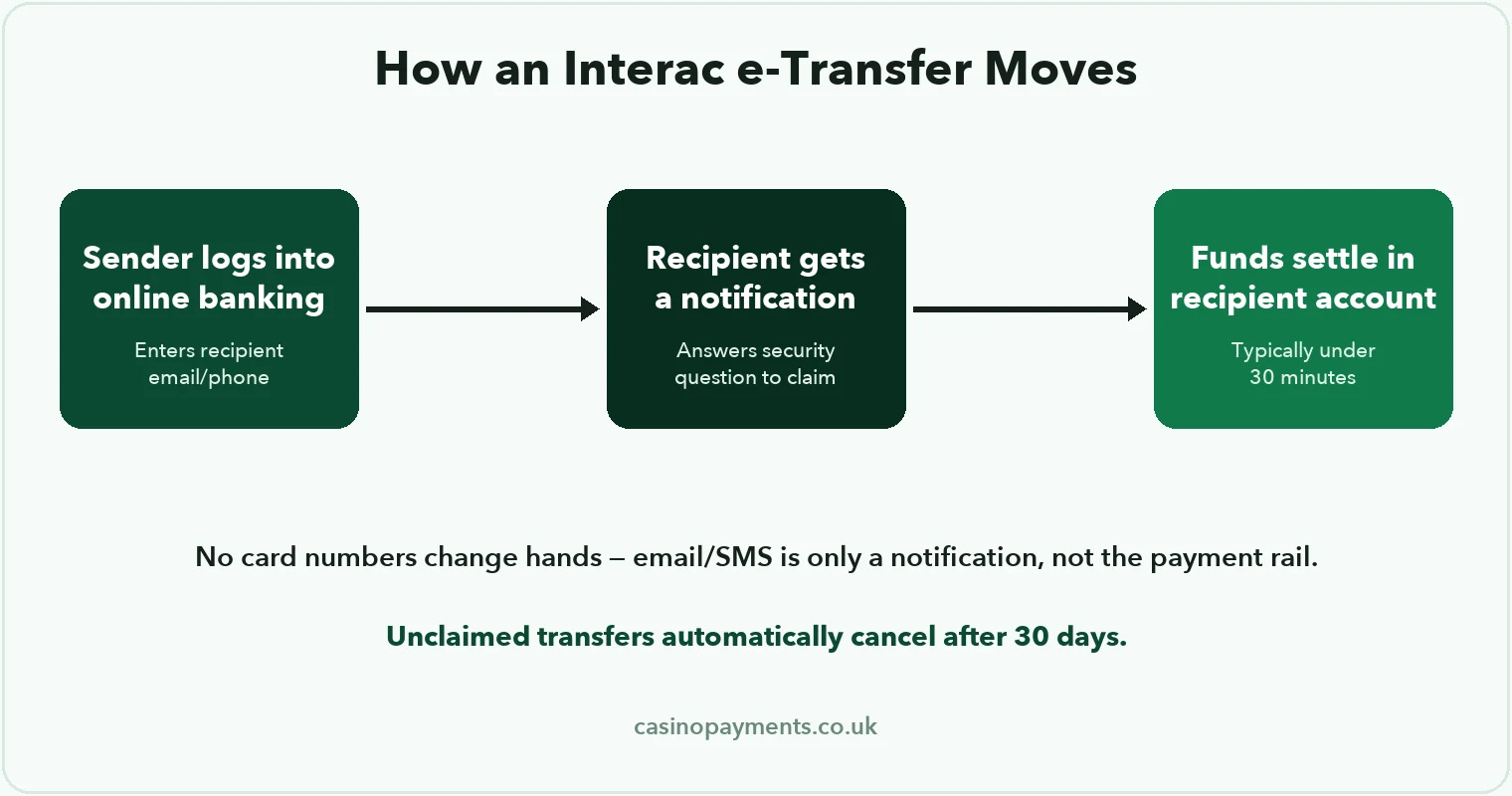
Interac e-Transfer moves funds through Canada’s existing banking rails — email or SMS is only ever a notification channel, never the payment mechanism itself. A sender initiates a transfer through their own online or mobile banking, and their account is debited instantly. The recipient then gets a notification and, unless they’ve set up Autodeposit, must log into their own banking to answer a security question and pull the funds in. No card or account numbers are ever shared with the recipient directly.
Step by step, a typical transfer looks like this:
- Sender logs into online or mobile banking and selects Interac e-Transfer.
- Enters the recipient’s email or phone number and the amount to send — the sender’s account is debited immediately.
- Recipient receives a notification and follows a link back to their own banking to accept the transfer, answering a security question if Autodeposit isn’t set up.
- Funds land in the recipient’s account, typically within 30 minutes; unclaimed transfers automatically cancel after 30 days.
For a Canadian casino cashier, that means deposits clear almost immediately and withdrawals can arrive the same way — a genuine two-way method, unlike several UK-favoured wallets that only work for deposits.
Interac’s Role in Canada’s Regulated Betting Market
Ontario opened Canada’s first fully regulated online gambling market in April 2022, licensing operators through the AGCO (Alcohol and Gaming Commission of Ontario) under a commercial framework run by iGaming Ontario, which became fully independent of the AGCO in May 2025. Interac e-Transfer sits alongside debit and credit cards as one of the standard deposit and withdrawal rails at these licensed sites, and it’s frequently the fastest withdrawal route on offer: regulated Ontario operators typically process Interac withdrawals within 24 hours, compared with the 24–48 hours common at unregulated offshore sites once identity checks are factored in.
The appeal for Canadian bettors mirrors exactly what draws UK players to open banking: no card details stored with the casino, a transfer that comes directly from a bank account the player controls, and settlement fast enough that neither deposits nor withdrawals become the bottleneck in a session.
Ontario isn’t the whole story, though it’s the largest single market. Other provinces run their own models — British Columbia and Quebec operate government-run online casinos (PlayNow and Espacejeux respectively) rather than Ontario’s competitive multi-operator licensing system, and Interac e-Transfer is standard at both, alongside Interac Online while that product still existed. That patchwork — one province licensing dozens of private operators, others running a single state monopoly — is itself very different from the UK’s single national regulator, and it’s part of why “Canadian gambling regulation” doesn’t map onto a single UKGC-style body the way UK readers might expect.
Security and the E-Transfer Fraud Pattern
Interac e-Transfer authenticates through the sender’s own online banking login plus a security question (or password-free Autodeposit), and transfers are not covered by the same zero-liability protections that apply to card fraud — once a transfer is accepted, the sender generally bears responsibility for having sent it to a legitimate recipient. That design has produced two well-documented fraud patterns in Canada: interception fraud, where a criminal diverts a legitimate transfer meant for someone else by guessing or phishing the security answer before the real recipient claims it, and phishing emails that impersonate genuine e-Transfer notifications to harvest banking logins. Canadian banks and police have specifically flagged e-Transfer fraud tied to online marketplace scams as a fast-growing problem.
None of this is unique to gambling — it’s the same category of risk that comes with any instant, hard-to-reverse push-payment system, UK open banking included. The practical lesson for any reader, Canadian or British: verify who you’re sending money to before an instant transfer clears, because “instant” also means “difficult to claw back.”
Why Interac’s Origin Matters to UK Players
Canadian financial institutions created Interac in 1984 as shared domestic banking infrastructure. Its Canadian membership and account network explain why it is useful in Canada but does not provide a general payment route for UK bank accounts or UK casino cashiers.
Interac’s own current positioning, checked directly on interac.ca this month: “It’s your money” — a consumer-facing emphasis on control and ownership that runs through its Payments, Verification and Company sections alike, consistent with its role as bank-owned infrastructure rather than a bank in its own right.

Where Interac Works
Interac connects participating Canadian banks and credit unions. It is not a standard payment method for UK-licensed casino accounts; British players looking for a similar bank-based flow should compare UK open-banking casino payments.
Safer Gambling and Interac
A UK bank gambling block, a GAMSTOP self-exclusion alert, a deposit-limit prompt built into a British current account — every one of those tools watches transactions moving through UK banking, and an Interac transfer never touches that system at all. It isn’t that Interac evades these protections; there’s simply nothing for a UK bank to see, because the money never crosses UK rails in the first place.
Ontario handles this by building responsible-gambling requirements into the operator’s AGCO licence rather than the payment method: the same rules on deposit limits, self-exclusion and advertising apply whether a Canadian bettor funds their account with Interac, a card, or another approved route. A UK player’s own safer-gambling toolkit — GAMSTOP, a bank-level gambling block, deposit limits set with your own bank — only ever covers UK-side transactions, which is one more practical reason there’s no upside to routing around it via a foreign payment rail.
What Canadian Players Say About Interac
Trawl Canadian gambling forums and the same word keeps surfacing: reliability. Where cards can get held up or flagged on the way out, Interac transfers land in a player’s own bank account directly, and Canadian bettors regularly single it out as the withdrawal method that “just works” once a licensed operator releases the funds — a meaningful distinction in a market that, like the UK’s, has its share of slower and more restricted payout routes.
A Canadian bettor’s confidence in Interac says nothing about what’s on offer at a UK-licensed site, though — it’s a verdict on Canadian rails and Canadian-regulated operators, not a signal about anything a British player can access.
What UK Players Use Where Canadians Use Interac
Strip away the Canadian branding and Interac e-Transfer is really a bank-redirect payment with an email address standing in for a card number — and that’s exactly what open banking providers (Trustly, Brite, Volt, and TrueLayer-powered “Pay by Bank” options) deliver at a UK cashier. It runs on different infrastructure, but the player-facing steps are near-identical, and it’s frequently the quickest withdrawal option a UK casino lists.
Prefer something closer to a plain bank transfer? Faster Payments covers that territory directly, usually settling within minutes. And where neither app-redirect option appeals, debit card remains the one method every single UKGC casino accepts without exception.
Setting up an open banking deposit takes roughly the same four steps as sending an Interac transfer:
- Select open banking at the cashier instead of card or e-wallet.
- Choose your own bank from the list the provider offers.
- Log in and confirm through your bank’s own app or website, using whatever authentication your bank normally requires.
- Funds appear in your casino balance within seconds to a couple of minutes, ready to play.
Our Verdict on Interac for UK Players
Interac out-competes Visa and Mastercard inside Canada, which almost no domestic network manages anywhere in the world: a bank-owned consortium beating the card giants on their own ground. For you it is irrelevant, because the system exists to connect Canadian bank accounts to one another and does nothing else. One thing is worth carrying away regardless. The interception and phishing patterns around e-Transfer are common to every instant-transfer system, Britain’s included, so that section repays reading even though you will never send one. The UK equivalent of the underlying flow is open banking.
Interac Casino FAQs
Can I use Interac to deposit at a UK online casino?
No. Interac only connects Canadian bank accounts to one another, and no UKGC-licensed operator can join Canada’s bank-owned settlement network. There is no UK casino, now or planned, that accepts it.
Is Interac banned in the UK, or just unavailable?
There’s no ban to point to. UK law has nothing to say about Interac one way or the other — it’s absent purely because a transfer needs a Canadian bank account at both ends, and no UK institution holds one.
What is Interac e-Transfer?
A Canadian payment service that moves money directly between bank accounts using the recipient’s email or phone number as an identifier — the email or text is only a notification, the transfer itself runs through the banks’ own rails.
Is Interac safe to use?
For ordinary transfers, yes, but it carries a known fraud risk: interception fraud (a criminal diverts a transfer meant for someone else) and phishing emails impersonating e-Transfer notifications are both documented problems in Canada, since accepted transfers are difficult to reverse.
Why do Canadian casinos use Interac?
Because it moves money directly from a player’s own bank account with no card details shared, and it’s one of the fastest withdrawal methods at Ontario’s AGCO-regulated online casinos — typically clearing within 24 hours.
What’s the closest UK equivalent to Interac?
Open banking (Trustly, Brite, Volt) — authorise a payment from your own banking app, no card numbers involved, similarly fast for both deposits and withdrawals.
Who owns Interac?
Interac Corporation, formed in 2018 when the nonprofit Interac Association (founded 1984 by RBC, CIBC, Scotiabank, TD and Desjardins) merged with its for-profit technology arm, Acxsys Corporation. It remains owned by its member banks and credit unions, not a single company.
How big is Interac compared to Visa and Mastercard in Canada?
Interac Debit holds roughly 37.6% of Canadian card-brand purchase transactions, ahead of Visa (36.5%) and Mastercard (23.9%) individually — an unusual position for a domestic network against two global card schemes.
Does every Canadian province regulate online gambling the same way?
No. Ontario runs a competitive licensing model through the AGCO and iGaming Ontario, with dozens of private operators. British Columbia and Quebec instead run their own single government-operated online casinos, with no equivalent to Ontario’s open market.
What happened to Interac Online?
Interac Online was a separate bank-redirect product used by some Canadian casinos before Interac e-Transfer became dominant; it was discontinued, and e-Transfer has since become the standard Interac option at Canadian operators.
Changelog: 9 July 2026 — added an at-a-glance box, Interac's own current positioning, and an official homepage screenshot.
Sources & Verification
Primary and press sources checked 5 July 2026: Interac’s own site and its company history (re-verified 9 July 2026); Interac’s 2024 Year in Review for transaction volume; Ontario Gambling on Interac’s role at AGCO/iGaming Ontario-regulated operators; CIBC’s e-Transfer fraud guidance; and the Gambling Commission’s guidance on blocking gambling transactions with your bank, which frames the safer-gambling comparison.

A bank consortium quietly out-competing Visa and Mastercard inside its own country is the kind of structural payments story the beat exists for, even one that will never touch a UK cashier. More about Will →