
ACH started in the 1970s as an electronic replacement for paper cheques, cleared through American banking infrastructure the Federal Reserve and NACHA jointly oversee — and it now underpins deposits and withdrawals at nearly every regulated US online casino. None of that reaches a UK cashier: ACH only moves money between accounts at US financial institutions. This page covers what ACH and eCheck actually are, the VIP Preferred verification service built on top of them, and the UK method that plays the identical role.
Why ACH Stops at the US Border
| ACH/eCheck at a Glance | |
|---|---|
| UK casino availability | None — US bank-account rail only, no UK equivalent scheme |
| Governing body | Nacha (the ACH Network operator), plus the Federal Reserve/The Clearing House |
| Where used | US regulated online casinos and sportsbooks, often via VIP Preferred |
| Speed | Same-day to multi-day, slower than card or wallet rails |
| UK equivalent | Faster Payments bank transfer or open banking |
Checked 5 July 2026 — and reliably checkable indefinitely, since ACH’s confinement to US banking is a matter of national clearing infrastructure, not a rule that could change.
ACH casinos are, in practice, American casinos — the network’s reach ends precisely where the US banking system’s does.
| Question | The reality |
|---|---|
| Can I deposit at a UK casino with ACH/eCheck? | No — ACH only moves money between US bank accounts through a US-specific clearing network |
| Why not? Is it banned? | Not banned — simply American infrastructure. The UK runs its own separate clearing system (Faster Payments/BACS), with no ACH connection |
| Is ACH used for gambling anywhere? | Yes — it's a standard deposit and withdrawal method at regulated US online casinos, often via a branded service called VIP Preferred |
| Could a UK casino add it later? | Only by joining the US ACH network directly, which requires US banking relationships no UK operator has |
| What should a UK player use instead? | UK bank transfer (Faster Payments) — the direct UK equivalent of moving money bank to bank |
So "ACH casino UK" and "eCheck casino UK" both lead nowhere — American bank-to-bank clearing infrastructure has no UK counterpart to plug into. What's worth understanding is how a 1970s-era paper-check replacement became one of the most trusted deposit and withdrawal rails at regulated American casinos, why a niche verification brand called VIP Preferred sits on top of it, and the UK method that already does the same underlying job. That's what this page covers.
Facts verified 5 July 2026 · 18+ · UKGC-licensed operators only · begambleaware.org
ACH/eCheck: Quick Facts
| What ACH is | The Automated Clearing House — America’s electronic bank-to-bank payment network, governed by Nacha, processed by the Federal Reserve and The Clearing House |
|---|---|
| What eCheck is | The player-facing product built on top of ACH — effectively a digital version of a paper cheque, authorised with a routing and account number |
| Governing body | Nacha (formed 1974), which sets and enforces ACH network rules without operating the network itself |
| UK casino availability | Zero — ACH only connects to US-domiciled bank accounts through US clearing infrastructure |
| US gambling role | A standard method at regulated US online casinos, frequently offered through a branded verification service called VIP Preferred |
| Speed | Typically one to a few business days each way — slower than cards or wallets, valued instead for reliability and high limits |
| What to use instead in the UK | Bank transfer (Faster Payments) — the direct UK equivalent |
ACH vs UK Bank Transfer
ACH and UK bank transfer solve the identical problem — move money directly between bank accounts without a card — using broadly comparable but entirely separate national clearing systems. ACH clears through Nacha’s rules and the Federal Reserve’s processing infrastructure; UK payments instead run through Faster Payments (for near-instant transfers) or BACS (for slower, batch-processed ones), overseen by Pay.UK rather than any US body. Neither system has any technical bridge to the other — a US bank account cannot receive a Faster Payments transfer, and a UK account cannot receive an ACH transfer, regardless of what either bank might want.
| ACH/eCheck (US) | Bank transfer (UK) | |
|---|---|---|
| Governing body | Nacha, with Federal Reserve processing | Pay.UK, running Faster Payments and BACS |
| Speed | One to a few business days typically | Minutes to hours via Faster Payments |
| Identifier | Routing number + account number | Sort code + account number |
| Gambling niche | Favoured for high-limit, verified deposits (VIP Preferred) | Used for large withdrawals and KYC-heavy accounts |
If ACH’s appeal was a direct, no-card bank transfer with high limits, UK bank transfer covers the same ground — generally faster, thanks to Faster Payments, but built on entirely separate national infrastructure. The speed gap is worth dwelling on: Faster Payments was purpose-built from the outset to move money in seconds, whereas ACH’s batch-based design reflects its 1970s origins as an electronic replacement for paper cheques that themselves took days to clear by mail. Modern same-day ACH options exist and have narrowed that gap somewhat, but the UK’s near-instant default remains the more consistently fast experience across ordinary bank transfers.
How ACH and eCheck Actually Work
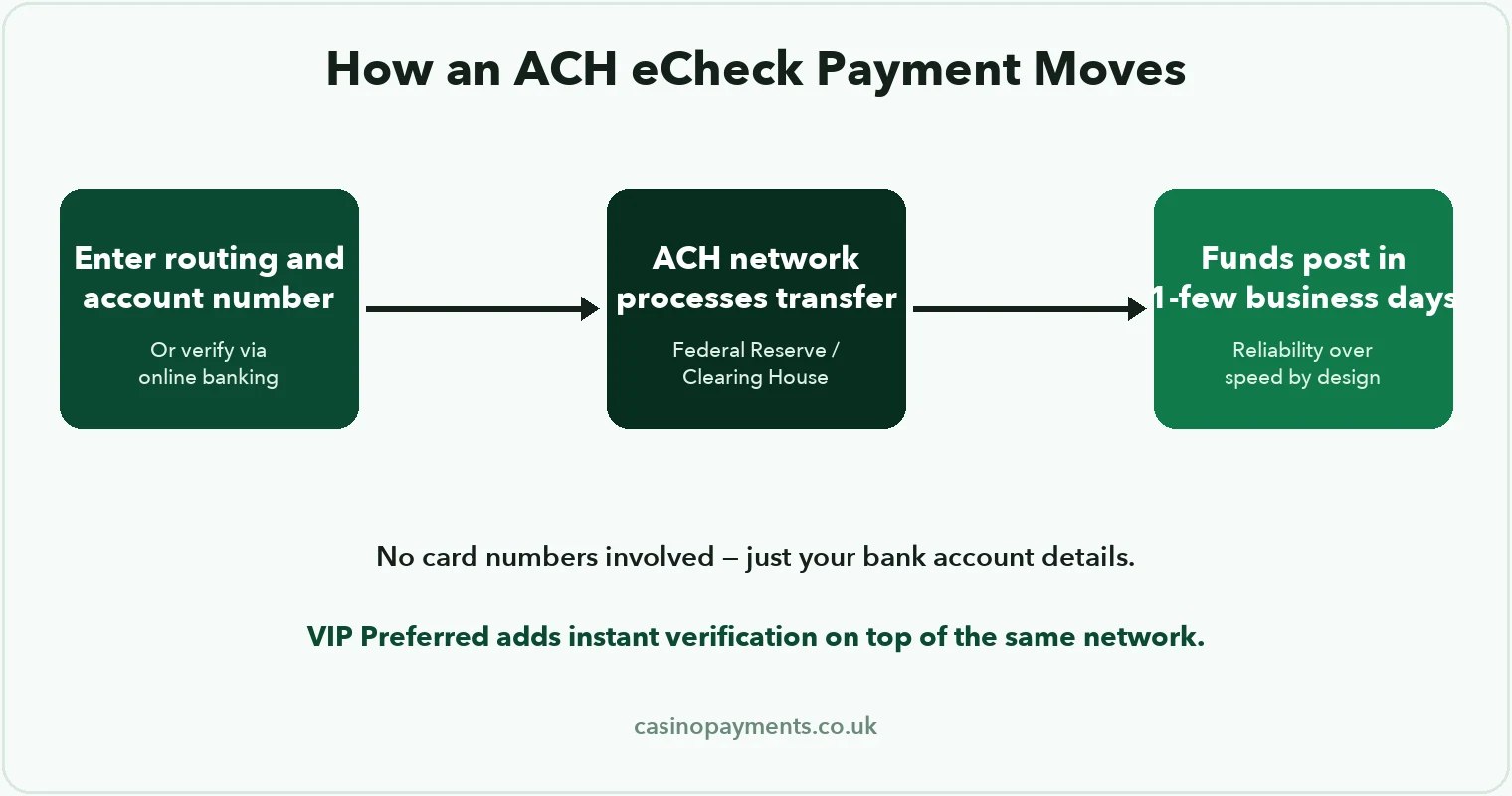
An eCheck payment at a US casino asks for exactly two numbers: your bank’s routing number (identifying the institution) and your account number. Behind the scenes, that authorises an ACH debit — the same electronic process that moves payroll deposits, tax refunds and utility bill payments across America, just directed at a casino cashier instead. Unlike a card payment or instant transfer, ACH transactions are typically batched and processed over one to a few business days rather than settling instantly, a deliberate trade-off for a system built on reliability and low cost rather than speed.
Step by step, a typical ACH casino deposit looks like this:
- Select eCheck/ACH at the cashier and enter your bank routing and account numbers.
- Verify ownership, often instantly via your online banking login, or through micro-deposits in older setups.
- Confirm the deposit amount, which debits your bank account through the ACH network.
- Funds typically post to your casino account within one business day, occasionally instantly with modern verification.
Withdrawals typically follow the reverse path, landing back in the same verified bank account, usually within a similar one-to-a-few-business-day window depending on the operator’s own processing queue.
ACH and VIP Preferred at US Regulated Casinos
ACH sits quietly behind one of the more recognisable brand names in US online gambling payments: VIP Preferred, a specialist eCheck verification service built specifically for the casino and sportsbook industry. Rather than making a player go through a slower manual bank-linking process at every operator, VIP Preferred verifies a bank account once using the player’s own online banking credentials, with approval typically arriving within seconds. Once enrolled, players commonly get revolving weekly limits reported as high as $50,000 and the ability to store multiple linked checking accounts for use across participating casinos.
NACHA’s own rules explicitly permit gambling transactions from state-licensed operators over the ACH network, which is part of why ACH-based eCheck has become a trusted, compliance-friendly option at regulated US sites rather than something operators have to work around. The trade-off for that trust and high limits is speed: ACH deposits and especially withdrawals typically take noticeably longer than a card or wallet transaction, which is why US players tend to reach for ACH specifically when they want to move large amounts reliably rather than when they want the fastest possible cashier experience. A UK player comparing the two systems should walk away with one clear takeaway: American gambling payments trade speed for verified trust far more readily than UK cashiers typically do, largely because the US market itself is younger, more fragmented across states, and still building the kind of nationwide payment confidence the UK has had since well before online gambling regulation even began.
That trust-first positioning matters more in the US market than it might elsewhere, because American online gambling regulation is fragmented state by state rather than governed by one national body like the UKGC. A payment method that comes pre-vetted by a national banking-industry association, with rules that explicitly address licensed gambling, gives operators and players in a new state market a level of established confidence that a brand-new payment provider without that regulatory pedigree would have to earn from scratch. VIP Preferred’s growth alongside the expansion of state-regulated online casinos since 2018 is partly a story about that pre-existing trust being repurposed for a newly regulated industry, rather than a payment product built specifically for gambling from day one.
Security and Verification
ACH transactions run through a heavily regulated network with fraud controls built in at the banking level, and NACHA continually tightens its rules around account validation to reduce unauthorised debits — a real risk given that, historically, initiating an ACH debit required only a routing and account number rather than the stronger authentication newer payment rails use. VIP Preferred’s instant-verification model, which confirms account ownership through the player’s own online banking login rather than relying on routing and account numbers alone, is itself a direct response to that historical weak point, and is generally considered more secure than older manual-entry eCheck setups.
The main practical risk for players isn’t a system-wide ACH vulnerability but individual account security: because ACH debits can be initiated with relatively basic account information in older or less rigorous implementations, protecting your own online banking credentials matters more with ACH-linked services than it does with card payments, which carry stronger built-in dispute and chargeback protections. US players are generally advised to only link bank accounts through reputable, established verification services like VIP Preferred rather than entering routing and account numbers directly into unfamiliar payment forms.
Dispute rights are also worth understanding before relying on ACH for large sums: unlike a credit card chargeback, which a cardholder can typically dispute directly with their card issuer under well-established consumer protection rules, ACH disputes generally route through your own bank’s own procedures and NACHA’s rules on unauthorised transactions, which can mean a slower and less standardised resolution process if something genuinely goes wrong. That’s rarely an issue with a reputable, licensed operator processing a legitimate transaction, but it’s a meaningful practical difference from card-based payments worth knowing about before moving unusually large amounts through any ACH-based method.
ACH: Fifty Years of US Bank Plumbing
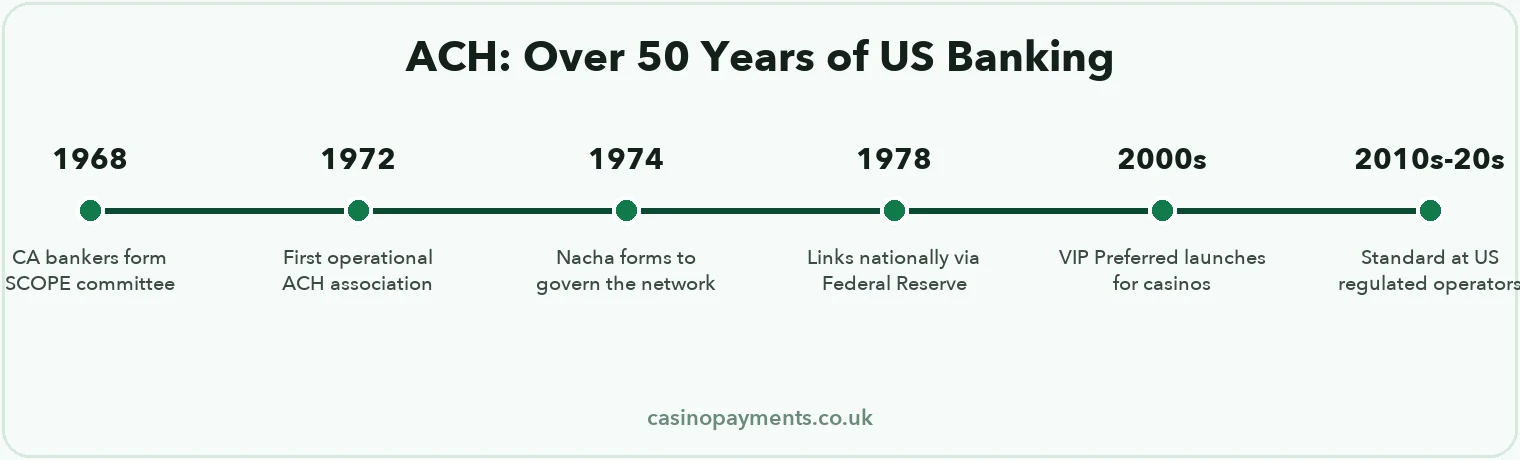
ACH traces back to 1968, when a group of California bankers formed the Special Committee on Paperless Entries in response to an unsustainable and growing volume of paper cheques clogging the banking system. In 1972, the California Automated Clearing House Association — now known as WesPay — became the first operational ACH association in the country, proving the concept regionally before it went national.
- 1968 — California bankers form the Special Committee on Paperless Entries to tackle rising cheque volumes.
- 1972 — The California Automated Clearing House Association becomes the first operational ACH association in the US.
- 1974 — Regional ACH associations combine to form Nacha, tasked with governing the network nationally.
- 1978 — Local ACH associations link at a national level through the Federal Reserve System.
- 2000s — eCheck services purpose-built for online gambling, including VIP Preferred, emerge as regulated US casino markets grow.
- 2010s–2020s — NACHA rules explicitly accommodate licensed gambling transactions as more US states regulate online casinos and sportsbooks.
Unlike PIX in Brazil or Sweden’s Swish, ACH was never built by a single company or even a single bank consortium — it’s a rules-based network governed by an industry association, with the actual processing split between the Federal Reserve and a separate private operator, The Clearing House. That distributed governance model, closer to a public utility than a branded product, is part of why ACH has no consumer-facing “owner” the way most other payment methods on this site do.
Nacha’s own description of its role is worth quoting directly: “Nacha governs the ACH Network, the payment system that drives Direct Deposits and Direct Payments with the capability to reach all U.S. bank and credit union accounts.” That’s a standards body describing infrastructure, not a company describing a product — the clearest possible illustration of why ACH has no marketing department and no app of its own.

Where ACH Works
ACH exists purely to move money between accounts at US financial institutions, cleared through US-specific infrastructure that the Federal Reserve and Nacha jointly oversee. There’s no international version, and no licensing arrangement lets a UK bank plug into the network — it was built to modernise American cheque processing specifically, and it has stayed within that footprint for over five decades.
That US-only design is exactly why no UK casino can simply add ACH or eCheck as a cashier option: there’s no membership a UK bank or operator can join, and the underlying routing-and-account-number system only resolves to US institutions. A US expatriate living in the UK who retains a US bank account could technically still use ACH-based services from British soil, but that has no bearing on what a UKGC-licensed cashier can offer its wider UK customer base.
ACH Beyond Gambling
ACH is genuinely foundational to American financial life well beyond any single sector: payroll direct deposit, mortgage and utility bill payments, tax refunds from the IRS, and bank-account funding for apps like Venmo all ultimately rely on the same ACH rails, even when the consumer-facing app looks nothing alike. The Federal Reserve and Nacha jointly report tens of billions of ACH transactions moving trillions of dollars annually across the US economy, making it one of the largest payment networks in the world by volume even though most Americans have never once heard the term “ACH” despite relying on it constantly, week in and week out, for money that matters.
That obscurity is itself notable: unlike Swish in Sweden or PIX in Brazil, which are household-name consumer brands, ACH operates almost entirely behind the scenes, with players interacting instead with branded front-ends like VIP Preferred or their own bank’s bill-pay feature rather than “ACH” as a recognisable product. It’s less a payment method in the branded sense and more a piece of national infrastructure that many other payment products, gambling-related and otherwise, quietly depend on.
That invisibility also explains something distinctive about how this page differs from most others on this site: there’s no single company history to tell, no founder’s origin story, no acquisition or rebrand to track, because ACH was never a product a company built and sold — it’s a rules framework an industry association maintains collectively. The closest comparison among methods covered here is Interac in Canada, which is also bank-consortium-owned rather than centrally built by one company, though even Interac has a single corporate entity behind it in a way ACH’s more distributed governance model doesn’t.
Safer Gambling and ACH
Since ACH transactions never touch UK banking, they sit entirely outside the reach of UK bank-level protections such as voluntary gambling blocks or GAMSTOP-linked alerts — not a shortcoming specific to ACH, simply the consequence of a payment network confined to US infrastructure.
US regulated operators build their own responsible-gambling requirements into state licensing conditions independent of payment method, and NACHA’s rules permitting gambling transactions specifically require the operator to be properly state-licensed in the first place, adding a compliance layer at the network level that unlicensed operators can’t easily access. For UK players, the relevant safer-gambling toolkit remains entirely UK-side: GAMSTOP registration, a bank-level gambling block set up with your own UK bank, and deposit limits agreed directly through your banking app.
What US Players Say About ACH/eCheck
American casino forums tend to discuss ACH and VIP Preferred in practical, unglamorous terms: reliability and high limits rather than excitement. Players who move significant sums — a large deposit or a substantial withdrawal — frequently favour ACH precisely because it lacks the transaction caps that can apply to cards, even accepting the one-to-a-few-business-day wait as a reasonable trade-off. Complaints, where they surface, tend to focus on the wait itself when a player expects card-speed settlement, or on the initial verification process feeling unfamiliar to players used to simply entering card details.
None of that sentiment is actionable for a UK reader, since it describes American players interacting with American-licensed operators through American banking infrastructure entirely separate from UKGC licensing. It’s worth noting the sentiment gap is itself informative: UK players rarely discuss deposit-limit ceilings the way American ACH users do, largely because UK bank transfer and open banking already handle large transactions quickly enough that the “high limits, slower speed” trade-off ACH represents simply doesn’t arise as a distinct payment category in British gambling discussion the way it does in the US.
What Replaces ACH for UK Players
Direct bank-to-bank movement without a card is exactly what UK bank transfer (Faster Payments) delivers at a British cashier — typically faster than ACH’s multi-day settlement, since Faster Payments was purpose-built for near-instant transfers rather than the slower batch processing ACH relies on.
For an even quicker, app-based version of the same idea, open banking (Trustly, Brite, Volt) authorises a payment straight from your bank app in seconds. And for the universal default every UKGC casino accepts, debit card remains the baseline regardless of bank.
Making a UK bank transfer deposit follows a similarly small number of steps to an ACH eCheck payment:
- Select bank transfer at the cashier instead of card or e-wallet.
- Enter or confirm your account details, or authorise via your bank’s own app depending on the provider.
- Confirm the payment through your usual banking security steps.
- Funds typically arrive within minutes to hours, considerably faster than ACH’s multi-day settlement.
Our Verdict on ACH/eCheck for UK Players
Fifty years old, invisible to nearly everyone who relies on it, and shifting trillions a year: ACH has earned its reputation as the backbone of American money, US casino cashiers included. It is also permanently out of your reach. Clearing happens only between accounts at US financial institutions, over infrastructure with no UK counterpart and no route to one. That is architecture rather than policy, so there is nothing here that a rule change could ever open up. What you actually want is UK bank transfer, which does the identical job and, since Faster Payments, generally does it quicker.
ACH/eCheck Casino FAQs
Can I use ACH or eCheck to deposit at a UK online casino?
No. ACH only clears between US bank accounts through US-specific infrastructure, and no UKGC-licensed operator connects to that network. It has never been offered at a UK casino and there is no plan to change that.
Is ACH banned in the UK?
No ban is involved — ACH simply has no UK presence because it’s a US clearing network with no bridge to UK banking, the same reason it doesn’t reach any country outside the US.
What is VIP Preferred?
A branded eCheck verification service built specifically for US casinos and sportsbooks, running on the ACH network. It verifies your bank account once using your own online banking login, then offers high revolving weekly deposit limits across participating operators.
Why is ACH slower than cards at US casinos?
ACH was designed as a batch-processed replacement for paper cheques rather than an instant-settlement system, so transactions typically take one to a few business days each way — a deliberate trade-off for reliability and high limits rather than speed.
Is ACH safe to use?
Generally yes, especially through verified services like VIP Preferred that confirm account ownership via online banking login. Older manual routing-and-account-number entry carries somewhat higher risk, since that information alone can, in some circumstances, be used to initiate a debit.
What’s the UK equivalent of ACH?
UK bank transfer via Faster Payments — the direct equivalent of moving money straight from your bank account, and generally faster than ACH thanks to the UK’s near-instant transfer infrastructure.
Who runs the ACH network?
Nacha (formed 1974) governs the rules, while the Federal Reserve and a private operator called The Clearing House handle the actual processing — no single company owns or runs ACH the way a bank owns Interac or Vipps.
Do UK banks use anything like ACH?
The UK’s equivalents are Faster Payments (for near-instant transfers) and BACS (for slower, batch-processed payments like direct debits), both overseen by Pay.UK rather than any US body — broadly comparable in purpose to ACH, but running on completely separate infrastructure.
Changelog: 9 July 2026 — added an at-a-glance box, Nacha's own governance statement, and an official homepage screenshot.
Sources & Verification
Checked 5 July 2026 against: Nacha’s own site and its history of the ACH Network; VIP Preferred’s own service description; independent US casino-payments coverage of eCheck deposits at regulated operators; and the UK Gambling Commission’s page on blocking gambling transactions with your bank.

A fifty-year-old cheque-replacement network quietly underpinning everything from payroll to casino withdrawals, while staying almost entirely invisible to the public, is exactly the kind of overlooked infrastructure story this beat exists to explain. More about Will →