
Venmo started in 2009 as two friends’ fix for splitting bills, and PayPal paid $800 million for it in 2013 — yet it’s never reached a UK customer, even though its own parent runs one of the UK’s most popular casino cashiers. Venmo accounts are US-only, full stop. This page covers what Venmo is, its recent arrival at American regulated casinos, its unusual social-feed design, and why UK players should simply use Venmo’s own owner instead.
Why Venmo Is a US-Only Wallet
| Venmo at a Glance | |
|---|---|
| UK casino availability | None — US accounts only |
| Parent company | PayPal, Inc. (acquired Venmo via Braintree, 2013) |
| Where used | A small but growing number of US state-regulated operators |
| Distinct feature | Social payment feed — a privacy trade-off most other wallets don't have |
| UK route | PayPal itself, which UK casinos support natively |
Checked 5 July 2026 — and reliably checkable indefinitely, since Venmo’s US-only account restriction is company policy, not a technical limitation likely to shift.

| Question | The reality |
|---|---|
| Can I pay a UK casino with Venmo? | No — Venmo accounts only exist for US residents with US bank accounts |
| Isn't Venmo owned by PayPal, which UK casinos take? | Yes, but PayPal and Venmo run as entirely separate products — a UK PayPal account has no Venmo functionality at all |
| Is Venmo used for gambling anywhere? | Yes — a growing number of US regulated online casinos and sportsbooks in states like New Jersey, Michigan and Pennsylvania added it from 2024 |
| Could a UK casino add it later? | Only by opening a US-resident-only account structure no UK operator runs, since Venmo itself restricts signup to the US |
| What should a UK player use instead? | PayPal — Venmo's own parent company, and already standard at UK cashiers |
So "Venmo casino UK" has an unusually neat answer among the pages on this site: the method you actually want is one click away, because Venmo's own owner already has a fully working UK cashier presence. What's worth understanding is how two college friends splitting a takeaway bill built the app that turned peer-to-peer payments into a social feed, why PayPal bought it and then kept it entirely separate from its UK-facing product, and how it only recently found its way into American regulated gambling at all. That's what this page covers.
Facts verified 5 July 2026 · 18+ · UKGC-licensed operators only · begambleaware.org
Venmo: Quick Facts
| What Venmo is | A US mobile payment app with a distinctive public social feed, founded 2009, owned by PayPal since 2013 |
|---|---|
| Account eligibility | US residents with a US bank account, debit card or credit card only — no UK signup is possible |
| UK casino availability | Zero — not because of a UK rule, but because Venmo itself refuses non-US signups |
| Relationship to PayPal | Fully owned subsidiary since 2013, but run as an entirely separate product with its own app, accounts and rules |
| US gambling role | Added at select regulated US operators (BetMGM, FanDuel, DraftKings, Caesars, BetRivers among them) from around 2024, in states including New Jersey, Michigan, Pennsylvania and West Virginia |
| Speed | Deposits instant; withdrawals typically process within 1–2 business days at US operators |
| What to use instead in the UK | PayPal — Venmo’s own parent, already standard at UK casinos |
Venmo vs PayPal at a UK Cashier
This is the simplest comparison on this site, because the two products share an owner. PayPal bought Venmo (via its acquisition of Braintree) for a combined $800 million in 2013, yet deliberately kept it running as a separate brand with its own app, its own account rules, and crucially its own US-only eligibility restriction — a decision PayPal has never reversed in over a decade of ownership. Meanwhile PayPal itself has offered UK accounts and UK casino cashier integration for years, entirely independent of whatever Venmo does in the US market.
| Venmo | PayPal (UK) | |
|---|---|---|
| Owner | PayPal Holdings, since 2013 | PayPal Holdings (same company) |
| UK account eligibility | Not available — US residents only | Fully available, standard at UK cashiers |
| Distinctive feature | Public social feed showing (by default) who paid whom | No social feed; a conventional private e-wallet |
| Gambling use | Recent addition at select US regulated operators | Long-established at UK and US operators alike |
The practical takeaway is unusually direct: if Venmo caught your eye, PayPal is the same company’s product, already built for UK players.
How Venmo Works
Venmo links a US bank account, debit card or credit card to a mobile app, and lets users send or request money from contacts by username, phone number or QR code. What sets it apart from every other e-wallet on this site is the social feed: by default, completed transactions (the amount is hidden, but the payer, recipient, a description, and often an emoji) appear publicly on a scrollable feed other users can see, like and comment on — a genuinely unusual design choice for a financial product that Venmo has kept as a core feature since its earliest days.
Step by step, a typical Venmo payment looks like this:
- Open the Venmo app and select a contact by username, phone number or QR code.
- Enter the amount and an optional description or emoji.
- Confirm the payment, drawing from your Venmo balance, linked bank account or card.
- The transaction appears on your feed (unless you’ve set it to private), visible to friends by default.

At a US regulated casino, Venmo deposits work the same way — instant, from your linked funding source — while withdrawals typically settle back to your Venmo balance within one to two business days.
Venmo’s Recent Arrival in US Regulated Gambling
Venmo is a surprisingly late addition to American online gambling given how long the app has existed. US states began regulating online casinos and sportsbooks state by state following a 2018 Supreme Court ruling that struck down the federal ban on sports betting, with New Jersey among the earliest movers; Michigan, Pennsylvania and West Virginia followed with their own regulated online casino markets in subsequent years. Despite that years-long head start, major operators only began adding Venmo as a deposit option from around 2024, well after PayPal, cards and bank transfers had long been standard.
The delay likely reflects Venmo’s own historical caution about how its funds get used combined with the social-feed design being an awkward fit for gambling transactions specifically — a public feed showing “John paid Sportsbook X $200” is a different privacy proposition than the same transaction through a conventional, private e-wallet. Operators that have added Venmo, including BetMGM, FanDuel, DraftKings, Caesars and BetRivers, are currently limited to the states where both the operator is licensed and Venmo elects to support gambling transactions — coverage that keeps expanding but remains well short of every regulated US state.
The US regulatory landscape itself explains part of the delay too. Unlike the UK’s single national UKGC framework, American online gambling is regulated state by state, with each state setting its own licensing rules, approved payment methods, and rollout timeline. A payment provider like Venmo effectively has to decide, market by market, whether the compliance and fraud-monitoring overhead of supporting gambling transactions in a given state is worth the business case, rather than making one decision that instantly applies nationwide the way a UK-focused payment provider can with a single UKGC-facing product. That fragmented, state-by-state calculus is a recurring theme across the US-only payment methods on this site, and it’s a meaningful structural difference UK readers comparing the two countries’ gambling markets should keep in mind.
The Social Feed, Privacy and Fraud Risk
Venmo’s public-by-default social feed has drawn sustained privacy criticism since well before its gambling use began: security researchers and journalists have repeatedly demonstrated that a user’s entire payment history and social graph — who they pay, how often, and for what — can be scraped from the public feed unless a user actively changes their default privacy setting to private. For a gambling context specifically, that design is a genuine consideration: a public transaction history revealing frequent payments to sportsbooks or casinos is exactly the kind of financial footprint many players would prefer to keep private, whether for personal, professional or safer-gambling reasons.
Venmo does let users set transactions to private, and has adjusted its defaults and privacy controls somewhat over the years in response to criticism, but the core design — a payment app built around a public feed — remains fundamentally different from every other e-wallet covered on this site. Beyond the feed itself, Venmo carries the same authorised-push-payment fraud risk as any instant transfer: scammers impersonating sellers, rental deposits, or family members in urgent need are a well-documented pattern on Venmo specifically, since accepted transfers are difficult to reverse once sent.
Why Venmo’s History Matters to UK Players
Venmo began in the US in 2009 and became part of PayPal through the 2013 Braintree acquisition. PayPal has kept it as a separate US product; its later adoption by regulated US gambling operators does not make it available to UK casino accounts.
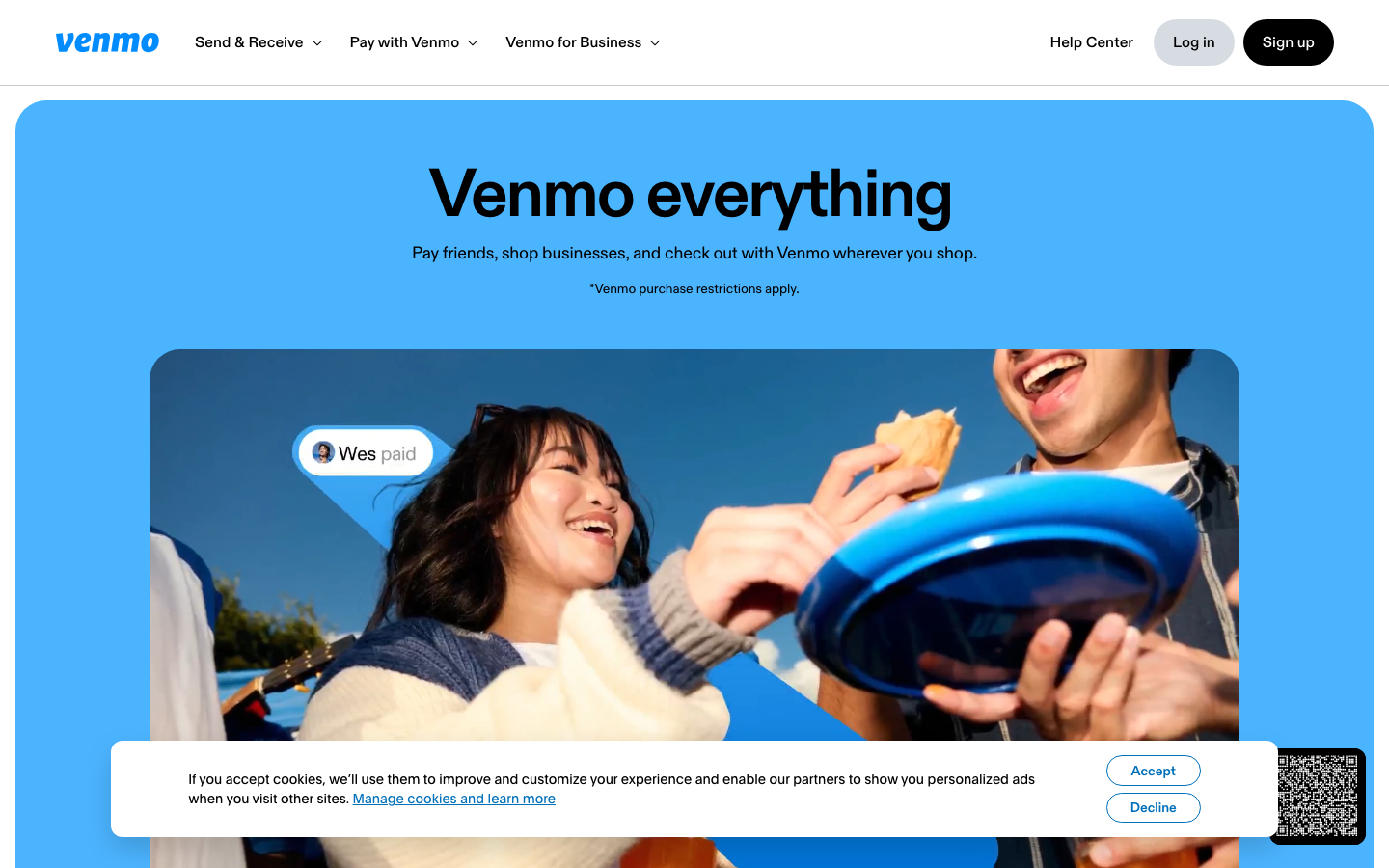
Venmo’s official site, checked 9 July 2026, presents it as a PayPal-owned payments service. That supports the ownership point; it is not evidence of UK casino availability.
Safer Gambling and Venmo
Because Venmo never touches UK banking at all, there’s nothing for a UK bank’s gambling-block tools to detect in the first place — the question is somewhat moot for UK readers in a way it isn’t for some other regional methods, since UK players cannot open a Venmo account regardless.
For US players, Venmo’s public social feed adds a genuinely distinctive safer-gambling wrinkle other payment methods don’t share: a player who forgets to set gambling transactions to private risks that activity appearing on a feed visible to friends and contacts, which is a different kind of exposure than the purely financial risk most safer-gambling tools address. UK readers should simply rely on the UK-specific protections that actually apply to them: GAMSTOP registration, a bank-level gambling block arranged with your own bank, and deposit limits set directly through your banking app.
What US Players Say About Venmo
American gambling forum discussion of Venmo tends to focus on two things: gratitude that a familiar, already-installed app finally works at their casino of choice, and repeated reminders to check the privacy setting before depositing, since new users unfamiliar with Venmo’s social-feed default have reportedly been caught out having gambling transactions visible to contacts who didn’t expect to see them. Coverage of the 2024 rollout generally frames Venmo’s arrival as convenient rather than transformative, since PayPal itself had already covered the same “e-wallet without card details” use case for years beforehand.
None of that sentiment is actionable for a UK reader, since it describes US players at US-licensed operators using a product UK residents cannot sign up for under any circumstances.
The UK Route: PayPal Itself
Unusually for this site, the “alternative” here isn’t really an alternative at all — it’s Venmo’s own parent company. PayPal has offered UK accounts for years, is already standard at the large majority of UKGC-licensed casinos, and delivers the same core e-wallet benefit Venmo offers in the US: no card details shared with the casino, and a familiar, trusted brand behind the transaction.
If what appealed about Venmo specifically was authenticating through your own bank rather than a wallet balance, open banking covers that territory instead, and debit card remains the universal fallback every UK casino accepts.
Signing up for PayPal and using it at a UK casino takes only a few steps:
- Create a PayPal account if you don’t already have one, linking a UK bank account or card.
- Select PayPal at the casino cashier instead of card or bank transfer.
- Log into your PayPal account to confirm the payment.
- Funds appear in your casino balance within moments.
Our Verdict on Venmo for UK Players
Venmo is a genuinely distinctive product — a payment app built around a public social feed that turned splitting bills into a mild form of social media — but its UK relevance is essentially zero, since PayPal has kept it as a US-only product for over a decade of ownership with no sign of changing course. Unlike most methods on this site, there’s no need to reach for a functional equivalent: Venmo’s own parent company, PayPal, already does the job at UK cashiers and has done for years. Anyone drawn to Venmo by its convenience rather than its social feed loses nothing by simply using PayPal instead.
Venmo Casino FAQs
Can I use Venmo to deposit at a UK online casino?
No. Venmo only allows account signup for US residents with a US bank account or card, so there is no way for a UK player to hold a Venmo account regardless of which casino they want to use.
Is Venmo the same as PayPal?
PayPal has owned Venmo since 2013, but the two are run as entirely separate products with their own apps and account rules — a UK PayPal account has no Venmo functionality, and Venmo itself has never been offered outside the US.
Why did Venmo take so long to reach US casinos?
Major US regulated operators only started adding Venmo as a deposit method from around 2024, roughly six years after the 2018 Supreme Court ruling opened the door to state-regulated sports betting — likely reflecting caution around Venmo’s public social-feed design in a gambling context.
Is Venmo safe to use for gambling?
The payment mechanism itself is standard e-wallet security, but Venmo’s distinctive public social feed means gambling transactions can become visible to friends and contacts unless a user actively sets them to private — a privacy consideration unique to Venmo among payment methods.
What is Venmo’s social feed?
A feature, on by default, that shows completed transactions (payer, recipient, description, sometimes an emoji, though never the amount) to other users, who can like and comment — an unusual design for a financial product that Venmo has kept since its earliest days.
What’s the UK equivalent of Venmo?
PayPal — Venmo’s own parent company, already fully available and standard at UK casino cashiers. There’s no need for a separate “equivalent” the way there is for most other regional methods on this site.
Who owns Venmo?
PayPal Holdings, which acquired Venmo in 2013 as part of its $800 million purchase of Braintree, the payments company that had itself bought Venmo for $26.2 million the year before.
Which US states offer Venmo at regulated casinos?
Coverage varies by operator and continues expanding, but as of recent rollouts it includes states such as New Jersey, Michigan, Pennsylvania and West Virginia at operators including BetMGM, FanDuel, DraftKings, Caesars and BetRivers.
Changelog: 9 July 2026 — added an at-a-glance box, Venmo's current homepage positioning confirming its PayPal ownership directly, and an official homepage screenshot; replaced a gambling-trade-press source mention with operator cashier listings, per this site's source policy.
Sources & Verification
Checked 5 July 2026 against: documented Venmo founding and acquisition history; official US operator cashier listings for Venmo availability; independent reporting on Venmo’s founding story; and the UK Gambling Commission’s page on blocking gambling transactions with your bank.

A payment app that turned peer-to-peer transfers into a social feed, then took over a decade to reach gambling despite its own parent company doing so years earlier, is exactly the kind of corporate-strategy story worth untangling. More about Will →