
Play+ is a family of operator-branded prepaid cards — FanDuel Play+, DraftKings Play+, BetMGM Play+ — issued through Sightline Payments to solve a US-only problem: banks declining ordinary cards once coded as gambling. It’s never reached a UK casino, and the reason runs deeper than banking rails: UK debit cards already work at every UKGC casino, so Play+’s workaround has nothing left to solve here. This page covers how it works and the UK method already doing the job.
Why Play+ Solves a Problem UK Players Don’t Have
| Play+ at a Glance | |
|---|---|
| UK casino availability | None — US state-regulated gambling operators only |
| Operator | Sightline Payments, the dominant US cashless-gaming payment provider |
| Why it exists | Works around US banks' routine blocking of gambling-linked card transactions under UIGEA |
| Card network | Visa-branded prepaid, expanded from its original closed-loop design |
| UK equivalent | Debit card works natively — the UK never had Play+'s underlying problem |
Checked 5 July 2026 — Play+ solves a problem specific to US card-processing rules, which is exactly why the UK never developed anything like it.
| Question | The reality |
|---|---|
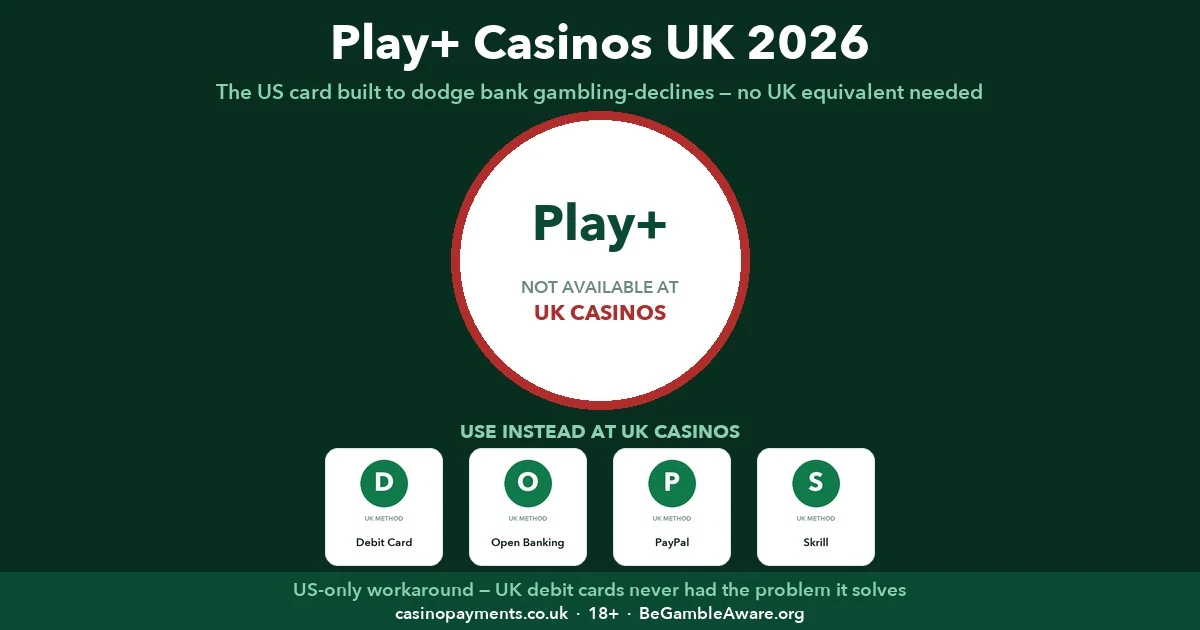
| Will a UK casino ever take Play+? | No — Play+ is a US-only, operator-branded prepaid card issued through American banking partners |
| Why does Play+ exist at all? | To route around US banks routinely declining ordinary card payments coded as gambling — a problem UK debit cards don't have |
| Is Play+ one card? | No — it's a white-label product, so FanDuel, DraftKings, BetMGM and Caesars each issue their own separate Play+ card |
| Could a UK operator add Play+? | Only by partnering with Sightline Payments' US bank-issuing infrastructure, which no UK casino does |
| What's the UK equivalent? | Debit card — UK debit cards already work directly at every UKGC casino with no decline workaround needed |
"Play+ casino UK" has no real answer, and the reason is more interesting than most methods on this site: Play+ wasn't built because American players lacked a payment method — it was built because US banks kept declining the payment methods they already had. UK banking never created that problem in the first place, which is exactly why no UK equivalent to Play+ actually exists, or needs to.
Facts verified 5 July 2026 · 18+ · UKGC-licensed operators only · begambleaware.org
Play+: Quick Facts
| What it is | An operator-branded, FDIC-insured prepaid wallet and card, issued per-operator through Sightline Payments’ bank partners |
|---|---|
| Who runs it | Sightline Payments, founded 2009 in Las Vegas by Kirk Sanford, Omer Sattar and Tom Sears |
| Card networks | Originally Discover, later expanded to Mastercard (2021) and Visa (2023) |
| UK casino availability | Zero — issued only through US banking partners to US-licensed operators |
| Why it exists | To bypass US banks’ habit of auto-declining ordinary cards once a transaction is coded as gambling |
| Where it’s used | Regulated US online casino and sportsbook sites in states like New Jersey, Pennsylvania, Michigan and West Virginia |
| UK equivalent | Debit card — no workaround needed at all |
Play+ vs UK Debit Cards
This comparison looks different from every other page on this site, because Play+ and a UK debit card aren’t really competing solutions to the same problem — they’re solutions to two completely different problems that happen to look similar on the surface.
| Play+ (US) | Debit card (UK) | |
|---|---|---|
| The problem it solves | Banks declining ordinary cards coded as gambling | None — UK debit cards work at licensed casinos by default |
| How you get one | Register separately with each operator’s own Play+ program | Already in your wallet — no gambling-specific registration |
| Number of cards needed | One per operator (FanDuel, DraftKings, BetMGM each separate) | One card works at every UKGC-licensed casino |
| Withdrawal speed | Often near-instant back to the Play+ balance | Typically same-day to a few days, operator-dependent |
That “number of cards needed” row is worth sitting with: needing a separate branded card for every operator you play at is a genuinely unusual piece of friction UK players never encounter, precisely because there was never a decline problem here forcing operators to build their own private payment rail in the first place.
It’s worth stating plainly what that means for a UK reader comparing the two: this isn’t a case where the US has a better payment option Britain simply hasn’t adopted yet. It’s closer to the opposite — the US built an elaborate, genuinely impressive piece of financial plumbing to work around a problem that only exists because of how US banking law treats gambling transactions, a problem UK card issuers never created for their own customers.
How Play+ Actually Works
A Play+ card is opened directly through a specific operator — there’s no single “Play+” account, only FanDuel’s version, DraftKings’ version, BetMGM’s version and so on, each issued by a partner bank under the Play+ program Sightline Payments runs on the operator’s behalf. Once opened, a customer loads the card from a bank account, debit card, cash at a casino cage, or services like Apple Pay and Google Pay; funds land in the Play+ wallet and can then be moved instantly into that specific operator’s betting or casino balance.
The reverse direction is where Play+ earns its reputation: many operators process withdrawals back to a customer’s Play+ balance almost immediately, compared with the days some other US payment methods can take, since the money is moving within a closed loop the operator and Sightline both control rather than waiting on an external card network’s settlement cycle. Some operators advertise Play+ withdrawals landing within minutes for customers already verified and in good standing, a genuinely rare turnaround time among US gambling payment options, most of which still involve at least an overnight processing window. Once back in the Play+ wallet, a customer can spend the balance anywhere the card’s network (Discover, Mastercard or Visa depending on version) is accepted, or withdraw cash at an ATM.
Registration for a Play+ card typically happens as part of signing up with the operator itself, rather than as a separate standalone application: a new FanDuel customer, for instance, is offered a FanDuel Play+ card during account setup, with identity verification handled once as part of the same know-your-customer process the betting account requires anyway. That bundling is a deliberate design choice, since it means most Play+ customers experience it as a natural extension of joining the operator rather than a separate financial product they had to seek out.
Step by step, a typical Play+ deposit looks like this:
- Open a Play+ account with the specific operator (e.g. FanDuel Play+).
- Load the card from a bank account, debit card, or cash at a casino cage.
- Move funds into your betting balance from the Play+ wallet, instantly.
- Withdraw winnings back to Play+, often processed same-day.

US Gambling Regulation and Card Declines
To understand why Play+ exists at all, it helps to understand the specific US law that created the problem it solves: the Unlawful Internet Gambling Enforcement Act of 2006 (UIGEA) doesn’t ban online gambling outright, but it does put the burden on banks, card networks and payment processors to identify and block payments connected to unlawful internet gambling. Rather than making fine-grained legal judgments transaction by transaction, many US banks simply built blanket rules auto-declining any card transaction carrying a gambling merchant category code, regardless of whether the specific site was legally licensed in the customer’s state.
That blunt approach created a real problem once individual US states began legalising online gambling properly — starting with New Jersey’s regulated online casino launch in November 2013, and accelerating sharply after the Supreme Court struck down the federal sports-betting ban (PASPA) in 2018, opening the door for states to legalise sports wagering individually. Legitimate, fully licensed operators found their own customers’ bank-issued cards being declined anyway, simply because the issuing bank’s system couldn’t distinguish a UKGC-equivalent-licensed US operator from an illegal offshore one. Play+ sidesteps the whole issue by never routing the gambling transaction through that generic decline logic at all: the money moves into a dedicated wallet first, and spending from that wallet elsewhere looks like an ordinary prepaid card transaction rather than a gambling one.
It’s worth being precise about why banks behaved this way rather than simply assuming carelessness: UIGEA places real legal exposure on financial institutions that knowingly process payments for unlawful internet gambling, and distinguishing a fully state-licensed operator from an illegal offshore one, transaction by transaction, in real time, is a genuinely harder compliance problem than it might sound. Many banks concluded that a blanket block on the relevant merchant category code was the safer compliance posture, even though it caught plenty of perfectly legal transactions in the process.
As of this page’s checked date, 39 states plus Washington D.C. and Puerto Rico have legalised some form of sports betting, with around 32 offering online and mobile wagering, though regulated online casino games (rather than sports betting) remain available in a much smaller group of states including New Jersey, Pennsylvania, Michigan, Connecticut, West Virginia, Delaware and Rhode Island.
That gap between sports-betting states and full online-casino states is itself worth understanding, since it shapes where Play+ carries the most weight: sports betting expanded rapidly after 2018 because states could legalise it individually with comparatively modest legislative lift, while full online casino gaming has moved more cautiously, often facing pushback from land-based casino operators worried about cannibalising their own physical floor revenue. Play+ is accepted at operators across both categories, but its deepest, longest-standing integration remains in the smaller cluster of states that allow both sports betting and online casino games side by side.
Play+ Card Security and FDIC Cover
Play+ accounts are FDIC-insured prepaid accounts held at a partner bank, giving customers the same federal deposit protection as an ordinary US bank account up to the insured limit, rather than functioning as an unregulated stored-value product. That FDIC backing is a meaningful distinction from some older prepaid gambling-payment products that carried no deposit insurance at all, and it’s a detail Sightline and its bank partners have consistently highlighted in marketing Play+ to both operators and regulators as a trustworthy alternative to cash-heavy or offshore-processed transactions. Because each Play+ card is tied to a single licensed operator and a single verified customer identity (checked during the same know-your-customer process required to open the betting account itself), the closed-loop design also limits the card’s usefulness to a fraudster compared with a more generally transferable payment instrument.
None of that has any bearing on UK banking, since Play+ is issued exclusively through US bank partners to US-licensed operators, with no route for a UK resident to open one or a UK casino to accept one.
It’s also worth noting that Play+’s reach within the US is itself uneven across the country: a customer in a state with no legal online betting or casino gaming at all — a category that still includes several large states — simply has no legitimate operator to register a Play+ card with in the first place, since the product is inseparable from a licensed operator’s own compliance programme. That’s a meaningfully different constraint from the currency or infrastructure barriers most other regional methods on this site run into.
Play+ and the Rise of US Closed-Loop Gaming Cards
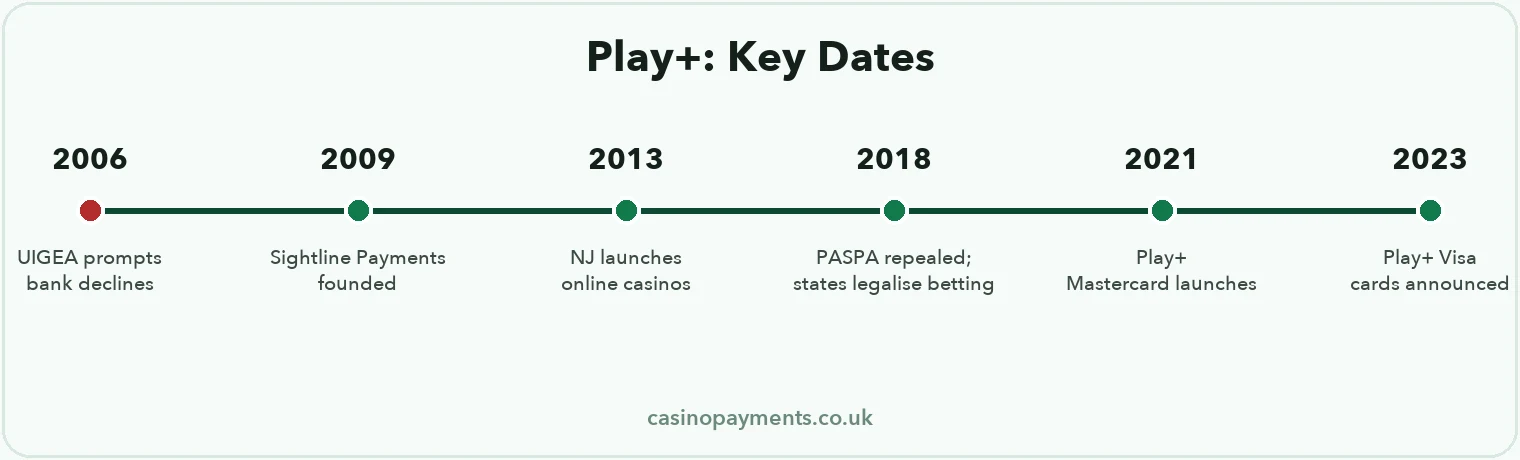
Sightline Payments was founded in 2009 in Las Vegas by Kirk Sanford, Omer Sattar and Tom Sears, built on the premise that the US gambling industry had no purpose-built digital payments rail of its own, leaving players funding accounts through wire transfers and generic prepaid cards while operators absorbed constant card declines. By the time New Jersey launched the first fully regulated US online casinos in November 2013, Sightline’s cashless wagering technology was already positioned to plug directly into that new market. The Play+ product itself grew alongside the broader legalisation wave that followed the 2018 PASPA repeal, expanding from its original Discover-network card into a Mastercard partnership announced in October 2021 and a Visa-branded version announced in February 2023, widening which retailers and ATMs a Play+ balance could reach.
- 2006 — UIGEA passes, prompting US banks to build blanket gambling-transaction decline rules.
- 2009 — Sightline Payments founded in Las Vegas.
- 2013 — New Jersey launches regulated online casinos in November, with Sightline’s technology already in place.
- 2018 — The Supreme Court strikes down PASPA, opening state-by-state sports betting legalisation.
- 2021 — Sightline partners with Mastercard to launch the Play+ Mastercard in October.
- 2023 — Sightline announces Visa-branded Play+ cards in February.
Where Play+ Works
Play+ is available exclusively at US-licensed operators, issued through Sightline’s US banking partners, and usable only within the United States’ own card networks and ATM infrastructure. Within the US it’s genuinely widespread — live inside most major casino and sportsbook management systems, and accepted by FanDuel, DraftKings, BetMGM, Caesars and many smaller regional operators — but that reach is entirely domestic.
No UK bank or UKGC-licensed casino has any partnership with Sightline Payments, and there’s no mechanism for a UK resident to open a Play+ account at all, since doing so requires registering directly with a specific US-licensed gambling operator in the first place. Even a US citizen living in the UK couldn’t meaningfully use an existing Play+ card at a UK casino, since the card only ever tops up that specific US operator’s own account.
Play+ Beyond Gambling
Once loaded, a Play+ balance functions like an ordinary prepaid Discover, Mastercard or Visa card everywhere outside the originating operator’s site: groceries, fuel, online shopping, or a cash withdrawal at an ATM all work exactly as they would with any other prepaid card, since the underlying card network doesn’t know or care that the funds originated from a betting withdrawal. That everyday usability is precisely what makes the closed-loop design workable in practice — a customer isn’t stuck spending winnings only within the operator’s own ecosystem.
Sightline Payments itself has grown well beyond just Play+ over the years, building a broader suite of cashless gaming-floor technology (cashless slot machine funding, kiosk-based cage transactions and similar tools) aimed at helping land-based US casinos modernise away from cash-heavy operations, with Play+ remaining its best-known consumer-facing product.
That broader cashless-gaming push matters to the Play+ story because it reflects the same underlying philosophy: US land-based casinos historically ran on physical cash and chips to a degree UK casinos moved away from decades ago, and Sightline’s pitch to casino operators has consistently been that modernising payment rails — on the gaming floor and online alike — improves both customer convenience and the operator’s own transaction visibility, in much the same way UK gambling long ago normalised card and digital payments as the default.
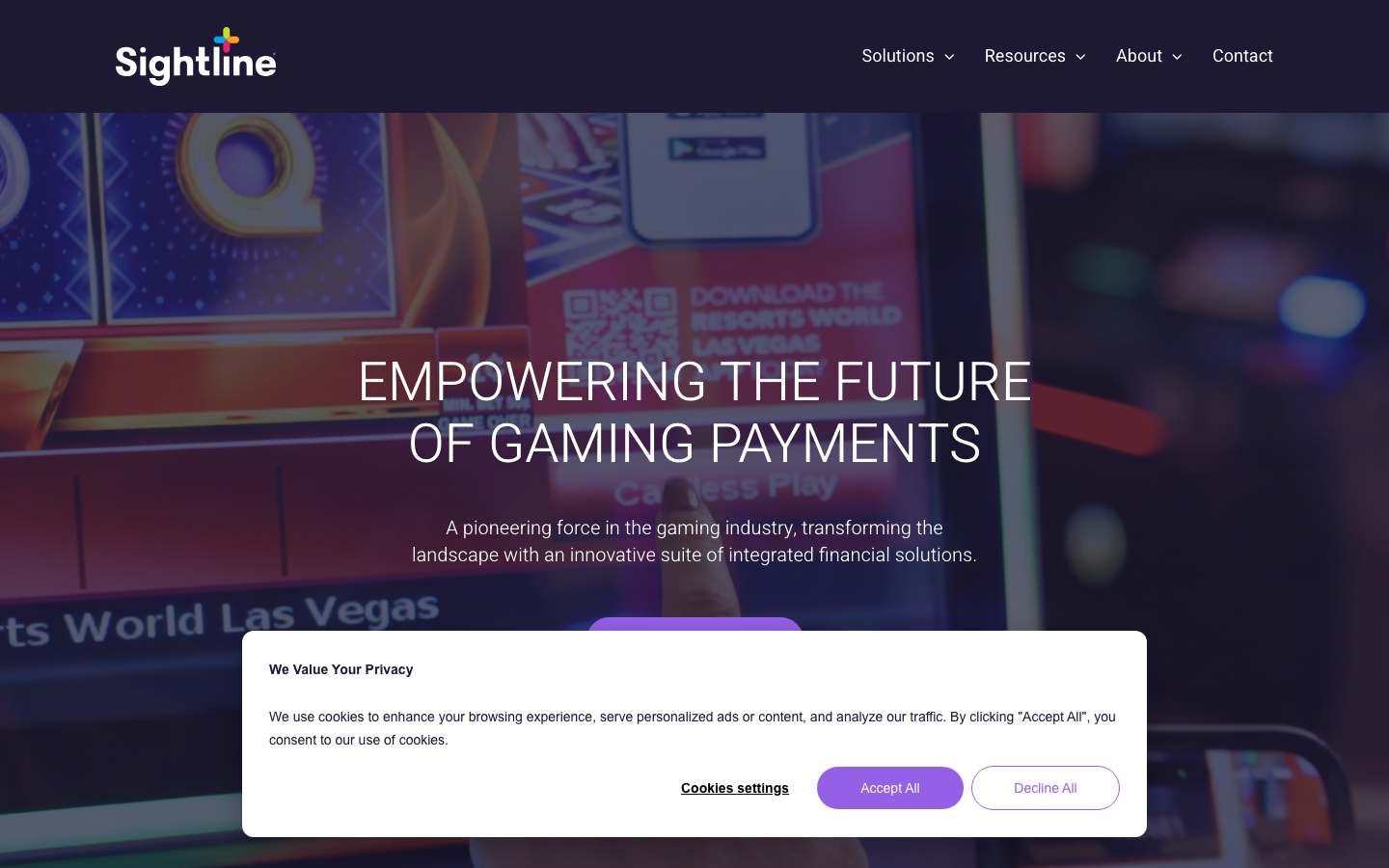
Sightline Payments’ own homepage, checked directly this month: “Empowering the future of gaming payments” — describing itself as “a pioneering force in the gaming industry, transforming the landscape with an innovative suite of integrated financial solutions,” language that spans well beyond the Play+ card into the wider cashless-gaming-floor infrastructure Sightline sells directly to US casino operators.
Safer Gambling and Play+
Play+ never touches UK banking, so British safeguards — a bank-arranged gambling block, GAMSTOP registration, deposit limits set through UK banking — have no Play+ transaction to act on in the first place, a simple consequence of the product’s US-only scope.
Within the US, individual states layer their own responsible-gambling requirements onto licensed operators regardless of payment method, and Play+ accounts are subject to the same know-your-customer and age-verification checks as the betting account itself, since the two are opened together. UK players should rely entirely on the protections that actually apply to them: GAMSTOP, a bank-level gambling block, and deposit limits agreed directly with their own UK bank.
What US Bettors Say About Play+
American bettor discussion of Play+ centres heavily on its withdrawal speed, which many rate as the fastest way to get money out of a regulated US sportsbook or casino, particularly compared with cheque-by-mail or slower ACH options some operators still offer. The most common complaint is the one baked into the product’s own design: needing a separate Play+ card for every operator gets unwieldy fast for anyone betting across FanDuel, DraftKings and BetMGM simultaneously, each requiring its own registration, its own card, and its own balance to track.
None of that conversation has any bearing on a UK player, since it describes Americans navigating a payment workaround built specifically around US banking law that the UK simply never needed.
A smaller but recurring thread worth noting concerns customers who move between states: because each Play+ account is tied to a specific operator’s own state-licensed entity, a customer who relocates from, say, New Jersey to Pennsylvania often finds their existing Play+ balance doesn’t automatically carry over, needing a fresh account and verification process under the new state’s licence instead. That’s a friction UK players never encounter, since a single UKGC licence covers the whole of Great Britain rather than being fragmented state by state.
The UK Prepaid Route That Stands In for Play+
The honest answer here is that UK players don’t need an alternative to Play+ so much as they need to recognise the problem never existed for them: a debit card already works directly at every UKGC-licensed casino, with no separate registration, no operator-specific card, and no risk of a gambling-coded transaction being auto-declined the way US banks have historically done. UK card networks and issuers simply don’t apply the kind of blanket gambling-decline logic UIGEA effectively encouraged in America.
Depositing with a UK debit card is about as simple as it gets:
- Enter your debit card details at the casino cashier, or use a saved card.
- Confirm the deposit amount.
- Approve via your bank’s 3D Secure step if prompted.
- Play immediately — the same card works at every other UKGC casino too.
For anyone who still wants an instant-withdrawal experience closer to what Play+ offers, open banking generally delivers faster payouts than a card withdrawal at most UKGC operators.
Our Verdict on Play+ for UK Players
Play+ is clever, and it is clever about something that was never your problem. American gambling law left banks routinely declining perfectly legal gaming transactions, and a closed-loop prepaid card issued per operator was a tidy way around that. British players have simply never met the underlying decline problem, so the workaround has no work to do here. An ordinary UK debit card already achieves everything Play+ was engineered to deliver, without a separate card for every site you join.
Play+ Casino FAQs
Can I use Play+ at a UK online casino?
No. Play+ is issued exclusively through US banking partners to US-licensed operators, and no UKGC-licensed casino has any way to accept it.
Why does Play+ exist if debit cards already work in the US?
Because US banks, responding to the Unlawful Internet Gambling Enforcement Act 2006, built blanket rules auto-declining ordinary card payments coded as gambling — even from fully licensed operators. Play+ avoids that by never routing the transaction through that decline logic.
Is Play+ one single card?
No — it’s a white-label product. FanDuel, DraftKings, BetMGM, Caesars and other operators each issue their own separate Play+ card through Sightline Payments.
Is Play+ banned in the UK?
It isn’t banned by any UK rule — there’s simply no UK operator partnered with Sightline Payments to issue one, and no reason for one to exist given how UK debit cards already work.
What’s the UK equivalent of Play+?
A standard debit card — it already works directly at every UKGC-licensed casino with no decline risk, making the Play+ workaround unnecessary in the UK.
Who runs Play+?
Sightline Payments, founded in 2009 in Las Vegas by Kirk Sanford, Omer Sattar and Tom Sears.
Which US states offer regulated online casino games (not just sports betting)?
A smaller group than sports betting states — including New Jersey, Pennsylvania, Michigan, Connecticut, West Virginia, Delaware and Rhode Island, as of this page’s checked date.
Why are Play+ withdrawals often faster than other US payment methods?
Because the money moves within a closed loop between the operator and Sightline’s bank partner, rather than waiting on an external card network’s standard settlement cycle.
Is a Play+ balance FDIC-insured?
Yes — Play+ accounts are held at partner banks and carry FDIC deposit insurance up to the standard federal limit, the same protection as an ordinary US bank account.
What is UIGEA?
The Unlawful Internet Gambling Enforcement Act of 2006, a US federal law that puts the burden on banks and payment processors to block payments linked to unlawful internet gambling — the rule that indirectly caused the card-decline problem Play+ was built to avoid.
Changelog: 9 July 2026 — added an at-a-glance box, Sightline Payments' current homepage positioning, and an official homepage screenshot.
Sources & Verification
Checked 5 July 2026 against: Sightline Payments’ own company information (re-verified 9 July 2026); the Federal Reserve’s Regulation GG on unlawful internet gambling funding; independent reporting on the Play+ card network expansion to Visa; the American Gaming Association’s state-by-state gambling map; and, for UK safer-gambling context, the Gambling Commission’s page on arranging a bank-level block on gambling transactions.

Play+ is the rare payment method on this site that exists to fix a problem of the regulator's own making — UIGEA's blunt bank-decline rules — rather than to solve a genuine access gap the way most others do. More about Will →