

PayNearMe’s gambling product, MoneyLine, lets a player generate a barcode online and pay it in cash at a 7-Eleven, CVS or similar US store, with the deposit reflecting in their casino account within 10 to 30 minutes. It’s never reached a UK casino, since it’s built around American retail partners and settles only in dollars. It’s also deposit-only, with no way to withdraw through it. This page covers how PayNearMe works, who uses it, and the UK cash-voucher methods filling the same gap.
Why PayNearMe Is a US-Only Route
| PayNearMe at a Glance | |
|---|---|
| UK casino availability | None — US retail cash network only |
| What it is | Barcode-based cash deposit system for US regulated gambling |
| Where used | US-regulated online casinos and sportsbooks via retail partners |
| Withdrawals | Via linked bank account, not the cash network directly |
| UK equivalent | paysafecard (cash) or debit card |
Checked 5 July 2026 — PayNearMe’s confinement to a US retail-partner network makes this one of the more durable “not available” verdicts on this site.
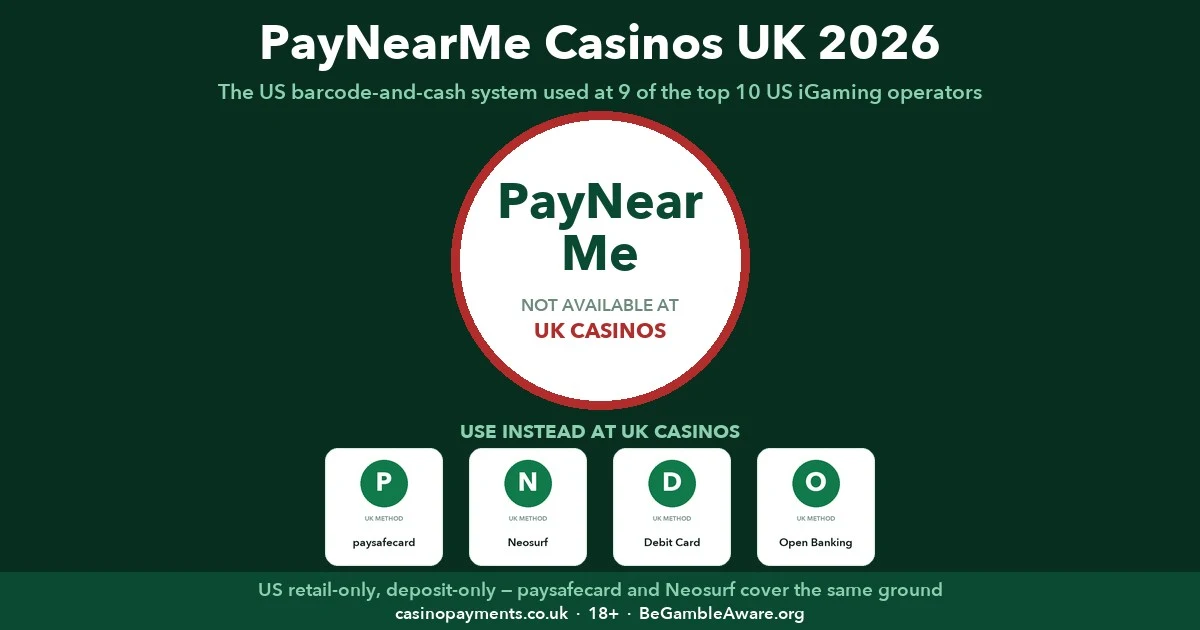
| Question | The reality |
|---|---|
| Will a UK casino ever take PayNearMe? | No — PayNearMe's barcode-and-cash system only reaches US retail partners like 7-Eleven and CVS |
| Can I withdraw with PayNearMe? | No — it's deposit-only, so US players still need a separate method to cash out |
| Is it used at real US casinos? | Yes, widely — 9 of the top 10 US iGaming operators offer it under the MoneyLine brand |
| Could a UK operator add PayNearMe? | Only by joining PayNearMe's US retail-partner network directly, which no UK casino does |
| What's the UK equivalent? | paysafecard or Neosurf — the same cash-at-till idea, on UK high streets |
"PayNearMe casino UK" has no real destination, since PayNearMe is a US-only barcode system tying a specific deposit to a specific American retail till. What's worth understanding is less the payment mechanic itself, which is simple, and more why an entire industry of cash-to-digital barcode services exists in America at all — a story that says a lot about which US customers still prefer paying with cash even at a fully regulated online casino.
Facts verified 5 July 2026 · 18+ · UKGC-licensed operators only · begambleaware.org
PayNearMe: Quick Facts
| What it is | A barcode-based cash-deposit system letting US customers pay online orders and gambling deposits in cash at a retail till |
|---|---|
| Gambling product name | MoneyLine by PayNearMe |
| Who runs it | PayNearMe Inc, founded 2009 in Santa Clara, California by Danny Shader |
| UK casino availability | Zero — tied entirely to US retail partners and US dollar settlement |
| Deposit limits | Typically $10 to $500 per transaction |
| Fees | Usually $2.99 to $3.99, charged by the retailer |
| Withdrawals | Not supported — deposit-only |
| UK equivalent | paysafecard or Neosurf |
PayNearMe vs UK Cash Vouchers
PayNearMe and UK cash-voucher methods solve the identical underlying problem — letting someone fund an online account with physical cash at an ordinary shop till — but they package it slightly differently, and the comparison highlights a few genuine differences worth knowing before assuming they’re interchangeable.
| PayNearMe (US) | paysafecard/Neosurf (UK) | |
|---|---|---|
| How it’s generated | A barcode created online, shown at the till | A voucher bought upfront at the till, with a printed PIN |
| Reusable | Yes — the same barcode can be used for repeat deposits | No — each voucher is single-use, spent down to zero |
| Processing time | 10 to 30 minutes to reflect in the account | Instant once the PIN is entered |
| Withdrawals | Not supported | Not supported — both are deposit-only |
That reusable-barcode design is the detail that most sets PayNearMe apart: rather than buying a new voucher every time the way a UK paysafecard purchase works, an American PayNearMe user keeps the same barcode on their phone or printed once, and simply repeats the cash hand-over at the till whenever they want to top up again.
That reusability cuts both ways in practice: it removes the small friction of buying a new voucher each time, but it also means the barcode itself carries no stored value on its own — unlike a paysafecard PIN, which represents a fixed, spendable amount the moment it’s purchased, a PayNearMe barcode is simply an identifier that only becomes a real transaction once cash actually changes hands at the till.
Fees are the other detail worth flagging honestly, since they cut against PayNearMe on a direct comparison: the $2.99–$3.99 charge levied at the point of deposit has no real parallel in the UK cash-voucher market, where paysafecard and Neosurf are typically sold at face value with the retailer’s margin built quietly into wholesale pricing rather than itemised as a separate line the customer sees and feels at the till.
How PayNearMe Actually Works
A customer selects PayNearMe (branded as MoneyLine at most operators) at the casino’s cashier, enters the amount they intend to deposit, and receives a barcode — sent by email or SMS, or simply displayed on screen to be shown from a phone. That barcode is taken to any participating retail location (7-Eleven, CVS, Walgreens, Family Dollar, Kroger, Dollar General and Casey’s General Store are among the most common), handed to the cashier along with the cash amount, and the retailer’s own point-of-sale system credits the payment back to PayNearMe, which in turn notifies the casino to add the funds to the player’s balance.
Processing typically takes 10 to 30 minutes rather than being instant, since it depends on the retail transaction being settled and passed back through PayNearMe’s system rather than an instant card-style authorisation. Most operators display an expected processing window at the point of deposit, and customer-support teams generally advise waiting the full window before assuming a payment has gone missing, since retail-till reconciliation on the retailer’s end is the most common source of a short delay.
Step by step, a typical PayNearMe deposit looks like this:
- Select PayNearMe/MoneyLine at the casino cashier and enter the deposit amount.
- Receive a barcode by email, SMS, or on-screen.
- Take the barcode to a participating store and pay in cash.
- Funds reflect in your account within 10 to 30 minutes.

PayNearMe in the US Gambling Market
PayNearMe’s MoneyLine product has become one of the most widely integrated cash-deposit options in regulated US online gambling, used by 9 of the top 10 US iGaming operators by PayNearMe’s own account, precisely because it addresses a segment of American bettors that card and bank-transfer methods alone don’t fully reach: customers who prefer paying in cash, don’t want a gambling transaction appearing on a bank or card statement, or simply lack the banking relationship needed for other deposit methods. That’s a genuinely different customer need from the bank-decline problem covered on this site’s Play+ page, even though both methods emerged from the same broader US regulatory environment around gambling payments.
Because PayNearMe operates only where the underlying online casino or sportsbook product is itself legally licensed, its retail footprint effectively tracks US state-by-state gambling legalisation: available at operators in states with regulated online casino games or sports betting, and simply irrelevant everywhere else, since there’s no licensed product to deposit into. The $10 to $500 per-transaction limit and $2.99–$3.99 retailer fee are both fairly consistent across operators, though exact figures can vary slightly by state and store.
It’s worth situating PayNearMe against the broader menu of US gambling payment methods this site has covered: Play+ solves a bank-decline problem for card-holding customers, while PayNearMe solves an entirely different problem for customers who’d rather not use a card or bank transfer at all, whether from personal preference, privacy concerns about a gambling transaction appearing on a statement, or simply not holding a mainstream US bank account. Having both options live side by side at most major operators reflects how differently individual American bettors want to fund an account, even within a single regulated market.
Operators themselves have an obvious commercial reason to offer PayNearMe alongside card and bank options: every customer who can only realistically fund an account in cash is a customer who’d otherwise be lost entirely, so adding a cash-deposit rail widens the addressable market rather than merely offering a marginal convenience to customers already served by other methods.
PayNearMe’s Barcode Security Model
Because a PayNearMe barcode is tied to a specific customer account rather than being a bearer instrument like a lost banknote, a barcode alone isn’t especially useful to a third party who intercepts it without also being able to authenticate as the account holder at the retail till. The bigger practical risk sits on the social-engineering side, familiar from every cash-voucher method covered on this site: a scammer convincing a victim to generate a PayNearMe barcode and hand over cash believing it serves some other legitimate purpose, with the funds instead diverted to the scammer’s own account.
PayNearMe’s retail partners handle the cash transaction through their own existing till and loss-prevention systems, giving the cash-handling side of the process the same basic protections as any other retail cash sale. None of this has any bearing on UK banking, since PayNearMe transactions never route through a British retailer or reach a UKGC-licensed casino’s cashier.
PayNearMe has also built anti-fraud monitoring specific to its barcode system, watching for unusual patterns like the same barcode being presented at multiple stores in quick succession, or repeated high-value transactions inconsistent with a customer’s typical usage, and can flag or freeze an account pending verification if something looks off. That monitoring sits entirely within PayNearMe’s own US systems and has no counterpart a UK reader would ever interact with.
PayNearMe’s Growth in US Regulated Gambling
Danny Shader founded PayNearMe in Santa Clara, California in 2009, building it initially as a general-purpose cash-payment network for bills, loan repayments and other everyday transactions, letting underbanked American consumers pay at a familiar local store rather than needing a bank account or card. Gambling-specific integration came later, as US states began legalising online casino games and sports betting following New Jersey’s 2013 online casino launch and the wider expansion that followed the 2018 Supreme Court ruling against the federal sports-betting ban, with PayNearMe building MoneyLine specifically to plug into that emerging regulated market’s cash-deposit need.
Shader’s own background is worth a brief mention, since PayNearMe wasn’t his first payments venture: he had previously founded Accept.com, an early consumer-to-consumer payment service acquired by Amazon in 1999, and later led Good Technology (acquired by Motorola in 2007) before starting PayNearMe in 2009. That track record of building and selling payments and mobile-technology companies is part of why PayNearMe was able to scale its retail partnerships as quickly as it did, moving from a general bill-payment tool to a multi-billion-dollar-a-year network within roughly a decade.
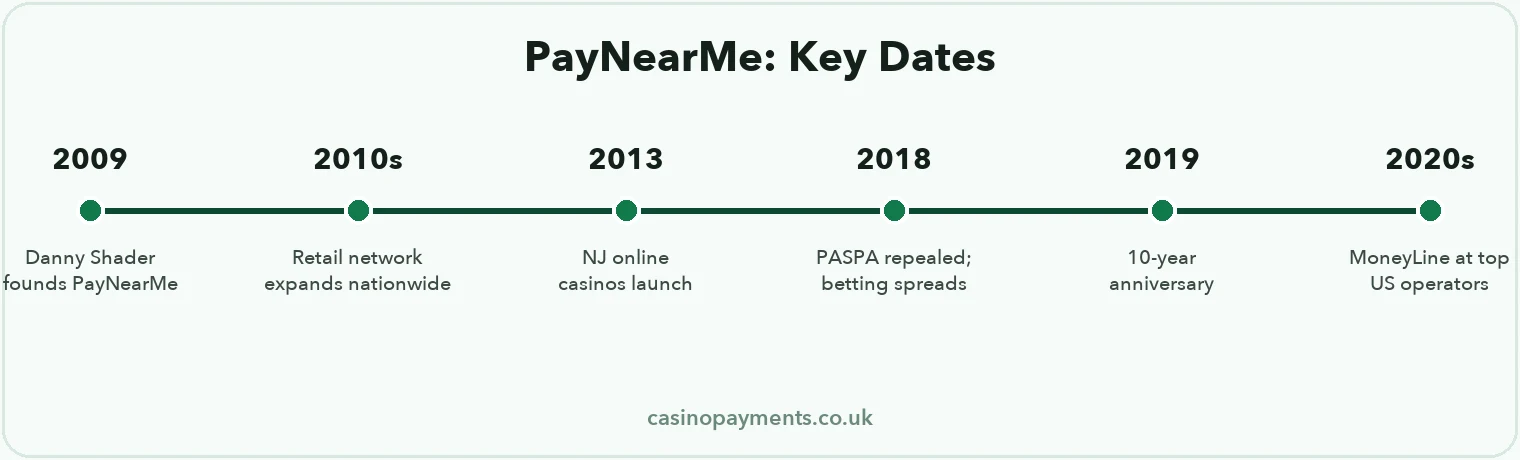
- 2009 — Danny Shader founds PayNearMe in Santa Clara, California.
- 2010s — PayNearMe expands its retail partner network across major US chains including 7-Eleven and CVS.
- 2013 — New Jersey’s regulated online casino launch creates the first major US market for gambling-specific cash deposits.
- 2018 — The Supreme Court’s PASPA ruling triggers rapid state-by-state sports-betting legalisation, expanding demand for cash-deposit tools.
- 2019 — PayNearMe marks its tenth anniversary, by then processing billions of dollars annually across thousands of clients.
- 2020s — MoneyLine becomes standard at the large majority of top US iGaming and sportsbook operators.
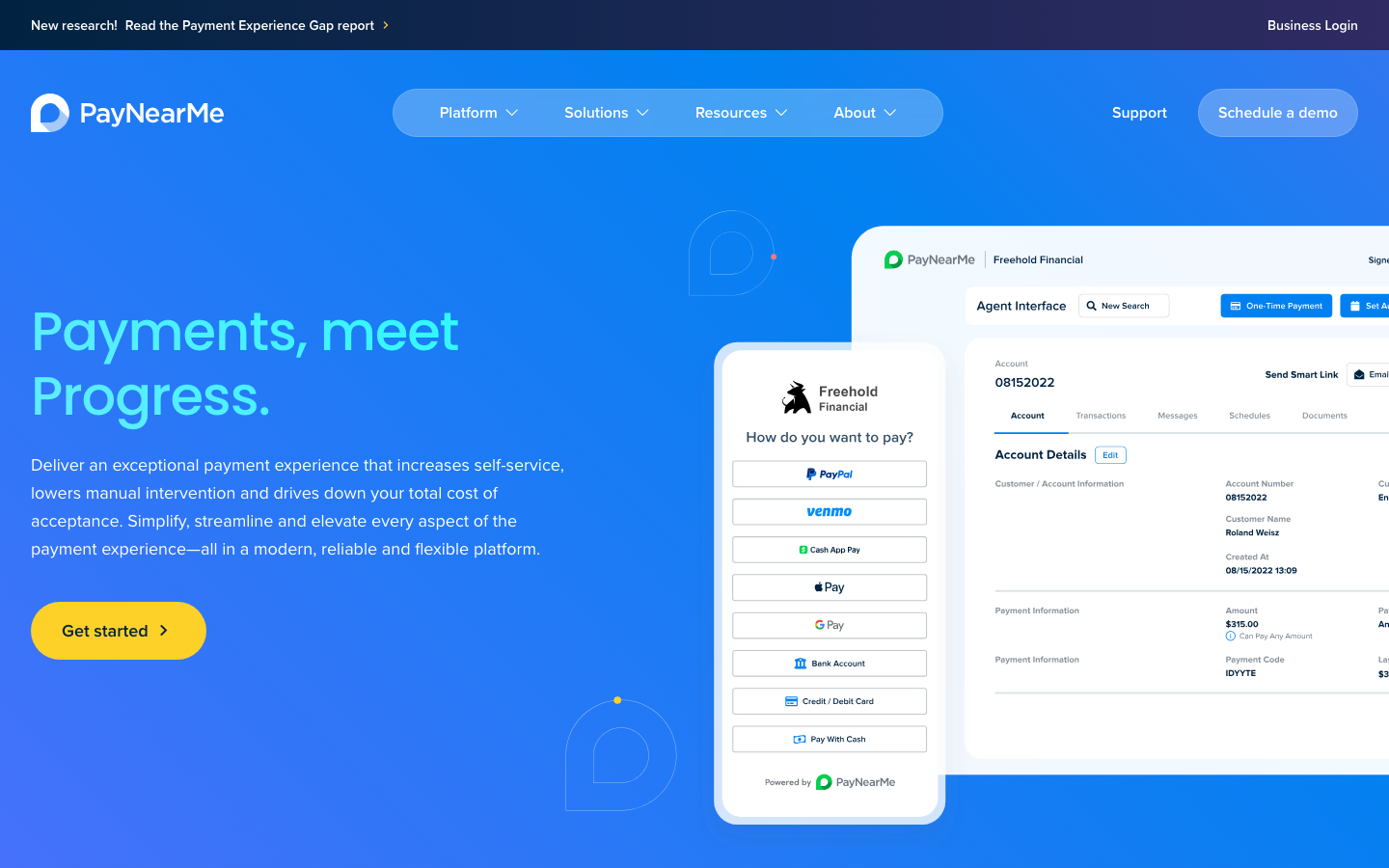
PayNearMe’s own homepage, checked directly this month: “Payments, meet Progress” — and its live product demo shows a “How do you want to pay?” screen listing PayPal, Venmo, Cash App Pay, Apple Pay, Google Pay, bank account, card and cash side by side, illustrating how far the platform has grown beyond its original barcode-cash niche into a full payment-orchestration layer that regulated gambling operators plug into.
Where PayNearMe Works
PayNearMe operates exclusively within the United States, tied to a network of American retail chains and settling only in US dollars through its own domestic payment-processing infrastructure. Its gambling-specific MoneyLine product follows US state gambling law closely, available at licensed operators in states permitting online casino games or sports betting, and simply absent everywhere a state hasn’t legalised either.
No UK retailer participates in PayNearMe’s network, and no UKGC-licensed casino has any technical route to accept a PayNearMe payment. An American living in the UK couldn’t meaningfully use PayNearMe from British soil either, since generating a barcode still requires paying it in cash at a physical US store.
It’s also worth noting that PayNearMe’s retail footprint isn’t perfectly uniform even within the US: participation varies by individual store and region rather than being guaranteed at every location of a partner chain, so American players are generally advised to confirm a specific nearby branch actually processes PayNearMe barcodes before relying on it, rather than assuming every 7-Eleven or CVS nationwide automatically supports it.
PayNearMe Beyond Gambling
PayNearMe’s roots and much of its ongoing business sit well outside gambling: the company processes cash payments for rent, utility bills, loan repayments, government fees and property-management charges, serving customers who prefer or need to pay in cash across thousands of client businesses. That broader cash-acceptance infrastructure is precisely what made the pivot into gambling straightforward once US states began legalising online betting — PayNearMe didn’t need to build a new retail network from scratch, only a gambling-specific product (MoneyLine) layered onto partnerships it already had with chains like 7-Eleven, CVS and Dollar General.
The company has described its own growth in terms of serving financially underserved Americans specifically, a mission that predates and sits alongside its gambling business rather than being defined by it, moving tens of billions of dollars a year across its full client base.
That same underserved-consumer focus explains why PayNearMe expanded so naturally into property management and government-fee collection alongside gambling: all three sectors share a customer base that includes people paying rent, fines or deposits in cash for reasons ranging from personal preference to not holding a traditional bank account, and PayNearMe’s retail-till model serves that need identically regardless of which bill or balance the cash happens to be funding.
That cross-sector footprint also gives PayNearMe a form of resilience most single-purpose gambling payment tools don’t have: even if a particular state’s gambling market slowed or a specific operator relationship ended, the underlying retail-cash infrastructure keeps earning its keep through rent, utility and government-fee clients, which is a meaningfully different business model from a payments company built solely around gambling deposits.
Safer Gambling and PayNearMe
PayNearMe never touches UK banking, so tools a British bank provides — a card-scheme gambling block, a GAMSTOP-linked flag, deposit limits set inside a UK banking app — have no PayNearMe transaction anywhere to act on, a simple consequence of the system’s US-only scope rather than a specific gap in its design.
Within the US, PayNearMe’s own per-transaction limit ($10–$500) functions as a mild natural brake on very large single deposits compared with an uncapped bank transfer, though it says nothing about how many separate deposits a customer makes in a day. Individual operators layer their own responsible-gambling tools (deposit limits, time-outs, self-exclusion) on top regardless of payment method, consistent with each state’s own licensing requirements. UK players should rely on the protections that actually apply to them: GAMSTOP, a bank-arranged gambling block, and deposit limits set directly through their own UK bank.
What US Bettors Say About PayNearMe
American bettor discussion of PayNearMe tends to focus on convenience for cash-preferring customers and mild frustration with the retailer fee, which some view as an unwelcome surcharge compared with fee-free bank transfer or debit card deposits at the same operator. The 10-to-30-minute processing window also draws occasional complaints from players expecting instant crediting the way a card payment provides, though most reviews describe it as a reasonable trade-off for the ability to deposit without ever sharing bank or card details at all.
A recurring theme in more detailed player reviews is choice of retailer: regulars often develop a preference for a specific participating chain based on which store is nearest, which cashiers seem most familiar with processing the barcode smoothly, and which locations stay open at the hours a player is most likely to be topping up, turning what sounds like a purely mechanical payment choice into something closer to a habitual, almost neighbourhood-level routine.
None of that discussion has any bearing on a UK player’s experience, since PayNearMe’s retail network and dollar settlement never reach a UKGC-licensed cashier in the first place.
A smaller recurring comment from American reviewers concerns store staff unfamiliarity: because PayNearMe barcodes cover many different use cases (bills, rent, gambling deposits and more), a cashier at a busy till occasionally isn’t sure how to scan or process one correctly, leading to an awkward few minutes at the counter. UK cash-voucher purchases don’t carry that same ambiguity, since paysafecard and Neosurf tills are set up as a single, purpose-built product line rather than one barcode system serving many different payment types.
The UK Cash Options That Replace PayNearMe
paysafecard and Neosurf are the direct UK equivalents of what PayNearMe offers: cash-bought vouchers available at ordinary UK shops, redeemed instantly at the casino cashier with no bank account or card required. The mechanics differ slightly — a UK voucher is bought upfront rather than generated as a reusable barcode — but the underlying outcome (cash in, casino balance funded, no bank details shared) is identical.
A UK cash-voucher deposit runs through fewer steps than a PayNearMe barcode transaction:
- Buy a paysafecard or Neosurf voucher with cash at a UK shop.
- Note the PIN printed on the voucher.
- Enter the PIN at the casino cashier.
- Your balance updates immediately, without the 10-to-30-minute wait PayNearMe involves.
For withdrawals, since neither PayNearMe nor UK cash vouchers support cashing out, UK players typically pair a voucher deposit with debit card or open banking for getting winnings back out.
It’s worth flagging one further practical difference: because a UK voucher carries a fixed value from the moment it’s purchased, there’s no equivalent to PayNearMe’s 10-to-30-minute retail-till reconciliation wait — the PIN either works or it doesn’t, and a working PIN credits the account the instant it’s entered, with none of the “has my cash payment actually gone through yet” uncertainty that occasionally comes up in American PayNearMe reviews.
Our Verdict on PayNearMe for UK Players
Getting cash-preferring bettors into 9 of the top 10 US iGaming operators without a bank account anywhere in the chain is a real achievement, and PayNearMe deserves the credit it gets for it. It is also an entirely American achievement: no UK retail footprint, no UK banking connection, and no sign either is coming. If what you want is the cash route rather than the brand, paysafecard and Neosurf are standard at every UKGC-licensed casino and work instantly.
The broader takeaway from this page is less about PayNearMe specifically and more about what it reveals: even a payments market as sophisticated as regulated US online gambling, with instant cards, bank transfers and closed-loop products like Play+ all available, still finds real, sustained demand for old-fashioned cash at a shop till. The UK’s own long-standing cash-voucher options serve exactly that same instinct, just through a fixed-value voucher rather than a reusable barcode.
PayNearMe Casino FAQs
Can I use PayNearMe at a UK online casino?
No. PayNearMe is tied entirely to a network of US retail partners and settles only in US dollars, and no UKGC-licensed operator has any way to accept it.
Can I withdraw winnings through PayNearMe?
No — PayNearMe (and its gambling product MoneyLine) is deposit-only. US players use a separate method such as a bank transfer or cheque to withdraw.
How long does a PayNearMe deposit take?
Typically 10 to 30 minutes to reflect in your casino account after paying the barcode in cash at a participating store.
Is PayNearMe banned in the UK?
It isn’t banned by any rule — it simply has no UK retail partnerships and no route into British banking, since it’s built entirely around US stores.
What’s the UK equivalent of PayNearMe?
paysafecard or Neosurf — cash-bought vouchers available at UK shops, redeemed instantly at the casino cashier, delivering the same no-bank-account outcome.
Who owns PayNearMe?
PayNearMe Inc, founded in 2009 in Santa Clara, California by Danny Shader, who remains the company’s CEO.
What stores accept PayNearMe?
Participating 7-Eleven, CVS, Walgreens, Family Dollar, Kroger, Dollar General and Casey’s General Store locations, among others, across the US.
Are there fees for using PayNearMe?
Yes — typically $2.99 to $3.99 per transaction, charged by the retailer processing the cash payment.
Can the same PayNearMe barcode be used more than once?
Yes — unlike a single-use UK voucher, a PayNearMe barcode can be reused for repeat deposits, so a customer doesn’t need to generate a new one every time.
What is the deposit limit for PayNearMe?
Typically between $10 and $500 per transaction, though the exact limit can vary slightly by operator and state.
Changelog: 9 July 2026 — added an at-a-glance box, PayNearMe's current multi-method product positioning, and a screenshot.
Sources & Verification
Checked 5 July 2026 against: PayNearMe’s own site and its MoneyLine cash-deposit product page (re-verified 9 July 2026); PayNearMe’s 10-year company anniversary announcement; independent reporting on PayNearMe’s use at regulated US online casinos; and for UK safer-gambling context, the Gambling Commission’s page explaining how to set up a bank-level gambling block.

PayNearMe is a reminder that even in a market as digitally mature as regulated US online gambling, a meaningful slice of customers still prefer paying with physical cash — a preference UK cash vouchers serve just as well, on a UK high street instead of an American one. More about Will →