

1Voucher turns cash into a spendable code at a South African till, and it’s become standard at the country’s licensed sports-betting sites — but it has no route to a UK casino, since every voucher is bought in rand with no bridge to sterling. This page covers what 1Voucher is, its South African payment family (Ozow, Capitec Pay), the country’s unusual gambling regulation, and the UK methods that do the same job.
Why 1Voucher Doesn’t Reach a UK Casino
| 1Voucher at a Glance | |
|---|---|
| UK casino availability | None — South African rand only, no currency bridge to sterling |
| Operator | 1Voucher, part of the Flash Group |
| Where used | South African retail, bill payments, and licensed sports-betting sites |
| Withdrawals | Not supported — deposit-only, like all cash vouchers |
| UK equivalent | paysafecard or Neosurf |
Checked 5 July 2026 — and reliably checkable indefinitely, since 1Voucher’s confinement to South African retail is structural, not a rule that could change.
| Question | The reality |
|---|---|
| Can I deposit at a UK casino with 1Voucher? | No — 1Voucher is bought and redeemed only in South African rand at South African retailers |
| Why not? Is it banned? | Not banned — simply South African. There's no UK retail network selling 1Voucher codes and no currency bridge to sterling |
| Is 1Voucher used for betting anywhere? | Yes — it's a standard deposit method at South African licensed sports-betting operators, though online casinos sit in a more contested legal position there |
| What about Ozow and Capitec Pay? | Similar story — South African instant-EFT and open-banking-style methods, also confined to South African bank accounts |
| What should a UK player use instead? | paysafecard or Neosurf — the closest UK equivalents of a cash-bought prepaid voucher |
So "1Voucher casino UK" leads nowhere — this is a South African retail-voucher system with no route into British payments. What's genuinely interesting is how South Africa's own gambling regulation splits sports betting (properly provincially licensed) from online casinos (still a contested legal grey area nationally), and how a family of local payment methods — vouchers, instant EFT, open banking — grew up around that specific market. That's what this page covers.
Facts verified 5 July 2026 · 18+ · UKGC-licensed operators only · begambleaware.org
1Voucher: Quick Facts
| What 1Voucher is | A South African cash-to-digital voucher — buy a code at a retail till, redeem it online, no bank account required |
|---|---|
| Currency | South African rand only — bought and spent in ZAR, with no sterling or multi-currency option |
| UK casino availability | Zero — no UK retailer sells 1Voucher codes and no currency bridge connects it to sterling |
| Where it’s used | South African licensed sports-betting sites, everyday retail, and bill payments |
| Related SA methods | Ozow (instant EFT) and Capitec Pay (open-banking-style, mobile-number-based) — also South Africa-only |
| South African gambling status | Sports betting is provincially licensed; online casinos sit in a more contested legal position nationally |
| What to use instead in the UK | paysafecard or Neosurf — cash-bought prepaid vouchers with the same budgeting logic |
1Voucher vs UK Prepaid Vouchers
1Voucher and UK cash vouchers like paysafecard or Neosurf solve an identical problem — turn cash into a spendable online code without needing a bank account or card — and they share the same fundamental limitation: deposit-only, no withdrawal path, since a voucher code has no bank account behind it to send winnings back to.
| 1Voucher (South Africa) | paysafecard/Neosurf (UK) | |
|---|---|---|
| Currency | South African rand only | Pounds sterling |
| Where to buy | South African retail tills | UK shops, newsagents, supermarkets |
| Withdrawals | No — deposit-only | No — deposit-only (paysafecard) or Neosurf, same limitation |
| Typical use case | Budgeting and no-bank-account access at SA betting sites | Budgeting and anonymity at UK cashiers |
The underlying logic is identical — cash in, spending ceiling by design — so a UK player drawn to 1Voucher’s budgeting appeal loses nothing by using paysafecard or Neosurf instead.
Where the two markets genuinely diverge is in why the voucher model matters. In the UK, paysafecard and Neosurf exist primarily as a budgeting and privacy choice for consumers who already have full access to cards, bank transfers and open banking but prefer a hard spending ceiling or want to keep gambling activity off a shared bank statement. In South Africa, 1Voucher additionally serves a genuine, everyday banking-access function that goes well beyond simple preference: a meaningful share of the population remains unbanked or underbanked by international standards, making a cash-to-code voucher not just a preference but, for some users, the only practical way to fund an online account at all. That’s a materially different social role for what looks, on the surface, like an identical payment mechanism, and it’s worth keeping in mind whenever comparing “voucher” methods across different countries on this site — the same product can be a lifestyle choice in one market and essential financial infrastructure in another. That distinction is worth remembering whenever a payment method looks superficially interchangeable with one already familiar from a different country — the mechanics might match exactly, while the reason it exists at all can be entirely different.
How 1Voucher Actually Works
Buying a 1Voucher is straightforward: a customer pays cash (or sometimes card) at a participating South African retailer — supermarkets, convenience stores and similar tills — and receives a voucher with a unique code, denominated in rand. That code can then be entered at any site accepting 1Voucher, including licensed sports-betting operators, to fund an account instantly, with no bank details, card numbers or personal financial information changing hands at any point in the transaction.
Step by step, using a 1Voucher looks like this:
- Buy a voucher with cash at a participating South African retailer.
- Receive a unique code printed on the voucher or sent digitally.
- Enter the code at checkout on a site or app accepting 1Voucher.
- Funds credit instantly, up to the voucher’s face value.
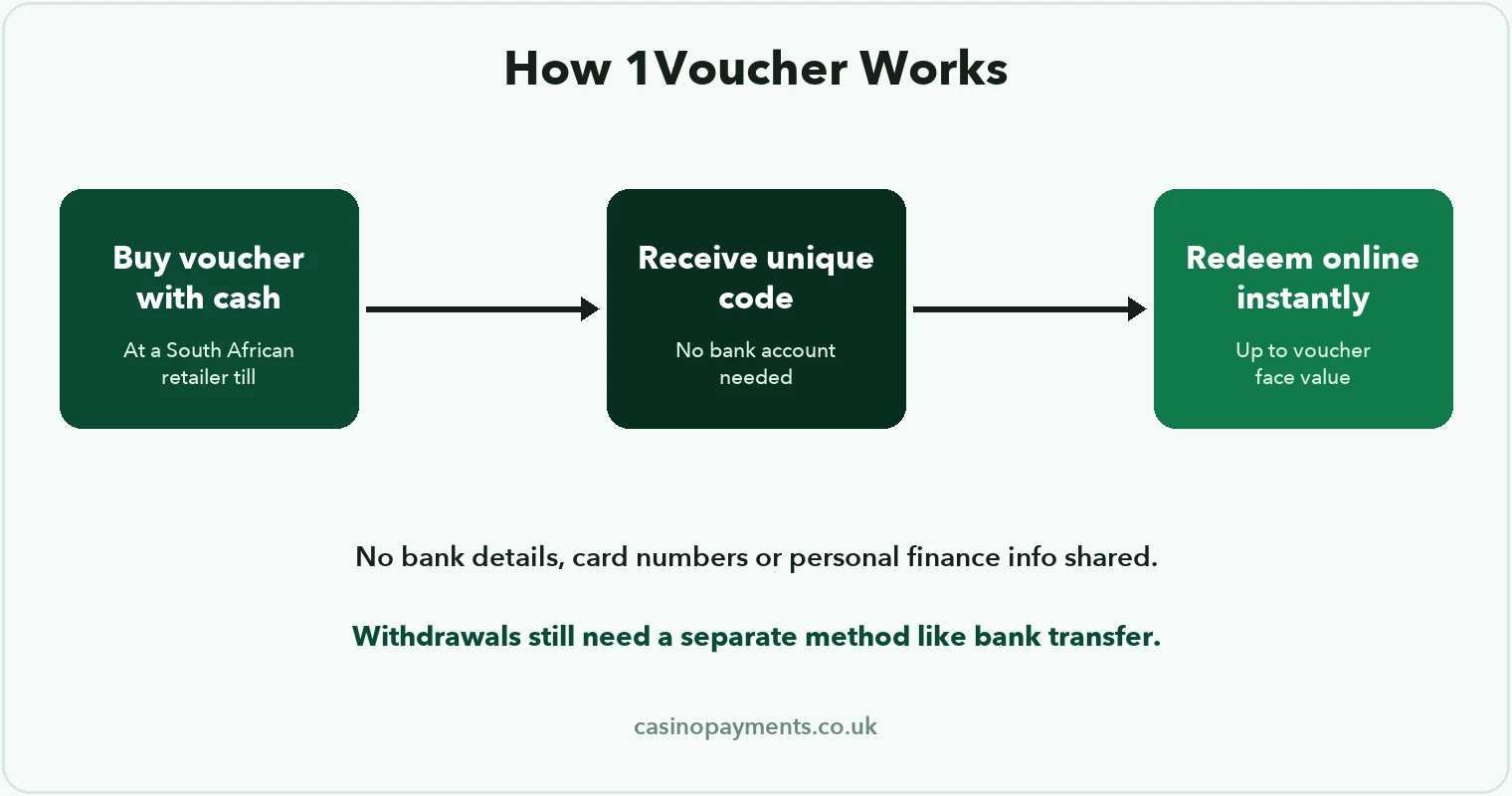
Because 1Voucher has no bank account behind it, withdrawals from any betting site always route through a separate method — typically bank transfer, matching exactly how UK prepaid vouchers pair with a different withdrawal route too.
South Africa’s Genuinely Unusual Gambling Regulation
South African online gambling regulation is more fragmented than most countries covered on this site, and it’s worth being precise about it. Sports betting, including horse racing, is properly licensed at provincial level through nine separate provincial gambling boards working alongside the National Gambling Board, which sets national norms and standards. That system is functioning and substantial: the National Gambling Board reported roughly R1.5 trillion (about $89 billion) wagered in the 2024/2025 financial year, up 31.3% on the year before, with betting activities accounting for 75% of that turnover.
Online casinos are a different story entirely. A Gauteng High Court ruling reaffirmed that online casino games remain illegal under current national law, even as some provinces — notably the Western Cape and Mpumalanga — license fixed-odds betting on casino-style games, live-dealer tables and virtual games under their own sports-betting frameworks, creating a genuine grey area where most operators serving South African online casino players hold licences from precisely those two provinces. A Remote Gambling Bill, introduced in 2024, aims to create a proper national framework, and the Department of Trade, Industry and Competition has been reviewing the underlying Act since October 2025, with a foundational policy document expected to inform new legislation. Until that lands, South Africa’s online casino market operates in a considerably less settled legal position than the UK’s own long-established UKGC framework.
The National Gambling Board’s own response to this fragmentation has been a verification portal, letting players and researchers check whether an operator holds a genuine provincial licence rather than relying on marketing claims alone — a direct parallel to how UK players can check the UKGC’s own public register before trusting an unfamiliar site. That the NGB felt a dedicated verification tool was necessary says something about how much confusion the current patchwork has created among South African players trying to tell a properly licensed operator from one operating in the grey area the courts have flagged, or worse, an entirely unlicensed offshore site exploiting the regulatory gap.
How 1Voucher PINs Get Stolen
1Voucher’s security model mirrors any prepaid cash voucher: the code itself is the money, so anyone who obtains it — whether legitimately or through a scam — can redeem it, and there’s no recall mechanism once that happens. South African consumer-protection guidance around voucher-based scams follows the same pattern seen with paysafecard and Neosurf in the UK: never send a voucher code to someone claiming to be from a bank, a government agency, or law enforcement, and treat any unsolicited request for a voucher code as a scam by default, since no legitimate organisation asks for payment that way.
Because 1Voucher requires no bank account or personal financial details to purchase or redeem, it carries less exposure to the account-takeover and phishing risks that affect bank-linked payment methods, but that same anonymity is precisely what makes voucher codes attractive to scammers running romance fraud, fake prize claims, or impersonation scams — a trade-off common to every prepaid cash voucher covered on this site, not something specific to 1Voucher.
Consumer-education campaigns from South African banks and voucher providers alike form the main practical defence against this pattern, much as UK banks and retailers run similar awareness efforts around paysafecard and Neosurf scams, since the payment mechanism itself offers no technical way to reverse a completed redemption once a code has been used.
How 1Voucher Grew Out of the Prepaid Voucher Boom
1Voucher operates within South Africa’s broader prepaid and cash-to-digital payments sector, which has grown substantially to serve a population where a meaningful share of consumers remain unbanked or prefer cash-based budgeting even where bank accounts are available. That context matters: prepaid vouchers solve a genuinely different problem in South Africa than they do in the UK, where paysafecard and Neosurf serve budgeting and privacy preferences rather than filling a banking-access gap.
- 2010s — 1Voucher and similar South African cash-to-digital voucher products launch, serving retail, bill payments and online spending.
- 2020s — South African licensed sports-betting operators including Hollywoodbets, Supabets and Easybet add 1Voucher as a standard deposit method.
- 2021 — Capitec Pay and Ozow-style instant-EFT and open-banking methods grow alongside vouchers as South African betting payment options.
- 2024 — South Africa’s National Gambling Board reports R1.5 trillion wagered nationally, up 31.3% year on year.
- 2024 — The Remote Gambling Bill is introduced, aiming to create a proper national online gambling framework.
- 2025 — The Department of Trade, Industry and Competition begins a formal review of the underlying gambling Act, with a foundational policy document expected to shape new legislation.
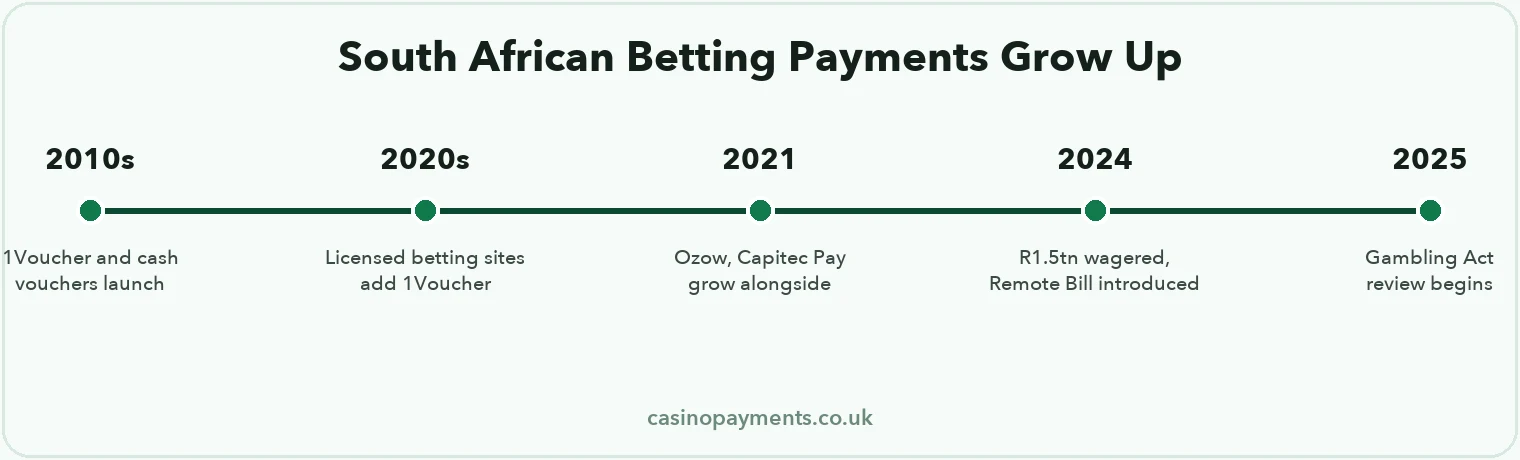
Unlike most methods on this site, 1Voucher’s story is less about a single company’s growth and more about an entire category of South African cash-access payment tools — vouchers, instant EFT, open banking — developing in parallel with a gambling regulatory framework that’s still visibly a work in progress.
That parallel development is genuinely worth dwelling on: in most countries covered on this site, the payment infrastructure came first and gambling regulation caught up to it, or the two developed roughly in step. South Africa’s case is closer to payment innovation racing ahead of a settled legal framework for the specific sector — online casinos — that increasingly relies on it, which is precisely the kind of mismatch the ongoing Remote Gambling Bill process is trying to resolve, and the outcome will matter well beyond payments — it will determine which operators can build a genuinely sustainable long-term online casino business in South Africa rather than one perpetually exposed to a future court challenge or provincial policy reversal. Whether that legislation ultimately extends full national recognition to online casino gambling, or continues the current provincial-workaround approach, will shape how confidently South African operators and their payment partners can build for the years ahead.
Where 1Voucher Works
1Voucher is sold and redeemed exclusively in South Africa, denominated in rand, through a retail network with no presence outside the country. There’s no currency conversion feature, no UK retail partnership, and no technical bridge that would let a British shopper buy or redeem a 1Voucher code — it was built specifically to serve South African consumers and South African-facing merchants and betting sites.
That single-country, single-currency design is exactly why no UK casino could add 1Voucher as a cashier option even if it wanted to: there’s no scheme membership to join and no way for the voucher’s rand-denominated value to translate into a sterling transaction. A South African visiting or living in the UK with a 1Voucher code from home would need to redeem it at a South African-facing site, not a UK one, since the currency and merchant network simply don’t connect.
1Voucher Beyond Gambling
1Voucher’s core use case sits well outside gambling entirely: it’s a general-purpose cash-to-digital tool used for online shopping, bill payments, and topping up other services, aimed squarely at South African consumers who prefer cash or lack easy access to card payments for online transactions. That positioning places it alongside a wider family of South African fintech tools — Ozow’s instant EFT and Capitec Pay’s mobile-number-based open banking among them — all built to solve the same underlying access problem from different angles.
The growth of Capitec Pay specifically is worth noting: it layers an open-banking-style mobile-number payment experience on top of South Africa’s existing instant-EFT infrastructure, letting a payment initiate with just a phone number while keeping the payer’s actual bank details hidden from the merchant — a genuinely modern design echoing the mobile-number-as-identifier pattern Sweden’s Swish and the Nordic MobilePay/Vipps merger both use, arrived at independently in a completely different market.
That convergence — South African, Nordic and Dutch payment innovators separately landing on similar “authenticate through your bank, hide the account details” designs — suggests the underlying idea is closer to an obvious solution than a hard-to-copy innovation, which is worth keeping in mind whenever a payment provider markets a feature as uniquely theirs. South Africa’s specific contribution is the emphasis on cash accessibility that vouchers like 1Voucher provide alongside these more modern instant-payment tools, addressing a segment of consumers that purely digital, bank-account-dependent innovations like Capitec Pay or Ozow simply cannot reach on their own.
1Voucher itself is run by the Flash Group, a major South African fintech and retail-distribution company whose network extends the voucher’s reach into supermarket and convenience-store tills nationwide — the same distribution muscle that keeps paysafecard and Neosurf stocked at UK newsagents, just built on a different retail network entirely.

Safer Gambling and 1Voucher
Because 1Voucher never touches UK banking, it sits entirely outside the reach of UK bank-level protections like voluntary gambling blocks or GAMSTOP-linked alerts — not a gap specific to 1Voucher, simply the consequence of a payment method confined to South African retail and banking infrastructure.
South Africa’s provincial gambling boards require licensed sports-betting operators to run their own responsible-gambling measures independent of payment method, though the framework is generally considered less mature than the UK’s, partly reflecting how recently South African online gambling regulation has developed and how much of the online casino sector still sits in a contested legal position. UK players should rely entirely on UK-specific protections: GAMSTOP registration, a bank-level gambling block set up with your own bank, and deposit limits agreed directly through your banking app.
What South African Bettors Say About 1Voucher
South African betting discussion around 1Voucher and similar vouchers tends to emphasise accessibility over any other feature: it’s valued specifically because it lets someone without a bank card, or without wanting to link one to a betting account, still fund a deposit with cash from a nearby shop. Ozow and Capitec Pay draw a different kind of praise, usually for speed and the “no bank details shared” privacy angle, closer to how UK players discuss open banking.
None of that sentiment is actionable for a UK reader, since it describes South African bettors navigating South African retail and banking infrastructure with no bearing on UKGC-licensed cashiers. A recurring theme worth noting, though, is how often South African players raise the licensing grey area itself in forum discussion — asking which province an operator is actually licensed in, and whether that licence genuinely covers online casino games, has become a normal part of choosing a site in a way it simply isn’t for a UK player picking between UKGC-licensed operators, where the single national licence removes that question entirely.
The Voucher Routes UK Players Can Actually Use
For the exact same cash-to-code budgeting logic 1Voucher offers, paysafecard and Neosurf are both widely available at UK shops and newsagents, bought with cash, and accepted at UKGC-licensed cashiers with the same deposit-only limitation.
If it was the “no bank details shared” angle of Ozow or Capitec Pay that appealed, open banking (Trustly, Brite, Volt) delivers that on UK infrastructure instead. And debit card remains the universal fallback every UKGC casino accepts.
Buying and using a UK prepaid voucher takes the same basic steps as 1Voucher:
- Buy a paysafecard or Neosurf voucher with cash at a participating UK shop.
- Note the unique PIN printed on the receipt or voucher.
- Enter the PIN at the casino cashier when depositing.
- Your balance updates instantly, up to the voucher’s value.
Our Verdict on 1Voucher for UK Players
Sold in rand, at South African tills, with no currency bridge to sterling: that one fact ends 1Voucher’s story for a UK player, and no amount of product merit changes it. The merit is real. Cash access and budgeting discipline matter enormously in its home market, and it is built well for both. South Africa’s split regulation, with sports betting licensed provincially while online casinos sit in a more contested position, is worth a look if you compare gambling regimes for interest. But if the appeal is spending only what you can physically hold, paysafecard and Neosurf do precisely that on a UK high street today. Buy one of those instead; there is nothing here to wait for.
1Voucher Casino FAQs
Can I use 1Voucher to deposit at a UK online casino?
No. 1Voucher is bought and redeemed only in South African rand at South African retailers, with no currency bridge to sterling and no UK retail network selling the vouchers.
Is 1Voucher banned in the UK?
No ban is involved — it simply has no UK presence because it’s a rand-denominated, South African retail-only product with no technical way to reach UK payments.
Can I withdraw casino winnings to 1Voucher?
No — like all cash-bought vouchers, 1Voucher has no bank account behind it, so it’s deposit-only. Withdrawals at South African betting sites route through a separate method such as bank transfer.
Is online casino gambling legal in South Africa?
It’s a genuinely contested area — a Gauteng High Court ruling affirmed online casino games remain illegal under national law, though some provinces license casino-style fixed-odds betting under their own sports-betting frameworks, and reform legislation is under active review.
What are Ozow and Capitec Pay?
South African instant-EFT and open-banking-style payment methods, similar in concept to UK open banking, but confined to South African bank accounts with no UK availability.
What’s the UK equivalent of 1Voucher?
paysafecard or Neosurf — both cash-bought prepaid vouchers available at UK shops, offering the identical budgeting logic 1Voucher provides in South Africa.
Is 1Voucher safe to use?
The mechanism itself is straightforward and secure, but like any cash voucher, the code is bearer value — never share a 1Voucher code with anyone claiming to be a bank, government body or prize administrator, since that’s a well-documented scam pattern.
Where can I buy a 1Voucher?
At participating South African retailers, including supermarkets and convenience stores, using cash or sometimes a card, receiving a rand-denominated code redeemable at sites and apps that accept 1Voucher.
Changelog: 9 July 2026 — added an at-a-glance box, confirmed 1Voucher's ownership under the Flash Group, and added an official homepage screenshot.
Sources & Verification
Checked 5 July 2026, re-verified 9 July 2026 against: 1Voucher’s own site (confirming its ownership under the Flash Group and current retailer network); the Gauteng Gambling Board and National Gambling Board reporting on South African wagering volumes; and the Gambling Commission’s own guidance for UK readers on setting up a bank-level gambling block.

South Africa's split-personality gambling regulation — sports betting properly licensed provincially, online casinos still a genuine legal grey area — made this one of the more nuanced regulatory pictures worth getting precisely right on this site. More about Will →