

Klarna turned ‘buy now, pay later’ into a verb and its pink branding into checkout furniture across British retail — which makes its total absence from UK casinos conspicuous. The absence is no accident: gambling on borrowed money has been banned in the UK since April 2020, and Klarna’s own merchant rules shut the door from the other side. This page explains both walls, the workaround myths, the 2025 regulation that formalised BNPL’s status, and the deposit methods that actually belong in a cashier.
Why UK Casinos Cannot Accept Klarna
| Klarna & Gambling at a Glance | |
|---|---|
| UK casino availability | None — BNPL is credit, and credit-funded gambling is banned |
| Regulatory status | Changing 15 July 2026 — FCA begins regulating BNPL/Deferred Payment Credit |
| What that changes for gambling | Nothing — BNPL remains structurally incompatible with the credit-card gambling ban |
| Closest legal relative | Pay by mobile, permitted only due to its ~£30/day cap |
| UK equivalent | Debit card or open banking, funded from your own money |
Checked 5 July 2026 — and checkable forever, because both walls holding this table in place are structural.
| Question | The reality |
|---|---|
| Can I deposit at a UK casino with Klarna? | No — no UKGC casino offers Klarna, and none ever has |
| Why not? | Two independent walls: the UK's 2020 ban on gambling with credit, and Klarna's own prohibition on gambling merchants |
| Does that include Pay in 3 / Pay in 30? | Yes — instalment products are credit, squarely inside the ban |
| What about Klarna's Pay Now / balance? | Still no — Klarna's merchant rules exclude gambling regardless of funding type |
| Any BNPL rival that works? Clearpay? Zilch? | None — the whole category sits behind the same two walls |
So "Klarna casinos UK" describes an empty set, and any site claiming otherwise is either confused or advertising an unlicensed operator. What's genuinely worth understanding — and what fills this page — is why the fastest-growing payment brand of its generation is locked out of an industry that would love its checkout numbers, and what that says about gambling, credit and where you should actually deposit from.
Rules verified 5 July 2026 · 18+ · UKGC-licensed operators only · begambleaware.org
Klarna & UK Gambling: Quick Facts
| What Klarna is | Swedish payments and shopping firm — BNPL instalments, Pay Now transfers, a shopping app and (elsewhere) banking products |
|---|---|
| UKGC casino availability | Zero — no licensed operator lists it, ever |
| Wall one | The UK ban on gambling with credit (April 2020) covers instalment products entirely |
| Wall two | Klarna’s acceptable-use rules exclude gambling merchants across all its products |
| BNPL regulation | FCA regulation of buy-now-pay-later landed via 2025 legislation — affordability checks and complaints rights arrived with it |
| Rivals’ position | Identical — Clearpay, Zilch, PayPal’s pay-later: all barred from UK gambling |
| The card trick? | Doesn’t work — Klarna’s virtual cards decline gambling merchant codes |
| What to use instead | Debit, open banking, or a prepaid ceiling — own-money methods all |
The Two Walls, Taken One at a Time
Wall one is the law. The Gambling Commission’s April 2020 rules bar UKGC operators from accepting gambling funds that arrive as credit — and a Klarna instalment plan is consumer credit in its plainest form: Klarna pays the merchant today, you owe Klarna across the coming weeks. Every BNPL structure — Pay in 3, Pay in 30, financing — sits inside that definition, exactly as our credit card ban guide maps in full. No operator can take the money; no intermediary may smuggle it.
Wall two is Klarna itself. Long before and entirely apart from UK gambling law, Klarna’s merchant terms exclude gambling operators from its network worldwide — a risk-appetite decision common across BNPL, whose entire model depends on predictable repayment and regulator goodwill. That’s why even Klarna’s non-credit rails (Pay Now bank transfers, stored balance) don’t appear in cashiers: the company won’t onboard the merchant category at all.

The double-wall structure is what makes this page’s conclusion so stable: a change of UK law wouldn’t put Klarna in cashiers (its own rules remain), and a change of Klarna’s heart wouldn’t either (the law remains). Empty sets don’t come better defended.
Klarna vs the Methods That Work
What each thing people like about Klarna maps to in a legal cashier:
| The Klarna appeal | The cashier equivalent | The honest note |
|---|---|---|
| One-tap checkout familiarity | Debit cards, Apple Pay | Same speed, your own balance |
| Bank-transfer simplicity (Pay Now) | Open banking | The identical rail, UK implementation, free |
| Smoothed cash flow (Pay in 3) | Nothing — by law and by design | Instalment gambling is the harm the 2020 ban targets |
| Spending visibility in one app | Banking-app controls + casino deposit limits | Every UKGC site must offer limit tools; your bank’s app shows the rest |
| A ceiling on impulse spend | paysafecard / prepaid | Hard ceilings BNPL never had |
The pattern repeats from our credit-card page because it’s the same truth: everything convenient about the banned method exists legally; only the borrowing doesn’t, and that’s the point of the rules.
Why Every Klarna Route Into a Cashier Fails
For completeness — and because search results still float these — the supposed routes and their failure points:
- Klarna at the cashier directly: the option doesn’t exist; Klarna onboards no gambling merchants. Nothing to click.
- Klarna’s one-time virtual card at a casino: declines — the cards carry merchant-category restrictions and gambling codes are refused, the same network-level mechanism that enforces the credit card ban.
- BNPL a purchase, gamble the freed-up cash: mechanically possible, financially identical to gambling on credit — you’ve borrowed to preserve gambling money. No rule catches it because no rule can; the affordability logic in the next section is the only guard, and it’s yours to apply.
- Fund a wallet with Klarna, deposit from the wallet: UK wallets must verify funding sources for gambling under the intermediary rules; credit-origin funds are blocked, and Klarna’s own rails won’t load gambling-bound wallets anyway.
- Offshore sites advertising Klarna deposits: the advert is a licence disclosure — no UKGC operator can make that offer, so the site making it holds no UK licence and none of the protections this site assumes.
Five routes, five dead ends, two of them dangerous. The legal alternatives take less effort than any of them.
BNPL, Gambling & the Debt Spiral Evidence
The reason both walls exist is visible in the debt-advice casework of the early 2020s: BNPL’s frictionless borrowing paired badly with gambling’s loss-chasing psychology wherever the two met. Multiple overlapping instalment plans are hard enough to track when they bought trainers; when freed-up cash cycles into deposits, losses acquire repayment schedules, and the debt charities documented exactly that pattern among their gambling-affected clients — StepChange’s client data through the BNPL boom years repeatedly flagged the products’ overrepresentation in gambling-related debt cases.
The 2025 arrival of FCA regulation for BNPL — affordability checks, Financial Ombudsman access, proper complaint rights — fixed the consumer-credit gaps but changed nothing about gambling: regulated credit is still credit, and the 2020 gambling ban’s logic applies to it identically. If any of this section reads personally — instalments funding deposits, purchases BNPL’d to keep cash free for play — the response toolkit is the same one our credit-card page points to: gambling-side controls in the section below, and debt-side help from StepChange or National Debtline, free and without judgment. The instinct to smooth gambling losses across future paydays is precisely the signal both walls were built to answer.
Klarna & Gambling: A History of Never Meeting
Two timelines that conspicuously never intersect:
- 2005 — Klarna founded in Stockholm around invoice payments — trust-first checkout for a card-shy Swedish e-commerce market.
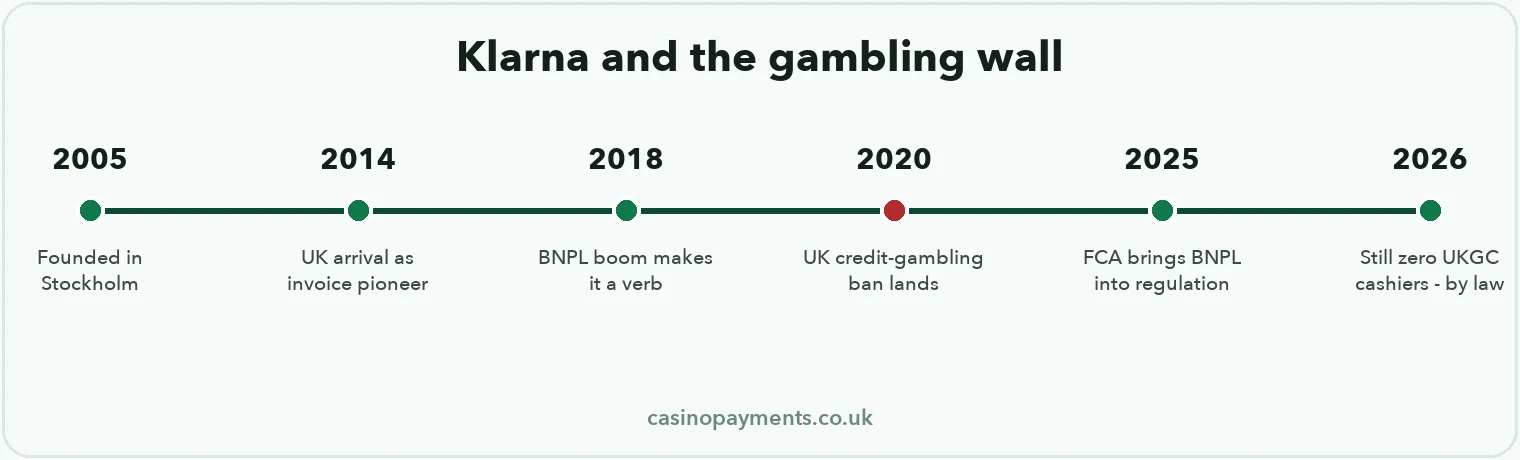
- 2014 — UK arrival; the instalment model begins its climb through British retail checkouts.
- 2018–2020 — The boom: “Klarna it” enters the vocabulary, the pink branding saturates fashion retail, and BNPL becomes a category regulators start watching.
- April 2020 — The UK bans gambling on credit. Klarna, already excluding gambling merchants by policy, is now doubly barred — a wall built in front of a door that was never open.
- 2021–2023 — The Woolard Review flags BNPL’s regulatory gap; scrutiny years follow; Klarna diversifies toward banking products and its app ecosystem.
- 2025 — BNPL formally enters FCA regulation via secondary legislation — affordability rules and ombudsman access land across the sector.
- 2026 — Klarna is bigger than ever in retail and precisely as absent from gambling as in 2005: the empty set, six years defended and counting.
Genuinely time-sensitive update, checked directly on fca.org.uk this month: the FCA begins regulating Deferred Payment Credit (DPC) — the formal name for Buy Now Pay Later — from 15 July 2026, following a consultation published 18 July 2025 and final rules confirmed 11 February 2026. This brings Klarna and similar providers under FCA conduct rules, affordability-check requirements and Financial Ombudsman access for the first time — but it regulates BNPL as a credit product, which changes nothing about its incompatibility with UK gambling: regulated credit is still credit, and the 2020 ban covers all of it.

BNPL & Gambling Rules Around the World
The UK’s double wall is the international norm, not an outlier. Sweden — Klarna’s home — requires licensed operators to offer non-credit payment routes and restricts credit gambling under its 2019 regime. Australia extended its interactive-wagering credit ban to capture BNPL explicitly in 2024, closing the loophole by name. Ireland’s new gambling regulator barred credit and credit-adjacent funding from the start. Across the EU’s licensed markets, a mix of gambling law and the BNPL sector’s own merchant exclusions produces the same empty set. The United States is again the permissive patchwork — but even there, the major BNPL brands’ own acceptable-use policies exclude gambling, so the pink button stays out of American cashiers by corporate choice rather than law. The global summary in one line: nowhere on earth does a licensed cashier offer Klarna, and both kinds of wall — legal and corporate — are being built higher, not lower.
Klarna Beyond the Cashier Door
Fairness demands the other side: away from gambling, Klarna is a genuine consumer-payments success story — interest-free instalments that undercut credit-card costs for planned purchases, a shopping app with real budgeting features, price-drop tools, and in several markets full banking products. Used deliberately, BNPL beats revolving credit on cost for exactly the purchases it was designed for: bounded, planned, non-impulsive spending on things that outlast the repayment schedule. Which is precisely the profile gambling can never fit — unbounded, impulsive by design, and purchasing nothing that survives the session. The company’s continued exclusion of gambling merchants, maintained through years when the deposit volume would have been enormous, is arguably the most flattering thing in its risk playbook: it declined to let its best product meet its worst use case. The takeaway for a cashier-bound reader is symmetrical: keep Klarna for the sofa, and fund the session from money already yours.
Safer Gambling: The Borrowed-Money Boundary
This page and the credit card page guard the same boundary from different directions, so the toolkit is shared. The rules close the obvious routes; the open ones — BNPL-freed cash, overdrafts, informal borrowing — only you can close. The instruments: bank gambling blocks on the account your deposits come from (card-level toggles at every major UK bank, most with cooling-off periods); deposit limits under the 2026 standardised regime at every UKGC operator, set before the first spin rather than after a loss; and GAMSTOP when exclusion is the right tool — one registration, every licensed site.
The self-check this page adds to the site’s standard set: look at next month’s obligations — instalments, minimum payments, planned BNPL — and ask whether this month’s deposits exist because that money is deferred. If the answer is yes or even maybe, the sequence is our responsible gambling hub for the gambling side, StepChange for the debt side, and the National Gambling Helpline — 0808 8020 133, free, confidential, 24/7 — for the conversation that sorts out which is which. 18+.
What Players Actually Ask About Klarna Casinos
Klarna generates a distinctive forum genre: not experience reports — there’s no experience to report — but recurring questions, and the questions themselves map the confusion this page exists to clear. The commonest is definitional (“it worked for my trainers, why not a deposit?”), answered by the credit distinction most BNPL users never needed to learn until a cashier refused them. Second commonest is the virtual-card attempt, reported failing exactly as the mechanics section predicts, usually alongside a veteran explaining merchant category codes to a newcomer.
The third genre is the one that earns its place in the safer-gambling record: threads where the question behind the question is cash-flow — players explicitly describing BNPL-ing groceries or bills to keep deposit money free, asking whether that’s “against the rules”. The community’s better answers note that no rule catches it and that the absence of a rule isn’t the same as the absence of a problem — forum wisdom converging, as it often does, on exactly what the debt-charity casework says. And threading through it all: the offshore adverts, reported and warned against with the usual speed. On the evidence of its own question patterns, the “Klarna casinos” search is mostly people discovering the borrowed-money boundary for the first time — which makes it, oddly, one of the more useful searches in gambling.
What to Use Instead of Klarna
Switching takes three steps whichever route fits:
- Pick the replacement below that matches what drew you to Klarna in the first place.
- Set a deposit limit at your casino before the first deposit with the new method — the prompt appears anyway; use it deliberately.
- Retire the workaround research: every route into a cashier that involves deferral fails, by law or by Klarna’s own rules.
By the itch Klarna was scratching:
- Checkout speed and familiarity — Debit cards or Apple Pay / Google Pay: one-tap deposits from your own balance, accepted everywhere that matters.
- The Pay Now experience — Open banking: Klarna’s bank-transfer rail is this rail, UK edition — free, instant, faster on payouts than any card.
- Impulse control BNPL never provided — paysafecard, Neosurf or a loaded prepaid card: the load is the limit, enforced by physics rather than willpower.
- A wallet layer for privacy and consolidation — PayPal or MiFinity, funded from your own bank.
- Smoothing losses across paydays — nothing, permanently, and the evidence section above is the why.
The Grey Areas, Answered Straight
Between the clear rules sit the questions people actually hesitate over. Straight answers to the four commonest:
“I have a Klarna balance from a refund — surely spending that isn’t credit?” Correct in accounting terms, irrelevant in practice: Klarna’s merchant exclusion operates at the operator level, so no funding type — refund balance, Pay Now, anything — reaches a cashier, because the cashier was never onboarded. Wall two doesn’t check where your money came from; it checks who the merchant is.
“Klarna’s bank accounts exist in some countries — could a Klarna debit card work?” Where Klarna issues card products, gambling merchant codes sit inside its own acceptable-use restrictions — the company applies its exclusion to its cards, not just its checkout. And a hypothetical future card that permitted gambling would just be another debit card, at which point you’ve rebuilt the method our debit page already covers, minus the detour.
“Is using BNPL for bills so I can afford deposits actually against any rule?” No rule, no algorithm, no clause — and that’s precisely why it deserves the honest label: self-administered credit gambling. The 2020 ban removed the industry’s ability to lend you deposit money; it never claimed to remove yours. The affordability question survives every workaround because it was never a technical question.
“If BNPL is regulated now, couldn’t regulated BNPL gambling exist someday?” The 2025 regime regulated BNPL as credit — which files it under the gambling ban more firmly, not less. A future that reverses this would require unwinding the credit ban itself, and six years of settled, evaluated, internationally-copied policy say that future isn’t loading.
Every grey area resolves the same direction once stated plainly — which is the surest sign the boundary is in the right place.
Why BNPL Checkout Psychology and Gambling Can’t Mix
Beneath the rules sits a design truth worth making explicit: BNPL checkout is engineered to do precisely the thing gambling regulation is engineered to prevent. Klarna’s conversion genius — the reason retailers pay for it — is friction removal at the moment of spending doubt: the price splits into gentle quarters, the first charge shrinks toward zero, and the purchase decision detaches from the full cost. In retail this is (at worst) an upsell mechanic on a bounded purchase of a real thing.
Point that machinery at gambling and every safeguard inverts. Deposit-limit prompts work by making the player confront a full amount at a decision point — quartering it defeats the confrontation. Affordability logic assumes this month’s deposits draw on this month’s money — deferral breaks the assumption silently. Loss-chasing, the behaviour every gambling control ultimately targets, is friction-limited: the pause while a payment “feels” expensive is often the intervention. A checkout built to erase that pause, attached to an activity whose harm profile lives in that pause, isn’t a neutral tool in the wrong shop — it’s a key shaped exactly like the lock the 2020 ban installed.
Seen this way, the double wall stops looking like coincidence and starts looking like convergent diagnosis: the regulator and the BNPL industry examined the same combination from opposite ends and reached the same refusal. It’s also the cleanest answer to this page’s recurring “but it’s only £30 split in three” objection — the smallness of the pieces was never the reassurance; it was the mechanism.
The Verdict on Klarna at UK Casinos
Klarna at UK casinos is a question with an unusually final answer: never available, doubly barred, and built to stay that way — the 2020 credit ban on one side, Klarna’s own worldwide gambling exclusion on the other, and the 2025 FCA regulation of BNPL changing the paperwork but not the principle. Unlike most methods this site covers, there’s no trajectory to watch and no comeback to track; the empty set is the permanent state, and every advert claiming otherwise is an unlicensed operator introducing itself. The productive redirect: open banking already gives you Klarna’s best rail without the borrowing, debit gives you its checkout speed, and prepaid gives you the ceiling it never had. Gambling’s one sustainable funding rule — money already yours, in amounts that can vanish without consequence — was never going to have a pink pay-later button, and six years of evidence say that’s the system working.
Klarna Casino FAQs
Can I use Klarna to deposit at an online casino?
No. No UKGC-licensed casino offers Klarna in any form — instalment gambling has been banned as credit since April 2020, and Klarna’s own merchant rules exclude gambling operators worldwide regardless. Both walls stand independently.
Why won’t Klarna work at casinos when it works everywhere else?
Retail checkout and gambling sit in different rulebooks: UK law bans gambling on borrowed money, and Pay in 3 / Pay in 30 are borrowing. Klarna additionally refuses to onboard gambling merchants at all, which is why even its non-credit Pay Now rail never appears in cashiers.
Does the ban cover Klarna’s Pay in 3 specifically?
Yes — splitting a payment into instalments means Klarna pays today and you repay later, which is consumer credit in its plainest form. Every BNPL structure sits inside the 2020 gambling credit ban alongside conventional credit cards.
Can I use a Klarna virtual card at a casino?
No — the one-time cards carry merchant-category restrictions and decline gambling codes at the network level, the same mechanism that enforces the wider credit card ban. Attempts simply fail at the cashier.
Do Clearpay, Zilch or PayPal Pay Later work at casinos?
None of them — the entire BNPL category is barred by the same combination of UK gambling law and the providers’ own merchant exclusions. There is no compliant instalment route into any UKGC cashier.
Is it illegal for me personally to try paying a casino with BNPL?
No — like the credit card ban, the rules bind operators and payment firms rather than players. There’s simply nothing to attempt: the option doesn’t exist at licensed sites, and the technical routes decline automatically.
What if I use Klarna for shopping and gamble the cash I saved?
No rule catches it, but the finances are identical to gambling on credit — you’ve borrowed to keep deposit money free, and losses now have repayment schedules. Debt charities documented exactly this pattern; treat the temptation as the warning it is.
Did the 2025 BNPL regulation change anything for gambling?
No — FCA regulation brought affordability checks and ombudsman rights to BNPL as consumer credit, which is welcome, but regulated credit is still credit. The gambling ban applies to it exactly as before.
A casino site says it accepts Klarna for UK players — is it real?
It’s real information about the site: since no UKGC licensee can make that offer, the site is unlicensed for British players — no GAMSTOP, no dispute rights, no fund protection. The Klarna logo there is a warning label, not a payment option.
What’s the closest legal thing to Klarna at a casino?
For the checkout feel, debit cards or Apple Pay / Google Pay; for Klarna’s bank-transfer Pay Now rail, open banking is the same idea on UK infrastructure — free, instant, and better than cards on withdrawal speed. Both run on money you already have, which is the whole point.
Can I pay off gambling losses using Klarna?
No mechanism exists for it and the framing itself is the red flag: converting losses into instalments is the debt spiral the rules exist to prevent. If losses need financing of any kind, the useful next steps are StepChange for the debt and the National Gambling Helpline (0808 8020 133) for the gambling.
Does Klarna block gambling merchants everywhere or just the UK?
Globally — the gambling exclusion sits in Klarna’s own acceptable-use policy, independent of any national law. That’s why no licensed market anywhere shows Klarna in a cashier, whatever its local credit rules say.
Are there any pay-later products legal for UK gambling?
None — every deferred-payment structure is credit, and credit can’t fund UKGC gambling. The closest legal relative is pay by mobile, where deposits join your phone bill — permitted only because of its tight ~£30 daily cap, which is the exception that proves the rule.
Changelog: 9 July 2026 — fixed a dead FCA source link (the old /firms/buy-now-pay-later URL 404s); added an at-a-glance box and the FCA's official BNPL regulation timeline (regulation begins 15 July 2026) with a screenshot.
Sources & Verification
Primary sources checked 5 July 2026: the Gambling Commission’s credit licence condition underpinning the borrowed-money ban; Klarna’s published merchant acceptable-use terms excluding gambling; HM Treasury and FCA materials, including the corrected current page on BNPL regulation; StepChange client-data reporting on BNPL and gambling debt for the evidence sections.

Will's most-repeated line on this beat — 'the empty cashier slot is the system working' — was written about Klarna first, and this page is that argument given the room it deserves. More about Will →